Introduction
Creator Monetization Platforms are specialized software solutions that enable individual creators, influencers, and media publishers to earn revenue from their digital content. These platforms provide tools to charge for subscriptions, sell digital products, receive tips or donations, run paid communities, and integrate monetization directly into content delivery channels. In , the creator economy continues to explode as audience engagement shifts to digital-first models, and creators seek sustainable revenue streams beyond traditional advertising.
Real-world use cases include:
- Charging recurring subscription fees for exclusive content.
- Selling digital goods such as courses, ebooks, templates, and artwork.
- Offering pay‑per‑view content or gated livestream events.
- Enabling fan tipping, donations, and virtual gifts.
- Running tiered membership communities with premium benefits.
Buyers evaluating Creator Monetization Platforms should consider:
- Flexibility of monetization models (subscriptions, tips, digital commerce).
- Integration with content platforms (video, blogs, podcasts, social).
- Creator economics (fee structures and payout timing).
- Analytics and reporting on revenue and engagement.
- Audience engagement tools (gated communities, messaging, comments).
- Payment processing options and global currencies.
- Security and compliance, including fraud protection.
- Custom branding and creator control.
- Scalability for growing audiences.
- Customer support and onboarding resources.
Best for: Independent creators, influencers, coaches, educators, podcasters, artists, and small to mid‑sized publisher teams looking to monetize content directly.
Not ideal for: Organizations with no direct audience or creators not seeking paid engagement channels, where traditional marketing and advertising tools may suffice.
Key Trends in Creator Monetization Platforms
- AI‑enabled revenue optimization with personalized pricing suggestions.
- Hybrid monetization models combining recurring subscriptions with micro‑transactions.
- Integrated ecommerce allowing creators to sell products without third‑party carts.
- Live commerce and pay‑per‑view streams becoming mainstream revenue generators.
- Cross‑platform revenue attribution across social, video, podcasts, and web.
- Mobile‑first monetization experiences for subscriptions and tipping.
- Creator‑centric analytics linking engagement directly to revenue outcomes.
- Global payment flexibility supporting multi‑currency, localized payouts.
- Security and fraud detection baked into monetization workflows.
- Custom communities and membership tiers to increase lifetime value.
How We Selected These Tools (Methodology)
- Evaluated market adoption and popularity among creators of various sizes.
- Assessed core monetization features including subscriptions, digital commerce, and tipping.
- Reviewed performance, reliability, and scalability signals.
- Verified security posture including payment protection and compliance.
- Examined integration capabilities with major content platforms and social channels.
- Considered creator economics including fees, payout terms, and global support.
- Evaluated analytics and reporting capabilities.
- Prioritized innovation in features like live commerce, AI monetization tools, and community features.
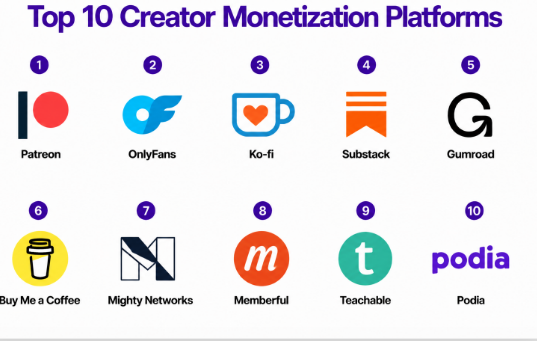
Top 10 Creator Monetization Platforms
1‑ Patreon
Short description: Patreon enables creators to earn recurring income through fan memberships, offering tiered subscription levels with exclusive content and community perks.
Key Features
- Tiered subscription management.
- Exclusive content delivery.
- Patron messaging and community boards.
- Analytics on revenue and engagement.
- Integration with creator tools and content platforms.
Pros
- Excellent for recurring revenue with loyal fanbases.
- Strong community and engagement tools for patrons.
Cons
- Platform fees can impact creator margins.
- Content gating may limit discoverability.
Platforms / Deployment
- Web / iOS / Android / Cloud
Security & Compliance
- Payment encryption
- Not publicly stated
Integrations & Ecosystem
Supports integration with content platforms and creator tools:
- Messaging platforms
- CMS tools
- Analytics dashboards
Support & Community
- Help documentation, creator webinars, email support
2‑ OnlyFans
Short description: OnlyFans is a subscription‑based platform where creators can monetize content through monthly subscriptions and pay‑per‑view messaging, popular with adult content creators and diverse niches.
Key Features
- Subscription and pay‑per‑view content.
- Direct messaging with paid unlocks.
- Tipping and virtual gifts.
- Analytics and earnings dashboard.
- Creator payout controls.
Pros
- Flexible monetization beyond simple subscriptions.
- Direct fan interaction through messaging.
Cons
- Brand perception issues for some niches.
- Platform fees and payout terms may vary.
Platforms / Deployment
- Web / iOS / Android / Cloud
Security & Compliance
- Payment encryption
- Not publicly stated
Integrations & Ecosystem
- Payment processors
- Analytics tools
Support & Community
- Online help center, ticket support
3‑ Ko‑fi
Short description: Ko‑fi allows creators to receive one‑time payments, recurring support, and sell digital products with low fees and simple setup, popular among artists, writers, and streamers.
Key Features
- One‑time and recurring payments.
- Digital product sales.
- Tip jars and goal tracking.
- Membership tiers with perks.
- Integration with websites and social profiles.
Pros
- Low friction for fans to pay.
- Simple setup with flexible payment options.
Cons
- Limited advanced community tools.
- Less suited for enterprise creators.
Platforms / Deployment
- Web / Cloud
Security & Compliance
- Payment encryption
- Not publicly stated
Integrations & Ecosystem
- Website embeds
- Social integrations
- Analytics
Support & Community
- Help documentation, email support
4‑ Substack
Short description: Substack enables writers, journalists, and newsletters to monetize through paid subscriptions with native publishing, email lists, and analytics.
Key Features
- Newsletter publishing and monetization.
- Paid subscription management.
- Reader analytics.
- Commenting and community features.
- Integration with publishing workflows.
Pros
- Simple publishing + monetization in one place.
- Strong reader conversion tools.
Cons
- Less focus on multimedia monetization.
- Subscription options limited to newsletters primarily.
Platforms / Deployment
- Web / Cloud
Security & Compliance
- Payment encryption
- Not publicly stated
Integrations & Ecosystem
- Email systems
- Analytics dashboards
Support & Community
- Documentation, creator resources
5‑ Gumroad
Short description: Gumroad helps creators sell digital products and subscriptions directly to their audience, offering flexible pricing, product bundling, and revenue dashboards.
Key Features
- Digital product sales.
- Recurring subscription options.
- Pay‑what‑you‑want pricing.
- Analytics and sales reporting.
- Customer management features.
Pros
- Excellent for direct digital commerce.
- Flexible pricing and product options.
Cons
- Lacks community engagement features.
- Platform fees on transactions.
Platforms / Deployment
- Web / Cloud
Security & Compliance
- Payment encryption
- Not publicly stated
Integrations & Ecosystem
- Website embeds
- Email marketing tools
- Analytics
Support & Community
- Email help, documentation
6‑ Buy Me a Coffee
Short description: Buy Me a Coffee enables creators to collect one‑time tips, recurring membership, and offer creator extras like content downloads or digital goods.
Key Features
- Tip and donation support.
- Membership tiers with perks.
- Digital product distribution.
- Goal tracking.
- Embeddable buttons for sites.
Pros
- Very low barrier for audience support.
- Simple setup and fan usability.
Cons
- Limited advanced monetization options.
- Fewer analytics than some competitors.
Platforms / Deployment
- Web / Cloud
Security & Compliance
- Payment encryption
- Not publicly stated
Integrations & Ecosystem
- Website widgets
- Email lists
- Analytics
Support & Community
- Documentation, email support
7‑ Mighty Networks
Short description: Mighty Networks allows creators to build membership communities with courses, events, subscriptions, and community features all in one platform.
Key Features
- Membership tiers and paid groups.
- Course creation and content modules.
- Live events and community spaces.
- Analytics on engagement and revenue.
- Branding and customization.
Pros
- Combines community engagement with monetization.
- Strong course and membership tools.
Cons
- Can be complex for simple monetization needs.
- Higher pricing for advanced features.
Platforms / Deployment
- Web / iOS / Android / Cloud
Security & Compliance
- Encryption, access control
- Not publicly stated
Integrations & Ecosystem
- Email marketing tools
- Analytics
Support & Community
- Documentation, webinars, support teams
8‑ Memberful
Short description: Memberful specializes in subscription and membership monetization for creators and small publishers, offering seamless integration with existing websites.
Key Features
- Recurring subscriptions.
- Member dashboards and perks.
- Website integration with branding.
- Analytics and revenue tracking.
- Promo code and pricing flexibility.
Pros
- Great integration with custom sites.
- Strong membership control.
Cons
- Limited digital commerce features.
- Community tools not as robust.
Platforms / Deployment
- Web / Cloud
Security & Compliance
- Payment encryption
- Not publicly stated
Integrations & Ecosystem
- Website CMS
- Email platforms
- Analytics
Support & Community
- Documentation, email support
9‑ Teachable
Short description: Teachable enables creators to build and sell online courses and coaching services with built‑in monetization, student management, and analytics.
Key Features
- Course creation and delivery.
- Payment and subscription setup.
- Student engagement analytics.
- Bundles and upsells.
- Affiliate management.
Pros
- Excellent for education and coaching monetization.
- Built‑in engagement and retention tools.
Cons
- Less focus on community beyond courses.
- Fees on specific plans.
Platforms / Deployment
- Web / Cloud
Security & Compliance
- Encryption
- Not publicly stated
Integrations & Ecosystem
- Email tools
- Analytics
- Payment processors
Support & Community
- Online docs, email support
10‑ Podia
Short description: Podia provides creators with all‑in‑one tools to sell courses, digital products, and memberships with strong marketing and email communication features.
Key Features
- Courses and digital products.
- Memberships and subscriptions.
- Email marketing tools.
- Embeds and funnels.
- Analytics reporting.
Pros
- Unified monetization and marketing stack.
- Easy creators onboarding.
Cons
- Some advanced features require higher tiers.
- Platform fees on lower plans.
Platforms / Deployment
- Web / Cloud
Security & Compliance
- Encryption
- Not publicly stated
Integrations & Ecosystem
- Email platforms
- Analytics
- Website embeds
Support & Community
- Documentation, webinars, email support
Comparison Table (Top 10)
| Tool Name | Best For | Platform(s) Supported | Deployment | Standout Feature | Public Rating |
|---|---|---|---|---|---|
| Patreon | Subscription communities | Web/iOS/Android | Cloud | Tiered recurring monetization | N/A |
| OnlyFans | Subscription & messaging | Web/iOS/Android | Cloud | Pay‑per‑view + messaging | N/A |
| Ko‑fi | Tips & small commerce | Web | Cloud | One‑time + recurring support | N/A |
| Substack | Newsletter monetization | Web | Cloud | Newsletter subscriptions | N/A |
| Gumroad | Digital goods commerce | Web | Cloud | Sell digital products | N/A |
| Buy Me a Coffee | Quick tipping | Web | Cloud | Simple support buttons | N/A |
| Mighty Networks | Courses + community | Web/iOS/Android | Cloud | Cohesive community + monetization | N/A |
| Memberful | Membership + site integration | Web | Cloud | Website subscription integration | N/A |
| Teachable | Courses & coaching | Web | Cloud | Online course monetization | N/A |
| Podia | All‑in‑one creator stack | Web | Cloud | Combined courses/products/memberships | N/A |
Evaluation & Scoring of Creator Monetization Platforms
| Tool Name | Core | Ease | Integrations | Security | Performance | Support | Value | Weighted Total |
|---|---|---|---|---|---|---|---|---|
| Patreon | 9 | 8 | 8 | 7 | 8 | 8 | 7 | 7.9 |
| OnlyFans | 8 | 8 | 7 | 7 | 8 | 7 | 7 | 7.6 |
| Ko‑fi | 7 | 9 | 7 | 7 | 8 | 7 | 8 | 7.6 |
| Substack | 8 | 9 | 8 | 7 | 8 | 8 | 7 | 7.8 |
| Gumroad | 8 | 8 | 8 | 7 | 8 | 7 | 8 | 7.8 |
| Buy Me a Coffee | 7 | 9 | 7 | 7 | 8 | 7 | 8 | 7.7 |
| Mighty Networks | 8 | 7 | 8 | 7 | 8 | 8 | 7 | 7.7 |
| Memberful | 8 | 8 | 8 | 7 | 8 | 7 | 7 | 7.6 |
| Teachable | 8 | 8 | 7 | 7 | 8 | 8 | 7 | 7.6 |
| Podia | 9 | 8 | 8 | 7 | 8 | 8 | 7 | 7.9 |
Interpretation: Scores are comparative. Higher weighted totals indicate strong balance across core monetization, usability, integrations, security, performance, support, and value. Creators should choose based on audience size, monetization goals, content type, and technical resources.
Which Creator Monetization Platform Is Right for You?
Solo / Freelancer
- Ko‑fi, Buy Me a Coffee, Substack: Easy setup, minimal overhead, quick monetization.
SMB
- Patreon, Gumroad, Memberful: Recurring subscription and digital commerce capabilities.
Mid‑Market
- Podia, Mighty Networks, Teachable: Strong course and membership monetization with engagement tools.
Enterprise / Growth Creators
- Podia, Patreon (high tiers), Mighty Networks (custom plans): Scalable tools with analytics and automation.
Budget vs Premium
- Budget: Ko‑fi, Buy Me a Coffee
- Premium: Patreon, Podia, Mighty Networks (advanced tiers)
Feature Depth vs Ease of Use
- Platforms like Substack and Ko‑fi offer ease of use.
- Podia and Mighty Networks provide deeper features but require setup.
Integrations & Scalability
- Patreon and Gumroad integrate widely with creator tools and analytics.
- Enterprise creators may choose ecosystems with API support and web embeds.
Security & Compliance Needs
- All major platforms include encrypted payments and basic compliance; ensure global payment support if needed.
Frequently Asked Questions (FAQs)
1. What monetization models do creators use?
Creators use subscriptions, one‑time purchases, tipping, memberships, pay‑per‑view, and courses to diversify revenue.
2. How do platform fees impact earnings?
Most platforms charge transaction fees and platform fees; high revenue creators should compare net payout terms.
3. Can creators use multiple platforms at once?
Yes, creators often combine platforms (e.g., Substack + Ko‑fi) to maximize revenue streams.
4. Do these tools support global payments?
Many support multi‑currency and international payouts, but always confirm payout regions.
5. How quickly can creators onboard?
Simple tools like Ko‑fi or Buy Me a Coffee can onboard in minutes; advanced course platforms may take hours to set up.
6. Are analytics included?
Most include basic revenue and engagement analytics; advanced reporting may require higher tiers.
7. Can creators control branding?
Many platforms allow custom branding, especially with web integrations and embedded widgets.
8. Do these platforms support community features?
Some (e.g., Mighty Networks, Patreon) include community spaces; others focus on commerce only.
9. Are there alternatives?
Alternatives include ecommerce platforms, video-based paywalls, affiliate monetization, and direct sponsorship systems.
10. How do creators handle taxes?
Creators must manage tax compliance and reporting based on their region and income; many platforms provide basic statements.
Conclusion
Creator Monetization Platforms are essential in for independent creators, influencers, educators, and publishers seeking sustainable revenue. Solo creators benefit from Ko‑fi or Buy Me a Coffee, SMB creators from Patreon or Gumroad, and growth creators from Podia or Mighty Networks. To get started, shortlist 2–3 platforms aligned with your monetization goals, test workflows, assess fees and payouts, and ensure global payment and security features meet your needs before full deployment.
