Introduction
Community Forum Software provides organizations, brands, and online communities with a centralized platform to engage users, share knowledge, and foster collaboration. These platforms allow members to ask questions, share insights, discuss topics, and build relationships in a structured and moderated environment. In , digital engagement and user retention are more important than ever, making community forums a critical part of marketing, customer support, product development, and brand loyalty strategies.
Real-world use cases include:
- Providing customer support through discussion threads and knowledge-sharing.
- Facilitating product feedback and beta testing discussions.
- Creating niche communities around brands, interests, or professional domains.
- Hosting events, webinars, or live Q&A sessions within a community.
- Fostering engagement and retention through gamification, badges, and leaderboards.
Buyers evaluating community forum software should consider:
- Core forum features like threads, categories, moderation, and search.
- Ease of use for admins, moderators, and end-users.
- Integration with CRM, marketing, and support platforms.
- Security and compliance features, including encryption, SSO, and RBAC.
- Analytics and reporting for engagement tracking.
- Scalability for growing communities.
- Mobile and cross-device accessibility.
- Gamification and community engagement tools.
- Customer support and training resources.
- Pricing and licensing flexibility.
Best for: Brands, SaaS companies, nonprofits, and professional associations seeking to foster member engagement, support, and collaboration.
Not ideal for: Organizations with minimal community interaction or internal-only groups that could leverage simpler messaging or collaboration tools.
Key Trends in Community Forum Software
- AI-powered moderation and automated spam detection.
- Recommendation engines for personalized content delivery.
- Integration with CRM, marketing automation, and helpdesk platforms.
- Gamification and engagement analytics to drive member retention.
- Cloud-native and hybrid deployment models for flexibility and scalability.
- Real-time chat and discussion alongside traditional threaded forums.
- Security enhancements including SSO, MFA, and GDPR compliance.
- Low-code/no-code customization for branding and workflows.
- Mobile-first experiences for user engagement across devices.
- Flexible pricing models including subscription, per-user, or feature-based tiers.
How We Selected These Tools (Methodology)
- Market adoption and overall mindshare in community software segment.
- Feature completeness including discussion threads, moderation, and analytics.
- Reliability and performance signals from active communities.
- Security posture and compliance measures.
- Integration capabilities with CRM, marketing, and support platforms.
- Customer fit across industries and community sizes.
- Scalability for large user bases and high engagement.
- Innovation in AI, gamification, and engagement tracking.
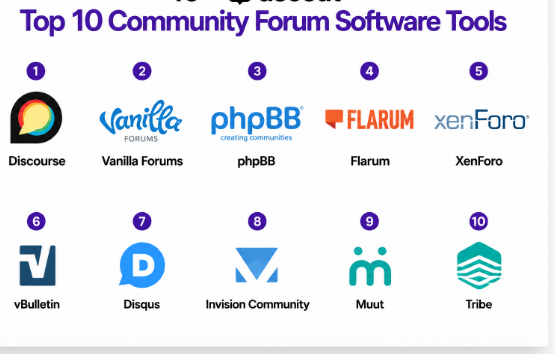
Top 10 Community Forum Software Tools
1- Discourse
Short description: Discourse is an open-source community forum platform designed for professional and interest-based communities. It emphasizes conversation threading, moderation tools, and user engagement.
Key Features
- Threaded discussions with dynamic notifications.
- Advanced moderation and spam detection.
- Gamification with trust levels and badges.
- Mobile-friendly responsive design.
- Integration with Single Sign-On and external apps.
Pros
- Highly customizable and open-source.
- Strong community engagement tools.
Cons
- Requires technical knowledge for hosting and configuration.
- May need third-party hosting for optimal performance.
Platforms / Deployment
- Web / Cloud / Self-hosted / iOS / Android
Security & Compliance
- SSO, encryption, audit logs
- Not publicly stated for certifications
Integrations & Ecosystem
Supports CRM, email, and analytics integration.
- Slack integration
- Zapier automation
- Salesforce connectors
- Custom API
Support & Community
- Active open-source community, discussion forums, documentation.
- Email and chat support vary by hosting provider.
2- Vanilla Forums
Short description: Vanilla Forums is a cloud-based and open-source platform aimed at creating branded communities for customer support, product engagement, and brand advocacy.
Key Features
- Threaded and Q&A style discussions.
- Gamification and rewards system.
- Integration with CRM and analytics.
- Customizable branding and themes.
- Moderation and reporting tools.
Pros
- Enterprise-grade SaaS solution.
- Extensive engagement and gamification features.
Cons
- Premium features may require higher-tier subscriptions.
- Customization can require development resources.
Platforms / Deployment
- Web / Cloud / Self-hosted
Security & Compliance
- SSO, encryption, audit logs
- Not publicly stated for SOC 2 or ISO 27001
Integrations & Ecosystem
- Salesforce, HubSpot, Zendesk, Slack, Zapier
Support & Community
- Enterprise support, online documentation, webinars, and forums.
3- phpBB
Short description: phpBB is a free, open-source forum solution for creating discussion boards. It is highly customizable and widely used for online communities of all sizes.
Key Features
- Multi-category discussion boards.
- User roles and permissions.
- Plugin and extension ecosystem.
- Customizable themes and templates.
- Spam prevention and moderation tools.
Pros
- Open-source and free.
- Flexible customization options.
Cons
- Requires technical expertise for installation and maintenance.
- Limited native integrations.
Platforms / Deployment
- Web / Self-hosted
Security & Compliance
- Encryption and access controls available
- Not publicly stated for formal certifications
Integrations & Ecosystem
- Plugin library for extensions
- API and custom integrations possible
Support & Community
- Active user forums and developer community
- Limited formal support
4- Flarum
Short description: Flarum is a modern, open-source forum platform focusing on simplicity, speed, and extensibility. It is designed for both small and large communities.
Key Features
- Responsive, mobile-first interface.
- Extensible plugin architecture.
- Tagging and discussion filtering.
- Minimalist, fast-loading design.
- Moderation and user management tools.
Pros
- Lightweight and fast.
- Active open-source development community.
Cons
- Smaller ecosystem compared to larger forum platforms.
- Requires technical knowledge to extend functionality.
Platforms / Deployment
- Web / Self-hosted
Security & Compliance
- Basic access controls and spam tools
- Not publicly stated
Integrations & Ecosystem
- Plugins for SEO, analytics, and authentication
- API for custom integrations
Support & Community
- Open-source community, online documentation, discussion forums
5- XenForo
Short description: XenForo is a commercial forum platform used for professional and community-oriented discussions, with strong moderation and monetization features.
Key Features
- Threaded discussions and rich media support.
- User reputation and gamification.
- Advanced moderation and spam controls.
- Integration with payment gateways for subscriptions.
- Reporting and analytics dashboards.
Pros
- Highly polished, professional interface.
- Strong moderation and engagement tools.
Cons
- Paid license required.
- Limited cloud hosting options; typically self-hosted.
Platforms / Deployment
- Web / Self-hosted
Security & Compliance
- SSO and encryption
- Not publicly stated for formal certifications
Integrations & Ecosystem
- Payment gateways, CRM, analytics, APIs
Support & Community
- Official support, online documentation, active user forums
6- vBulletin
Short description: vBulletin is a veteran forum platform that provides comprehensive discussion and community management tools for enterprises and large online communities.
Key Features
- Threaded discussions, polls, and messaging.
- User group permissions and moderation tools.
- SEO optimization and analytics.
- Integration with third-party plugins.
- Monetization support through subscriptions.
Pros
- Mature, feature-rich platform.
- Scales well for large communities.
Cons
- Interface feels dated compared to modern platforms.
- Paid license required.
Platforms / Deployment
- Web / Self-hosted
Security & Compliance
- SSO, encryption, role-based access
- Not publicly stated
Integrations & Ecosystem
- CRM, analytics, payment gateways, plugins
Support & Community
- Paid support tiers, documentation, forums
7- Disqus
Short description: Disqus is a cloud-based discussion platform primarily used for website comment systems and embedded community forums. It enables user interaction and moderation directly on websites.
Key Features
- Embedded comment sections for websites.
- Threaded discussions and moderation tools.
- Social login and single sign-on.
- Real-time notifications and engagement tracking.
- Spam prevention and analytics.
Pros
- Easy to integrate with websites.
- Cloud-based, minimal maintenance.
Cons
- Less suited for large standalone communities.
- Limited branding and customization options.
Platforms / Deployment
- Web / Cloud / iOS / Android
Security & Compliance
- SSO and moderation tools
- Not publicly stated
Integrations & Ecosystem
- WordPress, CMS platforms, APIs, analytics
Support & Community
- Online documentation, email support, knowledge base
8- Invision Community
Short description: Invision Community is a professional forum and community software platform supporting discussions, content management, and member engagement.
Key Features
- Forums, galleries, blogs, and events.
- Gamification with badges and reputation points.
- Moderation and spam controls.
- Reporting and analytics dashboards.
- API for integrations and extensions.
Pros
- Comprehensive community engagement tools.
- Enterprise-grade features for large communities.
Cons
- Paid license required.
- Customization can be complex.
Platforms / Deployment
- Web / Cloud / Self-hosted
Security & Compliance
- SSO, encryption, moderation audit logs
- Not publicly stated
Integrations & Ecosystem
- CRM, CMS, analytics, payment systems, APIs
Support & Community
- Official support, forums, tutorials
9- Muut
Short description: Muut provides embeddable, real-time discussion forums and comment systems for websites, with focus on simplicity and speed.
Key Features
- Embeddable forum and comment sections.
- Real-time messaging and notifications.
- Mobile-friendly design.
- Custom branding and moderation.
- Analytics and engagement tracking.
Pros
- Easy integration into websites.
- Fast, modern interface.
Cons
- Limited for large standalone communities.
- Fewer enterprise features than traditional AMS.
Platforms / Deployment
- Web / Cloud / iOS / Android
Security & Compliance
- Encryption, basic moderation tools
- Not publicly stated
Integrations & Ecosystem
- CMS platforms, analytics, APIs, social login
Support & Community
- Email support, tutorials, online documentation
10- Tribe
Short description: Tribe is a cloud-based modern community platform designed for SaaS products and brands to build branded online communities with integrations and engagement tools.
Key Features
- Customizable community pages and categories.
- Gamification and user badges.
- Integration with SaaS platforms and CRMs.
- Analytics dashboards for engagement tracking.
- Mobile-first responsive design.
Pros
- Modern, branded community experience.
- Easy integration with other tools.
Cons
- Advanced features may require paid tiers.
- Less suited for self-hosted deployment needs.
Platforms / Deployment
- Web / Cloud / iOS / Android
Security & Compliance
- SSO, encryption, role-based access
- Not publicly stated
Integrations & Ecosystem
- Salesforce, Zapier, Slack, CRMs, analytics
Support & Community
- Online documentation, email support, community resources
Comparison Table (Top 10)
| Tool Name | Best For | Platform(s) Supported | Deployment | Standout Feature | Public Rating |
|---|---|---|---|---|---|
| Discourse | Open-source communities | Web / Cloud / Self-hosted / iOS / Android | Hybrid | Threaded discussions & moderation | N/A |
| Vanilla Forums | Customer & brand communities | Web / Cloud / Self-hosted | Hybrid | Branded SaaS communities | N/A |
| phpBB | Open-source boards | Web | Self-hosted | Free, highly customizable | N/A |
| Flarum | Modern lightweight communities | Web | Self-hosted | Mobile-first, fast interface | N/A |
| XenForo | Professional communities | Web | Self-hosted | Monetization & gamification | N/A |
| vBulletin | Large-scale forums | Web | Self-hosted | Enterprise-level features | N/A |
| Disqus | Embedded website comments | Web / Cloud / iOS / Android | Cloud | Easy website integration | N/A |
| Invision Community | Enterprise & brand communities | Web / Cloud / Self-hosted | Hybrid | Multi-content platform | N/A |
| Muut | Website forums & comments | Web / Cloud / iOS / Android | Cloud | Real-time discussion | N/A |
| Tribe | Branded SaaS communities | Web / Cloud / iOS / Android | Cloud | Customizable & integrations | N/A |
Evaluation & Scoring of Community Forum Tools
| Tool Name | Core | Ease | Integrations | Security | Performance | Support | Value | Weighted Total |
|---|---|---|---|---|---|---|---|---|
| Discourse | 9 | 7 | 8 | 7 | 8 | 7 | 8 | 7.8 |
| Vanilla Forums | 8 | 8 | 8 | 7 | 8 | 8 | 7 | 7.8 |
| phpBB | 7 | 6 | 6 | 6 | 7 | 6 | 9 | 6.7 |
| Flarum | 7 | 8 | 7 | 6 | 7 | 6 | 8 | 7.0 |
| XenForo | 8 | 7 | 7 | 7 | 8 | 7 | 7 | 7.3 |
| vBulletin | 8 | 6 | 7 | 7 | 8 | 7 | 7 | 7.1 |
| Disqus | 7 | 9 | 6 | 6 | 7 | 7 | 8 | 7.1 |
| Invision Community | 9 | 7 | 8 | 7 | 8 | 8 | 7 | 7.8 |
| Muut | 7 | 8 | 7 | 6 | 7 | 6 | 8 | 7.0 |
| Tribe | 8 | 8 | 8 | 7 | 8 | 7 | 7 | 7.5 |
Interpretation: Scores are comparative. Weighted totals reflect balance between core features, usability, integrations, security, and value. Organizations should match scores with community goals and scale needs.
Which Community Forum Tool Is Right for You?
Solo / Freelancer
- Discourse or Muut provide lightweight, flexible options for small personal communities or niche forums.
SMB
- Vanilla Forums, Flarum, or Disqus offer easy-to-manage, SaaS-hosted communities with moderate integration capabilities.
Mid-Market
- XenForo, Tribe, and Invision Community provide scalable engagement features, gamification, and analytics for mid-sized organizations.
Enterprise
- vBulletin, Invision Community, and Vanilla Forums enterprise tiers serve large-scale communities with strong moderation, analytics, and integrations.
Budget vs Premium
- Budget-conscious communities benefit from phpBB, Flarum, or Discourse (self-hosted).
- Premium platforms like Invision Community and Tribe offer advanced features, analytics, and enterprise integrations.
Feature Depth vs Ease of Use
- Open-source platforms require technical setup but provide customization.
- SaaS solutions prioritize ease of deployment, engagement, and support.
Integrations & Scalability
- Enterprise-grade platforms integrate with CRMs, marketing automation, and analytics systems, supporting community growth.
Security & Compliance Needs
- Organizations handling sensitive member data should select platforms with SSO, MFA, encryption, and audit logs.
Frequently Asked Questions (FAQs)
1. What pricing models are common for community forum software?
SaaS platforms often use subscription-based pricing, while open-source solutions are free but may require hosting costs. Enterprise tiers may include additional support fees.
2. How long does onboarding typically take?
SaaS platforms can be deployed in days, while open-source tools may require weeks for configuration, customization, and integration.
3. Can these platforms handle large user bases?
Yes, enterprise-grade platforms like Invision Community, XenForo, and vBulletin scale to tens of thousands of members with performance optimization.
4. Are these forums secure for sensitive discussions?
Top platforms offer encryption, SSO, MFA, audit logs, and role-based access. Certifications vary by vendor.
5. What integrations are typically available?
Integrations include CRM, analytics, marketing automation, payment gateways, and API access for custom workflows.
6. Can small communities use enterprise platforms?
While possible, small communities may benefit more from lightweight or self-hosted open-source solutions for cost and simplicity.
7. What moderation tools are included?
Most platforms provide admin dashboards, spam filters, user roles, reporting, and automated moderation tools.
8. Are these platforms mobile-friendly?
Modern SaaS and open-source platforms offer responsive design or dedicated mobile apps for engagement on any device.
9. Can forums be branded for organizations?
Yes, SaaS and self-hosted solutions allow custom branding, themes, logos, and domain configuration.
10. Are there alternatives to traditional forum software?
Alternatives include social media groups, Slack/Discord channels, and community messaging apps, though they may lack structured discussion and analytics.
Conclusion
Community Forum Software is essential for fostering engagement, knowledge-sharing, and brand loyalty in . Small communities benefit from lightweight, self-hosted solutions like Flarum or Discourse, while mid-market and enterprise organizations require feature-rich SaaS platforms like Vanilla Forums, XenForo, or Invision Community. To proceed, shortlist aligned with your community goals, run pilot tests to validate usability and integrations, and ensure security measures are in place before full deployment.
