Introduction
Donation Management Software are platforms designed to help nonprofits, charities, and fundraising organizations track, process, and report on contributions. These systems go beyond simple payment collection — they manage donor profiles, campaign tracking, recurring gift setups, tax receipts, segmentation for messaging, and analytics that help organizations understand donor behavior. Whether your organization conducts online fund drives, recurring giving programs, peer‑to‑peer campaigns, or major gift solicitations, a robust donation management system can streamline operations, reduce administrative overhead, and increase donor engagement.
In, expectations for these platforms include seamless online giving, mobile donations, integration with CRM and marketing tools, advanced reporting, and secure payment processing — all while ensuring data privacy and compliance. As the nonprofit sector becomes more digital, leaders must evaluate tools that help grow donations while maintaining transparency and trust.
Real‑world use cases include:
- Annual fund campaigns: Tracking and managing yearly giving from individuals and foundations.
- Recurring and sustainer gifts: Automating monthly or periodic donations with donor portals and reminders.
- Peer‑to‑peer fundraising: Supporting supporters who fundraise on behalf of the organization.
- Major gifts and matching gifts: Segmenting high‑value contributors and managing corporate match campaigns.
- Event fundraising: Registering donors, processing event gifts, and tracking sponsorships.
What buyers should evaluate:
- Ease of donation processing (online, mobile, text‑to‑give)
- Donor profile management and engagement history
- Recurring and scheduled giving tools
- CRM and email/marketing integrations
- Reporting and analytics dashboards
- Security and payment compliance
- Custom branding and campaign design
- Peer‑to‑peer and crowdfunding support
- Receipt and acknowledgment automation
- Support and training resources
Best for: Nonprofits of all sizes, community organizations, faith‑based groups, educational institutions, and fundraising teams needing structured donation lifecycle management.
Not ideal for: Organizations that rarely solicit donations or only process occasional one‑off gifts with minimal tracking needs.
Key Trends in Donation Management Software
- AI‑assisted donor segmentation for personalized campaigns.
- Mobile and text‑to‑give optimization.
- Automated tax receipt and compliance workflows.
- Real‑time analytics dashboards for fundraising performance.
- Peer‑to‑peer and social giving support with integrated referrals.
- Recurring giving and subscription management.
- CRM and marketing ecosystem integrations for unified supporter profiles.
- Gamification features to encourage donor engagement.
- Secure, multi‑currency global donation support.
- Donor lifetime value metrics and predictive insights.
How We Selected These Tools (Methodology)
- Breadth of donation and fundraising features.
- Ease of use for donors and administrators.
- Security and payment compliance infrastructure.
- Reporting, analytics, and segmentation capabilities.
- Integration options with CRM, marketing, and financial software.
- Mobile and online giving support.
- Support resources, documentation, and onboarding tools.
- Scalability for small to enterprise‑level organizations.
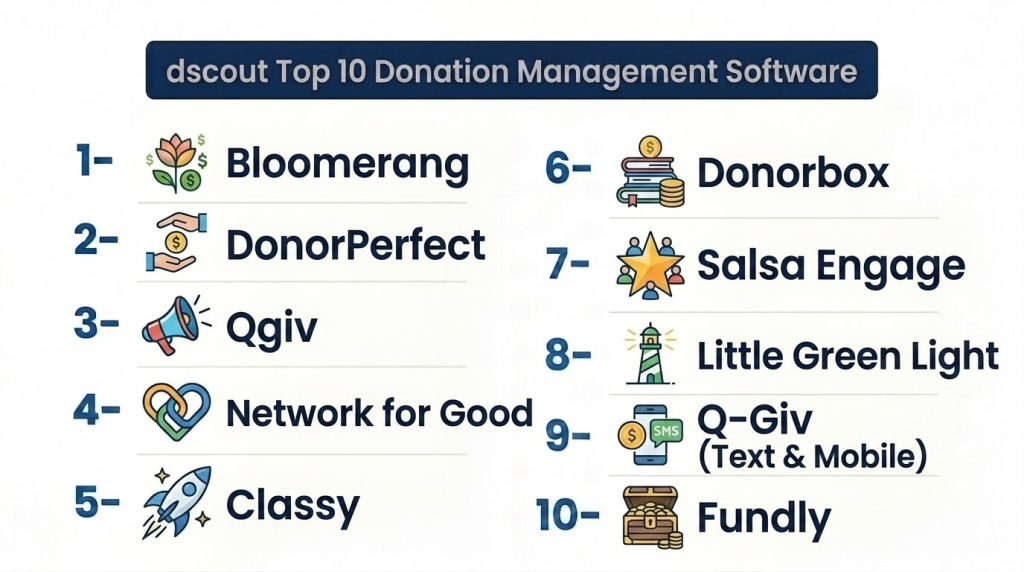
Top 10 Donation Management Software
1 — Bloomerang
Short description: Bloomerang is a donor management and fundraising platform designed for nonprofits focused on retention, engagement, and simple gift processing, alongside robust donor communication tools.
Key Features
- Donor profiles and engagement history
- Online giving forms and landing pages
- Recurring gift management
- Campaign and appeal tracking
- Reporting dashboards
- Email and communication tools
Pros
- Strong donor engagement tracking
- Easy setup for small to mid‑size organizations
Cons
- Limited advanced peer‑to‑peer support
- Some features tiered by pricing
Platforms / Deployment
- Web / Cloud
Security & Compliance
Not publicly stated
Integrations & Ecosystem
- CRM connectors
- Email marketing integration
- Payment processors
- Analytics and reporting tools
Support & Community
Documentation, onboarding support, and user community
2 — DonorPerfect
Short description: DonorPerfect offers comprehensive fundraising and donor management features for nonprofits, including custom gift tracking, recurring donations, and reporting.
Key Features
- Donor and gift database
- Recurring donation tools
- Custom reports and dashboards
- Online donation forms
- Event and campaign tracking
- Communication tools
Pros
- Deep customization options
- Scales as organizations grow
Cons
- Interface learning curve for new users
- Add‑ons may increase costs
Platforms / Deployment
- Web / Cloud
Security & Compliance
Not publicly stated
Integrations & Ecosystem
- CRM and fundraising software
- Email automation
- Event tools
- Payment gateways
Support & Community
Live support, training resources, and user forums
3 — Qgiv
Short description: Qgiv is a flexible fundraising platform with donation forms, peer‑to‑peer fundraising, event registration, and text giving — ideal for modern multichannel campaigns.
Key Features
- Customizable giving forms
- Peer‑to‑peer campaign support
- Text‑to‑give tools
- Event registration and ticketing
- Recurring giving management
- Reporting and dashboards
Pros
- Excellent multichannel giving support
- Strong event and peer‑to‑peer features
Cons
- Learning curve for advanced campaign setups
- Some features require higher plans
Platforms / Deployment
- Web / Cloud
Security & Compliance
Not publicly stated
Integrations & Ecosystem
- CRM integration
- Email and marketing tools
- Payment processors
- Reporting export capabilities
Support & Community
Comprehensive support, onboarding, and tutorials
4 — Network for Good
Short description: Network for Good focuses on small and mid‑size nonprofits, offering donor management, online giving, and coaching resources to grow fundraising results.
Key Features
- Donor database and tracking
- Online donation pages
- Recurring gifts
- Email fund appeals
- Coaching and fundraiser resources
- Dashboards and reports
Pros
- Designed for smaller organizations
- Coaching and best practices support
Cons
- Fewer advanced enterprise features
- Limited peer‑to‑peer options
Platforms / Deployment
- Web / Cloud
Security & Compliance
Not publicly stated
Integrations & Ecosystem
- CRM synchronization
- Email tools
- Payment gateways
Support & Community
Training resources, webinars, and help center
5 — Classy
Short description: Classy is a fundraising platform built for online campaigns, recurring gifts, peer‑to‑peer events, crowdfunding, and mission‑driven engagement.
Key Features
- Online and mobile donation pages
- Peer‑to‑peer and crowdfunding support
- Recurring giving tools
- Team and event fundraising
- Analytics and impact dashboards
Pros
- Excellent peer‑to‑peer and campaign tools
- Strong analytics for fundraisers
Cons
- Pricing may be high for small nonprofits
- Some learning curve for advanced campaigns
Platforms / Deployment
- Web / Cloud
Security & Compliance
Not publicly stated
Integrations & Ecosystem
- CRM and data systems
- Marketing automation
- Payment processing tools
- Reporting connectors
Support & Community
Support portal, community groups, and educational content
6 — Donorbox
Short description: Donorbox provides easy‑to‑set‑up donation forms, recurring billing, and multiple donor engagement tools with a user‑centric interface.
Key Features
- Custom donation forms
- Recurring donation support
- Peer‑to‑peer campaigns
- Donor CRM basics
- Tax receipts
- Multilingual forms
Pros
- Quick setup
- Low barrier to entry
Cons
- Less advanced reporting
- Basic CRM features
Platforms / Deployment
- Web / Cloud
Security & Compliance
Not publicly stated
Integrations & Ecosystem
- CRM connectors
- Email tools
- Payment processors
Support & Communit
7 — Salsa Engage
Short description: Salsa Engage combines donor management, online fundraising, advocacy tools, and automation workflows for nonprofits seeking a unified engagement platform.
Key Features
- Constituent database
- Online giving and forms
- Email and text campaigns
- Advocacy and petitions
- Analytics dashboards
Pros
- Combines fundraising and engagement
- Automation and advocacy tools
Cons
- More complex interface
- Higher learning curve
Platforms / Deployment
- Web / Cloud
Security & Compliance
Not publicly stated
Integrations & Ecosystem
- CRM and advocacy software
- Marketing automation
- Payment systems
Support & Community
Professional support, training, and community forums
8 — Little Green Light
Short description: Little Green Light offers donor and gift management with flexible data organization, communications, and reporting tools tailored for small to mid‑size nonprofits.
Key Features
- Donor database and tracking
- Gift entry and reporting
- Online giving form integration
- Mail and email tools
- Dashboard analytics
Pros
- Strong donor record management
- Simple, flexible reporting
Cons
- Limited advanced fundraising campaigns
- Fewer peer‑to‑peer tools
Platforms / Deployment
- Web / Cloud
Security & Compliance
Not publicly stated
Integrations & Ecosystem
- CRM connectors
- Email tools
- Payment integrations
Support & Community
Knowledge base and support options
9 — Q‑Giv (Text & Mobile)
Short description: Q‑Giv emphasizes mobile giving and text‑to‑give campaigns, with tools for recurring gifts, event fundraising, and donation forms optimized for mobile experiences.
Key Features
- Mobile‑first donation forms
- Text‑to‑give campaign tools
- Recurring donation support
- Event and auction fundraising
- Reporting dashboards
Pros
- Excellent mobile/ text giving experience
- Good for event‑driven campaigns
Cons
- Customization options may be limited
- Fewer CRM features
Platforms / Deployment
- Web / Mobile / Cloud
Security & Compliance
Not publicly stated
Integrations & Ecosystem
- CRM and marketing tools
- Payment gateways
Support & Community
Help center and guides
10 — Fundly
Short description: Fundly focuses on peer‑to‑peer and crowdfunding campaigns, enabling nonprofits and individuals to raise funds with social sharing and campaign tracking.
Key Features
- Peer‑to‑peer and crowdfunding pages
- Social sharing tools
- Recurring donation options
- Campaign progress dashboards
- Donor communication tools
Pros
- Strong peer‑to‑peer and social fundraising
- Campaign tracking tools
Cons
- Limited deep donor analytics
- Less suited for recurring giving programs
Platforms / Deployment
- Web / Cloud
Security & Compliance
Not publicly stated
Integrations & Ecosystem
- CRM and database tools
- Social media sharing
- Payment processors
Support & Community
Support resources and tutorials
Comparison Table (Top 10)
| Tool Name | Best For | Platform(s) Supported | Deployment | Standout Feature | Public Rating |
|---|---|---|---|---|---|
| Bloomerang | Mid‑size nonprofits | Web / Cloud | Cloud | Donor engagement focus | N/A |
| DonorPerfect | Growth nonprofits | Web / Cloud | Cloud | Custom reporting | N/A |
| Qgiv | Multi‑channel fundraising | Web / Cloud | Cloud | Peer‑to‑peer & events | N/A |
| Network for Good | Small nonprofits | Web / Cloud | Cloud | Coaching & ease of use | N/A |
| Classy | Online campaigns | Web / Cloud | Cloud | Crowdfunding & peer‑to‑peer | N/A |
| Donorbox | Quick setup | Web / Cloud | Cloud | Easy donor forms | N/A |
| Salsa Engage | Engagement + advocacy | Web / Cloud | Cloud | Unified engagement suite | N/A |
| Little Green Light | Donor tracking | Web / Cloud | Cloud | Flexible donor management | N/A |
| Q‑Giv | Mobile & text giving | Web / Mobile | Cloud | Text‑to‑give experience | N/A |
| Fundly | Crowdfunding | Web / Cloud | Cloud | Social fundraising | N/A |
Evaluation & Scoring of Donation Management Software
| Tool Name | Core (25%) | Ease (15%) | Integrations (15%) | Security (10%) | Performance (10%) | Support (10%) | Value (15%) | Weighted Total (0–10) |
|---|---|---|---|---|---|---|---|---|
| Bloomerang | 9 | 9 | 8 | 8 | 9 | 8 | 8 | 8.6 |
| DonorPerfect | 9 | 8 | 8 | 8 | 8 | 8 | 7 | 8.2 |
| Qgiv | 8 | 8 | 8 | 8 | 8 | 8 | 8 | 8.0 |
| Network for Good | 8 | 9 | 7 | 8 | 8 | 8 | 8 | 8.1 |
| Classy | 9 | 8 | 9 | 8 | 9 | 8 | 7 | 8.3 |
| Donorbox | 7 | 9 | 7 | 8 | 7 | 8 | 8 | 7.9 |
| Salsa Engage | 8 | 7 | 9 | 8 | 8 | 8 | 7 | 8.0 |
| Little Green Light | 8 | 8 | 7 | 8 | 8 | 7 | 8 | 7.9 |
| Q‑Giv | 8 | 9 | 7 | 8 | 8 | 8 | 8 | 8.1 |
| Fundly | 8 | 8 | 7 | 8 | 8 | 8 | 8 | 8.0 |
Interpretation:
Weighted scores help organizations compare platforms based on core features, ease of use, integration potential, performance, support, and overall value — guiding decisions aligned with fundraising strategies and organizational scale.
Which Donation Management Software Is Right for You?
Solo / Small Nonprofits
- Donorbox and Network for Good offer easy setup and essential fundraising tools with minimal complexity.
- Q‑Giv provides excellent mobile and text giving support for event‑driven campaigns.
SMB / Mid‑Size Nonprofits
- Bloomerang, Little Green Light, and Qgiv balance donor engagement, campaign tools, and analytics.
- Classy offers powerful peer‑to‑peer and crowdfunding capabilities for growth.
Mid‑Market / Growth Organizations
- DonorPerfect and Classy scale with advanced reporting, CRM integration, and multi‑channel fundraising.
- Salsa Engage combines fundraising with engagement and advocacy workflows.
Enterprise / Large Nonprofits
- Bloomerang and DonorPerfect provide robust donor management and analytics for large portfolios.
- Classy supports complex peer‑to‑peer and mission‑driven campaigns with deep customization.
Budget vs Premium
- Donorbox and Q‑Giv are cost‑effective for smaller budgets with strong mobile support.
Feature Depth vs Ease of Use
- Bloomerang and Classy deliver deep features but may require onboarding.
- Network for Good and Donorbox provide easier onboarding with less complexity.
Integrations & Scalability
- Platforms with strong CRM and analytics connectors scale better for growing organizations.
Security & Compliance Needs
- Ensure payment compliance, secure data handling, and donor privacy policies are supported before adoption.
Frequently Asked Questions (FAQs)
1. What is donation management software?
Donation management software helps organizations track, process, and report contributions, while managing donor relationships and engagement.
2. Can these platforms handle recurring gifts?
Yes — most include tools for recurring and scheduled giving.
3. Do they integrate with CRM systems?
Many support CRM and marketing integrations to unify donor data.
4. Are mobile and text giving features important?
Yes — they improve accessibility and expand fundraising channels.
5. Can volunteers use these systems?
Administrators and volunteers can access dashboards used for outreach and donor follow‑ups.
6. Is security managed?
Secure payment processing and database protections are expected features in modern platforms.
7. How do reports help nonprofits?
Reports show fundraising performance, donor retention, campaign ROI, and segment breakdowns.
8. What’s the difference between basic and advanced plans?
Advanced plans include analytics, integrations, peer‑to‑peer campaigns, and automation.
9. Do platforms support international donors?
Some support multiple currencies and global payment processors.
10. What should a nonprofit consider first when choosing?
Clarify fundraising goals, expected donor volume, required integrations, and budget before evaluation.
Conclusion
Donation Management Software is essential for modern fundraising success. Whether managing a small community nonprofit or a large, multi‑campaign organization, these platforms help efficiently process gifts, engage donors, and measure impact. Tools like Bloomerang and Classy deliver deep engagement and multichannel campaign support, while Donorbox and Network for Good provide easy entry points for smaller programs. Organizations should assess scalability, integration needs, mobile giving support, and analytics capabilities to ensure the platform aligns with mission goals and fundraising strategies
