Introduction
Crypto custody platforms help institutions, businesses, and investors securely store, manage, transfer, and govern digital assets such as cryptocurrencies, stablecoins, tokenized assets, and digital securities. In simple terms, these platforms protect the private keys that control blockchain assets while adding operational controls such as approvals, audit trails, access permissions, reporting, and compliance workflows.
Crypto custody matters more than ever because digital assets are moving from experimental portfolios into institutional finance, corporate treasury, fintech products, tokenization programs, and regulated investment vehicles. As adoption grows, organizations need custody solutions that combine security, governance, scalability, and integration flexibility.
Real-world use cases include:
- Institutional crypto asset storage
- Digital asset treasury operations
- Exchange and broker custody infrastructure
- Tokenization and stablecoin custody
- Fund, ETF, and asset manager custody workflows
What buyers should evaluate:
- Key management architecture
- MPC, HSM, cold storage, or hybrid custody model
- Regulatory and compliance posture
- Supported assets and blockchains
- Transaction approval workflows
- API and integration capabilities
- Insurance and risk controls
- Reporting and audit logs
- Staking, DeFi, and settlement support
- Support quality and onboarding process
Best for: Crypto exchanges, fintech companies, asset managers, banks, family offices, hedge funds, Web3 companies, tokenization platforms, and enterprises managing digital assets at scale.
Not ideal for: Casual individual holders with small balances, businesses without digital asset exposure, or teams that only need a simple self-custody wallet and do not require institutional controls, auditability, or compliance workflows.
Key Trends in Crypto Custody Platforms
- MPC-based custody is becoming a mainstream institutional model because it reduces single-key failure risks and enables flexible transaction governance.
- Hybrid custody models are growing as institutions combine self-custody, third-party custody, cold storage, and operational wallets.
- Tokenization support is becoming more important as platforms expand beyond Bitcoin and Ethereum into real-world assets, stablecoins, and digital securities.
- AI-assisted risk monitoring is emerging for transaction anomaly detection, fraud signals, wallet behavior analysis, and operational risk alerts.
- Compliance automation is becoming a buyer priority with stronger demand for reporting, audit trails, policy controls, and regulatory workflows.
- Off-exchange settlement and collateral management are expanding as trading firms look to reduce exchange counterparty risk.
- API-first custody infrastructure is gaining traction among fintechs, exchanges, and Web3 platforms building embedded digital asset products.
- Institutional staking and DeFi access are becoming selective add-ons rather than generic features because governance and risk controls matter.
- Banks and traditional financial institutions are entering custody more actively as digital asset products become more regulated and institutionalized.
- Multi-chain custody is now expected as buyers want support for major blockchains, stablecoins, Layer 2 networks, and tokenized assets.
How We Selected These Tools (Methodology)
The platforms in this guide were selected using the following evaluation logic:
- Market adoption and recognition among institutional crypto users
- Strength of custody architecture, including MPC, HSM, cold storage, or hybrid models
- Breadth of digital asset and blockchain support
- Security posture signals such as access controls, auditability, and policy workflows
- Enterprise readiness for banks, fintechs, funds, exchanges, and corporate treasury teams
- Integration ecosystem, APIs, developer tools, and operational workflow coverage
- Support for compliance, reporting, governance, and transaction approvals
- Fit across different segments including startups, mid-market firms, enterprises, and regulated institutions
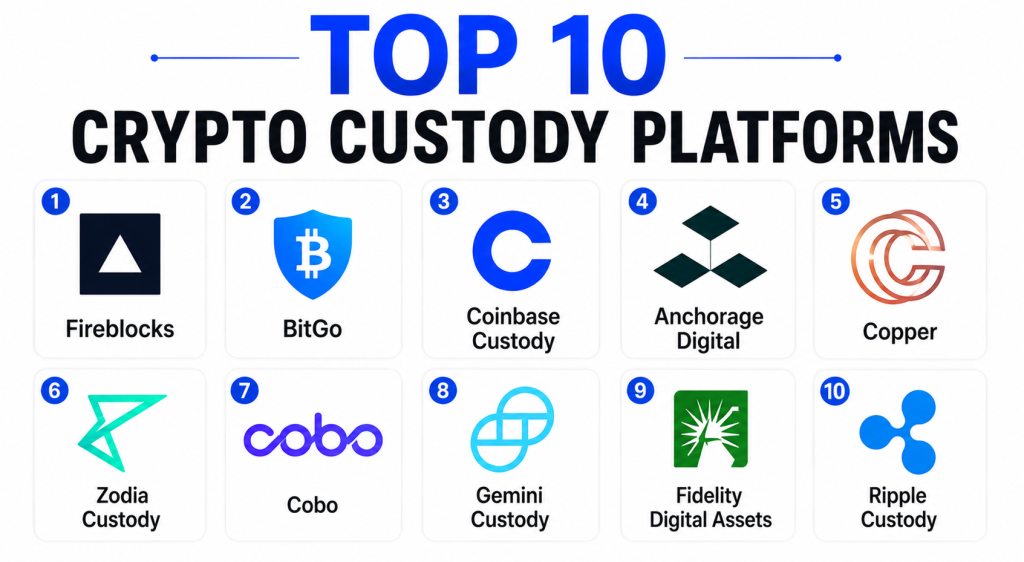
Top 10 Crypto Custody Platforms
1- Fireblocks
Short description:
Fireblocks is an institutional digital asset infrastructure platform used for custody, treasury operations, transfers, settlement, tokenization, and wallet management. It is best suited for exchanges, fintechs, banks, asset managers, and Web3 companies that need secure digital asset operations at scale. The platform is known for MPC-based wallet infrastructure, policy controls, workflow automation, and broad ecosystem connectivity. Fireblocks is not just a vault-style custody product; it supports operational movement of assets across trading venues, blockchains, and business applications. Teams often choose it when they need both security and high transaction velocity. It is especially relevant for organizations building digital asset products or managing active crypto treasury operations.
Key Features
- MPC-based wallet infrastructure
- Policy-based transaction approval workflows
- Digital asset treasury management
- Multi-chain and token support
- API-driven infrastructure for fintech and Web3 use cases
- Settlement and transfer network capabilities
- Support for tokenization and digital asset operations
Pros
- Strong fit for institutions needing active asset movement
- Broad ecosystem and integration capabilities
- Mature operational controls for treasury and settlement teams
Cons
- May be more advanced than small teams require
- Pricing is typically enterprise-oriented
- Requires proper onboarding and policy design
Platforms / Deployment
- Web
- Cloud
- Hybrid options may vary by implementation
Security & Compliance
- MPC-based key management
- Policy controls
- Audit logs
- RBAC
- Additional certifications: Varies / N/A
Integrations & Ecosystem
Fireblocks is designed to connect custody, treasury, settlement, trading, tokenization, and digital asset workflows through APIs and ecosystem integrations.
- Exchanges and liquidity venues
- Blockchain networks
- Treasury systems
- Tokenization platforms
- APIs and developer tools
- Compliance and monitoring workflows
Support & Community
Fireblocks offers enterprise onboarding, documentation, customer support, and implementation assistance. Community strength is strongest among institutional digital asset teams, fintech builders, and enterprise crypto operations.
2- BitGo
Short description:
BitGo is a long-standing crypto custody and digital asset infrastructure provider known for institutional wallet services, custody, trading, settlement, and security-focused operations. It serves asset managers, crypto funds, exchanges, fintech companies, and institutional investors. BitGo is often considered by organizations that need regulated custody options, multi-asset support, and institutional controls. The platform has a strong reputation in crypto custody because of its long market presence and enterprise focus. It supports secure asset storage while also offering operational tools for digital asset movement. Buyers often evaluate BitGo when governance, custody maturity, and asset coverage are important.
Key Features
- Institutional digital asset custody
- Multi-signature and security-focused wallet infrastructure
- Multi-asset support
- Transaction policy controls
- Trading and settlement support
- Institutional reporting
- Custody and wallet infrastructure services
Pros
- Strong market recognition in crypto custody
- Suitable for institutional and fund-level use cases
- Broad digital asset infrastructure coverage
Cons
- Enterprise setup may require due diligence and onboarding
- Pricing details are not always transparent
- Some use cases may require additional integrations
Platforms / Deployment
- Web
- Cloud
- Hybrid options may vary
Security & Compliance
- Multi-signature security model
- Audit logs
- Policy controls
- Regulatory details vary by service and jurisdiction
- Additional certifications: Not publicly stated
Integrations & Ecosystem
BitGo integrates with institutional crypto workflows that involve custody, trading, settlement, reporting, and wallet infrastructure.
- Exchanges
- OTC desks
- Trading platforms
- Treasury workflows
- APIs
- Institutional reporting tools
Support & Community
BitGo provides institutional support, onboarding, and account management. Its community presence is strongest among crypto-native institutions, funds, and businesses requiring custody infrastructure.
3- Coinbase Custody
Short description:
Coinbase Custody is an institutional crypto custody solution connected to the broader Coinbase ecosystem. It is designed for asset managers, institutions, funds, corporations, and clients that need secure digital asset storage with institutional-grade operational processes. The platform benefits from Coinbase’s strong market presence and regulated service model in supported jurisdictions. It is commonly considered by organizations that want custody, trading access, reporting, and institutional crypto services within a recognized ecosystem. Coinbase Custody is particularly relevant for firms needing a mainstream custody provider with broad industry familiarity. It is often evaluated for institutional crypto investment products and long-term asset safekeeping.
Key Features
- Institutional crypto custody
- Broad digital asset support
- Offline storage options
- Governance and approval workflows
- Integration with Coinbase institutional services
- Reporting and account management
- Support for institutional asset operations
Pros
- Strong brand recognition and institutional credibility
- Useful for asset managers and investment products
- Integrated ecosystem for custody and trading workflows
Cons
- May not fit teams seeking full self-custody control
- Supported features may vary by region
- Pricing is generally institutional
Platforms / Deployment
- Web
- Cloud
Security & Compliance
- Encryption
- Access controls
- Auditability
- Regulatory posture varies by jurisdiction
- Additional certifications: Varies / N/A
Integrations & Ecosystem
Coinbase Custody fits naturally into institutional workflows connected to Coinbase’s broader digital asset ecosystem.
- Coinbase institutional services
- Trading workflows
- Reporting systems
- Asset management operations
- APIs where available
Support & Community
Coinbase offers institutional onboarding and customer support. Community visibility is strong because of Coinbase’s broader market presence and enterprise crypto adoption.
4- Anchorage Digital
Short description:
Anchorage Digital is an institutional crypto platform offering custody, trading, staking, governance, and digital asset services. It is designed for institutions that need regulated digital asset infrastructure and secure asset operations. The platform is especially relevant for asset managers, protocols, banks, venture firms, and organizations managing large digital asset portfolios. Anchorage Digital focuses on institutional security, governance, and service depth. It is often evaluated when custody must be combined with broader financial services for digital assets. Organizations choose it when they need a custody provider built specifically for institutional requirements.
Key Features
- Institutional crypto custody
- Trading and settlement services
- Staking support
- Governance participation tools
- Secure asset management workflows
- Digital asset operations infrastructure
- Institutional account management
Pros
- Strong institutional positioning
- Useful for custody plus staking and governance workflows
- Built for regulated and sophisticated digital asset users
Cons
- Not designed for casual retail custody
- Enterprise onboarding may take time
- Some service availability may depend on jurisdiction
Platforms / Deployment
- Web
- Cloud
Security & Compliance
- Encryption
- Access controls
- Institutional governance controls
- Regulatory details vary by service and region
- Additional certifications: Not publicly stated
Integrations & Ecosystem
Anchorage Digital supports institutional digital asset workflows across custody, trading, staking, governance, and settlement.
- Trading services
- Staking networks
- Governance workflows
- Institutional reporting
- Digital asset operations
Support & Community
Anchorage Digital provides institutional onboarding, account management, and support. Its ecosystem strength is strongest among institutional crypto investors and digital asset financial services firms.
5- Copper
Short description:
Copper is a digital asset custody and prime services platform focused on institutional investors, trading firms, hedge funds, and asset managers. It is widely recognized for secure custody, settlement workflows, and off-exchange collateral management. Copper is particularly relevant for firms that trade actively and want to reduce exchange counterparty exposure. The platform combines custody controls with trading infrastructure and settlement network capabilities. It is often considered by sophisticated market participants that need security and capital efficiency. Copper is less suitable for basic long-term storage-only needs and more useful for active institutional operations.
Key Features
- Institutional digital asset custody
- Off-exchange settlement workflows
- Collateral management
- Multi-asset support
- Trading venue connectivity
- Governance and transaction controls
- Prime services capabilities
Pros
- Strong fit for trading firms and hedge funds
- Useful off-exchange settlement model
- Designed for active institutional digital asset operations
Cons
- May be too specialized for simple custody needs
- Enterprise workflows require onboarding
- Availability and features may vary by region
Platforms / Deployment
- Web
- Cloud
Security & Compliance
- Secure custody controls
- Transaction governance
- Auditability
- Regulatory and compliance details vary by jurisdiction
Integrations & Ecosystem
Copper supports institutional trading and custody workflows through exchange connectivity, settlement infrastructure, and operational integrations.
- Exchanges
- OTC desks
- Liquidity venues
- Trading systems
- Reporting workflows
Support & Community
Copper provides institutional support and onboarding. Its community strength is strongest among professional trading firms, asset managers, and hedge funds.
6- Zodia Custody
Short description:
Zodia Custody is an institutional digital asset custody provider backed by traditional financial services expertise. It focuses on secure custody for institutions, including banks, asset managers, corporations, and financial firms. Zodia is often evaluated by organizations that want a custody provider aligned with regulated financial market expectations. The platform emphasizes institutional controls, asset protection, and governance. It is relevant for buyers who prioritize trust, compliance posture, and institutional operating models. Zodia Custody is best suited for organizations needing professional custody rather than consumer wallet functionality.
Key Features
- Institutional digital asset custody
- Governance and operational controls
- Multi-asset custody support
- Secure asset storage workflows
- Institutional client onboarding
- Reporting and account controls
- Regulated-market orientation
Pros
- Strong institutional positioning
- Suitable for financial services organizations
- Focused on custody governance and trust
Cons
- Less suited for developer-first custody infrastructure
- Feature availability may vary by market
- Not ideal for retail users
Platforms / Deployment
- Web
- Cloud
Security & Compliance
- Encryption
- Access controls
- Auditability
- Compliance posture varies by jurisdiction
- Additional certifications: Not publicly stated
Integrations & Ecosystem
Zodia Custody is designed for institutional custody workflows and may connect with financial, reporting, and digital asset ecosystem partners.
- Institutional reporting systems
- Digital asset platforms
- Financial services workflows
- Asset management operations
- Partner ecosystem integrations
Support & Community
Zodia Custody provides professional institutional support. Its community is strongest across financial institutions and regulated digital asset market participants.
7- Cobo
Short description:
Cobo provides digital asset custody and wallet infrastructure for institutions, exchanges, funds, Web3 companies, and digital asset businesses. It supports custody, wallet-as-a-service, risk controls, and operational management for organizations handling crypto at scale. Cobo is often evaluated by teams needing flexible custody architecture and infrastructure services. The platform serves both custody-focused and developer-oriented digital asset needs. It is especially useful for businesses building products that require secure wallet management. Cobo can support operational, treasury, and platform-level crypto workflows.
Key Features
- Institutional custody
- Wallet-as-a-service capabilities
- MPC and custody infrastructure options
- Multi-chain asset support
- Risk and approval controls
- API access
- Operational wallet management
Pros
- Flexible custody and wallet infrastructure
- Useful for Web3 businesses and exchanges
- Strong fit for teams needing APIs and asset operations
Cons
- May require technical integration effort
- Service details vary by deployment model
- Enterprise due diligence is still required
Platforms / Deployment
- Web
- Cloud
- Hybrid options may vary
Security & Compliance
- MPC capabilities
- Access controls
- Transaction policies
- Audit trails
- Additional compliance details: Varies / N/A
Integrations & Ecosystem
Cobo supports digital asset businesses through wallet infrastructure, APIs, and operational integrations.
- Blockchain networks
- Wallet infrastructure
- Exchange workflows
- Treasury operations
- APIs and SDKs
- Web3 applications
Support & Community
Cobo provides documentation, onboarding, and support for institutional and developer-oriented customers. Community visibility is strongest in digital asset infrastructure and Web3 business contexts.
8- Gemini Custody
Short description:
Gemini Custody is an institutional crypto custody service connected to Gemini’s broader exchange and digital asset ecosystem. It is designed for institutions, funds, asset managers, and businesses requiring secure custody and account management. Gemini Custody is often considered by organizations seeking a recognizable custody provider with exchange ecosystem access. The platform supports digital asset safekeeping with operational controls and institutional workflows. It is best suited for firms that want a custody provider connected to broader crypto trading and account services. Buyers should evaluate regional availability, asset support, and service fit before choosing it.
Key Features
- Institutional crypto custody
- Secure digital asset storage
- Exchange ecosystem connectivity
- Account management workflows
- Multi-asset support
- Reporting support
- Institutional service options
Pros
- Recognized crypto brand
- Useful for custody connected to exchange workflows
- Suitable for funds and institutional investors
Cons
- May not offer the same infrastructure depth as API-first custody platforms
- Service availability may vary by jurisdiction
- Pricing details are not always public
Platforms / Deployment
- Web
- Cloud
Security & Compliance
- Encryption
- Access controls
- Auditability
- Regulatory details vary by service and jurisdiction
- Additional certifications: Varies / N/A
Integrations & Ecosystem
Gemini Custody integrates naturally with Gemini’s broader digital asset services and institutional account workflows.
- Gemini exchange ecosystem
- Institutional accounts
- Reporting workflows
- Asset management operations
- API access where available
Support & Community
Gemini provides institutional support and onboarding. Its community presence is strengthened by Gemini’s exchange ecosystem and institutional crypto brand visibility.
9- Fidelity Digital Assets
Short description:
Fidelity Digital Assets provides institutional digital asset custody and related services backed by a major traditional financial services institution. It is designed primarily for institutions such as asset managers, hedge funds, family offices, and financial intermediaries. The platform is especially relevant for buyers who value traditional finance experience, institutional operations, and secure custody models. Fidelity Digital Assets is often considered when organizations want digital asset exposure through a provider with strong financial market credibility. It may not be the best fit for developer-first crypto infrastructure or Web3 application builders. Its strongest use case is institutional asset custody and investment operations.
Key Features
- Institutional digital asset custody
- Secure asset storage
- Institutional account management
- Trading support where available
- Reporting workflows
- Financial services operating model
- Asset manager-oriented custody services
Pros
- Strong traditional finance credibility
- Suitable for institutional investors
- Useful for long-term custody and investment workflows
Cons
- Less developer-oriented than API-first platforms
- Service scope may be narrower than broader crypto infrastructure providers
- Availability and asset support may vary
Platforms / Deployment
- Web
- Cloud
Security & Compliance
- Institutional security controls
- Access management
- Auditability
- Certifications and compliance details: Varies / N/A
Integrations & Ecosystem
Fidelity Digital Assets fits institutional investment workflows where custody, account management, and financial services alignment are important.
- Asset management workflows
- Institutional reporting
- Trading services where available
- Financial intermediary operations
Support & Community
Support is institutionally focused, with account management and onboarding for qualified clients. Community presence is strongest in traditional finance and institutional investment markets.
10- Ripple Custody
Short description:
Ripple Custody is a digital asset custody platform designed for institutions building secure crypto, stablecoin, tokenization, and digital asset services. It focuses on secure key management, flexible deployment, and institutional digital asset operations. Ripple Custody is especially relevant for banks, fintechs, payment companies, and tokenization platforms looking to launch or scale digital asset products. The platform supports custody as part of a broader digital asset infrastructure strategy. It is not just for storing crypto; it can support business models involving tokenized assets, trading, and asset issuance. Buyers should evaluate fit based on asset coverage, deployment model, and integration requirements.
Key Features
- Institutional digital asset custody
- Tokenization support
- Stablecoin and asset issuance workflows
- Flexible deployment options
- Key management options
- Multi-custodian orchestration capabilities
- Digital asset infrastructure support
Pros
- Strong fit for fintechs and banks building digital asset products
- Supports broader tokenization and custody workflows
- Flexible infrastructure orientation
Cons
- May require enterprise implementation planning
- Best suited for institutional use cases
- Pricing and deployment details may vary
Platforms / Deployment
- Cloud
- Hybrid
- On-premise options may vary by implementation
Security & Compliance
- MPC or HSM-based key management options may be available
- Encryption
- Governance controls
- Compliance details vary by deployment and jurisdiction
Integrations & Ecosystem
Ripple Custody supports institutions building digital asset products across custody, tokenization, stablecoins, and operational workflows.
- Tokenization systems
- Stablecoin infrastructure
- Trading workflows
- Digital asset applications
- APIs
- Institutional control systems
Support & Community
Ripple provides enterprise support and implementation assistance. Community strength is strongest among fintech, banking, payments, and institutional digital asset infrastructure teams.
Comparison Table
| Tool Name | Best For | Platform(s) Supported | Deployment | Standout Feature | Public Rating |
|---|---|---|---|---|---|
| Fireblocks | Institutional treasury and digital asset operations | Web | Cloud / Hybrid | MPC wallet infrastructure and workflow automation | N/A |
| BitGo | Institutional custody and wallet security | Web | Cloud / Hybrid | Long-standing custody and wallet infrastructure | N/A |
| Coinbase Custody | Asset managers and institutional investors | Web | Cloud | Custody within a major crypto ecosystem | N/A |
| Anchorage Digital | Regulated institutional custody and staking | Web | Cloud | Custody with broader institutional digital asset services | N/A |
| Copper | Trading firms and hedge funds | Web | Cloud | Off-exchange settlement and collateral workflows | N/A |
| Zodia Custody | Banks and financial institutions | Web | Cloud | Institution-focused custody governance | N/A |
| Cobo | Web3 businesses and wallet infrastructure | Web | Cloud / Hybrid | Custody plus wallet-as-a-service capabilities | N/A |
| Gemini Custody | Funds and exchange-connected custody | Web | Cloud | Custody connected to Gemini ecosystem | N/A |
| Fidelity Digital Assets | Traditional finance institutions | Web | Cloud | Institutional custody backed by finance-market experience | N/A |
| Ripple Custody | Banks, fintechs, and tokenization platforms | Web | Cloud / Hybrid | Custody for tokenization and digital asset business models | N/A |
Evaluation & Scoring of Crypto Custody Platforms
| Tool Name | Core (25%) | Ease (15%) | Integrations (15%) | Security (10%) | Performance (10%) | Support (10%) | Value (15%) | Weighted Total |
| Fireblocks | 10 | 8 | 10 | 9 | 9 | 9 | 8 | 9.10 |
| BitGo | 9 | 8 | 9 | 9 | 8 | 9 | 8 | 8.60 |
| Coinbase Custody | 9 | 8 | 8 | 9 | 8 | 9 | 8 | 8.45 |
| Anchorage Digital | 9 | 7 | 8 | 9 | 8 | 9 | 7 | 8.20 |
| Copper | 9 | 7 | 9 | 9 | 8 | 8 | 7 | 8.25 |
| Zodia Custody | 8 | 7 | 7 | 9 | 8 | 8 | 7 | 7.70 |
| Cobo | 8 | 8 | 9 | 8 | 8 | 8 | 8 | 8.15 |
| Gemini Custody | 8 | 8 | 7 | 8 | 8 | 8 | 8 | 7.85 |
| Fidelity Digital Assets | 8 | 7 | 7 | 9 | 8 | 9 | 7 | 7.85 |
| Ripple Custody | 8 | 7 | 8 | 8 | 8 | 8 | 7 | 7.75 |
These scores are comparative and should not be treated as universal rankings. A trading firm may value settlement connectivity more than cold-storage simplicity, while a bank may prioritize governance, compliance, and deployment control. Developer-led fintechs may score API-first platforms higher, while asset managers may prefer providers with stronger institutional account services. The best way to validate fit is to run a controlled pilot, test approval workflows, review security documentation, and confirm supported assets and integrations.
Which Crypto Custody Platform Is Right for You?
Solo / Freelancer
Solo users and freelancers usually do not need institutional custody unless they manage client assets or run a crypto business. For personal holdings, a hardware wallet or reputable retail wallet may be more practical. If professional custody is needed, evaluate simple custody services with transparent onboarding and clear asset support.
SMB
Small and growing crypto businesses should consider platforms such as Cobo, BitGo, Gemini Custody, or Coinbase Custody depending on their operating model. The key is to balance security, ease of onboarding, asset coverage, and cost. SMBs should avoid overbuying complex enterprise infrastructure before defining transaction policies and custody responsibilities.
Mid-Market
Mid-market fintechs, trading firms, and Web3 businesses may benefit from Fireblocks, BitGo, Cobo, Copper, or Ripple Custody. These platforms can support more complex workflows such as treasury movement, settlement, asset issuance, and API-driven wallet infrastructure. Buyers should validate integration effort before signing long-term contracts.
Enterprise
Enterprises, banks, asset managers, and regulated institutions should evaluate Fireblocks, Coinbase Custody, Anchorage Digital, Zodia Custody, Fidelity Digital Assets, BitGo, and Ripple Custody. Enterprise selection should focus on governance, regulatory fit, reporting, operational controls, support quality, and security review outcomes.
Budget vs Premium
Budget-conscious teams may prefer simpler custody services or wallet infrastructure with clear pricing and limited operational complexity. Premium platforms are usually justified when the organization needs multi-user controls, settlement automation, policy engines, institutional reporting, or regulated custody support. Price should be compared against risk reduction, not just subscription cost.
Feature Depth vs Ease of Use
Fireblocks, Copper, Cobo, and Ripple Custody provide deeper infrastructure capabilities for operationally complex use cases. Coinbase Custody, Gemini Custody, Fidelity Digital Assets, and Zodia Custody may be easier to position for institutional safekeeping and investment workflows. The right choice depends on whether the team needs active asset operations or secure long-term storage.
Integrations & Scalability
API-first and infrastructure-focused platforms such as Fireblocks, Cobo, Ripple Custody, and BitGo are stronger choices for fintechs, exchanges, and Web3 builders. Asset managers and funds may prioritize integrations with reporting, trading, and account management workflows. Scalability should include asset support, blockchain support, transaction volume, and governance complexity.
Security & Compliance Needs
Security-focused buyers should evaluate key management model, approval workflows, audit logs, access controls, insurance options, incident response, and regulatory fit. Regulated firms should request security documentation, review jurisdictional coverage, and confirm whether the provider meets internal compliance requirements. Never assume a custody provider is compliant for your industry without formal due diligence.
Frequently Asked Questions (FAQs)
1- What is a crypto custody platform?
A crypto custody platform helps organizations securely store and manage digital assets by protecting the private keys that control blockchain funds. Institutional platforms also add approvals, audit trails, reporting, compliance workflows, and transaction governance.
2- How do crypto custody platforms make money?
Most custody providers use enterprise pricing, custody fees, transaction fees, asset-based fees, or custom commercial contracts. Exact pricing often depends on assets under custody, transaction volume, features, support level, and regulatory requirements.
3- What is the difference between self-custody and third-party custody?
Self-custody means the organization controls its own private keys, while third-party custody means a specialist provider safeguards assets on behalf of the client. Hybrid models combine both approaches for flexibility, security, and operational control.
4- What is MPC custody?
MPC custody uses multi-party computation to split signing authority across multiple key shares instead of relying on one complete private key. This can reduce single points of failure and support flexible approval workflows for institutions.
5- What is cold storage in crypto custody?
Cold storage keeps private keys offline or isolated from internet-connected environments. It is commonly used for long-term asset protection, but it may be slower for frequent transactions compared with hot or warm wallet models.
6- Are crypto custody platforms safe?
Crypto custody platforms can improve security when properly implemented, but safety depends on architecture, controls, governance, provider quality, and user practices. Buyers should review access controls, incident response, audit logs, insurance options, and compliance posture.
7- How long does onboarding take?
Onboarding can range from a short setup for simpler custody products to a longer enterprise implementation for banks, funds, and fintech platforms. The process may include KYB checks, security reviews, policy setup, wallet configuration, and integration testing.
8- What common mistakes should buyers avoid?
Common mistakes include choosing based only on brand, ignoring jurisdictional requirements, skipping security due diligence, underestimating integration effort, and failing to define approval workflows. Buyers should also avoid assuming all providers support the same assets and networks.
9- Can custody platforms integrate with exchanges and trading systems?
Yes, many institutional custody platforms integrate with exchanges, OTC desks, trading venues, treasury systems, and reporting tools. Integration depth varies widely, so buyers should validate APIs, supported venues, transaction limits, and settlement workflows.
10- Is insurance included with crypto custody?
Some providers may offer insurance options or coverage arrangements, but details vary significantly. Buyers should ask what is covered, what is excluded, who underwrites the policy, and whether coverage applies to operational errors, theft, or specific custody environments.
11- Can companies switch crypto custody providers later?
Yes, but switching can be complex because it may involve wallet migration, asset transfers, policy redesign, compliance reviews, and integration changes. Organizations should plan migration windows carefully and test small transfers before moving large balances.
12- What are alternatives to institutional crypto custody platforms?
Alternatives include hardware wallets, multisig wallets, exchange wallets, self-hosted custody infrastructure, and wallet-as-a-service tools. These may work for smaller teams, but institutions usually need stronger governance, reporting, controls, and accountability.
Conclusion
Crypto custody platforms have become essential infrastructure for institutions that hold, move, trade, tokenize, or manage digital assets. The best platform depends on the organization’s operating model: Fireblocks and Cobo are strong for infrastructure and active digital asset operations, BitGo and Coinbase Custody are widely recognized institutional options, Anchorage Digital and Fidelity Digital Assets fit institutional investment use cases, Copper is attractive for trading firms, and Ripple Custody is relevant for banks and fintechs building tokenization or digital asset products. No single custody provider is the perfect choice for every organization because custody needs vary by asset type, jurisdiction, transaction volume, risk appetite, and compliance expectations. The smartest next step is to shortlist two or three platforms, run a pilot with real approval workflows, validate integrations, review security documentation, and confirm that the provider’s custody model matches your long-term digital asset strategy.
