Introduction
Cloud-Native Application Protection Platform (CNAPP) suites combine multiple cloud security capabilities into a unified platform. Instead of using separate tools for cloud security posture management, workload protection, vulnerability management, identity security, and compliance monitoring, CNAPP platforms provide a centralized approach to securing modern cloud environments.
As organizations increasingly adopt multi-cloud architectures, containers, Kubernetes, serverless applications, and Infrastructure as Code, CNAPP solutions have become critical for maintaining visibility and reducing risk. Modern security teams need platforms that can identify misconfigurations, prioritize threats, automate remediation, and provide continuous compliance monitoring across dynamic cloud environments.
Common real-world use cases include:
- Securing AWS, Azure, and Google Cloud environments
- Monitoring Kubernetes clusters and container workloads
- Identifying cloud misconfigurations before exploitation
- Continuous compliance and audit preparation
- Infrastructure as Code security scanning
- Cloud identity and entitlement management
- Runtime threat detection and response
When evaluating CNAPP solutions, buyers should consider:
- Cloud platform coverage
- CSPM capabilities
- CWPP functionality
- CIEM support
- Kubernetes security features
- DevSecOps integrations
- Compliance reporting
- Threat detection quality
- Automation capabilities
- Pricing and scalability
Best for: Enterprises, cloud-native organizations, DevSecOps teams, security operations centers, financial institutions, healthcare providers, SaaS companies, and organizations operating in multi-cloud environments.
Not ideal for: Small businesses with limited cloud infrastructure, organizations running only on-premises workloads, or teams seeking only basic vulnerability scanning without broader cloud security requirements.
Key Trends in Security Posture Management (CNAPP) Suites Protection Tools
- AI-powered risk prioritization is becoming a standard capability across leading CNAPP platforms.
- Unified exposure management is replacing fragmented cloud security tools.
- Agentless security approaches continue gaining popularity due to easier deployment.
- Cloud identity security and entitlement management are increasingly integrated into CNAPP suites.
- Runtime protection is becoming tightly coupled with posture management.
- Infrastructure as Code scanning is shifting earlier into development workflows.
- Multi-cloud governance and policy standardization are growing priorities.
- Automated remediation and workflow orchestration are reducing manual security operations.
- Software supply chain security is becoming a key component of cloud protection strategies.
- Security teams are demanding contextual risk analysis rather than isolated alerts.
How We Selected These Tools (Methodology)
The following tools were selected using a consistent evaluation framework:
- Strong market adoption and industry recognition
- Comprehensive CNAPP feature coverage
- Cloud provider compatibility and breadth
- Security innovation and roadmap maturity
- Scalability for enterprise deployments
- Integration ecosystem and API capabilities
- DevSecOps workflow compatibility
- Operational reliability and customer adoption signals
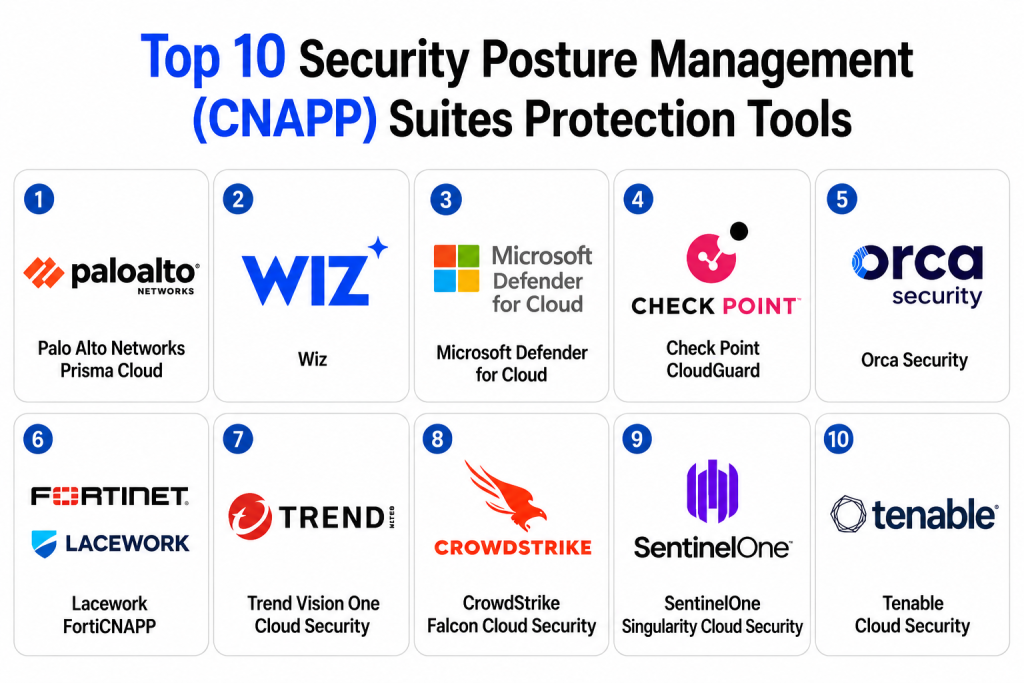
Top 10 Security Posture Management (CNAPP) Suites Protection Tools
1 — Palo Alto Networks Prisma Cloud
Short description
Prisma Cloud is one of the most comprehensive CNAPP platforms available today. It combines CSPM, CWPP, CIEM, container security, IaC security, and runtime protection into a unified platform. Large enterprises frequently adopt Prisma Cloud for securing complex multi-cloud environments. The platform provides extensive visibility into cloud assets, vulnerabilities, identities, and workloads. Its broad cloud coverage makes it suitable for organizations operating across AWS, Azure, Google Cloud, and Kubernetes environments. It is particularly popular among security teams seeking centralized governance and compliance.
Key Features
- Cloud Security Posture Management
- Cloud Workload Protection
- Cloud Infrastructure Entitlement Management
- Kubernetes Security
- Runtime Threat Detection
- Infrastructure as Code Scanning
- Compliance Monitoring
Pros
- Comprehensive CNAPP coverage
- Strong multi-cloud support
- Advanced threat detection capabilities
Cons
- Complex deployment for smaller teams
- Premium pricing
- Learning curve for new users
Platforms / Deployment
- Cloud
- Hybrid
Security & Compliance
- RBAC
- MFA
- SSO/SAML
- Audit Logging
- Encryption
- Compliance frameworks supported
Integrations & Ecosystem
Prisma Cloud integrates with major cloud providers, DevOps pipelines, ticketing platforms, and SIEM solutions.
- AWS
- Azure
- Google Cloud
- Kubernetes
- Jenkins
- ServiceNow
Support & Community
Strong enterprise support offerings, extensive documentation, training resources, and an active customer ecosystem.
2 — Wiz
Short description :
Wiz has rapidly become one of the most recognized CNAPP platforms due to its agentless architecture and simplified user experience. The platform provides cloud visibility, vulnerability management, identity security, compliance monitoring, and risk prioritization. Organizations appreciate Wiz for its quick deployment and ability to generate actionable cloud security insights. It is particularly attractive to fast-growing cloud-native businesses.
Key Features
- Agentless Cloud Security
- CSPM
- CIEM
- Vulnerability Management
- Kubernetes Security
- Risk Graph Analysis
- Compliance Monitoring
Pros
- Rapid deployment
- User-friendly interface
- Strong risk prioritization
Cons
- Advanced customization may require expertise
- Enterprise licensing costs
- Less runtime depth than some competitors
Platforms / Deployment
- Cloud
Security & Compliance
- SSO
- MFA
- RBAC
- Encryption
- Audit Logs
Integrations & Ecosystem
Supports major cloud platforms and DevOps tools.
- AWS
- Azure
- Google Cloud
- GitHub
- Jira
- ServiceNow
Support & Community
Strong customer success programs and growing community adoption.
3 — Microsoft Defender for Cloud
Short description :
Microsoft Defender for Cloud provides CNAPP capabilities tightly integrated with Microsoft’s cloud ecosystem. It offers posture management, workload protection, vulnerability assessment, and compliance reporting. Organizations already invested in Microsoft environments often find Defender for Cloud attractive due to seamless integration and centralized management capabilities. It also supports hybrid and multi-cloud environments.
Key Features
- CSPM
- Workload Protection
- Compliance Monitoring
- Threat Detection
- Container Security
- Security Recommendations
- Hybrid Cloud Security
Pros
- Strong Microsoft ecosystem integration
- Good compliance coverage
- Unified management experience
Cons
- Best experience within Microsoft environments
- Complex licensing structure
- Advanced features may require additional services
Platforms / Deployment
- Cloud
- Hybrid
Security & Compliance
- MFA
- RBAC
- SSO
- Audit Logging
Integrations & Ecosystem
- Azure
- Microsoft Sentinel
- GitHub
- Kubernetes
- Microsoft Security Stack
Support & Community
Extensive documentation and enterprise support.
4 — Check Point CloudGuard
Short description :
CloudGuard delivers cloud security posture management, workload protection, compliance monitoring, and threat prevention. The platform helps organizations secure cloud resources while maintaining visibility across complex environments. Enterprises frequently use CloudGuard to strengthen governance and automate compliance management.
Key Features
- CSPM
- CWPP
- Compliance Management
- Threat Prevention
- Container Security
- IaC Scanning
- Risk Analysis
Pros
- Strong compliance capabilities
- Mature security controls
- Broad cloud coverage
Cons
- User interface can be complex
- Deployment planning required
- Enterprise-focused pricing
Platforms / Deployment
- Cloud
- Hybrid
Security & Compliance
- RBAC
- MFA
- Audit Logs
- Encryption
Integrations & Ecosystem
- AWS
- Azure
- Google Cloud
- Kubernetes
- SIEM Platforms
Support & Community
Strong enterprise support and professional services.
5 — Orca Security
Short description :
Orca Security is known for its agentless cloud security architecture. It provides visibility into assets, vulnerabilities, identities, and cloud risks without deploying agents across workloads. The platform is designed to simplify cloud security operations while delivering comprehensive risk analysis and compliance monitoring.
Key Features
- Agentless Security
- CSPM
- Vulnerability Management
- Compliance Monitoring
- Identity Security
- Asset Discovery
- Risk Prioritization
Pros
- Fast deployment
- Minimal operational overhead
- Comprehensive asset visibility
Cons
- Limited customization in some scenarios
- Enterprise-oriented pricing
- Smaller ecosystem than larger vendors
Platforms / Deployment
- Cloud
Security & Compliance
- RBAC
- SSO
- MFA
- Audit Logging
Integrations & Ecosystem
- AWS
- Azure
- Google Cloud
- ServiceNow
- Jira
Support & Community
Growing customer base and strong vendor support.
6 — Lacework FortiCNAPP
Short description :
Lacework FortiCNAPP combines cloud security posture management, workload protection, threat detection, and behavioral analytics. The platform is widely recognized for its anomaly detection capabilities and contextual security insights across cloud environments.
Key Features
- Behavioral Analytics
- CSPM
- CWPP
- Threat Detection
- Compliance Reporting
- Container Security
- Vulnerability Management
Pros
- Strong behavioral detection
- Comprehensive analytics
- Cloud-native architecture
Cons
- Advanced features require tuning
- Learning curve
- Pricing complexity
Platforms / Deployment
- Cloud
Security & Compliance
- SSO
- RBAC
- MFA
- Encryption
Integrations & Ecosystem
- AWS
- Azure
- Google Cloud
- Kubernetes
- SIEM Tools
Support & Community
Good documentation and enterprise support services.
7 — Trend Vision One Cloud Security
Short description :
Trend Vision One Cloud Security offers a unified cloud protection platform that combines workload security, posture management, compliance monitoring, and threat detection. The solution is designed for organizations seeking centralized visibility across cloud infrastructure and workloads.
Key Features
- CSPM
- CWPP
- Compliance Monitoring
- Container Security
- Threat Intelligence
- Vulnerability Management
- Runtime Protection
Pros
- Unified security platform
- Mature threat intelligence
- Strong cloud coverage
Cons
- Feature-rich interface may overwhelm new users
- Enterprise-focused deployment
- Licensing considerations
Platforms / Deployment
- Cloud
Security & Compliance
- RBAC
- MFA
- SSO
- Audit Logs
Integrations & Ecosystem
- AWS
- Azure
- Google Cloud
- Kubernetes
- DevOps Tools
Support & Community
Global support organization and mature documentation.
8 — CrowdStrike Falcon Cloud Security
Short description :
CrowdStrike Falcon Cloud Security extends the company’s security platform into cloud environments. It combines posture management, workload protection, vulnerability assessment, and threat detection capabilities. Organizations already using CrowdStrike often benefit from platform consolidation.
Key Features
- CSPM
- CWPP
- Threat Intelligence
- Vulnerability Assessment
- Compliance Monitoring
- Runtime Security
- Risk Analysis
Pros
- Unified CrowdStrike ecosystem
- Strong threat intelligence
- Good visibility
Cons
- Premium pricing
- Enterprise-focused
- Advanced deployment planning required
Platforms / Deployment
- Cloud
Security & Compliance
- RBAC
- MFA
- Audit Logs
- Encryption
Integrations & Ecosystem
- AWS
- Azure
- Google Cloud
- Falcon Platform
- SIEM Tools
Support & Community
Strong customer support and enterprise adoption.
9 — SentinelOne Singularity Cloud Security
Short description:
SentinelOne delivers cloud-native security capabilities through its Singularity platform. The solution combines cloud posture management, workload protection, and threat detection with AI-assisted security analytics. It is designed for organizations seeking autonomous security operations.
Key Features
- CSPM
- AI-Assisted Analytics
- Threat Detection
- Vulnerability Management
- Compliance Monitoring
- Workload Protection
- Risk Prioritization
Pros
- Strong automation capabilities
- AI-driven insights
- Unified platform approach
Cons
- Newer CNAPP offering than some competitors
- Enterprise pricing
- Feature depth varies by deployment
Platforms / Deployment
- Cloud
Security & Compliance
- SSO
- MFA
- RBAC
- Audit Logging
Integrations & Ecosystem
- AWS
- Azure
- Google Cloud
- DevOps Platforms
- Security Tools
Support & Community
Growing ecosystem and enterprise support programs.
10 — Tenable Cloud Security
Short description :
Tenable Cloud Security provides posture management, exposure management, compliance monitoring, and cloud asset visibility. Organizations frequently use it to improve risk management and maintain compliance across cloud environments. The platform leverages Tenable’s extensive security expertise.
Key Features
- CSPM
- Exposure Management
- Compliance Reporting
- Asset Discovery
- Vulnerability Management
- Risk Prioritization
- Multi-Cloud Visibility
Pros
- Strong exposure management
- Good compliance support
- Established security vendor
Cons
- Enterprise-focused pricing
- Feature depth varies across modules
- Learning curve for advanced functions
Platforms / Deployment
- Cloud
Security & Compliance
- RBAC
- MFA
- SSO
- Audit Logs
Integrations & Ecosystem
- AWS
- Azure
- Google Cloud
- Ticketing Platforms
- SIEM Solutions
Support & Community
Comprehensive documentation and enterprise-grade support.
Comparison Table (Top 10)
| Tool Name | Best For | Platform(s) Supported | Deployment | Standout Feature | Public Rating |
|---|---|---|---|---|---|
| Prisma Cloud | Large Enterprises | Multi-Cloud | Cloud/Hybrid | Full CNAPP Coverage | N/A |
| Wiz | Cloud-Native Teams | Multi-Cloud | Cloud | Agentless Security | N/A |
| Microsoft Defender for Cloud | Microsoft Customers | Multi-Cloud | Cloud/Hybrid | Azure Integration | N/A |
| CloudGuard | Compliance-Focused Enterprises | Multi-Cloud | Cloud/Hybrid | Governance Controls | N/A |
| Orca Security | Fast Deployment | Multi-Cloud | Cloud | Agentless Visibility | N/A |
| Lacework FortiCNAPP | Threat Analytics | Multi-Cloud | Cloud | Behavioral Analytics | N/A |
| Trend Vision One | Unified Security | Multi-Cloud | Cloud | Threat Intelligence | N/A |
| Falcon Cloud Security | CrowdStrike Users | Multi-Cloud | Cloud | Threat Intelligence | N/A |
| SentinelOne Singularity | AI Security Operations | Multi-Cloud | Cloud | Autonomous Analytics | N/A |
| Tenable Cloud Security | Exposure Management | Multi-Cloud | Cloud | Risk Prioritization | N/A |
Evaluation & Scoring of Security Posture Management (CNAPP) Suites
| Tool | Core | Ease | Integrations | Security | Performance | Support | Value | Weighted Total |
|---|---|---|---|---|---|---|---|---|
| Prisma Cloud | 10 | 8 | 10 | 10 | 9 | 9 | 7 | 9.00 |
| Wiz | 9 | 10 | 9 | 9 | 9 | 9 | 8 | 9.00 |
| Defender for Cloud | 9 | 8 | 9 | 9 | 9 | 9 | 8 | 8.75 |
| CloudGuard | 9 | 7 | 8 | 9 | 8 | 8 | 7 | 8.10 |
| Orca Security | 8 | 9 | 8 | 8 | 9 | 8 | 8 | 8.30 |
| Lacework FortiCNAPP | 8 | 8 | 8 | 8 | 8 | 8 | 7 | 7.95 |
| Trend Vision One | 8 | 8 | 8 | 8 | 8 | 8 | 8 | 8.00 |
| Falcon Cloud Security | 8 | 8 | 8 | 9 | 9 | 8 | 7 | 8.10 |
| SentinelOne | 8 | 8 | 8 | 8 | 8 | 8 | 8 | 8.00 |
| Tenable Cloud Security | 8 | 8 | 8 | 8 | 8 | 8 | 8 | 8.00 |
These scores are comparative rather than absolute measurements. Organizations should prioritize criteria based on their business needs. Enterprise buyers may value security depth and integrations more heavily, while smaller teams may prioritize ease of use and operational efficiency. Running proof-of-concept evaluations remains the most reliable way to validate platform fit.
Which Security Posture Management (CNAPP) Tool Is Right for You?
Solo / Freelancer
Most solo users do not require a full CNAPP platform. Lightweight cloud security tools or cloud-native provider services are usually more cost-effective.
SMB
Wiz and Orca Security are attractive options for SMBs due to rapid deployment and simplified operations. Their agentless approaches reduce management overhead.
Mid-Market
Microsoft Defender for Cloud, Trend Vision One, and SentinelOne provide a balance between security depth and operational simplicity.
Enterprise
Prisma Cloud, CloudGuard, CrowdStrike Falcon Cloud Security, and Lacework FortiCNAPP are strong choices for large organizations with complex cloud environments.
Budget vs Premium
- Budget-conscious organizations should evaluate Microsoft Defender for Cloud.
- Premium buyers seeking maximum coverage should consider Prisma Cloud or Wiz.
Feature Depth vs Ease of Use
- Feature Depth: Prisma Cloud, CloudGuard
- Ease of Use: Wiz, Orca Security
Integrations & Scalability
- Highest scalability: Prisma Cloud
- Strong ecosystem support: Microsoft Defender for Cloud
- Developer-friendly integration model: Wiz
Security & Compliance Needs
Organizations with strict compliance requirements should prioritize Prisma Cloud, Defender for Cloud, and CloudGuard due to their extensive governance capabilities.
Frequently Asked Questions (FAQs)
1. What is a CNAPP platform?
A CNAPP platform combines multiple cloud security capabilities into a unified solution. It helps organizations secure cloud infrastructure, workloads, identities, containers, and applications while simplifying security operations.
2. Why are CNAPP solutions becoming popular?
Cloud environments have become increasingly complex. CNAPP platforms reduce tool sprawl by providing posture management, threat detection, vulnerability management, and compliance capabilities within a single platform.
3. How long does implementation typically take?
Implementation timelines vary. Agentless platforms may be operational within days, while enterprise-wide deployments with extensive integrations can require several weeks or months.
4. Are CNAPP tools only for large enterprises?
No. Many modern CNAPP vendors offer solutions suitable for SMBs and mid-sized organizations. However, feature requirements and pricing should be evaluated carefully.
5. What is the difference between CSPM and CNAPP?
CSPM focuses primarily on cloud posture management and configuration monitoring. CNAPP expands coverage to include workload protection, identity security, vulnerability management, and runtime protection.
6. Can CNAPP platforms support multi-cloud environments?
Yes. Most leading CNAPP solutions support AWS, Microsoft Azure, and Google Cloud environments simultaneously, allowing centralized visibility and governance.
7. Do CNAPP platforms help with compliance?
Yes. Most CNAPP solutions provide compliance dashboards, policy checks, reporting, and continuous monitoring against various regulatory and industry frameworks.
8. What are common mistakes when selecting a CNAPP platform?
Common mistakes include focusing only on feature lists, ignoring integration requirements, underestimating operational complexity, and failing to validate deployment models.
9. How important is runtime protection?
Runtime protection helps detect and respond to active threats after deployment. Organizations with high-security requirements often consider runtime protection a critical capability.
10. Should organizations replace existing security tools with CNAPP?
Not necessarily. Many organizations initially deploy CNAPP alongside existing tools. Over time, some consolidate platforms as confidence in CNAPP capabilities increases.
Conclusion
Security Posture Management and CNAPP platforms have become essential for securing modern cloud environments. The leading vendors now provide capabilities that extend beyond posture management into workload protection, identity security, vulnerability management, compliance monitoring, and runtime defense. Prisma Cloud and Wiz remain strong leaders for comprehensive cloud security coverage, while Microsoft Defender for Cloud offers compelling value for Microsoft-centric organizations. Orca Security and SentinelOne provide modern approaches focused on simplicity and automation. Ultimately, the best CNAPP solution depends on your cloud architecture, compliance requirements, security maturity, operational resources, and budget. Before making a final decision, shortlist two or three platforms, conduct a proof-of-concept deployment, validate integrations with your existing security stack, and confirm that the solution aligns with your long-term cloud security strategy.
Introduction
CSaaS Management Platforms, commonly understood as Cybersecurity-as-a-Service management platforms, help organizations outsource, centralize, and operationalize cybersecurity functions through managed platforms, expert teams, automation, and continuous monitoring. Instead of building a full in-house security operations center, businesses can use CSaaS platforms for threat detection, incident response, vulnerability management, cloud monitoring, endpoint protection, compliance support, and security reporting.
These platforms matter more now because cyber threats are becoming faster, more automated, and more targeted. Many organizations do not have enough internal security analysts, tools, or budget to manage security operations around the clock. CSaaS platforms help close that gap with managed detection and response, security analytics, threat intelligence, and expert support.
Common real-world use cases include:
- Managed detection and response
- Endpoint and cloud threat monitoring
- Incident investigation and response
- Compliance readiness and reporting
- Security operations outsourcing
Buyers should evaluate:
- Threat detection quality
- Incident response support
- Endpoint and cloud coverage
- SIEM and XDR capabilities
- Integration ecosystem
- Reporting and dashboards
- Compliance support
- Pricing transparency
- Onboarding complexity
- Analyst expertise
Best for: IT leaders, CISOs, security teams, SMBs, mid-market companies, enterprises, healthcare, finance, SaaS, retail, education, and organizations that need stronger cybersecurity without building a large internal SOC.
Not ideal for: Very small businesses with minimal digital assets, companies needing only basic antivirus, or organizations with mature internal SOC teams that prefer fully self-managed security operations.
Key Trends in CSaaS Management Platforms Protection Tools for 2026 and Beyond
- AI-assisted security operations are helping analysts investigate alerts faster and reduce repetitive manual work.
- Managed XDR adoption is increasing as organizations want endpoint, identity, email, cloud, and network visibility in one service.
- Cloud and SaaS security coverage is becoming essential as businesses rely more on cloud workloads and collaboration tools.
- Outcome-based pricing models are gaining attention because buyers want measurable security value, not just tool access.
- Compliance-driven security services are growing for industries that need audit evidence, reporting, and continuous monitoring.
- Identity threat detection is becoming more important as attackers target user accounts, privileges, and access tokens.
- Automation and playbooks are improving response speed for phishing, ransomware, endpoint compromise, and suspicious login activity.
- Hybrid security operations are becoming common, where internal teams keep strategic control while CSaaS providers handle monitoring and response.
- Security consolidation is increasing as companies reduce tool sprawl and prefer fewer, more integrated platforms.
- Executive-level reporting is becoming a key buying factor because leadership wants clear risk visibility, not only technical alerts.
How We Selected These Tools Methodology
The following tools were selected using a practical product analysis approach:
- Strong market recognition in managed cybersecurity, MDR, XDR, or security operations.
- Breadth of cybersecurity service coverage across endpoint, cloud, identity, network, and threat response.
- Ability to support SMB, mid-market, and enterprise security requirements.
- Evidence of mature security operations, analyst-led investigation, and response workflows.
- Integration capability with existing security tools, cloud platforms, and IT systems.
- Strength of dashboards, reporting, alert prioritization, and executive visibility.
- Practical fit for organizations that need managed cybersecurity expertise.
- Balance between premium enterprise platforms and scalable managed security options.
Top 10 CSaaS Management Platforms Protection Tools
#1 — Arctic Wolf
Short description
(6-8 lines): Arctic Wolf is a widely recognized cybersecurity operations platform focused on managed detection and response, managed risk, cloud monitoring, and security awareness. It is designed for organizations that want expert-led security operations without building a full internal SOC. The platform combines human security expertise, telemetry analysis, threat detection, and guided remediation. Arctic Wolf is often suitable for mid-market and enterprise buyers that need continuous monitoring and security improvement. Its concierge-style model helps customers understand risks and prioritize actions. It is especially useful for teams that need operational security support, not just another dashboard.
Key Features
- Managed detection and response
- Managed risk assessment
- Cloud security monitoring
- Security awareness support
- Threat hunting and investigation
- Incident response guidance
- Executive and technical reporting
Pros
- Strong managed security operations model
- Good fit for organizations with limited internal SOC resources
- Practical guidance beyond simple alerting
Cons
- May be more than very small businesses need
- Pricing can vary by environment and scope
- Less suitable for teams wanting fully self-managed tooling
Platforms / Deployment
- Cloud
- Hybrid
Security & Compliance
- SSO/SAML
- RBAC
- Encryption
- Audit logs
- Compliance support varies by service scope
Integrations & Ecosystem
Arctic Wolf integrates with common endpoint, network, identity, firewall, cloud, and productivity platforms to collect telemetry and support managed investigation.
- Microsoft security tools
- Endpoint security platforms
- Firewalls and network devices
- Cloud environments
- Identity providers
- SIEM and log sources
Support & Community
Arctic Wolf is known for guided onboarding, customer-facing security experts, and managed support. Documentation, service delivery, and analyst interaction are important parts of the customer experience.
#2 — CrowdStrike Falcon Complete
Short description
(6-8 lines): CrowdStrike Falcon Complete is a managed detection and response service built around the Falcon platform. It provides expert-led monitoring, endpoint detection, threat hunting, and response support. The solution is useful for organizations that want advanced endpoint and workload security with managed expertise. It is especially strong for teams already using CrowdStrike or those prioritizing endpoint-centric threat detection. Falcon Complete helps reduce alert fatigue by combining platform intelligence with expert analysts. It is a premium option for businesses that need rapid detection and response.
Key Features
- Managed endpoint detection and response
- Threat hunting
- Incident response support
- Malware and ransomware detection
- Cloud workload visibility
- Falcon platform integration
- Expert-led remediation guidance
Pros
- Strong endpoint and threat intelligence capabilities
- Good fit for enterprise-grade managed protection
- Useful for reducing internal analyst workload
Cons
- Premium pricing may not suit all SMBs
- Best value often comes within the Falcon ecosystem
- Some organizations may need additional tools for broader governance
Platforms / Deployment
- Cloud
- Windows
- macOS
- Linux
Security & Compliance
- SSO/SAML
- MFA
- RBAC
- Encryption
- Audit logs
- Compliance details vary by service and subscription
Integrations & Ecosystem
Falcon Complete works closely with the CrowdStrike ecosystem and can connect with security operations, ticketing, cloud, and identity tools.
- CrowdStrike Falcon modules
- SIEM platforms
- SOAR tools
- Cloud platforms
- Identity systems
- IT service management tools
Support & Community
CrowdStrike provides enterprise support, documentation, onboarding resources, and access to managed security expertise. Community and ecosystem strength are strong due to broad adoption.
#3 — Sophos MDR
Short description
(6-8 lines): Sophos MDR is a managed detection and response service designed for organizations that want continuous threat monitoring and expert response. It works well for SMBs and mid-market companies that need practical security coverage without complex SOC operations. Sophos MDR combines endpoint security, threat intelligence, human analysis, and response actions. It can be used by organizations with limited security teams or those looking to extend existing IT capabilities. The platform is known for being approachable and operationally practical. It is a strong option for buyers seeking managed protection with clear service delivery.
Key Features
- Managed threat detection
- Endpoint protection integration
- Threat hunting
- Incident response support
- Cloud and identity visibility options
- Analyst-led investigation
- Security reporting
Pros
- Good fit for SMB and mid-market organizations
- Practical managed service model
- Easier to adopt than many enterprise-heavy platforms
Cons
- Advanced enterprise customization may be limited
- Best fit often depends on Sophos ecosystem usage
- Deep integrations may vary by environment
Platforms / Deployment
- Cloud
- Windows
- macOS
- Linux
- Mobile support varies by product scope
Security & Compliance
- MFA
- RBAC
- Encryption
- Audit logs
- Compliance support varies by service plan
Integrations & Ecosystem
Sophos MDR integrates strongly with Sophos security products and can work with selected third-party telemetry sources depending on the service model.
- Sophos Endpoint
- Sophos Firewall
- Microsoft environments
- Cloud security tools
- Email security sources
- Third-party security telemetry
Support & Community
Sophos offers strong documentation, partner support, onboarding resources, and managed analyst services. Its partner ecosystem is helpful for SMB adoption.
#4 — Expel
Short description
(6-8 lines): Expel is a managed detection and response provider focused on transparent security operations and practical analyst workflows. It helps organizations monitor security alerts, investigate threats, and respond faster across multiple tools. Expel is useful for teams that already have several security tools but need expert monitoring and operational support. The platform emphasizes visibility into what analysts are doing and why certain alerts matter. It is well suited for mid-market and enterprise teams seeking managed SOC support. Expel can help reduce noise and improve security response consistency.
Key Features
- Managed detection and response
- Cloud security monitoring
- SaaS and identity monitoring
- Alert triage and investigation
- Analyst transparency
- Threat hunting
- Reporting and recommendations
Pros
- Strong operational transparency
- Good fit for multi-tool environments
- Helpful for reducing alert fatigue
Cons
- May require existing security tool investments
- Not always the simplest choice for very small teams
- Pricing depends on environment complexity
Platforms / Deployment
- Cloud
- Hybrid
Security & Compliance
- SSO/SAML
- MFA
- RBAC
- Encryption
- Audit logs
- Compliance support varies by service scope
Integrations & Ecosystem
Expel is designed to work with many existing security tools and cloud services, making it suitable for organizations that do not want to replace their entire stack.
- SIEM tools
- Endpoint platforms
- Cloud platforms
- Identity providers
- SaaS applications
- Ticketing systems
Support & Community
Expel provides analyst-led support, onboarding assistance, and customer-facing security operations visibility. Documentation and service guidance are typically part of implementation.
#5 — Red Canary
Short description
(6-8 lines): Red Canary is a managed detection and response platform known for threat detection, investigation, and response support. It helps organizations identify suspicious behavior across endpoints, cloud workloads, identities, and other telemetry sources. Red Canary is useful for teams that need high-quality threat detection with expert analysis. The platform focuses on reducing false positives and helping customers understand real threats. It is a strong fit for mid-market and enterprise security teams that want reliable managed security operations. Red Canary also provides useful educational content and security research.
Key Features
- Managed detection and response
- Threat hunting
- Endpoint and cloud telemetry analysis
- Identity threat visibility
- Alert investigation
- Response recommendations
- Security reporting
Pros
- Strong detection engineering focus
- Practical investigation and response workflows
- Helpful for teams seeking reliable MDR support
Cons
- May require integration planning
- Pricing depends on data sources and scope
- Not a basic entry-level security tool
Platforms / Deployment
- Cloud
- Hybrid
Security & Compliance
- SSO/SAML
- MFA
- RBAC
- Encryption
- Audit logs
- Compliance support varies by subscription
Integrations & Ecosystem
Red Canary integrates with endpoint, cloud, identity, and security analytics platforms to provide managed detection and response.
- Endpoint detection tools
- Cloud platforms
- Identity providers
- SIEM platforms
- Security data sources
- Ticketing workflows
Support & Community
Red Canary offers strong documentation, onboarding assistance, analyst access, and security research resources. Its community reputation is strong among security practitioners.
#6 — Rapid7 MDR
Short description
(6-8 lines): Rapid7 MDR provides managed detection and response services supported by Rapid7’s security analytics and vulnerability management ecosystem. It is useful for organizations that want a managed team to monitor, investigate, and respond to threats. Rapid7 MDR can be especially valuable for companies already using Rapid7 products for vulnerability management or detection. The platform helps security teams prioritize risks and respond to suspicious activity. It supports a broad security operations approach across detection, investigation, and reporting. Rapid7 MDR is suitable for mid-market and enterprise buyers.
Key Features
- Managed detection and response
- Threat hunting
- Security analytics
- Vulnerability context
- Incident validation
- Response recommendations
- Reporting and dashboards
Pros
- Strong connection to vulnerability and exposure data
- Good managed security operations support
- Useful for organizations using Rapid7 ecosystem
Cons
- Best fit may depend on existing Rapid7 adoption
- Some advanced workflows require configuration
- Pricing varies by service scope
Platforms / Deployment
- Cloud
- Hybrid
Security & Compliance
- SSO/SAML
- MFA
- RBAC
- Encryption
- Audit logs
- Compliance support varies by plan
Integrations & Ecosystem
Rapid7 MDR connects with cloud, endpoint, network, identity, and vulnerability data sources to support managed investigations.
- Rapid7 Insight platform
- Cloud platforms
- Endpoint tools
- SIEM sources
- Vulnerability management tools
- IT service management systems
Support & Community
Rapid7 provides documentation, customer support, onboarding services, and security research. Its broader security community and educational resources are useful for practitioners.
#7 — eSentire MDR
Short description
(6-8 lines): eSentire MDR provides managed detection and response services for organizations that need continuous security monitoring, investigation, and response. The platform supports endpoint, network, cloud, identity, and log-based detection use cases. eSentire is often used by mid-market and enterprise organizations that need managed SOC capabilities. The service combines human analysts, threat intelligence, and security technology to identify and respond to threats. It is useful for companies that need stronger protection against ransomware, credential attacks, and advanced threats. eSentire can also support compliance-focused security operations.
Key Features
- Managed detection and response
- Endpoint and network monitoring
- Cloud and identity visibility
- Threat intelligence
- Incident response support
- Security analytics
- Reporting and investigation workflows
Pros
- Strong managed SOC model
- Broad detection coverage
- Useful for regulated industries
Cons
- Service scope should be reviewed carefully
- May be too advanced for very small businesses
- Integration effort can vary by environment
Platforms / Deployment
- Cloud
- Hybrid
Security & Compliance
- SSO/SAML
- MFA
- RBAC
- Encryption
- Audit logs
- Compliance support varies by customer requirements
Integrations & Ecosystem
eSentire supports telemetry collection across security, cloud, identity, and network environments to enable managed monitoring.
- Endpoint security platforms
- Cloud platforms
- Network security tools
- Identity providers
- SIEM and log sources
- Ticketing systems
Support & Community
eSentire provides managed analyst support, onboarding, incident guidance, and service delivery resources. Support strength depends on selected service level.
#8 — Secureworks Taegis ManagedXDR
Short description
(6-8 lines): Secureworks Taegis ManagedXDR combines managed detection and response with the Taegis security analytics platform. It helps organizations detect threats, investigate security events, and respond with expert assistance. Secureworks has a long background in managed security services, making it relevant for organizations seeking mature security operations. The platform supports visibility across endpoints, networks, cloud services, and identity sources. It is suitable for mid-market and enterprise security teams that need managed XDR capabilities. Taegis ManagedXDR is especially useful for organizations wanting a combination of technology and security expertise.
Key Features
- Managed XDR
- Threat detection and investigation
- Security analytics
- Threat intelligence
- Cloud and endpoint visibility
- Response guidance
- Reporting and dashboards
Pros
- Mature managed security background
- Good fit for enterprise security operations
- Strong analytics-driven approach
Cons
- May require careful onboarding
- Pricing varies by environment size
- Some smaller businesses may find it too advanced
Platforms / Deployment
- Cloud
- Hybrid
Security & Compliance
- SSO/SAML
- MFA
- RBAC
- Encryption
- Audit logs
- Compliance support varies by contract and scope
Integrations & Ecosystem
Secureworks Taegis connects with multiple telemetry sources to support managed XDR and threat investigation.
- Endpoint tools
- Network security tools
- Cloud platforms
- Identity systems
- SIEM sources
- IT ticketing systems
Support & Community
Secureworks provides enterprise support, onboarding, managed analyst services, and security advisory resources. Its experience in managed security is a strong support factor.
#9 — Trustwave SpiderLabs MDR
Short description
(6-8 lines): Trustwave SpiderLabs MDR provides managed detection and response services backed by security research and threat intelligence. It helps organizations monitor threats, investigate alerts, and respond to security incidents. The service is useful for businesses that need managed security expertise and compliance-aware operations. Trustwave’s SpiderLabs research background supports threat analysis and security insight. The platform can fit organizations across regulated industries, retail, finance, and mid-market businesses. It is a practical choice for teams that need a managed security partner rather than only software tooling.
Key Features
- Managed detection and response
- Threat intelligence
- Security monitoring
- Incident investigation
- Vulnerability and risk context
- Compliance support
- Security reporting
Pros
- Strong security research background
- Useful for compliance-sensitive organizations
- Managed service approach reduces internal workload
Cons
- Service experience may vary by selected package
- Advanced integrations require planning
- May not be ideal for teams wanting fully self-managed workflows
Platforms / Deployment
- Cloud
- Hybrid
Security & Compliance
- SSO/SAML
- MFA
- RBAC
- Encryption
- Audit logs
- Compliance support varies by service scope
Integrations & Ecosystem
Trustwave MDR can connect with security, network, endpoint, and cloud tools to improve visibility and managed response.
- Endpoint platforms
- Network devices
- Cloud services
- SIEM platforms
- Vulnerability tools
- Ticketing systems
Support & Community
Trustwave offers managed support, advisory services, documentation, and security expertise through SpiderLabs. Support details vary by customer plan.
#10 — Alert Logic MDR
Short description
(6-8 lines): Alert Logic MDR is a managed detection and response service focused on helping organizations detect threats across cloud, hybrid, and on-premises environments. It is commonly considered by businesses that want managed security monitoring without building a full SOC. The platform supports log analysis, threat detection, vulnerability visibility, and expert investigation. Alert Logic is useful for organizations with cloud infrastructure, web applications, and compliance requirements. It helps security and IT teams prioritize threats and respond more effectively. The service is often a practical option for mid-sized organizations needing managed security coverage.
Key Features
- Managed detection and response
- Log-based threat detection
- Vulnerability visibility
- Cloud and hybrid environment monitoring
- Incident investigation
- Compliance-oriented reporting
- Web application security visibility
Pros
- Good fit for cloud and hybrid environments
- Useful managed security model
- Practical reporting for security teams
Cons
- Advanced capabilities depend on service scope
- May require tuning for noisy environments
- Not always ideal for highly customized enterprise SOCs
Platforms / Deployment
- Cloud
- Hybrid
Security & Compliance
- SSO/SAML
- MFA
- RBAC
- Encryption
- Audit logs
- Compliance support varies by service package
Integrations & Ecosystem
Alert Logic MDR supports integrations with cloud platforms, logs, security devices, and application environments.
- AWS
- Azure
- Google Cloud
- Network security tools
- Log sources
- Web application environments
Support & Community
Alert Logic provides onboarding, managed analyst services, documentation, and support resources. Support depth depends on service agreement and deployment requirements.
Comparison Table Top 10
| Tool Name | Best For | Platform(s) Supported | Deployment | Standout Feature | Public Rating |
|---|---|---|---|---|---|
| Arctic Wolf | Mid-market and enterprise security operations | Web / Cloud environments | Cloud / Hybrid | Concierge-style security operations | N/A |
| CrowdStrike Falcon Complete | Endpoint-focused managed security | Windows / macOS / Linux / Cloud | Cloud | Managed Falcon endpoint protection | N/A |
| Sophos MDR | SMB and mid-market managed security | Windows / macOS / Linux / Cloud | Cloud | Practical MDR for lean teams | N/A |
| Expel | Multi-tool security operations | Web / Cloud environments | Cloud / Hybrid | Transparent MDR workflows | N/A |
| Red Canary | High-quality threat detection | Web / Cloud environments | Cloud / Hybrid | Detection engineering focus | N/A |
| Rapid7 MDR | Managed detection with vulnerability context | Web / Cloud environments | Cloud / Hybrid | Insight platform ecosystem | N/A |
| eSentire MDR | Managed SOC and response | Web / Cloud environments | Cloud / Hybrid | Broad MDR coverage | N/A |
| Secureworks Taegis ManagedXDR | Enterprise managed XDR | Web / Cloud environments | Cloud / Hybrid | Taegis security analytics | N/A |
| Trustwave SpiderLabs MDR | Research-backed managed security | Web / Cloud environments | Cloud / Hybrid | SpiderLabs threat intelligence | N/A |
| Alert Logic MDR | Cloud and hybrid threat detection | Web / Cloud environments | Cloud / Hybrid | Cloud-focused MDR | N/A |
Evaluation & Scoring of CSaaS Management Platforms
| Tool Name | Core (25%) | Ease (15%) | Integrations (15%) | Security (10%) | Performance (10%) | Support (10%) | Value (15%) | Weighted Total (0–10) |
| Arctic Wolf | 9 | 8 | 8 | 9 | 8 | 9 | 8 | 8.45 |
| CrowdStrike Falcon Complete | 9 | 8 | 9 | 9 | 9 | 9 | 7 | 8.60 |
| Sophos MDR | 8 | 9 | 8 | 8 | 8 | 8 | 9 | 8.30 |
| Expel | 8 | 8 | 9 | 8 | 8 | 9 | 8 | 8.30 |
| Red Canary | 9 | 8 | 8 | 9 | 8 | 9 | 8 | 8.50 |
| Rapid7 MDR | 8 | 8 | 8 | 8 | 8 | 8 | 8 | 8.00 |
| eSentire MDR | 8 | 8 | 8 | 9 | 8 | 8 | 8 | 8.10 |
| Secureworks Taegis ManagedXDR | 9 | 7 | 8 | 9 | 8 | 8 | 7 | 8.10 |
| Trustwave SpiderLabs MDR | 8 | 8 | 7 | 8 | 8 | 8 | 8 | 7.85 |
| Alert Logic MDR | 8 | 8 | 7 | 8 | 8 | 8 | 8 | 7.85 |
These scores are comparative and should be used as a starting point, not as final buying advice. A higher score means the platform appears stronger across the listed evaluation categories, but the best choice depends on your environment, budget, team size, and security maturity. Buyers should validate integrations, reporting, response expectations, and service-level terms before making a decision.
Which CSaaS Management Platform Tool Is Right for You?
Solo / Freelancer
Solo users and freelancers usually do not need a full CSaaS management platform unless they manage sensitive client systems, cloud infrastructure, or regulated data. Basic endpoint protection, password management, secure backups, and cloud-native security settings may be enough. If managed security is required, a lightweight MDR service or managed IT security provider may be more practical than a premium enterprise platform.
SMB
SMBs should prioritize ease of use, guided support, clear pricing, and practical response capabilities. Sophos MDR, Arctic Wolf, and Alert Logic MDR can be suitable options depending on budget and environment. SMBs should avoid buying overly complex platforms if they do not have internal staff to manage integrations, reports, and response workflows.
Mid-Market
Mid-market organizations often need stronger detection, broader integrations, and better reporting. Arctic Wolf, Red Canary, Rapid7 MDR, Expel, and eSentire MDR are strong fits for this segment. These platforms can help security teams improve visibility, reduce alert fatigue, and create more consistent incident response workflows.
Enterprise
Enterprises usually need advanced integrations, scalable telemetry handling, compliance reporting, and strong analyst support. CrowdStrike Falcon Complete, Secureworks Taegis ManagedXDR, Red Canary, Expel, and Arctic Wolf are strong enterprise options. Enterprises should focus on response SLAs, integration flexibility, data retention, governance controls, and global support coverage.
Budget vs Premium
Budget-conscious buyers should focus on platforms that provide practical MDR coverage without unnecessary complexity. Sophos MDR and Alert Logic MDR may be attractive depending on requirements. Premium buyers needing stronger threat intelligence, advanced response, and broader ecosystem coverage may prefer CrowdStrike Falcon Complete, Red Canary, Expel, or Secureworks Taegis ManagedXDR.
Feature Depth vs Ease of Use
For feature depth, CrowdStrike Falcon Complete, Secureworks Taegis ManagedXDR, Red Canary, and Arctic Wolf stand out. For ease of adoption, Sophos MDR, Alert Logic MDR, and Arctic Wolf may be easier for lean teams. The right balance depends on whether your organization needs deep customization or simple operational support.
Integrations & Scalability
Organizations with many existing security tools should prioritize Expel, Red Canary, CrowdStrike, Rapid7, and Secureworks because integration flexibility matters. Companies with simpler environments may not need broad integrations immediately, but should still choose a platform that can scale as cloud, identity, endpoint, and SaaS usage grows.
Security & Compliance Needs
Regulated industries should evaluate audit logs, role-based access, reporting, incident documentation, retention policies, and compliance mapping. Arctic Wolf, Secureworks, Trustwave, eSentire, and Rapid7 can be relevant for compliance-oriented buyers. However, buyers should always verify exact compliance support for their specific industry and contract.
Frequently Asked Questions FAQs
1. What is a CSaaS Management Platform?
A CSaaS Management Platform helps organizations manage cybersecurity through a service-based model. It usually combines security technology, expert analysts, monitoring, threat detection, reporting, and response support.
2. Is CSaaS the same as MDR?
Not exactly. MDR is often a major part of CSaaS, but CSaaS can be broader. It may include risk management, compliance support, cloud monitoring, vulnerability management, security awareness, and advisory services.
3. How much do CSaaS platforms cost?
Pricing varies based on users, endpoints, cloud assets, log volume, service scope, and response requirements. Most vendors provide custom pricing, so buyers should request quotes based on their actual environment.
4. How long does onboarding take?
Onboarding can take from a few days to several weeks depending on the number of tools, endpoints, cloud accounts, identity systems, and log sources involved. Complex enterprise environments usually require more planning.
5. What are common mistakes when buying CSaaS platforms?
Common mistakes include focusing only on price, ignoring integration needs, not defining response expectations, and failing to clarify what the vendor will handle versus what the internal team must handle.
6. Are CSaaS platforms secure?
Reputable platforms generally include access controls, encryption, monitoring, audit logs, and secure operational practices. Buyers should verify security controls, compliance claims, data handling, and contractual responsibilities before purchase.
7. Can CSaaS platforms scale with business growth?
Yes, most leading platforms are designed to scale across users, endpoints, cloud accounts, and data sources. However, pricing and service scope may change as the environment grows.
8. Do these platforms integrate with existing tools?
Most CSaaS platforms integrate with endpoint tools, cloud platforms, identity providers, SIEM tools, firewalls, email security, and ticketing systems. Integration depth varies by vendor and plan.
9. Can a company switch from one CSaaS provider to another?
Yes, but switching requires planning. Organizations should export reports, document integrations, review data retention, map response workflows, and coordinate transition timelines to avoid monitoring gaps.
10. What are alternatives to CSaaS platforms?
Alternatives include building an internal SOC, using standalone SIEM or XDR tools, hiring MSSPs, adopting cloud-native security tools, or combining endpoint protection with internal monitoring. The right choice depends on budget, staffing, and risk level.
Conclusion
CSaaS Management Platforms help organizations strengthen cybersecurity without carrying the full cost and complexity of building a complete in-house security operations center. The best platform depends on company size, existing tools, cloud maturity, compliance needs, response expectations, and available budget. Arctic Wolf is strong for guided security operations, CrowdStrike Falcon Complete is powerful for endpoint-led managed protection, Sophos MDR is practical for SMBs and mid-market buyers, while Expel, Red Canary, Secureworks, and eSentire are strong choices for organizations needing deeper managed detection and response. Before selecting a platform, shortlist two or three vendors, run a pilot with real telemetry, validate integrations, review security and compliance controls, and confirm exactly how incident response responsibilities are shared between your team and the provider.
