Introduction
Customer Consent & Preferences Centers are platforms that allow organizations to collect, manage, store, and honor customer consent choices regarding communications, data usage, privacy preferences, cookies, and marketing permissions. These solutions help businesses provide transparency and control while maintaining compliance with privacy regulations.
As privacy regulations continue to expand globally and consumers become more aware of how their data is collected and used, organizations need centralized systems to manage consent across websites, mobile applications, email campaigns, customer portals, and digital experiences. Modern consent management platforms now extend beyond compliance and have become critical components of customer trust and digital experience strategies.
Real-world use cases include:
- Managing email marketing opt-ins and opt-outs.
- Cookie consent management across websites.
- Customer communication preferences management.
- Data privacy request handling.
- Multi-channel consent synchronization.
What buyers should evaluate:
- Consent capture capabilities.
- Regulatory compliance support.
- Preference center customization.
- Integration ecosystem.
- Audit trail capabilities.
- Identity resolution support.
- Scalability across channels.
- Reporting and analytics.
- Security controls.
- Global deployment capabilities.
Best for: Marketing teams, privacy officers, compliance teams, customer experience leaders, healthcare organizations, financial services companies, SaaS businesses, retailers, and enterprises managing large customer databases.
Not ideal for: Organizations with limited customer data collection requirements, small businesses operating exclusively offline, or companies with minimal regulatory exposure.
Key Trends in Customer Consent & Preferences Centers
- AI-powered consent recommendation engines.
- Unified preference centers across all customer touchpoints.
- Growing adoption of zero-party data strategies.
- Real-time consent synchronization across platforms.
- Increased focus on first-party data collection.
- Privacy-by-design implementations in customer journeys.
- Automated regulatory compliance monitoring.
- Integration with customer data platforms and identity systems.
- Granular consent controls for AI and data-sharing use cases.
- Expansion of consent management beyond cookies into broader data governance.
How We Selected These Tools
The tools in this list were evaluated using the following criteria:
- Market adoption and enterprise presence.
- Consent and preference management capabilities.
- Regulatory compliance support.
- Ease of implementation and administration.
- Integration ecosystem strength.
- Reporting and audit functionality.
- Security and governance controls.
- Suitability for organizations of different sizes and industries.
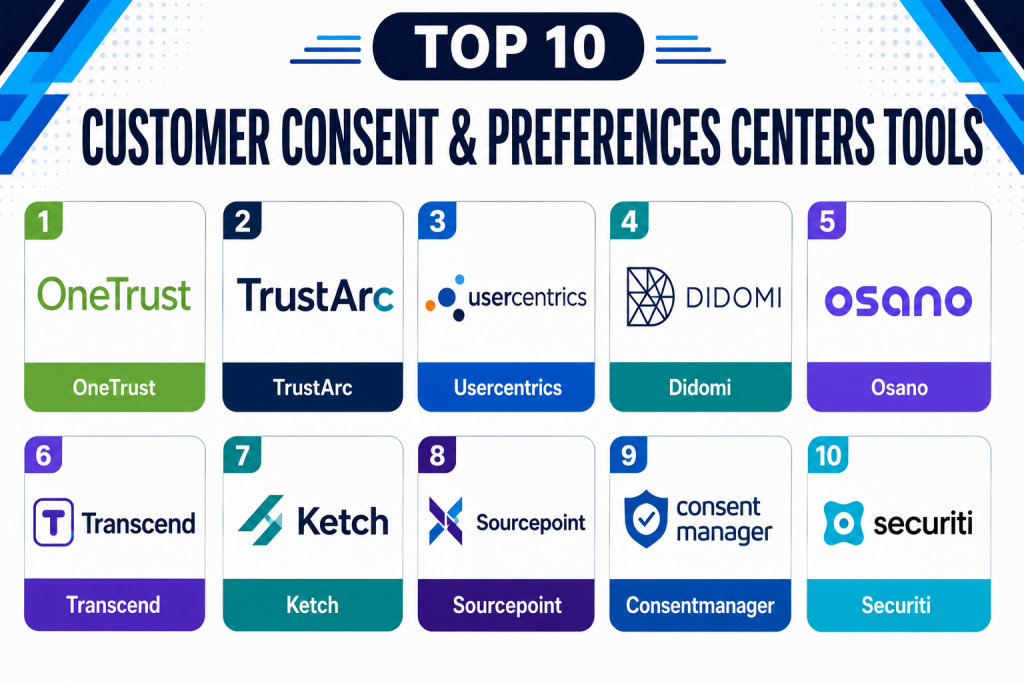
Top 10 Customer Consent & Preferences Centers Tools
1- OneTrust
Short description:
OneTrust is one of the most widely adopted privacy, consent, and preference management platforms globally. The platform helps organizations manage customer consent, privacy rights, cookie compliance, and communication preferences across digital channels. It is commonly used by large enterprises operating in highly regulated industries. OneTrust offers extensive compliance workflows, governance tools, and integrations. Its scalable architecture supports complex global privacy programs. Organizations seeking comprehensive privacy management often consider OneTrust a market leader.
Key Features
- Consent and preference management.
- Cookie consent banners.
- Data subject rights workflows.
- Privacy impact assessments.
- Consent analytics.
- Multi-language support.
- Regulatory compliance management.
Pros
- Comprehensive privacy platform.
- Strong enterprise capabilities.
- Global compliance support.
Cons
- Can be complex to configure.
- Higher cost for smaller businesses.
- Learning curve for administrators.
Platforms / Deployment
- Web
- Cloud
Security & Compliance
- SSO/SAML
- MFA
- RBAC
- Audit logs
- GDPR support
Integrations & Ecosystem
OneTrust integrates with major CRM, marketing automation, and customer experience platforms.
- Salesforce
- Adobe Experience Cloud
- HubSpot
- Microsoft ecosystem
- APIs
Support & Community
Strong enterprise support, onboarding programs, training resources, and extensive documentation.
2- TrustArc
Short description:
TrustArc provides privacy management and consent solutions for organizations seeking compliance and customer trust. The platform enables consent collection, preference management, and privacy governance across digital properties. It is widely used by enterprises with complex regulatory requirements. TrustArc also provides privacy assessment and compliance monitoring capabilities. Organizations benefit from centralized consent records and governance tools. Its privacy expertise makes it attractive to compliance-focused businesses.
Key Features
- Consent management.
- Cookie governance.
- Privacy assessments.
- Preference centers.
- Consent reporting.
- Compliance workflows.
- Regulatory monitoring.
Pros
- Strong compliance focus.
- Mature privacy platform.
- Enterprise-ready governance.
Cons
- Premium pricing.
- Complex implementation.
- Requires privacy expertise.
Platforms / Deployment
- Web
- Cloud
Security & Compliance
- SSO/SAML
- MFA
- Audit logs
- GDPR support
Integrations & Ecosystem
Supports integration with enterprise applications and privacy workflows.
- CRM platforms
- Marketing systems
- Identity providers
- APIs
Support & Community
Strong support organization and privacy-focused customer success programs.
3- Usercentrics
Short description:
Usercentrics specializes in consent management and preference collection for websites and digital products. The platform helps organizations maintain transparency while collecting and managing user permissions. It is particularly popular among digital businesses, publishers, and e-commerce organizations. Usercentrics provides flexible consent banners and preference centers. Its usability and implementation simplicity make it attractive to organizations seeking faster deployments.
Key Features
- Consent management.
- Preference center creation.
- Cookie banner management.
- Multi-language support.
- Consent records.
- Reporting dashboards.
- Compliance automation.
Pros
- Easy deployment.
- User-friendly interface.
- Strong compliance features.
Cons
- Enterprise customization may be limited.
- Advanced workflows require premium plans.
- Some integrations may require configuration.
Platforms / Deployment
- Web
- Cloud
Security & Compliance
- Encryption
- Audit records
- GDPR-focused features
Integrations & Ecosystem
Offers integrations with common web technologies and marketing platforms.
- Google Tag Manager
- CMS platforms
- Marketing tools
- APIs
Support & Community
Good documentation and responsive support services.
4- Didomi
Short description:
Didomi is a consent and preference management platform focused on transparency and customer trust. Organizations use it to collect consent across websites, mobile apps, and connected experiences. The platform supports privacy regulations and customer-centric data strategies. Didomi’s flexible implementation model allows organizations to customize consent experiences while maintaining compliance. It serves both mid-sized businesses and enterprises.
Key Features
- Consent collection.
- Preference center management.
- Mobile consent support.
- Privacy dashboards.
- Audit trails.
- Multi-channel consent.
- Compliance workflows.
Pros
- Strong mobile support.
- Flexible customization.
- Modern interface.
Cons
- Advanced features may require expertise.
- Enterprise deployments can be complex.
- Premium features increase costs.
Platforms / Deployment
- Web
- iOS
- Android
- Cloud
Security & Compliance
- Audit logs
- Encryption
- GDPR support
Integrations & Ecosystem
Supports customer engagement and analytics ecosystems.
- CRM systems
- CDPs
- Analytics tools
- APIs
Support & Community
Strong implementation support and customer onboarding.
5- Osano
Short description:
Osano focuses on privacy compliance, consent management, and customer trust initiatives. The platform helps organizations manage consent while simplifying regulatory requirements. It provides cookie management, preference centers, and privacy monitoring capabilities. Osano is popular among growing organizations seeking a balance between functionality and simplicity. Its intuitive interface reduces implementation complexity.
Key Features
- Consent management.
- Cookie compliance.
- Privacy monitoring.
- Vendor management.
- Preference centers.
- Compliance reporting.
- Customer rights workflows.
Pros
- Easy to use.
- Quick implementation.
- Good compliance coverage.
Cons
- Less enterprise depth.
- Limited advanced workflows.
- Customization limitations.
Platforms / Deployment
- Web
- Cloud
Security & Compliance
- Encryption
- Audit records
- Privacy governance features
Integrations & Ecosystem
Supports integration with popular marketing and web platforms.
- CMS tools
- CRM systems
- Marketing platforms
- APIs
Support & Community
Strong onboarding resources and responsive support.
6- Transcend
Short description:
Transcend provides privacy infrastructure for consent management, data rights, and customer preference orchestration. The platform is designed for organizations managing complex privacy operations across multiple systems. It enables automation of privacy workflows and customer data controls. Enterprises often adopt Transcend to modernize privacy operations and streamline compliance processes.
Key Features
- Consent orchestration.
- Data rights automation.
- Preference management.
- Workflow automation.
- Privacy governance.
- System integrations.
- Compliance monitoring.
Pros
- Strong automation.
- Enterprise scalability.
- Advanced privacy workflows.
Cons
- Complex deployments.
- Requires technical resources.
- Premium pricing.
Platforms / Deployment
- Web
- Cloud
Security & Compliance
- SSO/SAML
- MFA
- Audit logs
- RBAC
Integrations & Ecosystem
Built for integration across enterprise technology stacks.
- Salesforce
- Data platforms
- Customer systems
- APIs
Support & Community
Enterprise-grade onboarding and implementation support.
7- Ketch
Short description:
Ketch is a modern privacy operations platform designed to manage consent, preferences, and data governance. It helps organizations align customer experiences with privacy requirements. The platform provides centralized visibility into customer choices and privacy obligations. Businesses seeking scalable privacy infrastructure frequently evaluate Ketch as a strategic solution.
Key Features
- Consent management.
- Preference orchestration.
- Privacy governance.
- Compliance automation.
- Consent analytics.
- Identity integrations.
- Workflow management.
Pros
- Modern architecture.
- Strong governance capabilities.
- Good scalability.
Cons
- Enterprise-focused pricing.
- Technical implementation.
- Requires governance planning.
Platforms / Deployment
- Web
- Cloud
Security & Compliance
- SSO/SAML
- MFA
- Audit logging
Integrations & Ecosystem
Designed to connect privacy operations across multiple systems.
- CRM tools
- CDPs
- Marketing systems
- APIs
Support & Community
Strong enterprise customer support and implementation guidance.
8- Sourcepoint
Short description:
Sourcepoint helps organizations manage privacy compliance, consent collection, and customer preferences across digital channels. The platform is particularly popular among publishers, media companies, and digital businesses. Sourcepoint supports transparency while enabling organizations to optimize customer experiences. Its consent framework supports multiple privacy regulations and regional requirements.
Key Features
- Consent management.
- Privacy messaging.
- Preference centers.
- Reporting dashboards.
- Compliance support.
- User transparency tools.
- Regional configuration.
Pros
- Publisher-friendly.
- Strong compliance support.
- Flexible deployment.
Cons
- Less extensive governance capabilities.
- Enterprise customization varies.
- Specialized focus.
Platforms / Deployment
- Web
- Cloud
Security & Compliance
- Encryption
- Audit records
- Compliance controls
Integrations & Ecosystem
Works well within digital publishing ecosystems.
- CMS platforms
- Analytics systems
- Advertising technologies
- APIs
Support & Community
Good support services and implementation guidance.
9- Consentmanager
Short description:
Consentmanager provides cookie consent and preference management capabilities for organizations seeking compliance and transparency. The platform supports multiple privacy regulations and offers customizable consent experiences. Businesses of varying sizes use Consentmanager to manage customer permissions across digital properties. Its flexibility makes it attractive for international deployments.
Key Features
- Cookie consent management.
- Preference centers.
- Compliance monitoring.
- Multi-language support.
- Reporting tools.
- Audit logs.
- Consent storage.
Pros
- Flexible deployment.
- Multi-language capabilities.
- Broad compliance support.
Cons
- Advanced customization may require expertise.
- UI complexity in some areas.
- Enterprise features vary.
Platforms / Deployment
- Web
- Cloud
Security & Compliance
- Audit records
- Encryption
- Privacy controls
Integrations & Ecosystem
Supports numerous web and marketing integrations.
- CMS tools
- Marketing platforms
- Analytics solutions
- APIs
Support & Community
Documentation and customer support available across deployment tiers.
10- Securiti
Short description:
Securiti delivers privacy, consent, governance, and data intelligence capabilities through a unified platform. Organizations use Securiti to manage customer permissions, privacy operations, and compliance initiatives. The platform serves enterprises seeking centralized visibility and governance across customer data ecosystems. Its broad functionality extends beyond traditional consent management.
Key Features
- Consent management.
- Privacy operations.
- Data intelligence.
- Governance controls.
- Compliance workflows.
- Risk monitoring.
- Automated reporting.
Pros
- Broad platform coverage.
- Enterprise governance capabilities.
- Strong automation features.
Cons
- Large implementation scope.
- Enterprise-focused pricing.
- Requires dedicated administration.
Platforms / Deployment
- Web
- Cloud
Security & Compliance
- SSO/SAML
- MFA
- Audit logs
- RBAC
Integrations & Ecosystem
Integrates across enterprise privacy and governance environments.
- CRM systems
- Data platforms
- Security tools
- APIs
Support & Community
Enterprise onboarding, training, and dedicated support options.
Comparison Table
| Tool Name | Best For | Platforms Supported | Deployment | Standout Feature | Public Rating |
|---|---|---|---|---|---|
| OneTrust | Large Enterprises | Web | Cloud | Comprehensive Privacy Suite | N/A |
| TrustArc | Compliance Programs | Web | Cloud | Privacy Governance | N/A |
| Usercentrics | Digital Businesses | Web | Cloud | Fast Deployment | N/A |
| Didomi | Multi-Channel Consent | Web, iOS, Android | Cloud | Mobile Consent Management | N/A |
| Osano | SMB Privacy Compliance | Web | Cloud | Simplicity & Compliance | N/A |
| Transcend | Privacy Automation | Web | Cloud | Automated Privacy Workflows | N/A |
| Ketch | Modern Privacy Operations | Web | Cloud | Consent Orchestration | N/A |
| Sourcepoint | Publishers & Media | Web | Cloud | Publisher Privacy Controls | N/A |
| Consentmanager | International Deployments | Web | Cloud | Multi-Language Compliance | N/A |
| Securiti | Enterprise Governance | Web | Cloud | Unified Privacy Operations | N/A |
Evaluation & Scoring
| Tool | Core | Ease | Integrations | Security | Performance | Support | Value | Weighted Total |
| OneTrust | 10 | 8 | 10 | 10 | 9 | 9 | 7 | 9.0 |
| TrustArc | 9 | 7 | 8 | 9 | 8 | 9 | 7 | 8.2 |
| Usercentrics | 8 | 9 | 8 | 8 | 8 | 8 | 9 | 8.4 |
| Didomi | 8 | 8 | 8 | 8 | 8 | 8 | 8 | 8.0 |
| Osano | 8 | 9 | 7 | 8 | 8 | 8 | 9 | 8.3 |
| Transcend | 9 | 7 | 9 | 9 | 8 | 8 | 7 | 8.3 |
| Ketch | 9 | 8 | 9 | 9 | 8 | 8 | 7 | 8.4 |
| Sourcepoint | 8 | 8 | 7 | 8 | 8 | 8 | 8 | 7.9 |
| Consentmanager | 8 | 8 | 7 | 8 | 8 | 7 | 9 | 8.0 |
| Securiti | 9 | 7 | 9 | 9 | 8 | 8 | 7 | 8.3 |
These scores are comparative benchmarks rather than absolute measurements. Organizations should prioritize criteria aligned with their privacy strategy, technical resources, and compliance obligations. A platform with a lower overall score may still be the best choice for a specialized use case or industry requirement.
Which Customer Consent & Preferences Center Tool Is Right for You?
Solo / Freelancer
Osano and Usercentrics are often the easiest solutions to implement and manage without dedicated privacy teams.
SMB
Usercentrics, Osano, Didomi, and Consentmanager offer strong compliance coverage while remaining relatively accessible for growing organizations.
Mid-Market
Didomi, Ketch, and Transcend provide a balance between governance, automation, and scalability.
Enterprise
OneTrust, TrustArc, Securiti, Transcend, and Ketch offer advanced governance, compliance workflows, and enterprise-grade integrations.
Budget vs Premium
Budget-conscious buyers may prefer Osano, Consentmanager, or Usercentrics. Enterprises with larger compliance programs may benefit from OneTrust, TrustArc, or Securiti.
Feature Depth vs Ease of Use
Osano and Usercentrics emphasize usability, while OneTrust and Securiti provide deeper enterprise functionality at the cost of greater complexity.
Integrations & Scalability
OneTrust, Transcend, Ketch, and Securiti offer broad integration ecosystems suitable for large-scale deployments.
Security & Compliance Needs
Organizations in regulated industries should prioritize OneTrust, TrustArc, Securiti, and Transcend due to their governance and compliance capabilities.
Frequently Asked Questions
1. What is a Customer Consent & Preferences Center?
A Customer Consent & Preferences Center is a platform that allows customers to control how organizations collect, store, and use their data. It centralizes communication preferences, marketing permissions, and privacy choices.
2. Why are consent management platforms important?
These platforms help organizations maintain compliance with privacy regulations while building trust with customers. They also provide audit trails and governance controls for regulatory reporting.
3. What industries benefit most from these tools?
Financial services, healthcare, retail, telecommunications, media, SaaS, and e-commerce organizations frequently use consent management platforms due to their large customer databases and regulatory obligations.
4. Can these tools manage both marketing and privacy preferences?
Yes. Most modern platforms support marketing preferences, cookie consent, communication channels, and broader privacy-related permissions through a unified customer experience.
5. Are these solutions only for large enterprises?
No. While enterprise solutions dominate the market, several vendors provide offerings suitable for SMBs and growing businesses with simpler privacy requirements.
6. How difficult is implementation?
Implementation complexity varies significantly. Basic cookie consent deployments may take days, while enterprise-wide privacy orchestration projects can require months of planning and integration.
7. What integrations are most important?
Organizations commonly integrate consent platforms with CRM systems, marketing automation tools, customer data platforms, analytics platforms, and identity management solutions.
8. How do these tools support compliance?
Most platforms provide consent records, audit trails, preference histories, reporting capabilities, and workflows designed to help organizations meet privacy obligations.
9. What mistakes should organizations avoid?
Common mistakes include focusing only on compliance, ignoring customer experience, failing to integrate systems properly, and not maintaining ongoing governance processes.
10. What is the best approach for selecting a platform?
Start by identifying regulatory requirements, customer communication channels, integration needs, and governance objectives. Then shortlist two or three vendors and conduct a pilot before full deployment.
Conclusion
Customer Consent & Preferences Centers have evolved from compliance-focused tools into strategic platforms that help organizations build trust, improve customer experiences, and support responsible data practices. Solutions such as OneTrust, TrustArc, Usercentrics, Didomi, Osano, Transcend, Ketch, Sourcepoint, Consentmanager, and Securiti each address different organizational needs, ranging from simple consent collection to enterprise-wide privacy orchestration. The best platform depends on company size, regulatory obligations, technical maturity, and customer engagement strategy. Organizations should begin by defining their privacy objectives, identifying key integration requirements, and evaluating governance needs. A practical next step is to shortlist two or three platforms, conduct a controlled pilot, validate integrations and security controls, and then scale deployment based on measurable business and compliance outcomes.
