Introduction
Data Contract Management Tools are platforms that help organizations define, enforce, and monitor agreements between data producers and data consumers. A data contract specifies how data should be structured, validated, delivered, and maintained across systems, ensuring reliability, consistency, and trust in data-driven environments.
In modern enterprises, data flows through complex ecosystems involving data engineering teams, analytics platforms, APIs, and machine learning systems. Without formal contracts, schema changes, broken pipelines, and inconsistent data definitions can create downstream failures, analytics errors, and business disruptions.
Data contract management platforms solve this by providing governance, version control, schema validation, and automated enforcement across data pipelines and APIs.
Real-world use cases include:
- Enforcing schema consistency in data pipelines
- Managing data sharing between engineering and analytics teams
- Preventing breaking changes in APIs and datasets
- Supporting data mesh architectures
- Improving data quality in BI and reporting systems
- Ensuring compliance in regulated data environments
What buyers should evaluate:
- Schema definition and validation capabilities
- Version control for data contracts
- Integration with data pipelines and warehouses
- Automated enforcement and alerts
- Support for API and event-driven architectures
- Collaboration between data producers and consumers
- Observability and monitoring features
- Scalability across distributed data systems
- Governance and compliance controls
- Ease of adoption for engineering teams
Best for: Data engineering teams, platform engineering teams, analytics teams, SaaS companies, and enterprises adopting data mesh or modern data governance practices.
Not ideal for: Small teams with simple databases or organizations without complex data pipelines.
Key Trends in Data Contract Management Tools
- Shift toward data mesh and decentralized data ownership
- AI-assisted schema evolution detection and impact analysis
- Real-time contract validation in streaming pipelines
- Stronger integration with data observability platforms
- Git-based versioning for data contracts becoming standard
- Automated breaking-change detection and rollback suggestions
- Expansion into API contract + data contract convergence
- Cloud-native enforcement across multi-cloud data ecosystems
- Policy-as-code for data governance
- Increased adoption in ML/AI data pipelines
How We Selected These Tools (Methodology)
- Adoption in modern data engineering ecosystems
- Support for schema management and validation
- Integration with data warehouses and streaming platforms
- Version control and contract lifecycle management capabilities
- Observability and monitoring depth
- Ease of integration into CI/CD pipelines
- Scalability for enterprise data systems
- Security and governance maturity
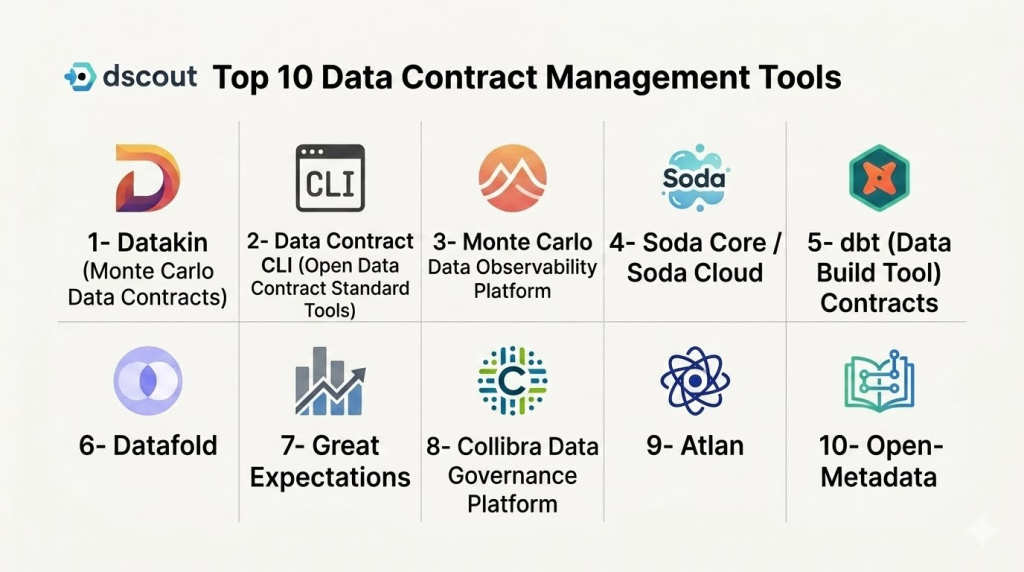
Top 10 Data Contract Management Tools
1- Datakin (Monte Carlo Data Contracts)
Short description:
Datakin, associated with Monte Carlo ecosystem capabilities, focuses on data observability and contract enforcement across modern data stacks. It helps teams define expectations for data quality, schema consistency, and pipeline reliability. It is widely used in data-driven enterprises adopting data mesh principles. The platform enables proactive detection of schema changes and pipeline issues. It integrates with modern data warehouses and streaming systems. It is especially strong for data observability-driven contract management.
Key Features
- Data contract definition and enforcement
- Schema change detection
- Data quality monitoring
- Pipeline observability
- Automated alerts
- Metadata tracking
- Data lineage visibility
Pros
- Strong observability integration
- Proactive issue detection
- Good enterprise scalability
Cons
- Complex setup for small teams
- Requires mature data stack
- Premium enterprise pricing
Platforms / Deployment
- Web
- Cloud
Security & Compliance
- SSO/SAML
- MFA
- Encryption
- Audit logs
- RBAC
Integrations & Ecosystem
- Snowflake
- BigQuery
- Databricks
- Kafka
- dbt
- APIs
Support & Community
Strong enterprise support and onboarding ecosystem.
2- Data Contract CLI (Open Data Contract Standard Tools)
Short description:
Data Contract CLI tools are open-source frameworks that enable teams to define and validate data contracts using YAML or JSON specifications. They are widely used in data engineering teams adopting data mesh architectures. These tools allow schema versioning, validation, and enforcement in CI/CD pipelines. They are highly flexible and developer-centric. The ecosystem supports integration into modern data stacks. They are ideal for engineering-driven organizations.
Key Features
- YAML/JSON contract definitions
- Schema validation
- CI/CD pipeline integration
- Version control support
- Breaking change detection
- Contract testing
- Git-based workflows
Pros
- Highly flexible and open-source
- Strong developer adoption
- Easy CI/CD integration
Cons
- Requires engineering expertise
- Limited UI-based management
- No enterprise support layer
Platforms / Deployment
- CLI / Self-hosted
- Cloud / Hybrid
Security & Compliance
- Depends on implementation
- Encryption via underlying systems
- Access control via Git systems
Integrations & Ecosystem
- GitHub
- GitLab
- dbt
- Airflow
- Kubernetes
- Data warehouses
Support & Community
Community-driven open-source ecosystem.
3- Monte Carlo Data Observability Platform
Short description:
Monte Carlo is a leading data observability platform that includes strong data contract enforcement capabilities. It helps organizations detect data quality issues, schema changes, and pipeline failures in real time. It is widely used in enterprise data platforms. The system provides automated monitoring and anomaly detection. It supports modern data stacks and cloud warehouses. It is especially strong for reliability-focused data teams.
Key Features
- Data observability dashboards
- Schema change detection
- Anomaly detection
- Pipeline monitoring
- Data lineage tracking
- Alerting system
- Contract enforcement layers
Pros
- Strong enterprise adoption
- Excellent observability capabilities
- Automated issue detection
Cons
- High enterprise cost
- Requires mature data infrastructure
- Complex onboarding
Platforms / Deployment
- Web
- Cloud
Security & Compliance
- SSO
- MFA
- Encryption
- Audit logs
- RBAC
Integrations & Ecosystem
- Snowflake
- BigQuery
- Redshift
- dbt
- Kafka
- APIs
Support & Community
Strong enterprise-grade support.
4- Soda Core / Soda Cloud
Short description:
Soda is a data quality and observability platform that supports data contract validation through checks and rules. It enables teams to define expectations for data quality and schema consistency. It is widely used in data engineering and analytics environments. Soda provides both open-source and enterprise offerings. It is known for simplicity and flexibility. It is suitable for modern data quality workflows.
Key Features
- Data quality checks
- Schema validation rules
- Contract-like assertions
- Pipeline integration
- Monitoring dashboards
- Alerting system
- Metadata tracking
Pros
- Flexible data validation
- Open-source availability
- Easy integration
Cons
- Limited full contract lifecycle management
- Requires configuration effort
- Advanced features in enterprise tier
Platforms / Deployment
- CLI / Web
- Cloud / Self-hosted
Security & Compliance
- SSO (enterprise)
- Encryption
- Audit logs
Integrations & Ecosystem
- dbt
- Snowflake
- BigQuery
- Airflow
- Databricks
- APIs
Support & Community
Strong open-source community + enterprise support.
5- dbt (Data Build Tool) Contracts
Short description:
dbt is a widely used data transformation tool that includes emerging support for data contracts through schema definitions and model governance. It enables teams to define structured transformations and enforce schema expectations. It is widely used in analytics engineering teams. dbt integrates deeply with modern data warehouses. It supports version control through Git workflows. It is a foundational tool in modern data stacks.
Key Features
- Schema definitions for models
- Data transformation pipelines
- Version control integration
- Testing framework
- Documentation generation
- CI/CD support
- Contract-like validation
Pros
- Widely adopted in analytics engineering
- Strong Git-based workflows
- Excellent ecosystem support
Cons
- Not a full contract management system
- Requires engineering expertise
- Limited real-time enforcement
Platforms / Deployment
- CLI / Cloud
- Self-hosted / Hybrid
Security & Compliance
- Depends on infrastructure
- Encryption via warehouse systems
- Access controls via Git
Integrations & Ecosystem
- Snowflake
- BigQuery
- Redshift
- Airflow
- GitHub
- APIs
Support & Community
Very large global open-source community.
6- Datafold
Short description:
Datafold is a data diffing and observability platform that helps detect schema changes and data issues across pipelines. It supports data contract-like workflows by enabling teams to compare datasets and validate changes. It is widely used in data engineering teams. The platform helps prevent breaking changes in production data. It integrates with modern data warehouses. It is especially useful for CI/CD-driven data workflows.
Key Features
- Data diffing engine
- Schema change detection
- Pipeline validation
- CI/CD integration
- Data quality monitoring
- Impact analysis
- Automated alerts
Pros
- Strong change detection
- Good CI/CD integration
- Easy to adopt
Cons
- Not full contract lifecycle system
- Limited governance features
- Requires modern data stack
Platforms / Deployment
- Web
- Cloud
Security & Compliance
- SSO
- MFA
- Encryption
- Audit logs
Integrations & Ecosystem
- Snowflake
- BigQuery
- dbt
- GitHub
- Airflow
- APIs
Support & Community
Strong data engineering-focused support.
7- Great Expectations
Short description:
Great Expectations is an open-source data validation framework used to define expectations (contracts) for data quality and schema consistency. It enables teams to create automated tests for data pipelines. It is widely used in data engineering and analytics workflows. The platform supports rule-based validation and reporting. It integrates into modern data stacks. It is highly flexible and developer-focused.
Key Features
- Data validation frameworks
- Expectation definitions
- Schema testing
- Pipeline integration
- Reporting dashboards
- CI/CD integration
- Data quality rules
Pros
- Highly flexible open-source tool
- Strong validation capabilities
- Large community support
Cons
- Requires engineering setup
- No built-in enterprise governance layer
- UI features are limited
Platforms / Deployment
- CLI / Self-hosted
- Cloud / Hybrid
Security & Compliance
- Depends on implementation
- Encryption via infrastructure
- Access control via pipelines
Integrations & Ecosystem
- dbt
- Airflow
- Snowflake
- BigQuery
- Databricks
- APIs
Support & Community
Large and active open-source community.
8- Collibra Data Governance Platform
Short description:
Collibra is a leading data governance platform that includes capabilities relevant to data contracts such as metadata management, data lineage, and policy enforcement. It is widely used in enterprise governance environments. The platform helps organizations manage data standards and definitions. It supports compliance and regulatory workflows. Collibra is highly scalable for large enterprises. It is strong in governance-heavy environments.
Key Features
- Data governance framework
- Metadata management
- Data lineage tracking
- Policy enforcement
- Data catalog
- Workflow automation
- Compliance reporting
Pros
- Strong enterprise governance
- Excellent metadata control
- Scalable architecture
Cons
- Complex implementation
- High cost
- Requires governance maturity
Platforms / Deployment
- Web
- Cloud / On-prem
Security & Compliance
- SSO
- MFA
- Encryption
- Audit logs
- Compliance controls
Integrations & Ecosystem
- Snowflake
- Databricks
- SAP
- Microsoft ecosystem
- APIs
- Data catalogs
Support & Community
Strong enterprise support and consulting ecosystem.
9- Atlan
Short description:
Atlan is a modern data workspace platform that combines data cataloging, governance, and collaboration features that support data contract workflows. It enables teams to manage metadata and enforce data standards across systems. It is widely used in modern data stack environments. The platform focuses on collaboration between data engineers and analysts. It integrates deeply with cloud data warehouses. It is known for modern UX and developer friendliness.
Key Features
- Data cataloging
- Metadata management
- Data lineage
- Collaboration workflows
- Policy enforcement
- Data discovery
- Governance tracking
Pros
- Modern user experience
- Strong collaboration features
- Good integration ecosystem
Cons
- Not pure contract enforcement tool
- Requires data maturity
- Premium pricing
Platforms / Deployment
- Web
- Cloud
Security & Compliance
- SSO
- MFA
- Encryption
- Audit logs
Integrations & Ecosystem
- Snowflake
- BigQuery
- Databricks
- dbt
- Airflow
- APIs
Support & Community
Strong enterprise onboarding and support.
10- OpenMetadata
Short description:
OpenMetadata is an open-source data governance platform that supports metadata management, data discovery, and schema tracking that can be extended for data contract use cases. It is widely adopted in modern data stacks. It enables teams to manage data definitions and lineage. It supports extensibility and API-driven workflows. It is suitable for engineering-led organizations. It is a strong open-source alternative in data governance.
Key Features
- Metadata management
- Data catalog
- Schema tracking
- Data lineage
- Workflow automation
- API-driven architecture
- Extensible governance
Pros
- Open-source flexibility
- Strong extensibility
- Active community
Cons
- Requires engineering setup
- Limited out-of-the-box governance depth
- No enterprise SLA by default
Platforms / Deployment
- Self-hosted / Cloud
- Hybrid
Security & Compliance
- Depends on deployment
- Encryption via infrastructure
- Access control via IAM
Integrations & Ecosystem
- Snowflake
- BigQuery
- Databricks
- Airflow
- dbt
- APIs
Support & Community
Strong open-source community-driven support.
Comparison Table
| Tool Name | Best For | Platform(s) Supported | Deployment | Standout Feature | Public Rating |
|---|---|---|---|---|---|
| Datakin | Data observability | Web | Cloud | Pipeline monitoring | N/A |
| Data Contract CLI | Developers | CLI | Self-hosted | Git-based contracts | N/A |
| Monte Carlo | Enterprises | Web | Cloud | Data observability | N/A |
| Soda | Data quality | CLI/Web | Cloud | Validation rules | N/A |
| dbt | Analytics engineering | CLI | Cloud/Self-hosted | Transformation + tests | N/A |
| Datafold | CI/CD data teams | Web | Cloud | Data diffing | N/A |
| Great Expectations | Data validation | CLI | Self-hosted | Expectation framework | N/A |
| Collibra | Enterprise governance | Web | Hybrid | Data governance | N/A |
| Atlan | Modern data teams | Web | Cloud | Data collaboration | N/A |
| OpenMetadata | Open-source teams | Web | Self-hosted | Metadata governance | N/A |
Evaluation & Scoring of Data Contract Management Tools
| Tool Name | Core | Ease | Integrations | Security | Performance | Support | Value | Weighted Total |
|---|---|---|---|---|---|---|---|---|
| Datakin | 9.0 | 8.0 | 9.0 | 9.0 | 9.0 | 8.5 | 8.5 | 8.8 |
| Data Contract CLI | 8.5 | 8.5 | 8.5 | 8.0 | 8.5 | 8.0 | 9.5 | 8.6 |
| Monte Carlo | 9.5 | 8.0 | 9.5 | 9.5 | 9.0 | 9.0 | 8.0 | 8.9 |
| Soda | 9.0 | 8.5 | 9.0 | 9.0 | 8.5 | 8.5 | 9.0 | 8.8 |
| dbt | 9.0 | 9.0 | 9.5 | 8.5 | 8.5 | 9.5 | 9.5 | 9.0 |
| Datafold | 8.5 | 9.0 | 9.0 | 8.5 | 8.5 | 8.5 | 9.0 | 8.7 |
| Great Expectations | 9.0 | 8.5 | 9.0 | 8.5 | 8.5 | 9.0 | 9.0 | 8.8 |
| Collibra | 9.5 | 7.5 | 9.5 | 9.5 | 9.0 | 9.0 | 8.0 | 8.8 |
| Atlan | 9.0 | 9.0 | 9.5 | 9.0 | 9.0 | 9.0 | 8.5 | 9.0 |
| OpenMetadata | 8.5 | 8.5 | 9.0 | 8.5 | 8.5 | 8.5 | 9.5 | 8.6 |
These scores reflect differences between enterprise governance platforms and developer-first open-source ecosystems. Atlan and dbt lead in usability and ecosystem maturity, while Collibra and Monte Carlo excel in enterprise governance and observability. Open-source tools like Great Expectations and OpenMetadata provide flexibility but require engineering ownership.
Frequently Asked Questions (FAQs)
1. What is a data contract?
A data contract is an agreement that defines how data is structured, delivered, and validated between producers and consumers.
2. Why are data contracts important?
They prevent broken pipelines, schema mismatches, and inconsistent data across systems.
3. Are data contract tools only for enterprises?
No, they are also used by startups with modern data stacks and CI/CD pipelines.
4. Do these tools replace data warehouses?
No, they work on top of warehouses to enforce structure and quality.
5. What is the difference between data contracts and data governance?
Data contracts are technical agreements, while governance is broader policy and control.
6. Do these tools support real-time validation?
Yes, many support streaming and near real-time validation.
7. Are open-source tools enough?
They can be, but enterprises often add governance platforms for scale.
8. Can they integrate with dbt?
Yes, most modern tools integrate directly with dbt workflows.
9. Do they support CI/CD pipelines?
Yes, developer-focused tools are designed for CI/CD integration.
10. What is the biggest benefit?
The biggest benefit is preventing data inconsistencies and breaking changes.
Conclusion
Data Contract Management Tools are becoming essential in modern data-driven organizations where reliability, consistency, and governance are critical. Platforms like dbt, Monte Carlo, Atlan, and Collibra provide strong enterprise and analytics engineering capabilities, while Great Expectations, Soda, and OpenMetadata offer flexible open-source options for engineering-led teams. The right choice depends on your data maturity, architecture complexity, and governance needs. A practical next step is to shortlist , evaluate integration with your data stack, test contract enforcement workflows, and validate CI/CD compatibility before full-scale adoption.
