Introduction
Data Federation Platforms are software solutions that enable organizations to access, query, and integrate data from multiple, heterogeneous sources without physically moving it. Instead of duplicating data into a central repository, these platforms provide a virtualized, unified view, making analytics, reporting, and operational workflows seamless across distributed datasets.
In , the importance of data federation has grown with the proliferation of multi-cloud environments, SaaS applications, and distributed data systems. Organizations demand real-time insights while avoiding the cost and complexity of traditional ETL pipelines. Data federation platforms allow enterprises to query across relational, NoSQL, and cloud data sources with minimal latency, while maintaining security, governance, and data consistency.
Real-world use cases include:
- Enabling cross-database analytics for finance, sales, and marketing teams.
- Providing unified access to operational and historical data for AI/ML training.
- Querying multiple cloud and on-premise sources for dashboards and BI reports.
- Simplifying mergers and acquisitions by federating data across legacy systems.
- Enforcing data governance and compliance across distributed datasets.
Evaluation Criteria for Buyers:
- Support for heterogeneous data sources (SQL, NoSQL, SaaS)
- Real-time query performance and caching
- Query federation across cloud and on-premises
- Security and access control (RBAC, SSO, encryption)
- Scalability for large, complex datasets
- Data governance, lineage, and compliance support
- Ease of integration with analytics and BI tools
- Monitoring, logging, and alerting capabilities
- Deployment flexibility (cloud, on-prem, hybrid)
- Vendor support and ecosystem maturity
Best for: Data engineers, analysts, IT architects, and enterprises managing multi-source, distributed data environments requiring real-time insights.
Not ideal for: Small teams with single data sources, where direct ETL or native database queries are sufficient.
Key Trends in Data Federation Platforms
- AI-driven query optimization to accelerate federated analytics.
- Integration with multi-cloud and hybrid environments for seamless access.
- Real-time data federation for low-latency operational analytics.
- Enhanced observability and query monitoring dashboards.
- Security-first architectures with RBAC, SSO, and end-to-end encryption.
- Automated data lineage tracking and compliance reporting.
- Support for streaming and batch data federation.
- Low-code integration with BI, ML, and AI platforms.
- Dynamic caching and query optimization for performance and cost efficiency.
- Subscription and consumption-based pricing for cloud deployments.
How We Selected These Tools (Methodology)
- Evaluated market adoption and recognition among enterprises and analytics teams.
- Assessed feature completeness: query federation, real-time access, security, and caching.
- Reviewed reliability and performance in production environments.
- Verified security posture, including access control, encryption, and compliance.
- Considered integration capabilities with BI, AI, ML, and analytics platforms.
- Checked customer fit across SMB, mid-market, and enterprise segments.
- Prioritized platforms with AI/ML optimizations and query acceleration.
- Examined support and community engagement for onboarding and troubleshooting.
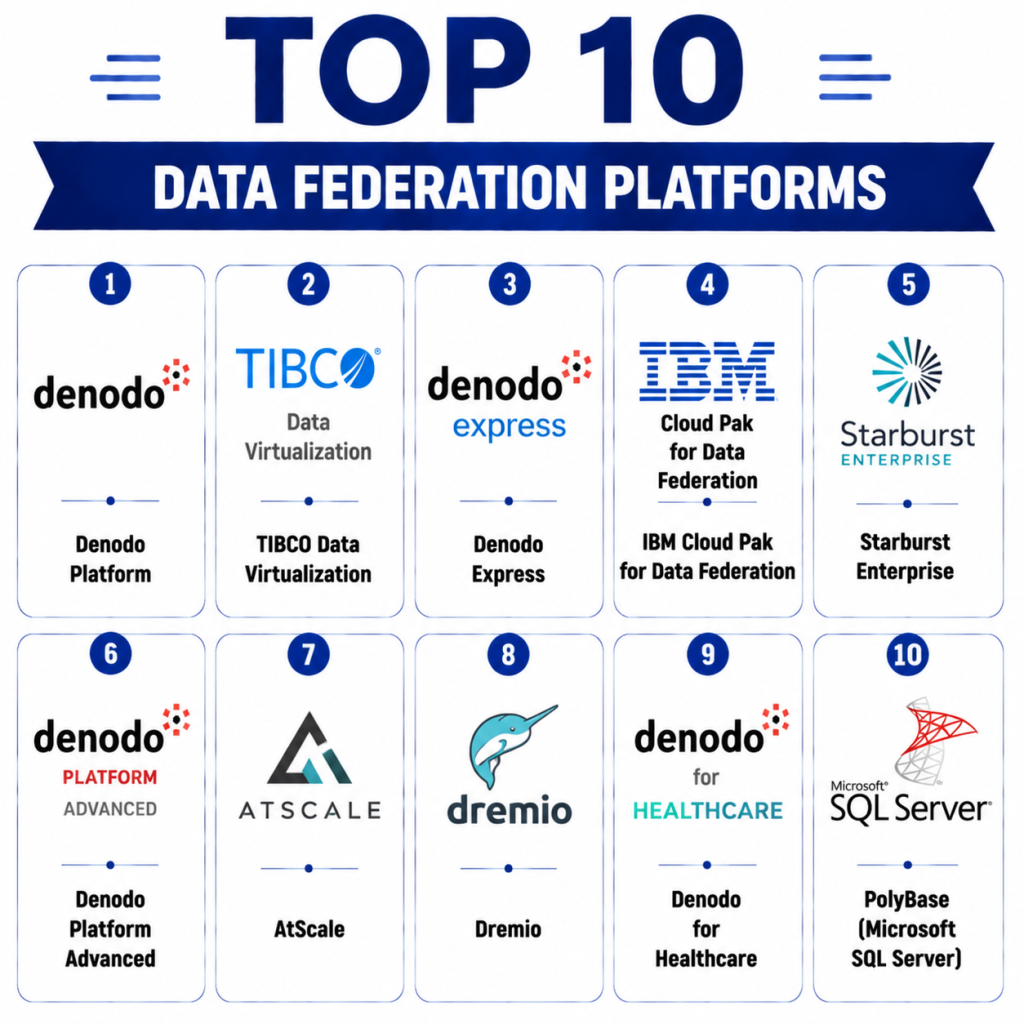
Top 10 Data Federation Platforms
1- Denodo Platform
Short description: Denodo provides a high-performance data virtualization and federation platform, offering unified access to structured, semi-structured, and cloud-based data sources for analytics and operational reporting.
Key Features
- Real-time query federation across heterogeneous sources
- Advanced caching and query optimization
- Data governance and lineage tracking
- Security with RBAC, SSO, and encryption
- Integration with BI and analytics platforms
- Support for cloud and on-prem deployments
Pros
- High-performance federation
- Comprehensive governance and security
- Multi-source compatibility
Cons
- Premium pricing for enterprise deployment
- Requires specialized expertise
Platforms / Deployment
- Linux, Windows / Cloud / On-prem / Hybrid
Security & Compliance
- SSO/SAML, RBAC, encryption
- SOC 2, ISO 27001, GDPR
Integrations & Ecosystem
Denodo integrates with BI, cloud storage, and analytics platforms.
- Tableau, Power BI
- Snowflake, BigQuery, Redshift
- REST/ODBC/JDBC connectors
Support & Community
Enterprise support available, extensive documentation, active global community.
2- TIBCO Data Virtualization
Short description: TIBCO provides a data federation platform that unifies disparate sources into a virtual layer for analytics, enabling real-time reporting and data access.
Key Features
- Virtualized data access with real-time queries
- Multi-source integration (SQL, NoSQL, SaaS)
- Data governance and lineage
- Query optimization and caching
- Role-based security and access controls
Pros
- Strong analytics integration
- Real-time performance optimization
- Enterprise-grade security
Cons
- Commercial licensing cost
- Setup complexity for large deployments
Platforms / Deployment
- Windows, Linux / Cloud / On-prem / Hybrid
Security & Compliance
- RBAC, encryption
- SOC 2, ISO 27001
Integrations & Ecosystem
Integrates with databases, SaaS, and analytics platforms.
- Tableau, Power BI
- AWS, Azure, GCP
- JDBC/ODBC connections
Support & Community
Vendor support, enterprise documentation, global user community.
3- Denodo Express
Short description: Denodo Express is a lightweight version of Denodo, offering federation and virtualization for smaller teams and rapid prototyping.
Key Features
- Connects multiple sources for unified querying
- Basic caching and query optimization
- Data preview and development tools
- Support for SQL queries and REST APIs
- Lightweight, quick deployment
Pros
- Free/low-cost option for small teams
- Fast deployment for prototyping
- Supports major source types
Cons
- Limited advanced governance features
- Not suitable for enterprise-scale production
Platforms / Deployment
- Linux, Windows / Cloud / On-prem
Security & Compliance
- Basic RBAC and encryption
- Not publicly stated
Integrations & Ecosystem
- BI tools and databases
- APIs and ODBC/JDBC
- Compatible with larger Denodo deployments
Support & Community
Documentation and community support, limited enterprise support.
4- IBM Cloud Pak for Data Federation
Short description: IBM provides a unified data federation solution enabling real-time access across hybrid cloud and on-premises systems with advanced governance and security.
Key Features
- Query federation across multi-cloud and on-prem systems
- Data catalog and lineage tracking
- Security with encryption, RBAC, and SSO
- AI-assisted query optimization
- Integration with BI and ML platforms
Pros
- Enterprise-grade federation and governance
- Hybrid cloud support
- AI-enhanced performance
Cons
- Requires IBM ecosystem
- Complex deployment
Platforms / Deployment
- Linux, Windows / Cloud / On-prem / Hybrid
Security & Compliance
- SSO/SAML, RBAC, encryption
- SOC 2, ISO 27001, GDPR, HIPAA
Integrations & Ecosystem
Integrates with cloud warehouses, SaaS, and analytics.
- Snowflake, Redshift, BigQuery
- Power BI, Tableau
- ML platforms: Watson, TensorFlow
Support & Community
Enterprise support, extensive IBM documentation, global user forums.
5- Starburst Enterprise
Short description: Starburst enables SQL-based querying across multiple sources without ETL, supporting multi-cloud analytics and federated data access.
Key Features
- Presto-based distributed query engine
- Multi-source federation
- Query caching and optimization
- Security with RBAC and SSO
- Real-time analytics support
Pros
- High-performance query federation
- SQL-native interface
- Multi-cloud compatible
Cons
- Commercial pricing
- Requires query optimization expertise
Platforms / Deployment
- Linux / Cloud / On-prem / Hybrid
Security & Compliance
- RBAC, SSO
- SOC 2, ISO 27001
Integrations & Ecosystem
- Data warehouses: Snowflake, Redshift
- BI tools: Tableau, Looker
- APIs and connectors
Support & Community
Enterprise support, active community, documentation.
6- Denodo Platform Advanced
Short description: Full-scale Denodo for enterprises, offering high-performance, secure federation, advanced caching, and AI-assisted query optimization.
Key Features
- Enterprise-grade virtualization
- Advanced caching and optimization
- Data governance and lineage
- AI-driven performance improvements
- Multi-cloud and on-prem support
Pros
- Scalable for large datasets
- Strong security and governance
- Optimized query execution
Cons
- High licensing cost
- Requires skilled data architects
Platforms / Deployment
- Linux, Windows / Cloud / On-prem / Hybrid
Security & Compliance
- SOC 2, ISO 27001, GDPR
- SSO/SAML, RBAC, encryption
Integrations & Ecosystem
- Cloud and on-prem sources
- BI and analytics platforms
- APIs and JDBC/ODBC connectors
Support & Community
Global enterprise support, documentation, professional services.
7- AtScale
Short description: AtScale provides virtualization for analytics, allowing queries across multiple warehouses and data lakes with a semantic layer for BI tools.
Key Features
- Semantic layer for analytics
- Query federation across warehouses
- Integration with BI tools
- Caching and query optimization
- Security and access control
Pros
- Simplifies multi-warehouse analytics
- Fast performance with caching
- Strong BI integration
Cons
- Commercial license
- Focused on analytics, limited operational data use
Platforms / Deployment
- Cloud / On-prem / Hybrid
Security & Compliance
- RBAC, encryption
- Not publicly stated for certifications
Integrations & Ecosystem
- Snowflake, BigQuery, Redshift
- Tableau, Power BI, Looker
- APIs for custom integration
Support & Community
Vendor support, documentation, community resources.
8- Dremio
Short description: Dremio provides a self-service data federation platform, enabling direct queries across lakes, warehouses, and sources with performance acceleration.
Key Features
- Query federation over multiple sources
- Cloud and on-prem support
- Caching and performance acceleration
- Data lineage and governance
- SQL-based access
Pros
- Self-service analytics
- High-performance queries
- Supports multiple storage types
Cons
- Requires setup for complex environments
- Enterprise features require subscription
Platforms / Deployment
- Linux / Cloud / On-prem / Hybrid
Security & Compliance
- RBAC, encryption
- Not publicly stated
Integrations & Ecosystem
- BI tools, warehouses, APIs
- Snowflake, Redshift, BigQuery
- Spark, Hadoop integration
Support & Community
Active open-source community, vendor support available.
9- Denodo for Healthcare
Short description: Specialized Denodo variant for healthcare, enabling secure, compliant federation of patient and operational data across multiple systems.
Key Features
- HIPAA-compliant data federation
- Real-time queries across hospital systems
- Role-based access control
- Query caching and performance optimization
- Data lineage and auditing
Pros
- Security and compliance focus
- Real-time access for clinical analytics
- Enterprise-grade scalability
Cons
- Healthcare-specific, may not suit other industries
- High licensing cost
Platforms / Deployment
- Linux, Windows / Cloud / On-prem / Hybrid
Security & Compliance
- HIPAA, SOC 2, ISO 27001
- SSO/SAML, RBAC, encryption
Integrations & Ecosystem
- EHR systems, databases
- BI platforms
- APIs for custom apps
Support & Community
Enterprise support, healthcare-focused documentation.
10- PolyBase (Microsoft SQL Server)
Short description: PolyBase allows federation of external data sources directly in SQL Server, enabling queries across Hadoop, Azure, and relational databases without ETL.
Key Features
- Query federation across multiple data sources
- Integration with SQL Server and Azure
- Supports relational and non-relational sources
- Push-down computation for performance
- Security and access control
Pros
- Tight SQL Server integration
- Supports multi-source queries
- Efficient push-down execution
Cons
- Limited to Microsoft ecosystem
- Not as flexible for SaaS sources
Platforms / Deployment
- Windows / Cloud / On-prem
Security & Compliance
- RBAC, encryption
- Not publicly stated
Integrations & Ecosystem
- SQL Server, Azure, Hadoop
- BI tools: Power BI
- APIs and ODBC/JDBC connectors
Support & Community
Microsoft support, extensive documentation, community forums.
Comparison Table (Top 10)
| Tool Name | Best For | Platform(s) Supported | Deployment | Standout Feature | Public Rating |
|---|---|---|---|---|---|
| Denodo Platform | Enterprise federation | Linux, Windows | Cloud / On-prem / Hybrid | High-performance virtualization | N/A |
| TIBCO Data Virtualization | Analytics & BI | Linux, Windows | Cloud / On-prem / Hybrid | Multi-source query federation | N/A |
| Denodo Express | Prototyping | Linux, Windows | Cloud / On-prem | Lightweight virtual layer | N/A |
| IBM Cloud Pak Data Federation | Hybrid enterprise | Linux, Windows | Cloud / On-prem / Hybrid | AI-assisted query optimization | N/A |
| Starburst Enterprise | Multi-cloud analytics | Linux | Cloud / On-prem / Hybrid | SQL-based distributed queries | N/A |
| Denodo Platform Advanced | Large-scale federation | Linux, Windows | Cloud / On-prem / Hybrid | AI-enhanced caching | N/A |
| AtScale | BI integration | Cloud / On-prem | Cloud / Hybrid | Semantic layer for BI | N/A |
| Dremio | Data lake access | Linux | Cloud / On-prem / Hybrid | Self-service federation | N/A |
| Denodo for Healthcare | Healthcare analytics | Linux, Windows | Cloud / On-prem / Hybrid | HIPAA-compliant federation | N/A |
| PolyBase | SQL Server integration | Windows | Cloud / On-prem | Direct SQL-based federation | N/A |
Evaluation & Scoring of Data Federation Tools
| Tool Name | Core (25%) | Ease (15%) | Integrations (15%) | Security (10%) | Performance (10%) | Support (10%) | Value (15%) | Weighted Total |
|---|---|---|---|---|---|---|---|---|
| Denodo Platform | 9 | 7 | 9 | 8 | 9 | 8 | 7 | 8.4 |
| TIBCO Data Virtualization | 8 | 7 | 8 | 8 | 8 | 7 | 7 | 7.8 |
| Denodo Express | 7 | 8 | 7 | 7 | 7 | 7 | 8 | 7.4 |
| IBM Cloud Pak | 9 | 7 | 8 | 8 | 9 | 8 | 7 | 8.3 |
| Starburst | 8 | 8 | 8 | 7 | 8 | 7 | 7 | 7.8 |
| Denodo Advanced | 9 | 7 | 9 | 8 | 9 | 8 | 7 | 8.4 |
| AtScale | 8 | 7 | 8 | 7 | 8 | 7 | 7 | 7.7 |
| Dremio | 8 | 7 | 8 | 7 | 8 | 7 | 7 | 7.7 |
| Denodo Healthcare | 9 | 7 | 8 | 9 | 9 | 8 | 7 | 8.5 |
| PolyBase | 7 | 7 | 7 | 7 | 7 | 7 | 7 | 7.0 |
Interpretation: Weighted scores reflect comparative platform strengths across core functionality, integrations, ease of use, and enterprise suitability. Higher totals indicate stronger overall federation capabilities.
Which Data Federation Tool Is Right for You?
Solo / Freelancer
- Denodo Express or Dremio for lightweight, cost-effective federation and experimentation.
SMB
- Starburst or AtScale for cloud-native, multi-source analytics without heavy infrastructure.
Mid-Market
- TIBCO Data Virtualization or IBM Cloud Pak for broader integration and hybrid deployments.
Enterprise
- Denodo Platform Advanced or Denodo for Healthcare for large-scale, secure, and regulated data federation.
Budget vs Premium
- Open-source and lightweight tools reduce cost; enterprise platforms deliver performance, governance, and compliance.
Feature Depth vs Ease of Use
- Dremio and AtScale emphasize self-service ease; Denodo Advanced and IBM Cloud Pak provide richer enterprise functionality.
Integrations & Scalability
- Denodo, Starburst, and IBM Cloud Pak scale across cloud, hybrid, and multi-source environments.
Security & Compliance Needs
- Denodo for Healthcare and IBM Cloud Pak provide strong compliance features including HIPAA, SOC 2, and ISO 27001.
Frequently Asked Questions (FAQs)
1- What pricing models are used?
Open-source tools are free; enterprise tools use subscription, per-user, or per-node pricing.
2- How long does deployment take?
Small-scale implementations can deploy in days; enterprise setups may take weeks.
3- Can these platforms handle multi-cloud sources?
Yes, modern federation platforms support cross-cloud and hybrid sources.
4- Are AI/ML optimizations included?
Some enterprise tools include query acceleration and predictive optimization; open-source tools may require custom configuration.
5- Do these tools provide real-time query capabilities?
Yes, caching, optimization, and virtualized access enable near real-time query responses.
6- Can business users leverage these platforms?
Low-code options like AtScale and Dremio allow business analysts to run queries and access unified datasets.
7- What are common adoption challenges?
Complex source configurations, network latency, and security misconfigurations are common pitfalls.
8- How is security enforced?
Platforms implement RBAC, encryption, SSO/SAML, and audit logging for secure access.
9- Are these platforms scalable?
Yes, enterprise-grade platforms scale to handle large, distributed datasets across multiple sources.
10- What are alternatives for smaller teams?
ETL pipelines or native SQL queries may suffice for simple, single-source analytics.
Conclusion
Data Federation Platforms provide unified, secure, and scalable access to distributed datasets, enabling analytics, BI, and AI/ML workflows without extensive ETL. Open-source platforms like Dremio and PolyBase offer flexibility and cost efficiency, while enterprise solutions like Denodo, IBM Cloud Pak, and Starburst deliver high performance, governance, and regulatory compliance.
