Introduction
Data Masking & Tokenization Tools are platforms that protect sensitive data by obscuring or replacing it with anonymized values while maintaining its usability for analytics, development, and AI workflows. In plain English, these tools ensure that confidential information—such as financial records, personal identifiers, and healthcare data—is hidden from unauthorized access while still allowing organizations to use the data safely. In , as enterprises increasingly rely on AI, cloud computing, and data-driven applications, masking and tokenization are essential to meet privacy regulations and protect against breaches.
Real-world use cases include:
- Masking PII in customer databases for AI training and analytics.
- Tokenizing payment card data in financial services for compliance with PCI DSS.
- Redacting sensitive healthcare data for HIPAA-compliant research.
- Obfuscating employee or HR records during software testing or AI model evaluation.
- Securing customer interactions in marketing and CRM platforms for data privacy.
Evaluation Criteria for Buyers often include:
- Accuracy and coverage of sensitive data detection
- Support for structured and unstructured data
- Integration with databases, AI/ML pipelines, and cloud platforms
- Flexibility in masking, anonymization, or tokenization techniques
- Compliance with GDPR, HIPAA, CCPA, PCI DSS
- Real-time or batch processing capabilities
- Scalability for enterprise workloads
- Audit logging and reporting for governance
- Extensibility via APIs and SDKs
- Cost-effectiveness and support infrastructure
Best for: Data governance teams, security officers, compliance teams, and AI/ML engineers in regulated industries such as healthcare, finance, and marketing.
Not ideal for: Small teams handling non-sensitive data or using pre-compliant cloud platforms where internal masking is low-risk.
Key Trends in Data Masking & Tokenization Tools
- AI-assisted sensitive data detection across large datasets.
- Integration of masking and tokenization in MLOps and AI pipelines.
- Support for multi-cloud, hybrid, and on-premises deployments.
- Policy-driven automation for compliance with GDPR, HIPAA, CCPA, and PCI DSS.
- Real-time masking for streaming data and chat logs.
- Flexible tokenization schemes for analytics and AI use without revealing sensitive information.
- Enhanced dashboards for auditability, compliance reporting, and monitoring.
- Scalable batch and real-time data protection for high-volume enterprise workflows.
- Subscription-based and usage-based pricing for flexible enterprise adoption.
- Cross-platform interoperability with databases, data warehouses, AI pipelines, and SaaS apps.
How We Selected These Tools (Methodology)
- Reviewed market adoption and enterprise mindshare in regulated industries.
- Assessed feature completeness, including masking, tokenization, and monitoring.
- Evaluated performance and reliability across large-scale data environments.
- Examined security posture, including encryption, SSO/MFA, and audit logging.
- Analyzed integration capabilities with AI, databases, and cloud platforms.
- Considered customer fit across SMB, mid-market, and enterprise organizations.
- Evaluated scalability for large datasets, multi-cloud environments, and global enterprises.
- Assessed support quality and community engagement for onboarding and troubleshooting.
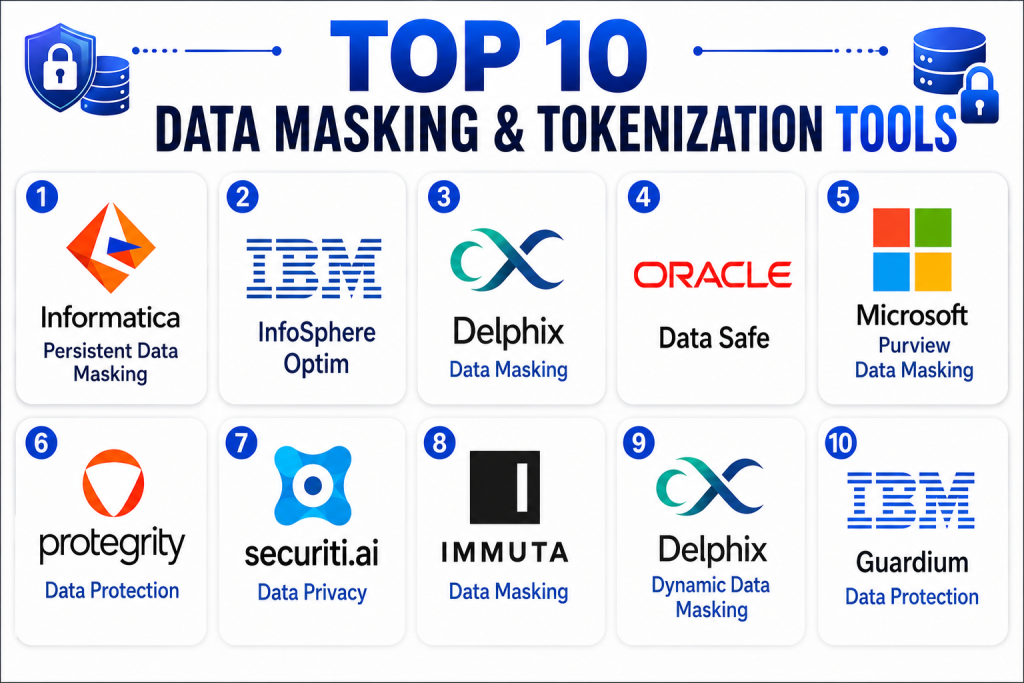
Top 10 Data Masking & Tokenization Tools
1- Informatica Persistent Data Masking
Short description: Informatica provides enterprise-grade masking and tokenization for structured and unstructured data, ensuring regulatory compliance across large datasets. Ideal for enterprises in finance, healthcare, and government.
Key Features
- Dynamic and static data masking
- Format-preserving tokenization
- Multi-source data support
- Compliance reporting dashboards
- Integration with MLOps and AI pipelines
- Role-based access control
Pros
- Enterprise-ready with strong scalability
- Comprehensive compliance reporting
Cons
- High complexity for small teams
- Licensing cost can be significant
Platforms / Deployment
- Web / Cloud / Hybrid
Security & Compliance
- SOC 2, ISO 27001, encryption
- GDPR, HIPAA, PCI DSS
Integrations & Ecosystem
- Oracle, SQL Server, AWS, Azure
- REST APIs and SDKs
- Integration with AI/ML pipelines
Support & Community
- Enterprise support and professional services
- Documentation and training resources
2- IBM InfoSphere Optim
Short description: IBM InfoSphere Optim enables large enterprises to mask, tokenize, and anonymize sensitive information across databases, files, and applications.
Key Features
- Data masking and pseudonymization
- Tokenization for secure data analytics
- Support for structured/unstructured datasets
- Audit logging and compliance reporting
- Integration with enterprise AI and data pipelines
Pros
- Scalable for large datasets
- Strong compliance and audit capabilities
Cons
- Complexity in setup
- Enterprise pricing
Platforms / Deployment
- Web / Cloud / Hybrid
Security & Compliance
- SOC 2, ISO 27001, encryption
- GDPR, HIPAA
Integrations & Ecosystem
- Oracle, SAP, AWS, Azure
- REST API and SDKs
- MLOps integration
Support & Community
- Enterprise support packages
- Training and documentation
3- Delphix Data Masking
Short description: Delphix provides secure masking and tokenization for cloud, on-prem, and hybrid environments, enabling AI/ML use without exposing PII.
Key Features
- Dynamic and static masking
- Tokenization and pseudonymization
- Multi-cloud support
- Audit trails and reporting
- Integration with AI and analytics pipelines
Pros
- Flexible deployment options
- Enterprise-scale PII protection
Cons
- Professional services recommended for setup
- Higher cost for small teams
Platforms / Deployment
- Web / Cloud / Hybrid
Security & Compliance
- SOC 2, encryption, RBAC
- GDPR, HIPAA
Integrations & Ecosystem
- AWS, Azure, GCP
- REST APIs and SDKs
- Integration with AI pipelines
Support & Community
- Enterprise support and documentation
- Training resources
4- Oracle Data Safe
Short description: Oracle Data Safe offers masking, tokenization, and monitoring for databases, securing sensitive data while maintaining usability for analytics and AI workflows.
Key Features
- Data discovery and classification
- Masking and tokenization
- Real-time activity monitoring
- Compliance dashboards and reporting
- Integration with Oracle Cloud AI services
Pros
- Strong database and cloud integration
- Enterprise-grade monitoring
Cons
- Limited outside Oracle ecosystem
- Enterprise pricing
Platforms / Deployment
- Web / Cloud
Security & Compliance
- SOC 2, encryption
- GDPR, HIPAA, PCI DSS
Integrations & Ecosystem
- Oracle DB, Oracle Cloud
- REST APIs and SDKs
- Integration with MLOps pipelines
Support & Community
- Enterprise support
- Documentation and forums
5- Microsoft Purview Data Masking
Short description: Microsoft Purview provides automated data masking and tokenization for Microsoft 365, Azure, and hybrid environments, helping enterprises manage sensitive AI datasets.
Key Features
- Multi-source PII discovery
- Dynamic masking and tokenization
- Policy-driven enforcement
- Audit logging and reporting
- Integration with AI pipelines and Power BI
Pros
- Seamless Microsoft ecosystem integration
- Centralized governance dashboards
Cons
- Limited outside Microsoft environments
- Enterprise licensing required
Platforms / Deployment
- Web / Cloud / Hybrid
Security & Compliance
- Azure security standards
- GDPR, SOC 2, HIPAA
Integrations & Ecosystem
- Azure, Office 365, Power BI
- REST APIs and SDKs
- MLOps integration
Support & Community
- Enterprise support
- Documentation and community forums
6- Protegrity Data Protection
Short description: Protegrity provides enterprise-grade data masking, tokenization, and pseudonymization for secure AI and analytics usage across cloud and on-premises environments.
Key Features
- Dynamic and static masking
- Tokenization for analytics and AI pipelines
- Multi-format and multi-cloud support
- Audit and compliance dashboards
- Policy-driven enforcement
Pros
- Scalable for enterprise workloads
- Strong compliance capabilities
Cons
- Complex initial setup
- Licensing cost
Platforms / Deployment
- Web / Cloud / Hybrid
Security & Compliance
- SOC 2, ISO 27001, encryption
- GDPR, HIPAA
Integrations & Ecosystem
- AWS, Azure, GCP, Salesforce
- REST APIs and SDKs
- Integration with AI and analytics pipelines
Support & Community
- Professional services and enterprise support
- Documentation and onboarding
7- Securiti.ai Data Privacy
Short description: Securiti.ai offers AI-driven data masking, tokenization, and automated governance for structured and unstructured datasets in enterprise environments.
Key Features
- AI-assisted sensitive data discovery
- Masking, tokenization, and pseudonymization
- Compliance dashboards and reporting
- Multi-cloud and hybrid support
- Alerts for sensitive data exposure
Pros
- AI-assisted detection enhances accuracy
- Enterprise scalability
Cons
- Enterprise pricing
- Setup complexity
Platforms / Deployment
- Web / Cloud / Hybrid
Security & Compliance
- SOC 2, encryption, RBAC
- GDPR, CCPA, HIPAA
Integrations & Ecosystem
- Cloud and SaaS applications
- REST APIs and SDKs
- MLOps and AI pipelines
Support & Community
- Professional services and support
- Documentation and knowledge base
8- Immuta Data Masking
Short description: Immuta automates data masking and tokenization for AI and analytics, enforcing privacy policies across multi-cloud and hybrid environments.
Key Features
- Policy-driven data masking
- Dynamic tokenization and pseudonymization
- Real-time compliance monitoring
- Multi-cloud integration
- Audit and reporting dashboards
Pros
- Flexible multi-cloud support
- Real-time policy enforcement
Cons
- Enterprise-oriented pricing
- Limited open-source community
Platforms / Deployment
- Web / Cloud / Hybrid
Security & Compliance
- SOC 2, ISO 27001, encryption
- GDPR, HIPAA
Integrations & Ecosystem
- AWS, Azure, GCP
- REST APIs, SDKs
- MLOps and analytics pipelines
Support & Community
- Enterprise support and documentation
- Professional services
9- Delphix Dynamic Data Masking
Short description: Delphix provides real-time masking and tokenization for development, testing, and AI pipelines, securing sensitive enterprise data without losing usability.
Key Features
- Dynamic and static masking
- Tokenization for AI and analytics pipelines
- Multi-format support
- Audit logging and compliance reporting
- Integration with cloud and on-prem databases
Pros
- Supports real-time AI workflows
- Scalable across enterprise environments
Cons
- Professional services recommended
- Higher cost for smaller teams
Platforms / Deployment
- Web / Cloud / Hybrid
Security & Compliance
- SOC 2, encryption, RBAC
- GDPR, HIPAA
Integrations & Ecosystem
- AWS, Azure, Oracle, SQL Server
- REST API and SDKs
- AI pipelines and MLOps frameworks
Support & Community
- Enterprise support
- Documentation and onboarding
10- IBM Guardium Data Protection
Short description: IBM Guardium offers enterprise-class data masking and tokenization to protect sensitive data across cloud, hybrid, and on-prem environments, including AI workflows.
Key Features
- Policy-driven masking and tokenization
- Real-time monitoring and alerts
- Multi-format and multi-cloud support
- Compliance dashboards and audit logs
- Integration with AI/ML pipelines
Pros
- Enterprise-grade security
- Comprehensive compliance reporting
Cons
- Setup and deployment complexity
- Enterprise licensing cost
Platforms / Deployment
- Web / Cloud / Hybrid
Security & Compliance
- SOC 2, ISO 27001, encryption, RBAC
- GDPR, HIPAA, CCPA
Integrations & Ecosystem
- AWS, Azure, Oracle, SQL Server
- REST API and SDKs
- MLOps and analytics pipelines
Support & Community
- Enterprise support and documentation
- Training and professional services
Comparison Table (Top 10)
| Tool Name | Best For | Platform(s) Supported | Deployment | Standout Feature | Public Rating |
|---|---|---|---|---|---|
| Informatica Persistent Data Masking | Enterprise datasets | Web | Cloud / Hybrid | Dynamic & static masking | N/A |
| IBM InfoSphere Optim | Large enterprises | Web | Cloud / Hybrid | Multi-format tokenization | N/A |
| Delphix Data Masking | Cloud & hybrid AI pipelines | Web | Cloud / Hybrid | Real-time masking | N/A |
| Oracle Data Safe | Databases & AI workflows | Web | Cloud | Real-time monitoring & reporting | N/A |
| Microsoft Purview Data Masking | Microsoft environments | Web | Cloud / Hybrid | Centralized compliance dashboards | N/A |
| Protegrity Data Protection | Enterprise AI & analytics | Web | Cloud / Hybrid | Tokenization & masking | N/A |
| Securiti.ai Data Privacy | Multi-cloud enterprise AI | Web | Cloud / Hybrid | AI-assisted detection | N/A |
| Immuta Data Masking | Multi-cloud governance | Web | Cloud / Hybrid | Policy-driven enforcement | N/A |
| Delphix Dynamic Data Masking | Dev/test & AI pipelines | Web | Cloud / Hybrid | Real-time masking | N/A |
| IBM Guardium Data Protection | Enterprise & hybrid environments | Web | Cloud / Hybrid | Multi-format tokenization | N/A |
Evaluation & Scoring of Data Masking & Tokenization Tools
| Tool Name | Core (25%) | Ease (15%) | Integrations (15%) | Security (10%) | Performance (10%) | Support (10%) | Value (15%) | Weighted Total |
|---|---|---|---|---|---|---|---|---|
| Informatica | 9 | 8 | 8 | 9 | 9 | 8 | 8 | 8.7 |
| IBM Optim | 8 | 7 | 8 | 8 | 8 | 7 | 7 | 7.7 |
| Delphix | 8 | 7 | 8 | 8 | 8 | 7 | 7 | 7.7 |
| Oracle Data Safe | 8 | 7 | 8 | 8 | 8 | 7 | 7 | 7.7 |
| Microsoft Purview | 8 | 7 | 8 | 8 | 8 | 7 | 7 | 7.7 |
| Protegrity | 9 | 7 | 8 | 8 | 9 | 8 | 8 | 8.3 |
| Securiti.ai | 9 | 7 | 8 | 8 | 9 | 8 | 8 | 8.3 |
| Immuta | 8 | 7 | 8 | 8 | 8 | 7 | 7 | 7.7 |
| Delphix Dynamic | 8 | 7 | 8 | 8 | 8 | 7 | 7 | 7.7 |
| IBM Guardium | 9 | 7 | 8 | 8 | 9 | 8 | 8 | 8.3 |
Interpretation: Weighted totals reflect relative strengths in core masking and tokenization capabilities, integrations, security, performance, support, and overall value. Higher totals indicate stronger enterprise readiness for large-scale data protection.
Which Data Masking & Tokenization Tool Is Right for You?
Solo / Freelancer
Open-source or cloud-native solutions are suitable for experimentation and smaller datasets.
SMB
Microsoft Purview and Immuta offer practical, policy-driven masking and tokenization for mid-sized organizations.
Mid-Market
Delphix, Protegrity, and Securiti.ai provide scalable, multi-cloud masking and tokenization with AI-assisted detection.
Enterprise
Informatica, IBM Optim, Oracle Data Safe, and IBM Guardium deliver comprehensive enterprise-grade masking, tokenization, and governance capabilities.
Budget vs Premium
Open-source and cloud-native tools reduce cost but may require manual configuration. Enterprise platforms provide dashboards, compliance reporting, and professional support.
Feature Depth vs Ease of Use
Enterprise tools offer extensive controls, dashboards, and automated workflows; cloud-native tools prioritize integration flexibility.
Integrations & Scalability
Enterprise solutions integrate across AI pipelines, databases, and cloud environments. Smaller tools may require custom integration for full-scale deployments.
Security & Compliance Needs
Regulated industries should prioritize Informatica, IBM Optim, and Protegrity. Teams processing non-sensitive data can leverage cloud-native or open-source tools.
Frequently Asked Questions (FAQs)
1- What pricing models do these tools use?
Enterprise solutions typically use subscription or usage-based pricing. Cloud-native or open-source tools may be free or pay-per-use.
2- How long does onboarding take?
Cloud-native or API-based tools can be deployed within days. Enterprise-scale solutions may require weeks for full integration and configuration.
3- What are common mistakes when implementing these tools?
Neglecting policy enforcement, skipping audit logging, or failing to integrate masking into AI pipelines are frequent errors.
4- Are these tools secure?
Enterprise platforms provide encryption, SSO/MFA, RBAC, and auditing. Open-source or cloud-native tools rely on secure deployment practices.
5- Can these tools scale for multiple datasets and clouds?
Yes, enterprise-grade tools support multi-cloud, hybrid, and high-volume deployments.
6- How do these tools integrate with AI and analytics pipelines?
Most tools provide REST APIs, SDKs, and connectors for seamless integration. Open-source tools may require manual integration.
7- Is switching between tools difficult?
Migration depends on data formats, masking policies, and existing pipelines. API compatibility eases transitions.
8- Are there alternatives to dedicated masking and tokenization tools?
Some MLOps platforms offer basic redaction or tokenization features, but dedicated tools provide higher accuracy, automation, and compliance reporting.
9- How frequently should data be masked or tokenized?
Continuous monitoring and real-time masking are ideal. Periodic reviews should occur quarterly for regulated environments.
10- Do these tools support regulatory compliance?
Enterprise solutions provide GDPR, HIPAA, PCI DSS, and CCPA reporting dashboards. Open-source tools require manual compliance workflows.
Conclusion
Data Masking & Tokenization Tools are critical for securing sensitive data, enabling AI workflows, and maintaining regulatory compliance in . Small teams may leverage cloud-native or open-source options, while mid-market and enterprise organizations benefit from platforms like Informatica, IBM Optim, Delphix, and
