Introduction
Device Fingerprinting Tools help businesses recognize devices by analyzing technical and behavioral signals such as browser type, operating system, IP address, screen properties, hardware details, device configuration, network signals, and session behavior. In simple English, these tools help identify whether a device looks trusted, suspicious, returning, spoofed, automated, or connected to previous fraud activity.
Device fingerprinting matters now because online fraud is becoming more automated and harder to detect with passwords, cookies, or basic IP checks alone. Attackers use VPNs, emulators, bots, device farms, stolen credentials, and synthetic identities to bypass simple controls. Device intelligence helps fraud, security, and risk teams identify suspicious activity earlier.
Real-world use cases include:
- Detecting account takeover attempts
- Blocking multi-accounting and bonus abuse
- Preventing payment fraud and chargebacks
- Identifying bot traffic and emulator use
- Strengthening onboarding and login risk checks
Evaluation Criteria for Buyers:
- Device recognition accuracy
- Browser, mobile, and API coverage
- Bot and emulator detection
- Risk scoring and rules engine
- Real-time API performance
- Privacy and compliance readiness
- Integration with fraud, identity, and payment systems
- Case management and investigation support
- False-positive reduction
- Pricing and scalability
Best for: Device fingerprinting tools are best for fintech companies, banks, e-commerce brands, marketplaces, gaming platforms, iGaming companies, SaaS apps, digital wallets, payment companies, fraud teams, risk teams, and security teams that need to recognize risky devices and prevent repeated abuse.
Not ideal for: These tools may not be ideal for very small websites with low login or transaction volume, static business websites, or teams that only need basic analytics. In those cases, standard MFA, CAPTCHA, payment gateway fraud rules, or identity provider controls may be enough before investing in a dedicated device fingerprinting platform.
Key Trends in Device Fingerprinting Tools
- Device intelligence is replacing simple fingerprinting: Buyers no longer want only a device ID. They want device reputation, risk scores, behavioral signals, emulator detection, VPN signals, and historical trust context.
- Privacy-aware fingerprinting is becoming critical: Businesses must balance fraud prevention with consent, transparency, data minimization, and regional privacy rules.
- Bot and device fingerprinting are converging: Many attacks use automation, headless browsers, mobile emulators, and scripted sessions, so fingerprinting tools increasingly include bot detection.
- AI-driven risk scoring is becoming standard: Modern tools combine machine learning, rules, anomaly detection, and historical risk patterns to classify devices more accurately.
- Mobile device intelligence is becoming more important: Fraud increasingly happens through mobile apps, mobile web, SIM-related signals, device farms, and app-based abuse.
- Account takeover protection depends on device context: A login from a new, spoofed, risky, or previously abused device is now an important ATO warning signal.
- Multi-accounting detection is a major use case: Marketplaces, gaming platforms, fintech apps, and promo-driven businesses use device fingerprints to detect duplicate or linked accounts.
- Real-time decisioning is expected: Device checks must happen during login, signup, checkout, withdrawal, password reset, or account recovery without slowing the user journey.
- Fraud orchestration is growing: Enterprises are combining device fingerprinting with identity verification, payment fraud scoring, behavioral biometrics, bot defense, and SIEM systems.
- Explainability matters more: Risk teams want reason codes, device attributes, confidence scores, and investigation context, not just a black-box device label.
How We Selected These Tools Methodology
- Selected vendors with strong recognition in device fingerprinting, fraud prevention, bot detection, digital identity, or risk scoring.
- Prioritized tools that support device intelligence through APIs, SDKs, browser signals, mobile signals, or behavioral data.
- Considered fit across fintech, e-commerce, marketplaces, banking, gaming, SaaS, and high-risk digital platforms.
- Evaluated feature completeness across device recognition, bot detection, emulator checks, IP intelligence, rules, and risk scoring.
- Considered integration strength with login flows, payment systems, onboarding journeys, fraud operations, and security tools.
- Reviewed practical buyer fit across SMB, mid-market, enterprise, developer-first, and high-volume fraud environments.
- Considered performance expectations such as low latency, real-time scoring, uptime, and attack burst resilience.
- Avoided invented ratings, unsupported certifications, and unverified compliance claims.
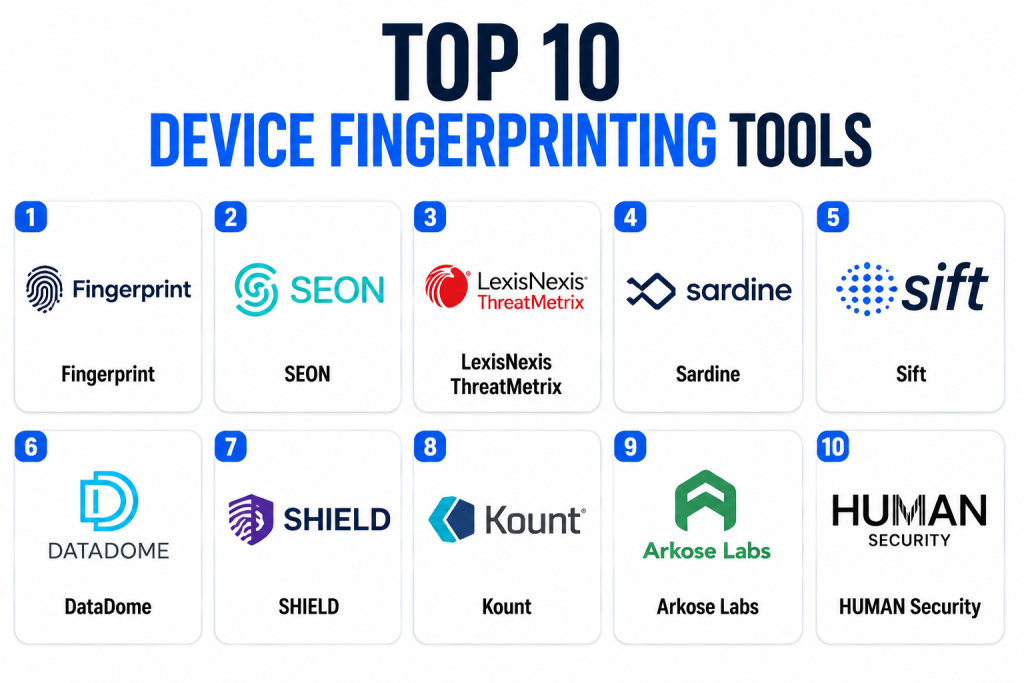
Top 10 Device Fingerprinting Tools
1- Fingerprint
Short description: Fingerprint is a device intelligence and visitor identification platform designed to help businesses recognize browsers and devices across sessions. It is useful for fraud prevention, account security, paywall protection, personalization, bot detection support, and suspicious activity analysis. The platform is especially attractive for developer teams that want a direct API and SDK-driven way to identify returning visitors and risky devices. Fingerprint is commonly considered by SaaS companies, marketplaces, fintech apps, e-commerce platforms, and digital products that need persistent visitor identification. Its strength is focused device identification and developer-friendly implementation. Buyers should validate privacy requirements, mobile coverage, and how its signals fit into broader fraud decisions.
Key Features
- Visitor and device identification
- Browser fingerprinting and device intelligence
- API and SDK-based implementation
- Bot and automation signal support
- Smart signals for suspicious behavior
- Web and mobile app support depending on implementation
- Risk and trust context for account protection workflows
Pros
- Strong developer-friendly device identification
- Useful for fraud, account abuse, and duplicate user detection
- Easy to combine with custom risk engines and internal systems
Cons
- May require additional fraud decisioning tools for full protection
- Privacy and consent setup must be planned carefully
- Advanced fraud operations may need custom workflows
Platforms / Deployment
Web / iOS / Android
Cloud
Security & Compliance
Fingerprint handles device and visitor intelligence data, so buyers should review its privacy, data handling, access control, encryption, and compliance documentation directly.
SOC 2: Not publicly stated
ISO 27001: Not publicly stated
GDPR: Relevant in applicable regions
SSO/SAML: Varies / N/A
MFA: Varies / N/A
RBAC and audit logs: Varies / N/A
Integrations & Ecosystem
Fingerprint is built for technical teams that want device identification through APIs, SDKs, and application workflows.
- JavaScript browser SDK
- Server-side APIs
- Mobile app integrations
- Webhooks and backend workflows
- Fraud and risk engines
- Custom analytics and security systems
Support & Community
Fingerprint provides documentation, developer resources, and support options. It is especially useful for teams comfortable with API-based implementation. Support depth may vary by plan and business size, so buyers should confirm onboarding and enterprise assistance before rollout.
2- SEON
Short description: SEON is a fraud prevention platform that includes device fingerprinting, device intelligence, email intelligence, phone intelligence, IP analysis, velocity rules, and risk scoring. It is widely used by fintechs, iGaming companies, online lenders, marketplaces, crypto platforms, and digital businesses that need fast fraud checks. SEON helps teams identify suspicious devices, emulators, VPNs, proxies, duplicate users, and risky account activity. It is useful when device fingerprinting needs to work alongside digital footprint analysis and customizable fraud rules. The platform is practical for teams that want API-based fraud prevention with configurable scoring. Buyers should ensure their fraud team can tune rules and interpret device signals properly.
Key Features
- Device fingerprinting and device intelligence
- Email, phone, IP, and digital footprint analysis
- Emulator, proxy, VPN, and suspicious setup detection
- Rules engine and risk scoring
- Velocity checks and duplicate account detection
- API-first fraud prevention workflows
- Fraud dashboard and manual review support
Pros
- Strong combination of device data and digital identity signals
- Flexible for fintech, gaming, marketplaces, and payment risk
- Useful API-first approach for modern fraud teams
Cons
- Best results require rule tuning and fraud expertise
- May need complementary tools for deep behavioral biometrics
- Some use cases require careful data mapping
Platforms / Deployment
Web
Cloud
Security & Compliance
SEON processes fraud and risk-related data. Buyers should verify current security documentation, privacy controls, access management, and compliance coverage directly.
SOC 2: Not publicly stated
ISO 27001: Not publicly stated
GDPR: Relevant in applicable regions
SSO/SAML: Varies / N/A
MFA: Varies / N/A
RBAC and audit logs: Varies / N/A
Integrations & Ecosystem
SEON integrates with onboarding, login, transaction, payment, withdrawal, and fraud review workflows.
- REST APIs
- Device fingerprinting scripts
- Webhooks
- Fraud scoring workflows
- Rules engine
- Risk dashboards and review queues
Support & Community
SEON provides documentation, technical onboarding, fraud resources, and customer support options. It is a strong fit for teams that want a configurable fraud solution and can actively manage rule logic over time.
3- LexisNexis ThreatMetrix
Short description: LexisNexis ThreatMetrix is a digital identity and fraud risk platform that uses device intelligence, identity signals, network data, behavioral context, and risk analytics to help organizations detect suspicious activity. It is commonly used by banks, fintechs, insurers, e-commerce businesses, and large enterprises that need risk decisions across login, onboarding, transaction, and account activity. ThreatMetrix can help identify risky devices, compromised sessions, account takeover attempts, and unusual customer behavior. It is best for enterprises that need broad digital identity intelligence rather than a simple fingerprinting script. Its value comes from combining device signals with identity and fraud risk context. Buyers should review deployment effort, privacy needs, and enterprise pricing fit.
Key Features
- Device intelligence and recognition
- Digital identity risk signals
- Account takeover risk detection
- Login and transaction risk scoring
- Network and behavioral indicators
- Rules and risk policy controls
- Fraud investigation and analytics support
Pros
- Strong enterprise digital identity intelligence
- Useful for banking, insurance, fintech, and large-scale risk teams
- Supports device context across multiple customer journeys
Cons
- May be too complex for small teams
- Implementation and pricing are often enterprise-oriented
- Requires careful governance and data review
Platforms / Deployment
Web
Cloud / Hybrid / Varies by enterprise agreement
Security & Compliance
ThreatMetrix handles identity, fraud, and device intelligence data. Buyers should verify security controls, data residency, access controls, encryption, and compliance documentation directly.
SOC 2: Not publicly stated for this specific product
ISO 27001: Not publicly stated for this specific product
GDPR: Relevant in applicable regions
SSO/SAML: Varies / N/A
MFA: Varies / N/A
RBAC and audit logs: Varies / N/A
Integrations & Ecosystem
ThreatMetrix integrates into enterprise fraud, identity, and transaction workflows to support risk decisions.
- APIs
- Login risk workflows
- Device intelligence integrations
- Transaction monitoring systems
- Fraud operations tools
- Enterprise analytics environments
Support & Community
LexisNexis Risk Solutions provides enterprise-level support, onboarding, and fraud expertise. Buyers should confirm technical implementation support, data onboarding, service levels, and account management before adoption.
4- Sardine
Short description: Sardine is a fraud prevention and compliance platform used by fintechs, crypto platforms, marketplaces, banks, and payment companies. Its device intelligence capabilities help detect suspicious devices, risky sessions, fraud rings, account takeover attempts, payment fraud, and onboarding abuse. Sardine is especially relevant for businesses where device fingerprinting must connect with payment risk, identity risk, and transaction monitoring. It can help teams evaluate device trust during signup, login, funding, withdrawal, and payment actions. The platform is well suited for high-risk financial workflows and fast-moving digital businesses. Buyers should validate which modules are needed and how Sardine fits with existing KYC, AML, and fraud systems.
Key Features
- Device intelligence and fingerprinting
- Fraud risk scoring
- Payment and transaction monitoring support
- Account takeover and onboarding abuse detection
- Risk signals for fintech and crypto use cases
- Rules and decision workflows
- Fraud investigation support
Pros
- Strong fit for fintech, crypto, and payment-heavy businesses
- Combines device intelligence with broader fraud risk
- Useful for high-risk money movement workflows
Cons
- May be more than standard e-commerce teams need
- Product scope should be reviewed carefully by module
- Pricing and implementation are typically business-specific
Platforms / Deployment
Web
Cloud
Security & Compliance
Sardine handles fraud, compliance, transaction, and risk data. Buyers should verify current certifications, access controls, privacy documentation, and compliance coverage directly.
SOC 2: Not publicly stated
ISO 27001: Not publicly stated
GDPR: Relevant in applicable regions
SSO/SAML: Varies / N/A
MFA: Varies / N/A
RBAC and audit logs: Varies / N/A
Integrations & Ecosystem
Sardine integrates into fintech, crypto, payment, onboarding, and transaction workflows where device trust is one part of a broader risk decision.
- APIs
- KYC and onboarding workflows
- Payment and withdrawal flows
- Transaction monitoring systems
- Fraud operations dashboards
- Case investigation workflows
Support & Community
Sardine provides documentation, implementation assistance, and customer support resources. Businesses should confirm support levels, onboarding timelines, model tuning, and integration planning before rollout.
5- Sift
Short description: Sift is a digital trust and fraud prevention platform that includes device, behavioral, account, transaction, and event-based fraud signals. It helps businesses detect suspicious users, risky devices, account takeover attempts, payment fraud, promo abuse, and marketplace abuse. Sift is well suited for marketplaces, e-commerce platforms, fintech companies, digital goods businesses, and subscription platforms with multiple user actions to analyze. Device intelligence is valuable inside Sift because it connects device behavior with account history, order patterns, and fraud outcomes. The platform works best when businesses send rich event data across the user journey. Buyers should evaluate whether they need a full fraud platform or a focused fingerprinting tool.
Key Features
- Device and account risk signals
- Event-based fraud modeling
- Account takeover and payment fraud detection
- Custom rules and risk workflows
- Case management and review queues
- Fraud reason codes and decision insights
- APIs and real-time scoring
Pros
- Strong for broader fraud prevention beyond fingerprinting
- Useful for marketplaces and complex digital platforms
- Combines device context with behavioral and transaction signals
Cons
- Requires good event data for best results
- May be more advanced than small merchants need
- Setup requires fraud workflow planning
Platforms / Deployment
Web
Cloud
Security & Compliance
Sift handles user behavior, transaction, and fraud data. Buyers should verify security documentation, privacy terms, access controls, and compliance coverage directly.
SOC 2: Not publicly stated
ISO 27001: Not publicly stated
GDPR: Relevant in applicable regions
SSO/SAML: Varies / N/A
MFA: Varies / N/A
RBAC and audit logs: Varies / N/A
Integrations & Ecosystem
Sift integrates across user events, login, checkout, account actions, and fraud operations workflows.
- APIs
- Event tracking
- Webhooks
- Payment and checkout systems
- Account activity signals
- Case management dashboards
Support & Community
Sift provides documentation, onboarding guidance, fraud expertise, and support options. Teams with strong data mapping and fraud operations processes can typically get more value from the platform.
6- DataDome
Short description: DataDome is a bot and online fraud protection platform that uses device, browser, behavioral, and traffic signals to detect malicious automation and suspicious activity. It is especially useful for companies facing credential stuffing, scraping, fake account creation, account takeover attempts, and bot-driven abuse. DataDome protects websites, mobile apps, and APIs by analyzing traffic in real time and responding to risky sessions. While it is not only a device fingerprinting tool, device intelligence is an important part of its bot defense approach. It is a strong fit for high-traffic e-commerce, ticketing, media, travel, SaaS, and marketplace businesses. Buyers should validate how it balances bot blocking with user experience.
Key Features
- Device and browser signal analysis
- Bot detection and mitigation
- Credential stuffing protection
- API abuse protection
- Real-time traffic scoring
- Mobile and web protection
- Attack dashboards and analytics
Pros
- Strong for bot-driven fraud and automated abuse
- Covers web, mobile, and API traffic
- Useful for high-traffic businesses facing attack spikes
Cons
- More focused on bot defense than full fraud investigation
- May need complementary tools for identity verification or payment fraud
- Tuning is important to reduce false positives
Platforms / Deployment
Web / iOS / Android
Cloud / Hybrid / Varies by setup
Security & Compliance
DataDome processes device, traffic, and behavioral risk data. Buyers should verify encryption, access control, privacy terms, compliance documentation, and logging capabilities directly.
SOC 2: Not publicly stated
ISO 27001: Not publicly stated
GDPR: Relevant in applicable regions
SSO/SAML: Varies / N/A
MFA: Varies / N/A
RBAC and audit logs: Varies / N/A
Integrations & Ecosystem
DataDome integrates at the application, API, edge, and mobile layers to detect and stop automated abuse.
- Web application integrations
- CDN and edge integrations
- Mobile SDKs
- API protection
- Security dashboards
- SIEM and monitoring workflows where supported
Support & Community
DataDome provides documentation, onboarding, technical support, and attack response guidance. Buyers should confirm deployment requirements, support levels, and tuning assistance based on architecture and traffic profile.
7- SHIELD
Short description: SHIELD is a device intelligence and fraud prevention platform focused on identifying risky devices, emulators, app cloners, tampering, GPS spoofing, device farms, and account abuse. It is especially relevant for mobile-first businesses such as fintech apps, super apps, ride-hailing, food delivery, digital wallets, gaming, and marketplaces. SHIELD helps teams detect when fraudsters are manipulating devices or creating multiple fake accounts from controlled environments. Its device-first approach is useful where mobile abuse is a major risk. The platform can support onboarding protection, account safety, promo abuse prevention, and transaction risk workflows. Buyers should evaluate mobile SDK fit, privacy requirements, and fraud operations integration.
Key Features
- Mobile device fingerprinting
- Emulator and app cloning detection
- Device tampering and spoofing signals
- Multi-accounting and promo abuse detection
- Risk scoring and decision signals
- Mobile SDK-based intelligence
- Fraud investigation support
Pros
- Strong fit for mobile-first fraud prevention
- Useful for detecting emulators, device farms, and spoofing
- Relevant for fintech, gaming, delivery, and marketplace apps
Cons
- Less relevant for web-only businesses
- Requires mobile SDK implementation
- Pricing and support details may be business-specific
Platforms / Deployment
iOS / Android
Cloud
Security & Compliance
SHIELD processes mobile device and fraud risk data. Buyers should verify current security documentation, data handling terms, privacy controls, and compliance coverage directly.
SOC 2: Not publicly stated
ISO 27001: Not publicly stated
GDPR: Relevant in applicable regions
SSO/SAML: Varies / N/A
MFA: Varies / N/A
RBAC and audit logs: Varies / N/A
Integrations & Ecosystem
SHIELD integrates into mobile apps and fraud decision workflows to identify risky devices and suspicious app environments.
- iOS SDK
- Android SDK
- APIs
- Fraud dashboards
- Risk decision workflows
- Account and transaction systems
Support & Community
SHIELD provides implementation resources and support for mobile fraud use cases. Buyers should confirm SDK documentation quality, onboarding assistance, regional support, and tuning guidance before adoption.
8- Kount
Short description: Kount is a fraud prevention and digital identity trust platform that uses device, transaction, identity, and behavioral signals to help businesses make risk decisions. It is commonly used by e-commerce merchants, payment teams, financial services companies, and digital businesses that need fraud scoring and account protection. Device intelligence supports Kount’s ability to detect suspicious orders, account takeover attempts, bot activity, and risky customer behavior. It is a strong fit for businesses that want device context inside a broader fraud prevention platform. Kount can help reduce chargebacks, manual review, and repeated abuse from linked devices. Buyers should validate integration fit, pricing, and whether its enterprise capabilities match their internal resources.
Key Features
- Device and identity risk signals
- Payment fraud scoring
- Account takeover and bot detection support
- Rules and policy controls
- Chargeback and transaction risk workflows
- Fraud analytics and reporting
- Digital identity trust intelligence
Pros
- Strong fit for enterprise fraud prevention
- Combines device context with transaction and identity risk
- Useful for e-commerce and payment risk teams
Cons
- May be too advanced for small merchants
- Implementation may require fraud operations resources
- Pricing is usually business-specific
Platforms / Deployment
Web
Cloud
Security & Compliance
Kount processes fraud, transaction, device, and identity risk data. Buyers should verify current security controls, certifications, privacy terms, and compliance documentation directly.
SOC 2: Not publicly stated
ISO 27001: Not publicly stated
GDPR: Relevant in applicable regions
SSO/SAML: Varies / N/A
MFA: Varies / N/A
RBAC and audit logs: Varies / N/A
Integrations & Ecosystem
Kount integrates with payment, commerce, account, and fraud decisioning workflows.
- APIs
- Payment gateway integrations
- E-commerce workflows
- Device intelligence
- Rules engine
- Fraud reporting dashboards
Support & Community
Kount provides documentation, onboarding help, and business support. Enterprise buyers should confirm support SLAs, technical implementation help, account management, and fraud strategy guidance.
9- Arkose Labs
Short description: Arkose Labs is a fraud and abuse prevention platform that uses device, behavior, risk, and challenge intelligence to stop bots, credential stuffing, fake account creation, and account takeover attempts. Device signals help Arkose identify suspicious traffic and decide whether to allow, challenge, or block user activity. It is especially useful for large consumer platforms, gaming companies, marketplaces, fintechs, e-commerce brands, and social platforms facing automated abuse. Arkose focuses on increasing attacker cost while minimizing friction for trusted users. The platform is best when attacks involve bots, device spoofing, and human-assisted fraud. Buyers should test challenge flows carefully to protect conversion and user experience.
Key Features
- Device and session risk signals
- Bot and automation detection
- Credential stuffing protection
- Adaptive challenge workflows
- Signup, login, and account recovery protection
- Real-time risk decisioning
- Attack analytics and reporting
Pros
- Strong for bot-driven device abuse and ATO attempts
- Adaptive challenges can reduce automated fraud at scale
- Useful for high-traffic consumer platforms
Cons
- Challenge experience must be tuned carefully
- May need complementary tools for payment fraud scoring
- Implementation requires careful placement across user journeys
Platforms / Deployment
Web / iOS / Android
Cloud
Security & Compliance
Arkose Labs handles device, session, and fraud risk data. Buyers should verify current security documentation, access controls, privacy terms, and compliance coverage directly.
SOC 2: Not publicly stated
ISO 27001: Not publicly stated
GDPR: Relevant in applicable regions
SSO/SAML: Varies / N/A
MFA: Varies / N/A
RBAC and audit logs: Varies / N/A
Integrations & Ecosystem
Arkose Labs integrates into high-risk digital flows where suspicious devices and automation must be challenged or blocked.
- Web and mobile SDKs
- APIs
- Login and registration flows
- Password reset workflows
- Fraud dashboards
- Security operations workflows
Support & Community
Arkose Labs provides enterprise onboarding, documentation, attack analysis, and support resources. Buyers should confirm tuning assistance, service levels, reporting depth, and support coverage before deployment.
10- HUMAN Security
Short description: HUMAN Security is a cyberfraud defense platform that helps businesses detect bots, automated abuse, credential stuffing, fake accounts, scraping, and account-related attacks. Device and browser intelligence are part of its broader approach to distinguishing human users from automated or malicious traffic. HUMAN is relevant for large digital businesses, media companies, e-commerce brands, marketplaces, advertising platforms, and financial services teams facing automated fraud. It is useful when attackers use device farms, headless browsers, scripts, and botnets to create or compromise accounts. The platform helps security and fraud teams reduce automation-driven risk before it damages revenue or user trust. Buyers should evaluate whether their main issue is bot traffic, device abuse, or broader fraud operations.
Key Features
- Device, browser, and automation signal analysis
- Bot detection and mitigation
- Credential stuffing protection
- Fake account and account abuse defense
- Web, mobile, and API protection
- Cyberfraud intelligence
- Security dashboards and analytics
Pros
- Strong for large-scale bot and automation defense
- Useful for protecting web, mobile, and API environments
- Relevant where device fingerprinting overlaps with cyberfraud protection
Cons
- May need additional tools for identity verification or payment fraud workflows
- Enterprise deployment can require technical planning
- Pricing and packaging are usually business-specific
Platforms / Deployment
Web / iOS / Android
Cloud / Hybrid / Varies by enterprise setup
Security & Compliance
HUMAN Security operates in cyberfraud and bot defense environments. Buyers should verify security documentation, access controls, data protection, privacy terms, and compliance scope directly.
SOC 2: Not publicly stated
ISO 27001: Not publicly stated
GDPR: Relevant in applicable regions
SSO/SAML: Varies / N/A
MFA: Varies / N/A
RBAC and audit logs: Varies / N/A
Integrations & Ecosystem
HUMAN integrates with digital security, fraud, and traffic protection workflows to detect suspicious devices and automated abuse.
- Web app integrations
- Mobile app protection
- API protection
- Edge and security infrastructure
- Fraud dashboards
- SIEM and monitoring workflows where supported
Support & Community
HUMAN provides enterprise documentation, support, onboarding, and security expertise. Buyers should confirm implementation scope, managed service options, escalation paths, and long-term tuning support.
Comparison Table Top 10
| Tool Name | Best For | Platform Supported | Deployment | Standout Feature | Public Rating |
|---|---|---|---|---|---|
| Fingerprint | Developer-first visitor and device identification | Web, iOS, Android | Cloud | Persistent visitor identification APIs | N/A |
| SEON | Fintech, gaming, marketplaces, and fraud teams | Web | Cloud | Device intelligence plus digital footprint scoring | N/A |
| LexisNexis ThreatMetrix | Enterprise digital identity risk | Web | Cloud / Hybrid | Device and identity trust intelligence | N/A |
| Sardine | Fintech, crypto, payments, and high-risk transactions | Web | Cloud | Device intelligence connected to fraud and compliance | N/A |
| Sift | Marketplaces and digital fraud operations | Web | Cloud | Event-based fraud scoring with device context | N/A |
| DataDome | Bot-driven device abuse and high-traffic websites | Web, iOS, Android | Cloud / Hybrid | Real-time bot and device risk detection | N/A |
| SHIELD | Mobile-first device fraud and emulator detection | iOS, Android | Cloud | Mobile device intelligence and spoofing detection | N/A |
| Kount | E-commerce and enterprise fraud prevention | Web | Cloud | Device, identity, and transaction risk scoring | N/A |
| Arkose Labs | Credential stuffing and automated abuse | Web, iOS, Android | Cloud | Adaptive challenges based on device and risk signals | N/A |
| HUMAN Security | Large-scale bot and cyberfraud defense | Web, iOS, Android | Cloud / Hybrid | Automation and device abuse protection | N/A |
Evaluation & Scoring of Device Fingerprinting Tools
| Tool Name | Core 25% | Ease 15% | Integrations 15% | Security 10% | Performance 10% | Support 10% | Value 15% | Weighted Total 0–10 |
| Fingerprint | 9 | 9 | 9 | 8 | 9 | 8 | 9 | 8.75 |
| SEON | 9 | 8 | 8 | 8 | 8 | 8 | 9 | 8.40 |
| LexisNexis ThreatMetrix | 9 | 7 | 8 | 8 | 8 | 8 | 7 | 7.95 |
| Sardine | 9 | 8 | 8 | 8 | 8 | 8 | 8 | 8.30 |
| Sift | 8 | 8 | 8 | 8 | 8 | 8 | 8 | 8.00 |
| DataDome | 8 | 8 | 8 | 8 | 9 | 8 | 8 | 8.20 |
| SHIELD | 9 | 8 | 8 | 8 | 8 | 8 | 8 | 8.30 |
| Kount | 8 | 7 | 8 | 8 | 8 | 8 | 7 | 7.75 |
| Arkose Labs | 8 | 8 | 8 | 8 | 9 | 8 | 8 | 8.20 |
| HUMAN Security | 8 | 7 | 8 | 8 | 9 | 8 | 7 | 7.95 |
These scores are comparative and designed for shortlisting, not final vendor ranking. A higher score indicates stronger general fit across common buyer needs, but your best tool depends on whether you need pure device identification, mobile fraud protection, bot defense, payment risk scoring, or enterprise identity intelligence. Buyers should test tools against real traffic, fraud outcomes, false positives, device stability, privacy requirements, and integration effort before making a final decision.
Which Device Fingerprinting Tool Is Right for You?
Solo / Freelancer
Solo founders and freelancers usually do not need a full fraud intelligence platform unless they run a login-heavy app, paid community, digital product, or marketplace. A developer-friendly tool like Fingerprint may be useful when you need visitor recognition, paywall protection, duplicate account detection, or basic abuse prevention. For simple websites, standard analytics, CAPTCHA, MFA, and payment gateway fraud rules may be enough. Start small and upgrade only when abuse becomes measurable.
SMB
SMBs should prioritize quick setup, clear pricing, and practical fraud reduction. Fingerprint, SEON, DataDome, or SHIELD can be good options depending on whether the business is web-first, mobile-first, or fraud-risk-heavy. E-commerce stores may want device signals connected to checkout and payment risk. Mobile apps may need emulator and tampering detection. SMBs should avoid overbuying enterprise tools if they lack the team to manage complex workflows.
Mid-Market
Mid-market companies often need deeper device intelligence because abuse patterns grow across signup, login, checkout, referral programs, and account recovery. SEON, Sardine, Sift, DataDome, SHIELD, and Arkose Labs are worth comparing depending on the fraud pattern. If the main issue is multi-accounting, device recognition and velocity rules matter. If the issue is credential stuffing, bot and automation protection become more important. If money movement is involved, device intelligence should connect with transaction risk.
Enterprise
Enterprise buyers should look for scalability, privacy controls, low-latency APIs, device graphing, integration flexibility, and operational analytics. LexisNexis ThreatMetrix, Sardine, Sift, Kount, DataDome, Arkose Labs, HUMAN Security, and SHIELD may be strong candidates depending on the business model. Banks and fintechs may prioritize identity and transaction risk. E-commerce and marketplaces may prioritize bot mitigation, account abuse, and order fraud. Enterprises should also evaluate data residency, SIEM integration, auditability, and vendor support.
Budget vs Premium
Budget-focused teams should first use built-in fraud tools from payment processors, identity providers, or e-commerce platforms. A dedicated device fingerprinting tool becomes valuable when fraud losses, duplicate accounts, bot attacks, or manual review costs increase. Premium tools often provide richer signals, better dashboards, enterprise support, mobile SDKs, and stronger automation detection. The right decision should compare tool cost against fraud prevention value and operational savings.
Feature Depth vs Ease of Use
Fingerprint is a strong option when you need focused visitor and device identification with developer-friendly implementation. SEON, Sift, Sardine, and Kount provide broader fraud scoring and decisioning. DataDome, Arkose Labs, and HUMAN Security are better when device fingerprinting overlaps with bot defense. SHIELD is stronger for mobile-first device fraud. ThreatMetrix is more suitable for enterprises needing digital identity intelligence.
Integrations & Scalability
Device fingerprinting tools must integrate at the right decision points: signup, login, password reset, checkout, payment change, withdrawal, referral redemption, and account recovery. Buyers should check web SDKs, mobile SDKs, APIs, webhooks, backend enrichment, dashboards, SIEM support, and fraud operations workflows. Scalability also includes device stability, low latency, attack burst handling, and analyst usability. A tool that slows down login or checkout can hurt the user experience.
Security & Compliance Needs
Device fingerprinting involves sensitive technical and behavioral data, so privacy and compliance review is essential. Buyers should evaluate encryption, access controls, consent requirements, data retention, regional processing, audit logs, and vendor security documentation. Regulated industries should also review explainability, data minimization, and legal basis for processing. Never assume a certification or compliance claim unless it is clearly documented by the vendor.
Frequently Asked Questions FAQs
1- What is device fingerprinting?
Device fingerprinting is a method of identifying a device using technical and behavioral signals such as browser settings, operating system, screen details, IP address, hardware indicators, and session behavior. It helps businesses recognize returning or suspicious devices. Fraud teams use it to detect abuse that cookies or passwords may miss.
2- How do device fingerprinting tools prevent fraud?
They identify risky devices, unusual configurations, emulators, VPNs, proxies, repeated account creation, and suspicious behavior patterns. When a device looks risky, the business can block, challenge, review, or limit the action. This helps reduce account takeover, payment fraud, fake accounts, and promo abuse.
3- Is device fingerprinting the same as cookies?
No. Cookies are stored in the browser and can be deleted, blocked, or reset. Device fingerprinting uses a combination of device and browser attributes to recognize a device even when cookies are unavailable. However, privacy rules and browser changes can affect how fingerprinting should be implemented.
4- What pricing models do device fingerprinting tools use?
Pricing may be based on API calls, monthly active users, sessions, devices identified, protected traffic, transaction volume, or custom enterprise contracts. Some vendors bundle fingerprinting with fraud scoring, bot protection, or identity intelligence. Buyers should compare pricing against fraud loss reduction and operational savings.
5- How long does implementation take?
Basic web fingerprinting can be implemented quickly with a script or SDK, while enterprise fraud deployments may take longer. Mobile SDKs, backend APIs, event tracking, dashboards, and rules require more planning. Teams should also allow time for testing false positives and privacy review.
6- What are common mistakes when choosing a device fingerprinting tool?
Common mistakes include choosing only by price, ignoring mobile coverage, not testing device stability, and failing to connect signals to real fraud decisions. Some teams collect device data but do not create useful rules or workflows. The tool should fit your fraud type, not just your technical stack.
7- Can device fingerprinting detect account takeover?
Yes, it can help detect account takeover when a login comes from a new, risky, spoofed, or previously abused device. It is especially useful when combined with behavioral analytics, MFA, bot detection, and session monitoring. Device fingerprinting alone should not be the only ATO control.
8- Is device fingerprinting useful for mobile apps?
Yes, mobile device fingerprinting is very useful for detecting emulators, app cloning, tampering, GPS spoofing, device farms, and repeated account creation. Mobile-first businesses should choose vendors with strong iOS and Android SDKs. Web-only fingerprinting may not be enough for mobile fraud risks.
9- Are device fingerprinting tools privacy compliant?
They can be used in privacy-aware ways, but compliance depends on implementation, region, consent, data retention, transparency, and vendor controls. Businesses should involve legal and privacy teams before deployment. Do not assume compliance without reviewing documentation and configuring the tool properly.
10- Should device fingerprinting replace MFA?
No. Device fingerprinting and MFA solve different problems. MFA verifies user identity, while fingerprinting helps assess device trust and risk. The strongest approach combines device intelligence, MFA, passkeys, bot detection, behavioral analytics, and risk-based decisioning.
Conclusion
Device Fingerprinting Tools are now a core part of modern fraud prevention because they help businesses recognize trusted, risky, returning, spoofed, or automated devices across digital journeys. Fingerprint is strong for developer-first visitor identification, SEON combines device intelligence with fraud scoring, ThreatMetrix supports enterprise digital identity risk, Sardine is strong for fintech and payment risk, Sift connects device context with broader fraud signals, DataDome, Arkose Labs, and HUMAN Security focus heavily on bot and automation abuse, SHIELD is strong for mobile-first device fraud, and Kount fits enterprise fraud prevention workflows. There is no single best tool for every business because the right choice depends on traffic type, fraud pattern, platform, compliance needs, integration resources, and budget. A practical next step is to shortlist two or three vendors, test them on real user and fraud data, validate privacy and security controls, compare false positives, and run a controlled pilot before scaling device fingerprinting across all high-risk journeys.
