Introduction
Differential Privacy (DP) Toolkits enable organizations to analyze and share datasets while ensuring that individual entries remain private. In plain English, differential privacy introduces controlled noise into data queries or model training so that the presence or absence of any single individual cannot be inferred. This makes it ideal for companies handling sensitive customer, healthcare, or financial data.
With the rise of AI, analytics, and multi-party collaboration in differential privacy toolkits are critical for enabling secure and compliant data use. They allow organizations to extract insights and train machine learning models without risking sensitive information exposure, even in cloud or shared environments.
Real-world use cases include:
- Publishing aggregated statistics on healthcare or census data while maintaining individual privacy.
- Training AI models on customer data for personalization without exposing identities.
- Privacy-preserving analytics for financial datasets and risk modeling.
- Federated learning scenarios where multiple organizations collaborate on model training.
- Sharing research data across universities while complying with GDPR and HIPAA.
Evaluation Criteria for Buyers often include:
- Supported differential privacy models (local, global, or epsilon-based controls)
- Integration with ML and AI pipelines
- Noise calibration and privacy budget management
- Scalability for large datasets and multi-party environments
- Compliance with privacy regulations (GDPR, HIPAA, CCPA)
- Ease of use and developer-friendly SDKs
- Multi-language and cross-platform support
- Monitoring and auditing capabilities
- Extensibility and API support
- Cost and support options
Best for: Data scientists, AI/ML engineers, security/privacy teams, and enterprises in regulated industries such as healthcare, finance, and government.
Not ideal for: Small teams or organizations working solely with public or anonymized datasets where strict DP guarantees are not required.
Key Trends in Differential Privacy Toolkits
- Integration with AI/ML pipelines to enable privacy-preserving model training.
- Increasing support for federated learning combined with differential privacy.
- Optimization of privacy budget and noise calibration for scalable datasets.
- Deployment across multi-cloud and hybrid environments.
- Automation of compliance monitoring and auditing.
- Enhanced developer-friendly SDKs and APIs for Python, R, and other languages.
- Support for real-time analytics with DP guarantees.
- Combination with secure enclaves and homomorphic encryption for added protection.
- Open-source community-driven toolkits with active research collaboration.
- Subscription or usage-based pricing models for enterprise adoption.
How We Selected These Tools (Methodology)
- Evaluated market adoption and mindshare in analytics and AI communities.
- Assessed feature completeness, including noise mechanisms, privacy budget management, and model integration.
- Considered reliability and performance signals in production and large-scale datasets.
- Reviewed security and compliance posture with GDPR, HIPAA, and CCPA.
- Examined integration capabilities with AI/ML frameworks, data pipelines, and cloud platforms.
- Checked customer fit across SMB, mid-market, and enterprise segments.
- Analyzed scalability for large datasets and distributed deployments.
- Considered support and community strength for onboarding, troubleshooting, and updates.
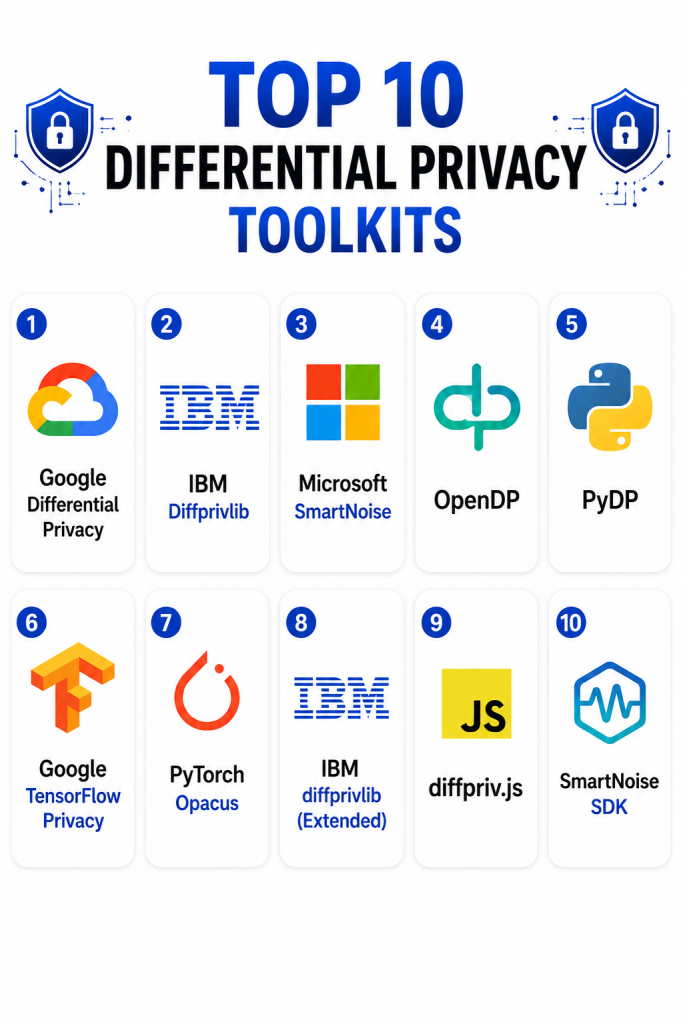
Top 10 Differential Privacy Toolkits
1- Google Differential Privacy
Short description: Google Differential Privacy library offers robust DP implementations for data analytics and machine learning, suitable for large datasets and enterprise use.
Key Features
- Local and global differential privacy models
- Epsilon-based noise calibration
- Integration with TensorFlow and BigQuery
- Privacy budget management tools
- Support for large-scale analytics
- Open-source library with community contributions
Pros
- Enterprise-grade scalability
- Strong integration with Google Cloud analytics
Cons
- Requires programming expertise
- Limited outside Google ecosystem
Platforms / Deployment
- Web / Linux / Cloud / Self-hosted
Security & Compliance
- Supports encrypted data handling
- Not publicly stated for SOC 2 or HIPAA
Integrations & Ecosystem
- TensorFlow, BigQuery
- REST APIs and SDKs
- Python integration for ML workflows
Support & Community
- Active open-source community
- Documentation and tutorials
2- IBM Diffprivlib
Short description: IBM Diffprivlib is a Python library for privacy-preserving analytics and ML model training with differential privacy guarantees.
Key Features
- Global and local DP support
- Integration with scikit-learn
- Privacy budget and noise management
- Open-source Python SDK
- Suitable for AI and analytics pipelines
Pros
- Easy to use for Python developers
- Integrates well with ML workflows
Cons
- Limited to Python environment
- Performance may vary with very large datasets
Platforms / Deployment
- Linux / macOS / Cloud / Self-hosted
Security & Compliance
- Provides privacy-preserving computation
- Not publicly stated for GDPR/HIPAA
Integrations & Ecosystem
- scikit-learn, pandas, NumPy
- REST API and SDK integration
- AI analytics pipelines
Support & Community
- Documentation and examples
- Open-source community support
3- Microsoft SmartNoise
Short description: SmartNoise provides tools for differential privacy in data analytics, supporting AI and enterprise workflows.
Key Features
- Supports SQL, Python, and C#
- Multi-platform deployment
- Privacy budget and noise calibration
- Integration with Azure AI and data pipelines
- Open-source and modular
Pros
- Multi-language support
- Enterprise-ready integration
Cons
- Advanced configuration required
- Performance may vary with complex queries
Platforms / Deployment
- Windows / Linux / Cloud / Self-hosted
Security & Compliance
- Encryption and privacy enforcement
- Not publicly stated for HIPAA/SOC 2
Integrations & Ecosystem
- Azure AI, data pipelines
- SDKs and APIs for integration
- Supports analytics workflows
Support & Community
- Enterprise support available
- Open-source community and documentation
4- OpenDP
Short description: OpenDP is an open-source differential privacy toolkit enabling privacy-preserving statistics and analytics for research and enterprise use.
Key Features
- Statistical functions with DP guarantees
- Privacy budget management
- Cross-language support (Python, R)
- Open-source modular design
- Suitable for research and enterprise pipelines
Pros
- Open-source and extensible
- Supports multiple programming languages
Cons
- Requires knowledge of DP concepts
- Limited performance optimization for very large datasets
Platforms / Deployment
- Linux / Windows / Cloud / Self-hosted
Security & Compliance
- Provides differential privacy enforcement
- Not publicly stated for HIPAA/SOC 2
Integrations & Ecosystem
- Python, R, AI/ML pipelines
- REST API and SDK
- Analytics frameworks
Support & Community
- Community-driven support
- Documentation and examples
5- PyDP
Short description: PyDP is a Python library built on OpenDP, providing accessible differential privacy functions for analytics and ML.
Key Features
- Python SDK for DP
- Supports multiple noise mechanisms
- Privacy budget control
- Integration with AI workflows
- Open-source
Pros
- Easy Python integration
- Rapid prototyping for DP analytics
Cons
- Limited to Python
- May require tuning for large datasets
Platforms / Deployment
- Linux / macOS / Cloud / Self-hosted
Security & Compliance
- DP guarantees
- Not publicly stated for HIPAA/SOC 2
Integrations & Ecosystem
- AI/ML pipelines
- Python SDK and APIs
- Research workflows
Support & Community
- Open-source community
- Documentation and examples
6- Google TensorFlow Privacy
Short description: TensorFlow Privacy adds differential privacy capabilities to AI/ML models built with TensorFlow, enabling privacy-preserving training.
Key Features
- Gradient perturbation for DP-SGD
- Integration with TensorFlow Keras
- Privacy budget monitoring
- Supports federated learning
- Open-source
Pros
- Native TensorFlow integration
- Supports privacy-preserving ML at scale
Cons
- Limited to TensorFlow ecosystem
- Advanced ML knowledge required
Platforms / Deployment
- Linux / Cloud / Self-hosted
Security & Compliance
- Provides DP-based ML training
- Not publicly stated for GDPR/HIPAA
Integrations & Ecosystem
- TensorFlow, Keras, AI pipelines
- Python SDK and APIs
- Federated learning integration
Support & Community
- Strong TensorFlow community
- Documentation and examples
7- PyTorch Opacus
Short description: Opacus is a PyTorch library enabling differential privacy for AI/ML model training in Python.
Key Features
- DP-SGD for model training
- Integration with PyTorch models
- Privacy budget monitoring
- Open-source library
Pros
- Python-native and PyTorch integrated
- Supports scalable ML workloads
Cons
- Requires ML expertise
- Limited to PyTorch ecosystem
Platforms / Deployment
- Linux / Windows / Cloud / Self-hosted
Security & Compliance
- DP guarantees for ML
- Not publicly stated for HIPAA/SOC 2
Integrations & Ecosystem
- PyTorch, AI pipelines
- Python SDK and APIs
- Federated learning support
Support & Community
- Open-source community
- Documentation and tutorials
8- IBM diffprivlib (Extended)
Short description: Extended IBM diffprivlib provides enhanced statistical analysis and ML integration with differential privacy features.
Key Features
- Supports global/local DP
- Integration with Python ML pipelines
- Privacy budget management
- Open-source
Pros
- Strong enterprise support options
- Easy integration with Python workflows
Cons
- Limited language support
- Performance depends on dataset size
Platforms / Deployment
- Linux / macOS / Cloud / Self-hosted
Security & Compliance
- Supports DP privacy guarantees
- Not publicly stated for HIPAA/SOC 2
Integrations & Ecosystem
- AI/ML pipelines
- Python SDK and API
- Analytics frameworks
Support & Community
- Community and enterprise support
- Documentation and examples
9- diffpriv.js
Short description: A JavaScript library providing differential privacy functions for web analytics and AI pipelines in Node.js environments.
Key Features
- Local and global DP functions
- Privacy budget control
- Node.js integration
- Open-source
Pros
- Web and JavaScript-friendly
- Easy integration with analytics pipelines
Cons
- Limited to JavaScript environment
- Smaller community
Platforms / Deployment
- Web / Linux / Cloud
Security & Compliance
- Provides DP guarantees
- Not publicly stated for HIPAA/SOC 2
Integrations & Ecosystem
- Node.js AI/analytics workflows
- REST API and SDK
- Web-based pipelines
Support & Community
- Open-source GitHub support
- Documentation and examples
10- SmartNoise SDK
Short description: SmartNoise SDK provides differential privacy mechanisms for SQL queries, AI pipelines, and analytics in enterprise environments.
Key Features
- SQL-based DP mechanisms
- Integration with Python, R, and AI workflows
- Privacy budget monitoring
- Multi-cloud compatible
- Open-source
Pros
- Enterprise-grade analytics support
- Multi-language and multi-platform
Cons
- Advanced configuration may be needed
- Performance varies by query complexity
Platforms / Deployment
- Linux / Windows / Cloud / Self-hosted
Security & Compliance
- Supports DP guarantees
- Not publicly stated for HIPAA/SOC 2
Integrations & Ecosystem
- SQL, Python, R, AI pipelines
- REST APIs and SDK
- Analytics frameworks
Support & Community
- Documentation and examples
- Open-source community support
Comparison Table (Top 10)
| Tool Name | Best For | Platform(s) Supported | Deployment | Standout Feature | Public Rating |
|---|---|---|---|---|---|
| Google Differential Privacy | Large-scale analytics | Web, Linux, Cloud | Cloud / Self-hosted | Enterprise scalability | N/A |
| IBM Diffprivlib | Python ML | Linux, macOS | Cloud / Self-hosted | Python integration | N/A |
| Microsoft SmartNoise | AI/ML pipelines | Windows, Linux | Cloud / Self-hosted | Multi-language support | N/A |
| OpenDP | Research & enterprise | Linux, Windows | Cloud / Self-hosted | Modular open-source | N/A |
| PyDP | Python ML | Linux, macOS | Cloud / Self-hosted | Python SDK | N/A |
| TensorFlow Privacy | TensorFlow ML | Linux | Cloud / Self-hosted | DP-SGD for ML | N/A |
| PyTorch Opacus | PyTorch ML | Linux, Windows | Cloud / Self-hosted | DP-SGD PyTorch integration | N/A |
| IBM diffprivlib (Extended) | Enterprise AI | Linux, macOS | Cloud / Self-hosted | Enhanced DP ML integration | N/A |
| diffpriv.js | Web analytics | Web / Node.js | Cloud | JavaScript-based DP | N/A |
| SmartNoise SDK | SQL & ML pipelines | Linux, Windows | Cloud / Self-hosted | SQL DP integration | N/A |
Evaluation & Scoring of Differential Privacy Toolkits
| Tool Name | Core (25%) | Ease (15%) | Integrations (15%) | Security (10%) | Performance (10%) | Support (10%) | Value (15%) | Weighted Total |
|---|---|---|---|---|---|---|---|---|
| Google Differential Privacy | 9 | 8 | 8 | 9 | 9 | 7 | 8 | 8.5 |
| IBM Diffprivlib | 8 | 9 | 8 | 8 | 8 | 7 | 8 | 8.1 |
| Microsoft SmartNoise | 8 | 8 | 8 | 8 | 8 | 7 | 8 | 8.0 |
| OpenDP | 8 | 7 | 8 | 8 | 8 | 7 | 7 | 7.7 |
| PyDP | 8 | 9 | 8 | 8 | 7 | 7 | 7 | 7.8 |
| TensorFlow Privacy | 9 | 8 | 8 | 9 | 9 | 7 | 8 | 8.4 |
| PyTorch Opacus | 9 | 8 | 8 | 9 | 9 | 7 | 8 | 8.4 |
| IBM diffprivlib (Extended) | 8 | 8 | 8 | 8 | 8 | 7 | 8 | 8.0 |
| diffpriv.js | 7 | 9 | 7 | 8 | 7 | 7 | 7 | 7.4 |
| SmartNoise SDK | 8 | 8 | 8 | 8 | 8 | 7 | 8 | 7.9 |
Interpretation: Higher weighted totals indicate stronger suitability for enterprise AI/ML, secure analytics, and privacy-preserving workflows. Scores are comparative and reflect features, ease of use, and integration capabilities.
Which Differential Privacy Toolkit Is Right for You?
Solo / Freelancer
Python libraries like PyDP or diffpriv.js are ideal for experimentation, small datasets, and quick analytics.
SMB
IBM Diffprivlib or Microsoft SmartNoise provide scalable DP features with manageable complexity.
Mid-Market
TensorFlow Privacy or PyTorch Opacus enable scalable privacy-preserving AI/ML workflows for analytics and modeling.
Enterprise
Google Differential Privacy, OpenDP, and SmartNoise SDK provide enterprise-grade compliance, scalability, and multi-platform integration.
Budget vs Premium
Open-source toolkits minimize cost but require technical expertise. Enterprise SDKs offer support, governance, and professional services.
Feature Depth vs Ease of Use
Enterprise-grade toolkits offer extensive DP features and performance optimizations; Python/JS libraries are easier for rapid prototyping.
Integrations & Scalability
Enterprise toolkits integrate across AI, ML, and analytics pipelines, while simpler SDKs are suited for smaller or experimental workloads.
Security & Compliance Needs
Regulated industries should prioritize Google Differential Privacy, TensorFlow Privacy, or SmartNoise SDK for stronger compliance and privacy guarantees.
Frequently Asked Questions (FAQs)
1- What types of differential privacy are supported?
Global DP, local DP, and epsilon-based mechanisms, each balancing privacy and accuracy.
2- How do these toolkits integrate with ML workflows?
They provide SDKs, APIs, and Python/JS libraries to enable privacy-preserving analytics and AI model training.
3- Are these toolkits open-source?
Most are open-source (Google DP, OpenDP, PyDP) with enterprise distribution options available.
4- How does privacy budget management work?
Noise is calibrated based on a defined epsilon, controlling privacy leakage over multiple queries or model iterations.
5- Can multiple organizations collaborate using DP?
Yes, differential privacy allows aggregated insights without exposing individual-level data.
6- Are these toolkits suitable for cloud deployment?
Yes, all toolkits support cloud, hybrid, or on-premises deployments for analytics and AI pipelines.
7- How long does it take to implement?
Small Python projects may take days; enterprise deployments may require weeks for integration and training.
8- Do they comply with regulations?
DP provides technical privacy guarantees. Compliance depends on deployment, auditing, and data governance practices.
9- Are there alternatives?
Secure multi-party computation, homomorphic encryption, and confidential computing platforms can complement DP.
10- Is programming knowledge required?
Yes, integrating DP into ML pipelines requires understanding of SDKs, APIs, and privacy concepts.
Conclusion
Differential Privacy Toolkits are essential for enabling privacy-preserving AI/ML, analytics, and collaborative data processing. Small teams benefit from PyDP or diffpriv.js for experimentation, while mid-market organizations can leverage TensorFlow Privacy or PyTorch Opacus for scalable AI/ML workflows. Enterprises handling sensitive data should consider Google Differential Privacy, OpenDP, or SmartNoise SDK for compliance, multi-platform integration, and enterprise-grade privacy. Recommended next steps include shortlisting 2–3 toolkits, piloting privacy-preserving workflows, and validating integration with AI pipelines and compliance frameworks to ensure secure and scalable data operations.
