Introduction
Digital Wallet SDKs are software development kits that help businesses add wallet-based payment, card, identity, ticketing, loyalty, or Web3 wallet experiences into websites, mobile apps, and digital products. In simple terms, they give developers ready-made tools to connect users with wallets such as Apple Pay, Google Wallet, Samsung Wallet, PayPal, cards, passes, crypto wallets, and embedded payment flows without building every wallet function from scratch.
Digital Wallet SDKs matter now because customers expect faster checkout, secure authentication, tokenized payments, mobile-first experiences, and smooth app-to-wallet journeys. Businesses use them for mobile payments, stored passes, loyalty cards, transit tickets, event access, in-app checkout, subscription payments, digital identity, and Web3 wallet connections.
What buyers should evaluate:
- Supported wallet types and payment methods
- iOS, Android, web, and cross-platform compatibility
- Tokenization and authentication support
- Developer documentation and SDK maturity
- Checkout conversion and user experience
- Security, encryption, and fraud controls
- API flexibility and webhook support
- Regional availability and currency coverage
- Compliance responsibilities
- Pricing and transaction cost structure
Best for: Digital Wallet SDKs are best for fintech teams, e-commerce brands, SaaS companies, marketplaces, mobile app developers, travel platforms, ticketing businesses, loyalty programs, banks, payment providers, and Web3 product teams that want secure wallet experiences inside their products.
Not ideal for: Digital Wallet SDKs may not be ideal for businesses that only need manual bank transfer workflows, very small websites with no mobile checkout demand, teams without developer support, or companies that need a full core banking system rather than wallet integration tools.
Key Trends in Digital Wallet SDKs
- Passkeys and biometric authentication are becoming standard: Digital wallets increasingly rely on face recognition, fingerprint authentication, secure device unlock, and passkeys to reduce friction while improving security.
- Tokenization is now a core payment expectation: Modern wallet SDKs reduce card exposure by replacing sensitive payment credentials with secure tokens during transactions.
- Wallets are expanding beyond payments: Businesses now use wallet SDKs for boarding passes, coupons, loyalty cards, transit passes, identity credentials, membership cards, and event tickets.
- Embedded finance is pushing wallet adoption: SaaS platforms, marketplaces, payroll apps, and fintech products are embedding wallet-like experiences for payouts, cards, rewards, and stored balances.
- Web3 wallet SDKs are becoming more user-friendly: WalletConnect, Coinbase Wallet SDK, and similar tools are helping dApps simplify wallet connections, signing, and cross-chain user journeys.
- Cross-platform checkout is a major buying factor: Buyers want SDKs that support iOS, Android, web, mobile web, and app-based checkout with consistent user experience.
- AI-powered fraud detection is becoming more relevant: Payment platforms are using automated risk scoring, behavioral signals, and transaction monitoring to identify suspicious wallet activity.
- Regulatory expectations are rising: Teams must evaluate PCI scope, data protection, customer consent, authentication, transaction monitoring, and region-specific payment rules.
- Super-app and marketplace use cases are growing: Platforms want wallet SDKs that can support payments, loyalty, identity, rewards, and stored credentials in one experience.
- Developer experience is a competitive differentiator: Clear SDKs, sandbox environments, testing tools, sample code, and stable APIs are now essential for adoption.
How We Selected These Tools
- Chose SDKs and platforms with strong market recognition in payments, mobile wallets, digital passes, or wallet connectivity.
- Prioritized tools that developers can realistically integrate into web, mobile, or app-based products.
- Balanced payment wallet SDKs, mobile wallet APIs, checkout SDKs, and Web3 wallet connection SDKs.
- Considered feature completeness across tokenization, checkout, wallet provisioning, pass support, identity, and APIs.
- Evaluated fit for different buyer types, including startups, SMBs, marketplaces, enterprises, fintechs, and developers.
- Considered ecosystem strength, including mobile OS support, payment processors, app platforms, and developer communities.
- Avoided unsupported claims about ratings, certifications, or compliance where details are not clearly known.
- Focused on practical buyer value rather than hype, including implementation complexity, scalability, and real-world trade-offs.
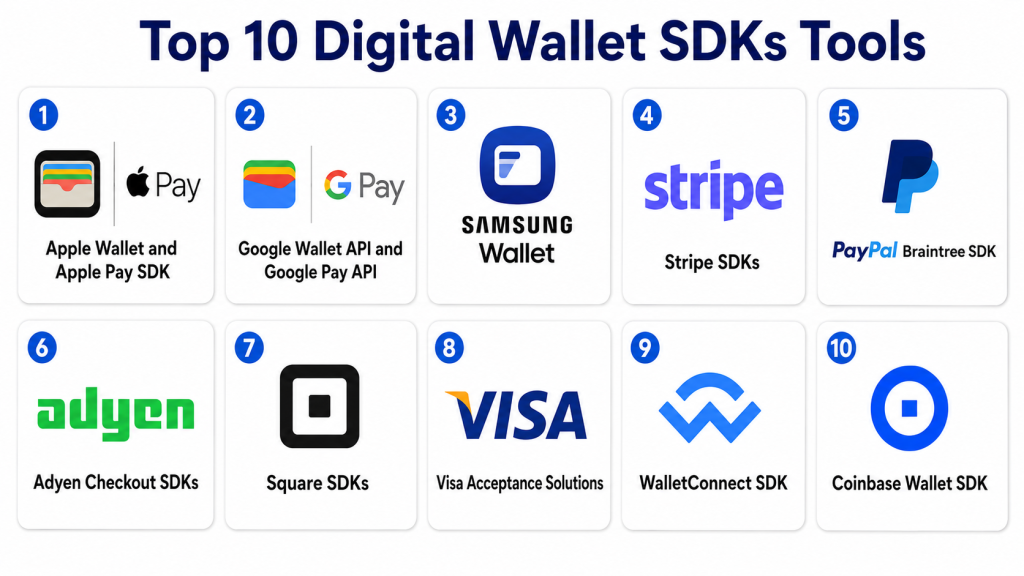
Top 10 Digital Wallet SDKs Tools
#1 — Apple Wallet and Apple Pay SDK
Short description: Apple Wallet and Apple Pay SDKs help businesses add secure wallet payments, passes, loyalty cards, tickets, boarding passes, and mobile-first wallet experiences for Apple users. They are especially valuable for iOS apps, Safari checkout, travel brands, retail businesses, event platforms, banks, fintechs, and loyalty programs. Apple Pay focuses on secure, tokenized payments, while Apple Wallet supports digital passes and stored credentials. The SDK is highly trusted because it is deeply integrated into Apple devices and biometric authentication. It is best for companies with a strong iPhone, iPad, Apple Watch, or Safari customer base. However, it is limited to Apple’s ecosystem and usually needs additional payment or pass infrastructure.
Key Features
- Apple Pay support for iOS apps, Safari, and compatible checkout flows
- Apple Wallet support for passes, tickets, loyalty cards, and boarding passes
- Device-based authentication using Face ID, Touch ID, or passcode
- Tokenized payment credentials for safer transactions
- Support for in-app and web-based wallet experiences
- Strong user experience across iPhone, Apple Watch, iPad, and Mac
- Useful for travel, retail, events, banking, and loyalty use cases
Pros
- Very strong trust and adoption among Apple users.
- Smooth mobile checkout and pass storage experience.
- Excellent fit for brands focused on iOS-first customer journeys.
Cons
- Limited to Apple ecosystem users.
- Requires Apple developer setup and correct payment processor support.
- Customization is more controlled compared with fully custom wallet systems.
Platforms / Deployment
iOS / iPadOS / watchOS / macOS / Web / Cloud
Security & Compliance
Apple Pay uses tokenization and device-based authentication. Apple Wallet and Apple Pay are built around privacy-focused device security. Specific business compliance responsibilities such as PCI scope, data handling, and merchant obligations should be validated based on the payment processor and implementation model.
Integrations & Ecosystem
Apple Wallet and Apple Pay integrate with payment processors, banks, card networks, e-commerce platforms, airline systems, event ticketing platforms, loyalty systems, and travel apps. The ecosystem is strongest when businesses already serve a large Apple user base.
- Payment processors and gateways
- iOS and Safari checkout flows
- Loyalty and rewards systems
- Ticketing and event platforms
- Travel and boarding pass systems
- Banking and card issuer programs
Support & Community
Apple provides official developer documentation, SDK guides, platform rules, and developer support resources. Community support is strong among iOS developers, but businesses may need experienced Apple ecosystem developers for advanced implementations.
#2 — Google Wallet API and Google Pay API
Short description: Google Wallet API and Google Pay API help businesses enable wallet payments, passes, loyalty cards, tickets, transit cards, offers, and Android-first wallet experiences. Google Pay focuses on secure payment flows, while Google Wallet supports stored passes and digital credentials. These tools are useful for e-commerce brands, Android apps, fintechs, ticketing companies, airlines, retailers, and loyalty programs. They are especially valuable for companies with large Android customer bases or mobile web checkout flows. Google’s wallet ecosystem supports quick payment experiences and practical pass management. Buyers should confirm regional availability, supported features, and integration requirements before choosing it.
Key Features
- Google Pay support for online, in-app, and Android checkout flows
- Google Wallet support for passes, tickets, loyalty cards, and offers
- Tokenized payment support through compatible payment providers
- Android-native wallet experience
- Support for mobile web and app-based checkout
- Useful for retail, travel, ticketing, transit, and loyalty use cases
- Developer APIs for pass creation and wallet integration
Pros
- Strong fit for Android-first mobile products.
- Supports both payments and non-payment wallet assets.
- Useful for brands that want mobile passes and fast checkout.
Cons
- Feature availability can vary by country and wallet type.
- Requires correct integration with payment processors or pass systems.
- Not a full custom wallet infrastructure platform by itself.
Platforms / Deployment
Android / Web / Cloud
Security & Compliance
Google Pay supports tokenized payments through supported payment providers and device-level security flows. Google Wallet use cases vary by pass type and region. Buyers should validate payment security responsibilities, data handling, PCI scope, and customer consent requirements for their implementation.
Integrations & Ecosystem
Google Wallet and Google Pay connect with Android apps, payment gateways, e-commerce platforms, loyalty systems, travel platforms, event ticketing tools, and mobile web checkout experiences.
- Android applications
- Payment gateways and processors
- E-commerce checkout systems
- Loyalty and coupon platforms
- Event and ticketing systems
- Transit and travel applications
Support & Community
Google provides developer documentation, API guides, sample code, and platform-specific implementation resources. Community support is strong because Android and web developers widely work with Google payment and wallet tools.
#3 — Samsung Wallet
Short description: Samsung Wallet helps businesses support wallet experiences for Samsung device users, including payments, passes, digital keys, tickets, loyalty cards, and identity-related experiences where available. It is most relevant for companies that want broader Android device coverage beyond Google Wallet, especially in markets where Samsung devices have strong adoption. Samsung Wallet can support retail, travel, ticketing, loyalty, access, and card-related use cases. It gives brands another route to reach mobile-first customers who use Samsung phones and wearables. The platform can be valuable for enterprises and consumer brands building multi-wallet strategies. Buyers should confirm regional availability and supported wallet object types before implementation.
Key Features
- Samsung Wallet support for compatible Samsung devices
- Payment, pass, ticket, and loyalty-related wallet use cases
- Support for selected digital key and identity-style experiences where available
- Mobile-first wallet experience for Samsung users
- Integration options for brands, issuers, and service providers
- Useful for retail, travel, events, automotive, and loyalty programs
- Complements Apple Wallet and Google Wallet in multi-wallet strategies
Pros
- Strong fit for Samsung-heavy customer bases.
- Useful for brands building multi-wallet coverage.
- Can support more than simple payment use cases.
Cons
- Availability and feature support vary by region and device.
- Smaller developer mindshare than Apple and Google wallet ecosystems.
- May require additional planning for multi-wallet consistency.
Platforms / Deployment
Android / Samsung Devices / Cloud
Security & Compliance
Samsung Wallet uses device-level security and wallet controls in supported environments. Specific compliance details, certifications, and business responsibilities should be verified based on the use case, region, and partner integration model.
Integrations & Ecosystem
Samsung Wallet integrates with supported payment, pass, key, loyalty, ticketing, and identity partners. It is often used as part of a broader wallet strategy rather than as the only wallet integration.
- Samsung mobile apps
- Retail loyalty systems
- Event and ticketing platforms
- Payment and card programs
- Travel and transport systems
- Digital key and access use cases
Support & Community
Samsung provides developer and partner resources for wallet-related integrations. Support and onboarding may depend on business type, country, wallet object type, and partnership requirements.
#4 — Stripe SDKs
Short description: Stripe SDKs help developers integrate digital wallet payments, mobile checkout, saved payment methods, cards, subscriptions, marketplace payments, and embedded financial experiences into apps and websites. Stripe supports wallet payment methods such as Apple Pay and Google Pay through eligible integrations and regions. It is especially strong for SaaS companies, e-commerce businesses, marketplaces, creator platforms, and fintech startups that want developer-friendly payment infrastructure. Stripe’s SDK ecosystem includes mobile SDKs, web checkout components, Payment Element, customer management, billing, fraud tools, and reporting. It is a strong choice when the wallet experience is part of a broader payments stack. Buyers should verify wallet availability by country, payment method, and business model.
Key Features
- Support for wallet payments through compatible payment methods
- Web and mobile SDKs for checkout and payment collection
- Payment Element and prebuilt checkout options
- Support for subscriptions, invoices, marketplaces, and platform payments
- Fraud prevention tools and risk workflows
- Developer-friendly APIs, webhooks, and dashboards
- Broad ecosystem for SaaS, e-commerce, and marketplace payments
Pros
- Excellent developer experience and documentation.
- Strong fit when wallet payments are part of a larger payments strategy.
- Useful for startups, SMBs, and enterprises building scalable checkout.
Cons
- Wallet availability varies by country and payment method.
- Advanced customization may require careful API design.
- Pricing can become complex across multiple products and payment flows.
Platforms / Deployment
Web / iOS / Android / API / Cloud
Security & Compliance
Stripe supports secure payment processing, tokenization-based payment flows, fraud tools, and compliance-oriented payment infrastructure. Specific certifications, SSO, audit logs, and compliance scope should be validated based on the products used and region.
Integrations & Ecosystem
Stripe integrates with commerce platforms, subscription systems, accounting tools, marketplaces, analytics systems, tax tools, fraud workflows, and custom applications. Its ecosystem is one of the strongest for wallet-enabled payments.
- E-commerce platforms
- SaaS billing systems
- Marketplaces and platform apps
- Accounting and finance tools
- Fraud and identity tools
- Data and analytics workflows
Support & Community
Stripe provides extensive documentation, API references, sample projects, developer support, and community resources. Enterprise support and onboarding may vary by plan, contract, and product usage.
#5 — PayPal Braintree SDK
Short description: PayPal Braintree SDK helps businesses accept PayPal, cards, Venmo where available, Apple Pay, Google Pay, and other payment methods through web and mobile applications. It is useful for merchants, marketplaces, mobile apps, and subscription businesses that want wallet-friendly checkout with broad consumer recognition. Braintree is often selected when PayPal acceptance is important alongside card and wallet payments. The SDK supports web, iOS, and Android integrations, making it practical for app-based commerce. It is especially relevant for businesses that want multiple payment methods without building separate integrations for each one. Buyers should verify regional wallet support, Venmo availability, and payment method coverage.
Key Features
- PayPal wallet support
- Apple Pay and Google Pay support where available
- Card payment acceptance through SDKs
- Web, iOS, and Android integration options
- Support for recurring and marketplace-style payment use cases
- Fraud and risk tools depending on setup
- Developer documentation and sandbox testing
Pros
- Strong consumer trust through PayPal brand recognition.
- Useful for merchants that want several wallet payment methods.
- Good fit for mobile apps and web checkout flows.
Cons
- Payment method availability varies by country.
- Advanced platform payment flows may require extra planning.
- Customization may feel less flexible than building directly with lower-level APIs.
Platforms / Deployment
Web / iOS / Android / Cloud
Security & Compliance
Braintree supports secure payment processing and tokenized payment workflows. Buyers should validate PCI scope, fraud tooling, access controls, and any compliance requirements based on country and payment method configuration.
Integrations & Ecosystem
Braintree integrates with PayPal, cards, mobile checkout flows, marketplace applications, e-commerce platforms, and business payment systems. Its ecosystem is especially useful when PayPal wallet acceptance is important.
- PayPal checkout
- Mobile commerce apps
- E-commerce platforms
- Subscription billing flows
- Marketplace payment workflows
- Fraud and payment operations tools
Support & Community
Braintree offers developer documentation, SDK references, sandbox support, and PayPal ecosystem resources. Support availability may vary by merchant size, region, and commercial agreement.
#6 — Adyen Checkout SDKs
Short description: Adyen Checkout SDKs help businesses accept cards, digital wallets, local payment methods, and mobile checkout flows across web, iOS, Android, and in-person channels. Adyen is especially strong for enterprise merchants, marketplaces, global commerce platforms, and businesses operating across multiple countries. Its SDKs are useful when wallet payments need to sit inside a broader payment orchestration, fraud, acquiring, and reconciliation strategy. Adyen supports many payment methods and is often used by brands that need international scale. It is better suited for serious commerce operations than very small businesses with basic checkout needs. Buyers should evaluate implementation complexity, regional coverage, and commercial model.
Key Features
- Web, iOS, and Android checkout SDKs
- Support for cards, wallets, and local payment methods
- Unified commerce support across online and in-person channels
- Risk management and payment optimization capabilities
- Global acquiring and multi-region payment coverage
- Marketplace and platform payment support
- Reporting, reconciliation, and payment operations tools
Pros
- Strong fit for global merchants and enterprise platforms.
- Broad payment method and regional coverage.
- Good option when wallet payments are part of complex payment operations.
Cons
- May be more complex than needed for small merchants.
- Implementation can require payment operations expertise.
- Pricing and commercial terms are often use-case specific.
Platforms / Deployment
Web / iOS / Android / API / Cloud
Security & Compliance
Adyen provides enterprise-grade payment infrastructure with security and compliance controls relevant to payment processing. Buyers should validate specific certifications, access controls, audit capabilities, and compliance responsibilities during procurement.
Integrations & Ecosystem
Adyen integrates with e-commerce platforms, marketplaces, POS systems, ERP tools, fraud systems, and finance operations workflows. It is strong for businesses that need wallet payments within a global payment stack.
- E-commerce platforms
- POS and in-store payment systems
- Marketplaces and platforms
- ERP and finance systems
- Risk and fraud workflows
- Reporting and reconciliation tools
Support & Community
Adyen provides documentation, developer resources, implementation support, and enterprise customer success options. Support depth may depend on region, business size, and contract.
#7 — Square SDKs
Short description: Square SDKs help businesses add payments, checkout, in-app payments, point-of-sale workflows, and wallet-friendly commerce experiences into apps and websites. Square is especially useful for small businesses, retail stores, restaurants, service providers, and businesses that combine online and in-person selling. Its SDKs and APIs support payment acceptance, catalog workflows, orders, customer data, and POS-related experiences. Square can support digital wallet acceptance through eligible payment flows and hardware or online checkout configurations. It is a practical option for teams that want payments plus business operations tools. However, it may not be the best fit for highly customized fintech wallet infrastructure.
Key Features
- Online and in-app payment SDKs
- Support for wallet-friendly checkout where available
- Point-of-sale and in-person payment ecosystem
- Orders, catalog, customer, and payment APIs
- Useful for retail, restaurants, and service businesses
- Developer APIs for custom commerce workflows
- Business dashboard and operational tools
Pros
- Strong fit for SMB commerce and in-person businesses.
- Combines payments with business management tools.
- Practical for hybrid online and offline selling.
Cons
- Less specialized for custom wallet infrastructure.
- Advanced enterprise or fintech use cases may require other providers.
- Feature availability can vary by country and product.
Platforms / Deployment
Web / iOS / Android / Cloud
Security & Compliance
Square provides secure payment processing infrastructure. Specific security controls, PCI responsibilities, wallet support, access controls, and compliance scope should be verified based on implementation and region.
Integrations & Ecosystem
Square integrates with retail systems, POS hardware, e-commerce tools, restaurant workflows, booking systems, accounting tools, and custom apps. Its ecosystem is strongest for commerce operations.
- POS systems
- E-commerce stores
- Restaurant platforms
- Appointment and booking tools
- Accounting systems
- Custom commerce applications
Support & Community
Square offers developer documentation, business support resources, and ecosystem guides. Community strength is strong among small business users and commerce developers.
#8 — Visa Acceptance Solutions
Short description: Visa Acceptance Solutions provides payment acceptance, tokenization, risk, and digital payment capabilities for businesses that need enterprise-grade payment infrastructure. It is relevant for companies that want to support digital wallet payments, card acceptance, fraud controls, and payment orchestration through Visa’s payment ecosystem. The platform is especially useful for enterprise merchants, payment providers, fintechs, and businesses with complex card and wallet acceptance needs. It can support secure payment flows, tokenized transactions, and global commerce requirements. Visa’s ecosystem strength comes from its payments network and financial services reach. Buyers should evaluate implementation scope, regional support, and whether the platform is too enterprise-focused for their needs.
Key Features
- Payment acceptance infrastructure
- Digital wallet and card payment support through compatible flows
- Tokenization and secure payment processing capabilities
- Fraud and risk management tools
- Enterprise payment orchestration support
- Global payment network relevance
- APIs and integration options for payment workflows
Pros
- Strong fit for enterprise payment environments.
- Useful for secure card and wallet acceptance strategies.
- Backed by a large global payment ecosystem.
Cons
- May be complex for small businesses or simple checkout needs.
- Product packaging and availability can vary.
- Implementation may require payment operations and integration expertise.
Platforms / Deployment
Web / API / Cloud / Varies / N/A
Security & Compliance
Visa operates within global payment security and compliance environments. Buyers should verify exact security controls, PCI responsibilities, tokenization scope, audit features, and contractual compliance details for their implementation.
Integrations & Ecosystem
Visa Acceptance Solutions integrates with enterprise payment systems, merchant platforms, card networks, risk tools, payment orchestration systems, and commerce applications. It is best suited for organizations needing payment infrastructure depth.
- Enterprise commerce platforms
- Payment orchestration systems
- Risk and fraud tools
- Merchant systems
- Card and wallet payment flows
- Reporting and settlement workflows
Support & Community
Support is typically business and enterprise focused. Documentation, onboarding, and technical support availability may vary by product, region, and commercial relationship.
#9 — WalletConnect SDK
Short description: WalletConnect SDK is a widely used Web3 wallet connection toolkit that helps decentralized applications connect users to crypto wallets across mobile, desktop, and browser environments. It is especially valuable for dApp developers, NFT platforms, DeFi products, DAO tools, identity apps, and blockchain-based consumer products. WalletConnect focuses on secure wallet-to-app connections, transaction signing, and multichain wallet interoperability. It is not a traditional payment wallet SDK for card checkout, but it is highly relevant for Web3 digital wallet experiences. The platform is useful when developers want users to connect their existing crypto wallets instead of creating a new wallet from scratch. Buyers should evaluate blockchain support, security model, user experience, and wallet compatibility.
Key Features
- Web3 wallet connection support
- Multichain wallet interoperability
- Mobile, desktop, and browser wallet connection flows
- Transaction signing and authentication support
- Developer SDKs for dApps and wallets
- Useful for DeFi, NFT, DAO, gaming, and identity apps
- Broad wallet ecosystem compatibility
Pros
- Strong wallet connection standard in Web3 ecosystems.
- Useful for apps that need broad crypto wallet compatibility.
- Helps reduce friction between dApps and user wallets.
Cons
- Not designed for traditional card or bank wallet checkout.
- Web3 wallet UX can still be complex for mainstream users.
- Security depends heavily on implementation and user signing behavior.
Platforms / Deployment
Web / iOS / Android / JavaScript / Cloud / Self-hosted components vary
Security & Compliance
WalletConnect supports secure wallet connection flows, but buyers should validate key management, signing policies, phishing protection, session handling, and compliance requirements based on the application type. Certifications are not publicly stated for all use cases.
Integrations & Ecosystem
WalletConnect integrates with many crypto wallets, dApps, DeFi protocols, NFT platforms, blockchain games, and Web3 infrastructure providers. Its ecosystem is one of the strongest for wallet connectivity.
- Crypto wallets
- DeFi applications
- NFT marketplaces
- DAO platforms
- Blockchain games
- Web3 identity tools
Support & Community
WalletConnect has developer documentation, SDK resources, ecosystem adoption, and strong Web3 community awareness. Support may vary by product tier, implementation type, and developer needs.
#10 — Coinbase Wallet SDK
Short description: Coinbase Wallet SDK helps developers connect decentralized applications to Coinbase Wallet across mobile, browser, and web-based Web3 experiences. It is designed for developers building DeFi apps, NFT platforms, crypto games, DAO tools, identity products, and blockchain applications. The SDK simplifies wallet connection and user onboarding for people who already use Coinbase Wallet or want a recognized wallet brand. It is not a general-purpose card payment wallet SDK, but it is important for Web3 wallet access and crypto transaction signing. Coinbase Wallet SDK is useful when trust, wallet recognition, and EVM ecosystem access matter. Buyers should compare it with WalletConnect when deciding how broad their wallet compatibility needs to be.
Key Features
- Coinbase Wallet connection support
- Web3 authentication and transaction signing
- Mobile and browser wallet connectivity
- Useful for dApps, NFT platforms, DeFi tools, and crypto apps
- Developer SDKs and integration resources
- Support for blockchain-based user journeys
- Helps simplify onboarding for Coinbase Wallet users
Pros
- Strong brand recognition in crypto and Web3.
- Practical for dApps targeting Coinbase Wallet users.
- Useful for developers who want a direct wallet connection path.
Cons
- More limited than multi-wallet connection layers for broad wallet support.
- Not suitable for traditional card-based digital wallet payments.
- Web3 user education and signing risks still need careful UX design.
Platforms / Deployment
Web / iOS / Android / Browser Extension / Cloud
Security & Compliance
Coinbase Wallet SDK supports wallet-based transaction signing and user-controlled wallet interactions. Buyers should verify security assumptions, signing flows, phishing protections, and compliance needs based on their dApp or Web3 product model. Certifications for the SDK-specific use case are not publicly stated.
Integrations & Ecosystem
Coinbase Wallet SDK integrates with decentralized applications, NFT products, DeFi protocols, blockchain games, DAO tools, and Web3 infrastructure. It is especially relevant for EVM-based user journeys.
- DeFi applications
- NFT platforms
- DAO tools
- Blockchain games
- Web3 identity apps
- EVM ecosystem tools
Support & Community
Coinbase provides developer documentation and wallet integration resources. Community support is strong within Web3 developer circles, though enterprise support expectations should be confirmed directly.
Comparison Table
| Tool Name | Best For | Platform(s) Supported | Deployment | Standout Feature | Public Rating |
|---|---|---|---|---|---|
| Apple Wallet and Apple Pay SDK | iOS payments, passes, tickets, and loyalty | iOS / iPadOS / watchOS / macOS / Web | Cloud | Deep Apple ecosystem integration | N/A |
| Google Wallet API and Google Pay API | Android wallet payments, passes, and offers | Android / Web | Cloud | Strong Android wallet and pass support | N/A |
| Samsung Wallet | Samsung device wallet experiences | Android / Samsung Devices | Cloud | Samsung-focused wallet, pass, and digital key use cases | N/A |
| Stripe SDKs | Developer-first wallet-enabled payments | Web / iOS / Android / API | Cloud | Broad checkout, payments, and wallet method support | N/A |
| PayPal Braintree SDK | PayPal, card, and wallet checkout | Web / iOS / Android | Cloud | PayPal wallet plus multi-method checkout | N/A |
| Adyen Checkout SDKs | Enterprise and global wallet payments | Web / iOS / Android / API | Cloud | Global payment method coverage and orchestration | N/A |
| Square SDKs | SMB commerce and in-person wallet payments | Web / iOS / Android | Cloud | Payments plus POS and business operations ecosystem | N/A |
| Visa Acceptance Solutions | Enterprise payment and wallet acceptance | Web / API | Cloud / Varies | Network-backed enterprise payment infrastructure | N/A |
| WalletConnect SDK | Web3 wallet connectivity | Web / iOS / Android / JavaScript | Hybrid / Varies | Multichain wallet-to-dApp connection standard | N/A |
| Coinbase Wallet SDK | Coinbase Wallet dApp integrations | Web / iOS / Android / Browser Extension | Cloud | Direct Coinbase Wallet connection for Web3 apps | N/A |
Evaluation & Scoring of Digital Wallet SDKs
| Tool Name | Core (25%) | Ease (15%) | Integrations (15%) | Security (10%) | Performance (10%) | Support (10%) | Value (15%) | Weighted Total (0–10) |
| Apple Wallet and Apple Pay SDK | 9.0 | 8.2 | 8.5 | 9.2 | 9.0 | 8.0 | 8.2 | 8.62 |
| Google Wallet API and Google Pay API | 8.8 | 8.4 | 8.5 | 8.8 | 8.8 | 8.0 | 8.3 | 8.54 |
| Samsung Wallet | 7.8 | 7.5 | 7.2 | 8.3 | 8.0 | 7.2 | 7.5 | 7.65 |
| Stripe SDKs | 9.2 | 9.0 | 9.3 | 8.8 | 9.0 | 8.6 | 8.5 | 8.98 |
| PayPal Braintree SDK | 8.4 | 8.2 | 8.3 | 8.4 | 8.3 | 8.0 | 8.0 | 8.24 |
| Adyen Checkout SDKs | 9.0 | 7.8 | 8.8 | 9.0 | 9.0 | 8.5 | 7.8 | 8.56 |
| Square SDKs | 8.0 | 8.5 | 8.0 | 8.2 | 8.2 | 8.0 | 8.3 | 8.16 |
| Visa Acceptance Solutions | 8.5 | 7.2 | 8.3 | 9.0 | 8.8 | 8.0 | 7.5 | 8.18 |
| WalletConnect SDK | 8.6 | 8.0 | 9.0 | 8.0 | 8.3 | 8.5 | 8.7 | 8.50 |
| Coinbase Wallet SDK | 8.0 | 8.2 | 8.0 | 8.0 | 8.2 | 8.0 | 8.2 | 8.09 |
These scores are comparative and should not be treated as universal product ratings. A high score means the SDK performs strongly across the selected criteria, but the right choice depends on your wallet type, platform, region, user base, and technical model. For example, Apple Wallet is strong for iOS-first experiences, Google Wallet is stronger for Android coverage, Stripe is excellent for payment-led wallet checkout, and WalletConnect is better for Web3 wallet connectivity. Buyers should use the table to shortlist options, then validate SDK behavior in a real sandbox or pilot.
Which Digital Wallet SDK Tool Is Right for You?
Solo / Freelancer
Solo developers and freelancers should avoid overcomplicated wallet infrastructure unless they are building a wallet-focused product. For simple payment acceptance, Stripe SDKs, PayPal Braintree SDK, or Square SDKs are practical options because they reduce development effort and provide prebuilt payment flows. For iOS-only apps, Apple Pay support may be enough. For Android-first apps, Google Pay may be the most practical starting point.
For Web3 freelancers building dApps, WalletConnect SDK or Coinbase Wallet SDK may be better choices. The key is to match the SDK to the user journey rather than trying to support every wallet from day one.
SMB
SMBs should focus on SDKs that improve checkout conversion, reduce payment friction, and support the devices their customers already use. Stripe SDKs are a strong fit for online businesses, SaaS platforms, and app-based checkout. Square SDKs are useful for retail, restaurants, and service businesses that combine online and offline payments. PayPal Braintree SDK is useful when PayPal wallet acceptance is important.
SMBs should not choose a wallet SDK only because it is popular. They should review customer device mix, country coverage, supported payment methods, integration workload, and settlement reporting before deciding.
Mid-Market
Mid-market companies usually need more flexibility, stronger reporting, broader payment coverage, and better integration with finance systems. Stripe, Adyen, and Braintree are strong candidates for payment-heavy wallet experiences. Apple Wallet, Google Wallet, and Samsung Wallet may be added for passes, loyalty, tickets, or device-native wallet support. Web3 companies may use WalletConnect and Coinbase Wallet SDK together for broader user access.
At this stage, businesses should test wallet adoption, checkout success rates, failure handling, refunds, reconciliation, fraud alerts, and customer support workflows. Wallet SDK selection should involve product, engineering, finance, and security teams.
Enterprise
Enterprises need wallet SDKs that support scale, governance, regional coverage, compliance review, strong documentation, and long-term vendor stability. Adyen Checkout SDKs and Visa Acceptance Solutions are strong candidates for complex global payment environments. Stripe may also work well for enterprises that prioritize developer velocity and broad payment tools. Apple Wallet and Google Wallet are important for enterprise brands offering passes, ticketing, loyalty, or mobile-first checkout.
Enterprise buyers should run formal technical reviews, legal reviews, security reviews, and operational pilots. Wallet SDKs can affect revenue, customer experience, fraud exposure, and financial reporting, so vendor choice should not be based only on developer convenience.
Budget vs Premium
Budget-focused teams should start with SDKs that are easy to implement and solve immediate problems. Stripe, Square, and Braintree are often practical starting points for wallet-enabled payments. Apple Wallet and Google Wallet can be cost-effective when used through existing payment providers or pass systems. Premium enterprise options such as Adyen and Visa Acceptance Solutions may offer deeper global payment operations but usually require more planning.
The cheapest SDK is not always the best value. Poor checkout design, failed payments, limited wallet support, and weak reporting can cost more than a higher-quality integration.
Feature Depth vs Ease of Use
Stripe and Square are strong when ease of use and developer speed matter. Adyen and Visa Acceptance Solutions provide more depth for complex payment operations. Apple Wallet, Google Wallet, and Samsung Wallet are strong for device-native wallet experiences but require platform-specific implementation. WalletConnect and Coinbase Wallet SDK are best when Web3 connectivity matters more than card-based payments.
Choose ease of use when launching quickly is the priority. Choose feature depth when wallet payments are mission-critical, global, regulated, or tied to complex transaction flows.
Integrations & Scalability
For scalability, buyers should evaluate API reliability, webhook design, test environments, mobile SDK stability, regional support, reporting, and finance integrations. Stripe and Adyen are strong for scalable payment workflows. Apple Wallet and Google Wallet are strong for user-facing wallet adoption. WalletConnect is highly relevant for Web3 interoperability.
Scalability also includes customer support, reconciliation, fraud handling, refunds, chargebacks, and monitoring. A wallet SDK must work well for both the user and the internal operations team.
Security & Compliance Needs
Security is one of the most important factors in wallet SDK selection. Buyers should evaluate tokenization, encryption, authentication, device security, PCI responsibilities, access controls, audit logs, fraud monitoring, and data protection rules. For Web3 wallet SDKs, teams must also evaluate transaction signing UX, phishing risks, smart contract interaction warnings, and wallet session handling.
Businesses should involve security and compliance teams before launch. A wallet SDK may reduce some security burden, but it does not remove the company’s responsibility for safe implementation, clear user consent, and proper data handling.
Frequently Asked Questions
1- What is a Digital Wallet SDK?
A Digital Wallet SDK is a developer toolkit that helps apps or websites connect with wallet-based services. It may support payments, cards, passes, loyalty programs, identity credentials, tickets, or crypto wallets. The SDK usually includes APIs, sample code, documentation, and integration components.
2- Are Digital Wallet SDKs only for payments?
No. Many wallet SDKs support payments, but digital wallets can also store tickets, loyalty cards, coupons, boarding passes, transit passes, digital keys, and identity credentials. Web3 wallet SDKs can support crypto wallet connections, transaction signing, and blockchain app access.
3- Which Digital Wallet SDK is best for mobile payments?
For iOS users, Apple Pay is often the most important wallet option. For Android users, Google Pay and Samsung Wallet may be relevant. For businesses wanting broader payment coverage, Stripe, Braintree, Adyen, and Square can help support wallet payments alongside cards and other payment methods.
4- What pricing models do Digital Wallet SDKs use?
Pricing varies by provider. Some wallet APIs may not charge a direct SDK fee, but payment processing fees, transaction fees, platform fees, implementation costs, or enterprise contracts may apply. Buyers should review the full cost, including payment fees, support, compliance, and engineering time.
5- How long does wallet SDK implementation take?
Implementation time depends on the SDK, app complexity, platform support, payment processor, compliance review, and testing needs. A basic wallet payment flow may be quicker, while multi-wallet, multi-region, pass-based, or Web3 wallet integrations may take longer. Teams should plan for sandbox testing and real-device validation.
6- What are common mistakes when choosing a wallet SDK?
Common mistakes include choosing a wallet SDK without checking customer device mix, ignoring regional availability, underestimating compliance needs, skipping real-device testing, and failing to design fallback payment methods. Another mistake is adding too many wallet options without improving the actual user journey.
7- Are Digital Wallet SDKs secure?
Many wallet SDKs support secure authentication, tokenization, encryption, and device-level protection. However, security also depends on implementation quality, backend handling, API keys, fraud monitoring, user consent, and compliance processes. Buyers should validate security responsibilities before launch.
8- Can Digital Wallet SDKs scale for enterprise use?
Yes, many wallet SDKs can support enterprise-scale payment or wallet experiences. Adyen, Stripe, Visa Acceptance Solutions, Apple Wallet, and Google Wallet can support large-scale use cases when implemented correctly. Enterprises should still validate uptime, reporting, support, compliance, and regional coverage.
9- What integrations should buyers look for?
Important integrations include payment gateways, mobile apps, e-commerce platforms, POS systems, loyalty systems, CRM tools, accounting software, fraud tools, analytics platforms, and customer support systems. Web3 teams should also evaluate blockchain networks, dApps, signing flows, and wallet compatibility.
10- When should a business switch wallet SDKs?
A business may switch when the current SDK lacks regional support, has poor checkout performance, limited payment methods, weak documentation, high costs, or poor support. Switching should be planned carefully because it can affect checkout flows, saved payment methods, customer experience, and finance operations.
11- What is the difference between Google Wallet and Google Pay?
Google Pay is generally associated with payment experiences, while Google Wallet is used for storing wallet items such as passes, cards, tickets, loyalty items, and other digital credentials. In real implementation, businesses should check the specific API and feature needed for their use case.
12- What are alternatives to Digital Wallet SDKs?
Alternatives include basic payment gateway integrations, hosted checkout pages, manual invoicing, bank transfer workflows, QR payment systems, custom wallet development, or full embedded finance platforms. These alternatives may be better if the business does not need wallet-native user experiences or mobile-first checkout.
Conclusion
Digital Wallet SDKs are now essential for businesses that want fast, secure, mobile-first, and user-friendly payment or wallet experiences. The best choice depends on the product type, user devices, region, transaction model, and technical goals. Apple Wallet and Apple Pay are strong for iOS-first users, Google Wallet and Google Pay are strong for Android-first experiences, Samsung Wallet adds device-specific reach, Stripe and Braintree are practical for broad wallet-enabled checkout, Adyen and Visa Acceptance Solutions fit larger payment operations, Square is useful for SMB commerce, and WalletConnect plus Coinbase Wallet SDK serve Web3 wallet connectivity. The right next step is to shortlist two or three SDKs, test them in a sandbox, validate real-device user experience, review security and compliance responsibilities, and confirm integrations before launching at scale.
