Introduction
Enterprise Data Fabric Platforms are advanced solutions designed to create a unified, intelligent layer over an organization’s entire data landscape. They enable seamless integration, access, and governance of data across multiple environments, whether on-premises, cloud, or hybrid setups. Unlike traditional data warehouses or lakes, data fabrics provide dynamic data discovery, real-time data virtualization, and automation to support analytics, AI, and operational workflows.
Organizations increasingly rely on diverse data sources—cloud applications, databases, IoT devices, and legacy systems. Enterprise data fabrics help reduce complexity, improve data consistency, and accelerate insights by connecting these sources in a unified layer. They empower business teams with secure, governed access to the right data at the right time.
Real-world use cases include:
- Connecting multiple cloud and on-prem systems for unified reporting
- Enabling real-time analytics across transactional and operational data
- Supporting AI and ML initiatives with integrated, clean datasets
- Accelerating regulatory compliance through unified governance
- Optimizing data workflows in global enterprises
Evaluation criteria for buyers include:
- Ability to connect and integrate diverse data sources
- Real-time versus batch data access capabilities
- Security, governance, and compliance features
- Query performance and scalability
- Automation, orchestration, and AI-driven insights
- Integration with BI, analytics, and ML platforms
- Deployment flexibility: cloud, hybrid, or on-premises
- Ease of use and self-service capabilities
- Metadata management and data lineage
- Pricing and total cost of ownership
Best for: Data architects, IT leaders, analytics teams, and enterprises with complex, multi-source environments.
Not ideal for: Small businesses with simple ETL needs or limited data diversity.
Key Trends in Enterprise Data Fabric Platforms
- AI-driven metadata management and data cataloging
- Real-time data access for operational analytics
- Self-service data access for business users
- Integration with cloud-native and multi-cloud environments
- Enhanced security, governance, and compliance controls
- Automated data quality checks and error detection
- Support for structured, semi-structured, and unstructured data
- Low-code and no-code interfaces for faster adoption
- Unified integration with BI, analytics, and ML platforms
- Flexible subscription and usage-based pricing models
How We Selected These Tools
- Assessed market adoption and enterprise usage
- Evaluated feature completeness for virtualization, integration, and analytics
- Reviewed performance and reliability across large datasets
- Analyzed security posture and compliance readiness
- Examined integration with cloud, BI, and ML ecosystems
- Considered customer fit across SMB, mid-market, and enterprise
- Verified ease of use and self-service capabilities
- Reviewed vendor support and community engagement
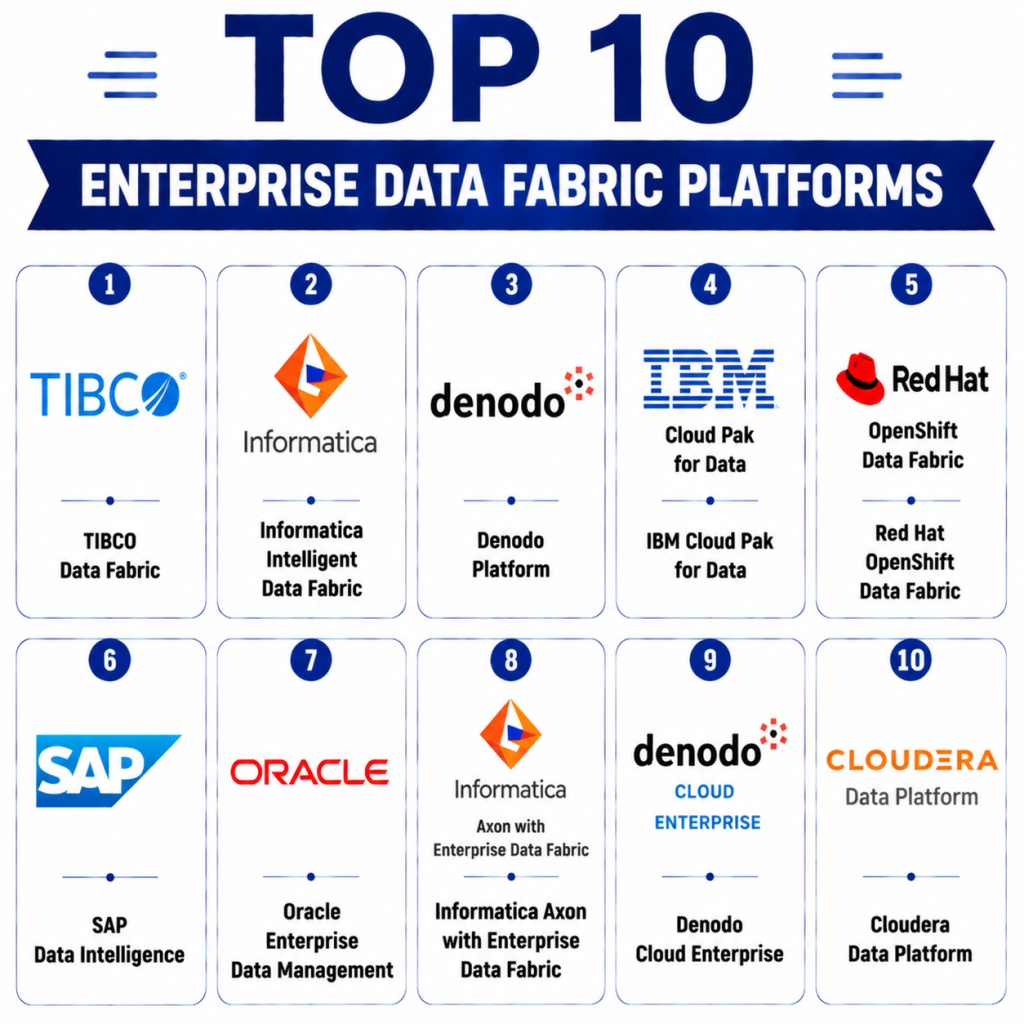
Top 10 Enterprise Data Fabric Platforms
1- TIBCO Data Fabric
Short description: TIBCO Data Fabric provides a comprehensive layer for unifying, managing, and governing enterprise data. It enables real-time analytics and ensures consistent data access across diverse sources.
Key Features
- Real-time data integration and virtualization
- Metadata management and data lineage
- Security and access control
- Cloud and on-premise connectors
- Data quality monitoring
- Self-service data access
Pros
- Strong real-time analytics support
- Extensive connector library for diverse sources
Cons
- Complex initial setup
- Premium pricing
Platforms / Deployment
- Windows / Linux
- Cloud / On-premises / Hybrid
Security & Compliance
- Encryption, RBAC, SSO
- Not publicly stated
Integrations & Ecosystem
- Integrates with BI tools and ETL pipelines
- API support for automation
- Extensible connector framework
Support & Community
- Enterprise support tiers
- Documentation and online community
2- Informatica Intelligent Data Fabric
Short description: Informatica offers a unified platform for integrating, managing, and governing enterprise data. It provides AI-driven insights and automation for analytics and operational applications.
Key Features
- AI-driven data integration
- Real-time and batch processing
- Data governance and lineage
- Cloud and on-prem integration
- Self-service data access
- Automation and workflow orchestration
Pros
- Robust AI and automation features
- Enterprise-grade security and governance
Cons
- Can be resource-intensive
- Higher learning curve
Platforms / Deployment
- Windows / Linux
- Cloud / On-premises / Hybrid
Security & Compliance
- SSO, encryption, audit logs
- SOC 2 / ISO 27001
Integrations & Ecosystem
- Connects with cloud apps, databases, and analytics tools
- API and SDK support
- Extensible connectors
Support & Community
- Strong vendor support
- Active documentation and training resources
3- Denodo Platform
Short description: Denodo Platform delivers real-time data virtualization and integration, enabling enterprises to access multiple sources without replication, improving analytics speed and flexibility.
Key Features
- Real-time data federation
- Virtualized data layers
- Metadata management
- Query optimization and caching
- Security and governance
- BI and analytics integration
Pros
- High-performance query engine
- Supports hybrid deployments
Cons
- Enterprise licensing cost
- Requires skilled implementation
Platforms / Deployment
- Windows / Linux / macOS
- Cloud / On-premises / Hybrid
Security & Compliance
- RBAC, SSO, encryption
- SOC 2 / ISO 27001
Integrations & Ecosystem
- Cloud platforms, databases, SaaS apps
- API access for automation
- Extensible connector framework
Support & Community
- Enterprise support
- Active community and documentation
4- IBM Cloud Pak for Data
Short description: IBM Cloud Pak integrates data virtualization with AI and analytics capabilities, providing enterprises with a unified data fabric across cloud and on-premises systems.
Key Features
- Unified data layer
- Real-time and batch data processing
- Integration with AI and ML tools
- Governance and security controls
- Monitoring and audit capabilities
Pros
- Enterprise-grade scalability
- Strong AI/analytics integration
Cons
- Complex deployment
- High cost
Platforms / Deployment
- Linux / Cloud
- Cloud / On-premises / Hybrid
Security & Compliance
- Encryption, RBAC, SSO
- ISO 27001 / SOC 2
Integrations & Ecosystem
- BI, ML platforms, ETL pipelines
- API support
- Extensible connectors
Support & Community
- Enterprise support packages
- Extensive documentation
5- Red Hat OpenShift Data Fabric
Short description: Red Hat OpenShift Data Fabric provides scalable virtualization and integration for hybrid environments, enabling data access and management across cloud and on-premises systems.
Key Features
- Data virtualization
- Integration with OpenShift and Kubernetes
- Security and compliance controls
- Metadata and lineage management
- Real-time query support
Pros
- Open-source flexibility
- Container-native deployment
Cons
- May require Red Hat ecosystem
- Limited advanced analytics features
Platforms / Deployment
- Linux / Cloud / On-premises
Security & Compliance
- RBAC, encryption
- Not publicly stated
Integrations & Ecosystem
- Cloud apps, databases, BI tools
- API support for automation
Support & Community
- Community and enterprise support
- Documentation and guides
6- SAP Data Intelligence
Short description: SAP Data Intelligence connects, integrates, and orchestrates enterprise data from various sources, offering data governance, pipeline automation, and analytics-ready datasets.
Key Features
- Data orchestration
- AI-powered insights
- Governance and lineage
- Real-time and batch integration
- Metadata management
Pros
- Deep SAP ecosystem integration
- Supports complex enterprise workflows
Cons
- SAP-focused
- Implementation complexity
Platforms / Deployment
- Linux / Cloud / On-premises
Security & Compliance
- Encryption, RBAC, SSO
- Not publicly stated
Integrations & Ecosystem
- SAP modules, cloud apps, BI tools
- API and SDK support
Support & Community
- Vendor support
- SAP community resources
7- Oracle Enterprise Data Management
Short description: Oracle provides a comprehensive data fabric platform enabling virtualization, integration, and governance for enterprise-scale analytics and AI initiatives.
Key Features
- Real-time data integration
- Data quality and governance
- Cloud and on-premises connectors
- Metadata and lineage
- BI and analytics integration
Pros
- Enterprise-grade scalability
- Strong Oracle ecosystem integration
Cons
- Licensing cost
- May require Oracle expertise
Platforms / Deployment
- Linux / Windows / Cloud
- Cloud / On-premises / Hybrid
Security & Compliance
- Encryption, SSO, audit logs
- SOC 2 / ISO 27001
Integrations & Ecosystem
- Databases, BI tools, cloud services
- API support
Support & Community
- Enterprise support
- Active documentation
8- Informatica Axon with Enterprise Data Fabric
Short description: Axon integrates with Informatica Data Fabric, providing enterprise-grade data governance, cataloging, and virtualization for analytics and operational efficiency.
Key Features
- Data cataloging
- Data virtualization
- Governance and lineage
- Self-service analytics
- Metadata management
Pros
- Strong governance and compliance
- Integrated with Informatica ecosystem
Cons
- Premium pricing
- Requires training to maximize features
Platforms / Deployment
- Windows / Linux / Cloud
Security & Compliance
- Encryption, RBAC, SSO
- SOC 2 / ISO 27001
Integrations & Ecosystem
- BI tools, ETL pipelines, cloud apps
- APIs for automation
Support & Community
- Enterprise support
- Training and documentation
9- Denodo Cloud Enterprise
Short description: Cloud-native edition of Denodo provides managed virtualization, data access, and governance for multi-cloud and hybrid enterprise environments.
Key Features
- Managed cloud deployment
- Real-time query optimization
- Security and governance
- Integration with BI and ML platforms
- Data caching
Pros
- Reduces on-prem infrastructure
- Elastic scaling
Cons
- Cloud-dependent
- Licensing cost
Platforms / Deployment
- Cloud (AWS, Azure, GCP)
Security & Compliance
- Encryption, SSO, RBAC
- SOC 2 / ISO 27001
Integrations & Ecosystem
- Cloud apps, databases, SaaS apps
- APIs for integration
Support & Community
- Enterprise support
- Documentation and guides
10- Cloudera Data Platform
Short description: Cloudera provides an enterprise data fabric with virtualization, governance, and integration capabilities across cloud and on-premises environments.
Key Features
- Real-time data access
- Data governance and lineage
- Hybrid deployment support
- Analytics and BI integration
- Security and compliance
Pros
- Strong multi-cloud support
- Scalable for large datasets
Cons
- Complexity for smaller teams
- Enterprise pricing
Platforms / Deployment
- Linux / Cloud / On-premises
Security & Compliance
- Encryption, RBAC, audit logs
- SOC 2 / ISO 27001
Integrations & Ecosystem
- Databases, cloud services, BI platforms
- API access for automation
Support & Community
- Vendor support
- Documentation and community
Comparison Table (Top 10 Enterprise Data Fabric Platforms)
| Tool Name | Best For | Platform(s) Supported | Deployment | Standout Feature | Public Rating |
|---|---|---|---|---|---|
| TIBCO Data Fabric | Multi-source integration | Windows / Linux | Cloud / Hybrid | Real-time access | N/A |
| Informatica Intelligent Data Fabric | AI & analytics | Windows / Linux | Cloud / Hybrid | AI-driven integration | N/A |
| Denodo Platform | Enterprise virtualization | Windows / Linux / macOS | Cloud / Hybrid | Real-time virtualization | N/A |
| IBM Cloud Pak for Data | Analytics and AI | Linux / Cloud | Cloud / On-prem | Unified data layer | N/A |
| Red Hat OpenShift Data Fabric | Hybrid deployments | Linux / Cloud / On-prem | Cloud / On-prem | Kubernetes-native data fabric | N/A |
| SAP Data Intelligence | SAP integration | Linux / Cloud / On-prem | Cloud / On-prem | AI-driven data orchestration | N/A |
| Oracle Enterprise Data Management | Enterprise-scale data | Linux / Windows / Cloud | Cloud / On-prem | Integration with Oracle ecosystem | N/A |
| Informatica Axon | Governance & cataloging | Windows / Linux / Cloud | Cloud / On-prem | Strong governance integration | N/A |
| Denodo Cloud Enterprise | Cloud-first enterprises | Cloud (AWS, Azure, GCP) | Cloud | Managed service | N/A |
| Cloudera Data Platform | Multi-cloud analytics | Linux / Cloud / On-prem | Cloud / On-prem | Scalable enterprise data fabric | N/A |
Evaluation & Scoring of Enterprise Data Fabric Platforms
| Tool Name | Core (25%) | Ease (15%) | Integrations (15%) | Security (10%) | Performance (10%) | Support (10%) | Value (15%) | Weighted Total (0–10) |
|---|---|---|---|---|---|---|---|---|
| TIBCO Data Fabric | 9 | 8 | 9 | 8 | 8 | 8 | 8 | 8.5 |
| Informatica Intelligent Data Fabric | 9 | 7 | 8 | 8 | 8 | 8 | 8 | 8.2 |
| Denodo Platform | 9 | 8 | 9 | 8 | 8 | 8 | 8 | 8.5 |
| IBM Cloud Pak for Data | 9 | 7 | 8 | 8 | 8 | 8 | 8 | 8.2 |
| Red Hat OpenShift Data Fabric | 8 | 7 | 8 | 7 | 7 | 7 | 7 | 7.5 |
| SAP Data Intelligence | 9 | 7 | 8 | 8 | 8 | 8 | 8 | 8.2 |
| Oracle Enterprise Data Management | 9 | 7 | 8 | 8 | 8 | 8 | 8 | 8.2 |
| Informatica Axon | 8 | 7 | 8 | 8 | 8 | 8 | 8 | 7.9 |
| Denodo Cloud Enterprise | 9 | 8 | 9 | 8 | 8 | 8 | 8 | 8.5 |
| Cloudera Data Platform | 9 | 7 | 8 | 8 | 8 | 8 | 8 | 8.2 |
Interpretation: Weighted totals provide a comparative assessment of enterprise data fabric platforms, measuring feature completeness, performance, security, and integration capabilities.
Which Enterprise Data Fabric Platform Is Right for You?
Solo / Freelancer
Denodo Express or Red Hat OpenShift Data Fabric for evaluation and smaller workloads.
SMB
TIBCO Data Fabric or Data Virtuality Logical Data Warehouse for moderate-scale multi-source integration.
Mid-Market
Denodo Platform Cloud Edition or IBM Cloud Pak for Data for hybrid environments with advanced analytics.
Enterprise
TIBCO Data Fabric, SAP Data Intelligence, or Oracle Enterprise Data Management for large-scale, multi-cloud deployments.
Budget vs Premium
Open-source or free editions for cost-sensitive teams; premium platforms offer advanced security, governance, and scalability.
Feature Depth vs Ease of Use
Complex analytics pipelines benefit from Denodo Platform or IBM Cloud Pak; simpler data access can leverage TIBCO or Denodo Express.
Integrations & Scalability
Cloud-native and hybrid platforms enable integration with BI tools, SaaS apps, and multiple databases.
Security & Compliance Needs
Enterprise deployments require encryption, RBAC, SSO, and audit logging to meet compliance standards.
Frequently Asked Questions (FAQs)
1- What is an enterprise data fabric platform?
A platform that integrates, virtualizes, and manages data across cloud and on-premises systems, providing a unified access layer for analytics and operations.
2- Can these platforms handle real-time data?
Yes, most platforms support real-time data virtualization and streaming integration for operational and analytical use cases.
3- Are there open-source options?
Yes, Red Hat OpenShift Data Fabric and some editions of Denodo provide open-source or community versions.
4- Do these platforms integrate with BI tools?
They commonly integrate with Tableau, Power BI, Qlik, and other reporting or analytics tools.
5- Are these suitable for SMBs?
Yes, lighter or cloud editions support small and medium businesses with moderate data needs.
6- What security features are included?
Encryption, RBAC, SSO, and audit logging are standard in enterprise-grade deployments.
7- Do I need coding skills to use these platforms?
Low-code or no-code interfaces are available, but SQL or scripting may be required for advanced integrations.
8- Can they connect to hybrid environments?
Yes, cloud and on-premises hybrid environments are fully supported.
9- How scalable are these platforms?
They scale to large enterprise workloads, multi-cloud deployments, and high data volumes.
10- How do I choose the right platform?
Consider integration needs, data volume, analytics requirements, cloud strategy, security, and team expertise.
Conclusion
Enterprise Data Fabric Platforms enable organizations to integrate, govern, and access data across diverse environments efficiently. Businesses should evaluate 2–3 platforms, run pilot projects, validate integration and security, and then scale enterprise-wide.
