Introduction
Enterprise Risk Management (ERM) Tools are software platforms that help organizations identify, assess, monitor, and mitigate risks across all functions — from operational and financial to strategic and compliance risk. An ERM tool centralizes risk data, provides dashboards and analytics, automates workflows, and supports governance, risk, and compliance (GRC) activities. As businesses grow more complex, globally interconnected, and technologically driven in and beyond, effective ERM platforms are crucial for resilience, regulatory compliance, and informed decision‑making.
Real‑world use cases include:
- Identifying and scoring strategic risks impacting business continuity.
- Monitoring operational risks across global supply chains.
- Automating compliance workflows for ISO, HIPAA, GDPR, and industry standards.
- Aggregating data from disparate departments into a unified risk dashboard.
- Supporting board‑level reporting and audit readiness.
What buyers should evaluate:
- Centralized risk registry and taxonomy
- Real‑time dashboards and analytics
- Scenario modeling and predictive risk scoring
- Workflow automation and alerts
- Compliance and audit management
- Integration with ERP, SCM, HR, and finance systems
- Scalability across business units and geographies
- Mobile access for field risk reporting
- Security, access controls, and audit trails
- Vendor support and training
Best for: risk leaders, compliance officers, internal audit teams, CFOs, and enterprise executives in sectors like finance, healthcare, manufacturing, technology, and utilities.
Not ideal for: very small organizations with simple processes or minimal risk tracking requirements; lightweight spreadsheet or basic project risk tools may suffice.
Key Trends in Enterprise Risk Management (ERM) Tools
- AI‑powered risk scoring and prioritization to highlight emerging threats.
- Predictive analytics and simulation for “what‑if” scenarios.
- Cloud‑native and hybrid deployments for scalable multi‑subsidiary management.
- Integration with ESG and sustainability metrics for broader risk visibility.
- Workflow automation for issue resolution and control testing.
- Mobile reporting and field risk assessment tools.
- Interoperability with ERP and GRC ecosystems.
- Automated regulatory compliance and audit trails.
- Risk heatmaps and visual dashboards for executive reporting.
- Subscription and usage‑based pricing models for flexible procurement.
How We Selected These Tools (Methodology)
- Evaluated market adoption and mindshare across enterprises and risk communities.
- Assessed feature completeness, including risk scoring, dashboards, compliance, and workflows.
- Reviewed performance and reliability, focusing on real‑time data and uptime.
- Verified security posture, such as encryption, audit trails, and role‑based access.
- Examined integration ecosystem with ERP, HR, finance, and analytics systems.
- Considered customer fit across segments, from mid‑market to global enterprises.
- Analyzed ease of use and configurability for risk analysts and executives.
- Factored in vendor support, documentation, and training resources.
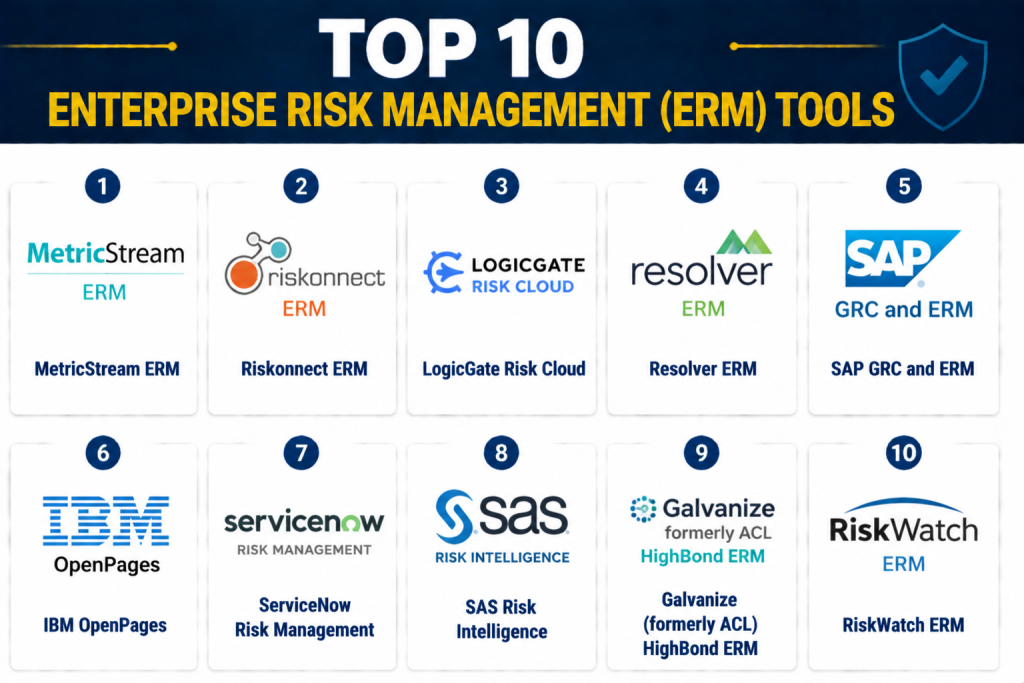
Top 10 Enterprise Risk Management (ERM) Tools
1 — MetricStream ERM
Short description: MetricStream ERM provides a comprehensive governance, risk, and compliance platform with robust risk analysis, dashboards, and automation capabilities designed for large global enterprises.
Key Features
- Centralized risk register
- Predictive risk scoring and heat maps
- Compliance and audit management
- Scenario modeling and simulation
- Workflow automation
- Integration with ERP and GRC systems
Pros
- Strong end‑to‑end risk and compliance coverage
- Scalable for large and complex organizations
Cons
- Can be costly for mid‑market companies
- Deployment may require specialized consulting
Platforms / Deployment
- Web / Cloud
Security & Compliance
- Encryption, audit logs
- ISO 27001, SOC 2 (varies by deployment)
Integrations & Ecosystem
MetricStream connects with enterprise systems:
- ERP and finance systems
- HR and operational systems
- BI and visualization tools
Support & Community
Comprehensive documentation, global support, and training programs.
2 — Riskonnect ERM
Short description: Riskonnect ERM delivers a cloud‑native risk management platform that unifies risk, compliance, and operational insights for enterprise leaders.
Key Features
- Real‑time risk dashboards
- Incident and claims tracking
- Automated alerts and workflows
- Risk scoring and aggregation
- Compliance and control testing
- Mobile risk reporting
Pros
- Cloud‑native with scalable architecture
- Strong workflow automation
Cons
- Customization may require internal resources
- Initial setup and configuration can be time‑intensive
Platforms / Deployment
- Web / Cloud
Security & Compliance
- Encryption, access controls, audit logs
- Not publicly stated: ISO/SOC specifics
Integrations & Ecosystem
- ERP and HR systems
- Compliance and audit platforms
- Data lakes and analytics tools
Support & Community
Documentation, training, and professional services.
3 — LogicGate Risk Cloud
Short description: LogicGate Risk Cloud is a low‑code platform enabling enterprises to configure risk workflows, incident tracking, and compliance processes without heavy development.
Key Features
- Low‑code workflow builder
- Risk scoring and dashboards
- Incident and issue management
- Compliance modules
- Scenario planning
- Integration APIs
Pros
- Highly configurable with minimal coding
- Rapid deployment for business users
Cons
- May require internal administrators for configuration
- Less industry‑specific templates than competitors
Platforms / Deployment
- Web / Cloud
Security & Compliance
- Encryption, role‑based access, audit logs
- Not publicly stated: Certifications
Integrations & Ecosystem
- ERP, HR, audit systems
- BI and analytics platforms
- APIs for custom workflows
Support & Community
Documentation and professional services available.
4 — Resolver ERM
Short description: Resolver ERM offers integrated risk, incident, and compliance management with automated alerts, analytics dashboards, and mobile access.
Key Features
- Central risk register
- Incident and control testing
- Loss event tracking
- Compliance and audit modules
- Real‑time dashboards
- Integration APIs
Pros
- Scalable enterprise workflows
- Strong analytics and reporting
Cons
- Learning curve for complex configurations
- Licensing may be higher for smaller teams
Platforms / Deployment
- Web / Cloud
Security & Compliance
- Encryption, audit logs
- Not publicly stated: ISO/SOC certifications
Integrations & Ecosystem
- ERP and finance systems
- Compliance tools
- Data visualization apps
Support & Community
Onboarding support, documentation, and training.
5 — SAP GRC and ERM
Short description: SAP’s ERM and GRC modules integrate enterprise risk management with broader governance and compliance capabilities, ideal for SAP‑centric enterprises.
Key Features
- Risk and control matrix
- Compliance and audit tracking
- Policy management
- Scenario simulation
- Centralized dashboards
- Integration with SAP ERP and analytics
Pros
- Strong integration with SAP landscapes
- Enterprise governance features
Cons
- Best suited for SAP customers
- Complexity can increase total cost
Platforms / Deployment
- Web / Cloud / On‑premises
Security & Compliance
- Encryption, audit trails
- ISO 27001/SOC 2 (varies by configuration)
Integrations & Ecosystem
- SAP ERP, finance, and HR
- Analytics and BI modules
- External risk feeds
Support & Community
Extensive SAP documentation and global support.
6 — IBM OpenPages
Short description: IBM OpenPages provides a flexible GRC and ERM platform with AI‑driven insights, control frameworks, and automated workflows.
Key Features
- Adaptive risk intelligence
- Control and compliance testing
- Incident and loss tracking
- Dashboards and analytics
- Workflow automation
- Integration with enterprise data sources
Pros
- Strong AI and analytics support
- Flexible modular design
Cons
- Implementation complexity
- Higher TCO for enterprise modules
Platforms / Deployment
- Web / Cloud / Hybrid
Security & Compliance
- Encryption, audit logging
- Not publicly stated: Full certifications
Integrations & Ecosystem
- ERP, data warehouses
- Compliance and audit tools
- Data lakes and API support
Support & Community
Documentation, professional services, and support.
7 — ServiceNow Risk Management
Short description: ServiceNow Risk Management is part of the broader ServiceNow platform, enabling risk detection, assessment, and remediation workflows tied to IT and business processes.
Key Features
- Integrated risk and control dashboards
- Automated risk workflows
- IT‑to‑business risk traceability
- Real‑time incident tracking
- Analytics and reporting
- Integration with service management
Pros
- Seamless integration with IT workflows
- Strong automation capabilities
Cons
- Requires ServiceNow ecosystem adoption
- Customization may need specialists
Platforms / Deployment
- Web / Cloud
Security & Compliance
- Encryption, role‑based access, audit logs
- Not publicly stated: Certifications
Integrations & Ecosystem
- ServiceNow modules (ITSM, SecOps)
- ERP and HR systems
- Analytics tools
Support & Community
ServiceNow documentation, training, and community forums.
8 — SAS Risk Intelligence
Short description: SAS Risk Intelligence integrates predictive analytics, risk scoring, and visualization for holistic enterprise risk management.
Key Features
- Predictive risk models
- Scenario analytics
- Real‑time dashboards
- Risk scoring and segmentation
- Automation of alerts
- Integration with data sources
Pros
- Advanced analytics and forecasting
- Scalable for data‑driven enterprises
Cons
- Requires analytical expertise
- Not focused on workflow automation
Platforms / Deployment
- Web / Cloud / Hybrid
Security & Compliance
- Encryption and audit trails
- Not publicly stated: Certifications
Integrations & Ecosystem
- ERP and HR data
- BI and visualization tools
- Data lakes
Support & Community
Documentation and analytics support.
9 — Galvanize (formerly ACL) HighBond ERM
Short description: Galvanize HighBond provides ERM capabilities with audit, compliance, and risk assessments in a unified environment.
Key Features
- Centralized risk register
- Control testing and compliance
- Incident workflow
- Audit integration
- Dashboards and reporting
- Integration APIs
Pros
- Strong audit and control linkage
- Unified GRC platform
Cons
- Requires training for full use
- Mid‑market focus limits enterprise scaling
Platforms / Deployment
- Web / Cloud
Security & Compliance
- Encryption, audit logs
- Not publicly stated: Certifications
Integrations & Ecosystem
- ERP, audit, and compliance systems
- BI tools
- API connectivity
Support & Community
Documentation and support services.
10 — RiskWatch ERM
Short description: RiskWatch ERM focuses on compliance‑driven risk assessments and dashboards for enterprise risk management, audit readiness, and control tracking.
Key Features
- Automated risk assessments
- Compliance and audit modules
- Dashboards and alerts
- Scenario planning
- Integration tools
- Reporting
Pros
- Easy to use dashboards
- Strong compliance focus
Cons
- Less advanced analytics
- Smaller integration ecosystem
Platforms / Deployment
- Web / Cloud
Security & Compliance
- Encryption, audit trails
- Not publicly stated: Certifications
Integrations & Ecosystem
- ERP, compliance, and audit tools
- Reporting systems
- API support
Support & Community
Documentation and professional support.
Comparison Table (Top 10 ERM)
| Tool Name | Best For | Platform(s) Supported | Deployment | Standout Feature | Public Rating |
|---|---|---|---|---|---|
| MetricStream ERM | Large enterprises | Web | Cloud | End‑to‑end risk & compliance | N/A |
| Riskonnect ERM | Enterprise risk teams | Web | Cloud | Unified dashboards & automation | N/A |
| LogicGate Risk Cloud | Configurable workflows | Web | Cloud | Low‑code automation | N/A |
| Resolver ERM | Incident + risk teams | Web | Cloud | Workflow & analytics | N/A |
| SAP GRC & ERM | SAP ecosystems | Web | Cloud / On‑prem | ERP integrated risk | N/A |
| IBM OpenPages | Enterprise risk | Web | Cloud / Hybrid | AI insights | N/A |
| ServiceNow RM | Tech‑centric risk | Web | Cloud | Workflow automation | N/A |
| SAS Risk Intelligence | Data‑driven risk | Web | Cloud / Hybrid | Predictive analytics | N/A |
| Galvanize HighBond ERM | GRC teams | Web | Cloud | Audit‑risk linkage | N/A |
| RiskWatch ERM | Compliance‑focused | Web | Cloud | Compliance dashboards | N/A |
Evaluation & Scoring of ERM Tools
| Tool Name | Core (25%) | Ease (15%) | Integrations (15%) | Security (10%) | Performance (10%) | Support (10%) | Value (15%) | Weighted Total |
|---|---|---|---|---|---|---|---|---|
| MetricStream ERM | 9 | 7 | 8 | 8 | 8 | 7 | 7 | 8.0 |
| Riskonnect ERM | 9 | 7 | 8 | 8 | 8 | 8 | 7 | 8.0 |
| LogicGate Risk Cloud | 8 | 8 | 7 | 7 | 8 | 7 | 7 | 7.7 |
| Resolver ERM | 8 | 7 | 7 | 7 | 8 | 7 | 7 | 7.5 |
| SAP GRC & ERM | 9 | 7 | 8 | 8 | 8 | 7 | 7 | 8.0 |
| IBM OpenPages | 8 | 6 | 7 | 8 | 8 | 7 | 7 | 7.6 |
| ServiceNow RM | 8 | 7 | 7 | 7 | 8 | 7 | 7 | 7.6 |
| SAS Risk Intelligence | 9 | 7 | 8 | 7 | 9 | 7 | 7 | 7.8 |
| Galvanize HighBond ERM | 8 | 7 | 7 | 7 | 8 | 7 | 7 | 7.6 |
| RiskWatch ERM | 7 | 8 | 7 | 7 | 7 | 7 | 7 | 7.1 |
Interpreting the Scores: Weighted totals compare core risk capabilities, ease of use, integration reach, security standards, performance, support options, and value. Organizations should weigh these against their size, complexity of risk processes, and integration needs.
Which Enterprise Risk Management Tool Is Right for You?
Solo / Freelancer
- Not typically necessary unless developing risk tools or analytics; smaller audit or compliance teams can use lightweight solutions.
SMB
- LogicGate Risk Cloud, RiskWatch ERM, and Galvanize HighBond ERM provide modular, cost‑effective solutions for small to mid‑market.
Mid‑Market
- SAS Risk Intelligence, Resolver ERM, and ServiceNow RM balance advanced analytics with usability.
Enterprise
- MetricStream ERM, Riskonnect ERM, and SAP GRC & ERM deliver enterprise‑grade risk management with compliance and integration breadth.
Budget vs Premium
- RiskWatch and LogicGate provide entry points; enterprise platforms like MetricStream and Riskonnect support broad risk programs.
Feature Depth vs Ease of Use
- Enterprise tools offer deep functionality but require training; mid‑market solutions prioritize configurable workflows.
Integrations & Scalability
- Large enterprises need deep ERP, HR, finance, and audit integrations; smaller organizations may leverage cloud‑based connectors.
Security & Compliance Needs
- Ensure encryption, IAM, audit logs, HIPAA/GDPR compliance, and enterprise‑grade access controls.
Frequently Asked Questions (FAQs)
1— What pricing models are typical?
SaaS subscription, enterprise licensing, or usage tiers based on modules and users.
2— How long does implementation take?
Small deployments may launch in weeks; enterprise multi‑module rollouts can take 3–6+ months.
3— Can ERM integrate with ERP and HR systems?
Yes, leading tools offer API or native integrations for ERP, HR, finance, and audit systems.
4— Are AI features essential?
AI enhances predictive risk scoring and trend forecasting, especially for complex enterprises.
5— Do ERM platforms support mobile access?
Many offer mobile reporting and dashboards for field risk assessments.
6— How secure are ERM solutions?
Enterprise platforms typically include encryption, access controls, audit logs, and compliance frameworks.
7— Can ERM tools handle compliance reporting?
Yes, most include modules for audit trails and regulatory reporting.
8— Do these tools support scenario modeling?
Yes, several provide predictive and simulation capabilities.
9— What mistakes should organizations avoid?
Avoid underestimating integration complexity and neglecting user training.
10— Are ERM tools necessary for small businesses?
Not always; small teams with light risk needs may prefer basic risk registers or spreadsheet tools.
Conclusion
Enterprise Risk Management (ERM) Tools empower organizations to unify risk data, automate workflows, and make data‑driven decisions. Enterprise offerings like MetricStream, Riskonnect, and SAP GRC & ERM provide deep risk and compliance coverage, while mid‑market solutions like LogicGate, Resolver, and SAS Risk Intelligence balance analytics with usability. shortlist aligned with organizational size and risk maturity, run pilots to validate workflows and integrations, and scale deployment while monitoring risk visibility, compliance, and operational resilience.
