Introduction
Homomorphic Encryption (HE) Toolkits enable organizations to perform computations on encrypted data without ever decrypting it, ensuring data privacy even during processing. In plain English, this allows sensitive datasets, such as healthcare records or financial transactions, to be analyzed securely without exposing the underlying information to external systems or unauthorized personnel. With AI, cloud computing, and multi-party analytics expanding rapidly in, HE toolkits have become essential for secure data collaboration and privacy-preserving analytics.
Real-world use cases include:
- Secure AI/ML model training on sensitive healthcare data without violating HIPAA.
- Financial institutions performing risk analysis on encrypted transaction data.
- Collaborative research where multiple parties compute on encrypted datasets without sharing raw information.
- Privacy-preserving analytics for government and census data.
- AI model inference on sensitive data in cloud environments without exposure.
Evaluation Criteria for Buyers typically include:
- Supported homomorphic encryption schemes (fully, partially, leveled)
- Performance and computational efficiency
- Integration with AI/ML pipelines
- Multi-party computation support
- Compliance with GDPR, HIPAA, and other privacy regulations
- Scalability for large datasets
- Ease of use and developer SDKs
- Security and key management
- Platform and deployment flexibility
- Community support and professional services availability
Best for: Data science teams, AI/ML engineers, security and privacy officers, and enterprises handling sensitive datasets in regulated sectors such as healthcare, finance, and government.
Not ideal for: Small businesses handling only public or non-sensitive data, or teams prioritizing speed over strict privacy requirements.
Key Trends in Homomorphic Encryption Toolkits
- Increasing adoption in privacy-preserving AI and ML workflows.
- Integration with multi-party computation (MPC) frameworks for collaborative analytics.
- Performance optimization for fully homomorphic encryption (FHE) schemes.
- Support for hybrid encryption, combining HE with standard encryption for efficiency.
- Deployment across multi-cloud and hybrid environments.
- Policy-driven access control and key management for regulatory compliance.
- Automation and SDKs for developer-friendly integration.
- Incorporation into secure data enclaves and confidential computing platforms.
- Subscription-based and usage-based pricing models for enterprise scalability.
- Expansion of open-source HE libraries with active community contributions.
How We Selected These Tools (Methodology)
- Analyzed market adoption and industry mindshare of HE toolkits.
- Evaluated feature completeness, including support for FHE, PHE, and leveled HE.
- Reviewed performance and reliability on large-scale, encrypted datasets.
- Assessed security posture, including encryption robustness and key management.
- Considered integration capabilities with AI/ML pipelines and cloud platforms.
- Evaluated customer fit across SMB, mid-market, and enterprise segments.
- Reviewed scalability for concurrent users and large datasets.
- Examined support and community for documentation, SDKs, and troubleshooting.
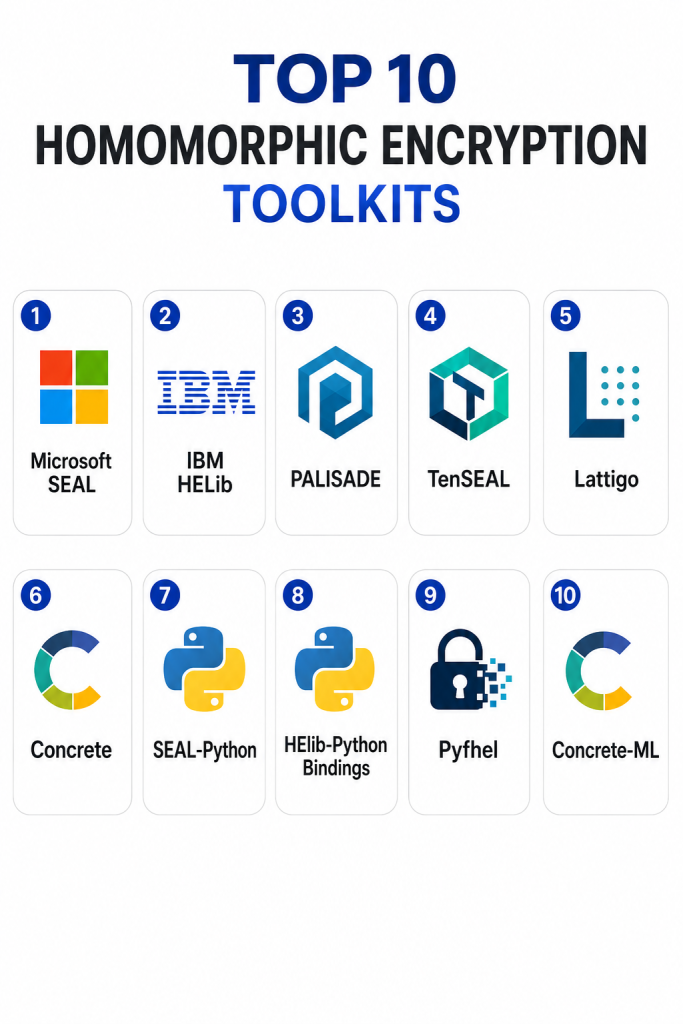
Top 10 Homomorphic Encryption Toolkits
1- Microsoft SEAL
Short description: Microsoft SEAL is an open-source HE library providing fast and secure fully homomorphic encryption, ideal for AI, analytics, and research teams.
Key Features
- Supports BFV and CKKS schemes
- High-performance FHE operations
- Cross-platform support
- Developer-friendly C++ and .NET SDKs
- Integration with AI/ML frameworks
- Detailed documentation and examples
Pros
- Open-source and widely used
- High-performance and versatile encryption
Cons
- Requires programming knowledge
- Advanced configuration may be needed
Platforms / Deployment
- Windows / Linux / macOS / Cloud / Self-hosted
Security & Compliance
- Supports secure computation, encryption standards
- Not publicly stated for SOC 2 or ISO
Integrations & Ecosystem
- AI/ML frameworks (TensorFlow, PyTorch)
- REST APIs for custom applications
- SDKs for C++ and .NET
Support & Community
- Strong developer community
- Active GitHub repository and examples
2- IBM HELib
Short description: HELib is an open-source C++ library for homomorphic encryption, providing leveled HE operations optimized for performance and AI workflows.
Key Features
- BGV scheme support
- Optimized for large-scale computations
- Modular arithmetic operations
- Supports batching and vectorized operations
- Integration with AI/ML pipelines
- Active open-source contributions
Pros
- High computational efficiency
- Open-source and flexible
Cons
- Steep learning curve
- Limited language support (C++)
Platforms / Deployment
- Linux / Cloud / Self-hosted
Security & Compliance
- Provides strong encryption
- Not publicly stated for HIPAA or SOC 2
Integrations & Ecosystem
- Compatible with research-grade AI tools
- SDK and C++ APIs for custom integration
- Supports HPC clusters
Support & Community
- Open-source community
- Documentation and developer forums
3- PALISADE
Short description: PALISADE is an open-source HE toolkit with support for multiple encryption schemes and scalable computation, suited for enterprise AI and research.
Key Features
- Supports BFV, CKKS, BGV schemes
- Multi-threaded HE computation
- Key switching and bootstrapping
- Developer-friendly C++ SDKs
- Integration with AI pipelines
- Modular and extensible design
Pros
- Versatile and scalable
- Multiple schemes supported
Cons
- Complex setup for beginners
- Requires programming knowledge
Platforms / Deployment
- Linux / Windows / Cloud / Self-hosted
Security & Compliance
- Supports encrypted computation
- Not publicly stated for HIPAA/SOC 2
Integrations & Ecosystem
- AI frameworks and analytics tools
- SDKs and APIs
- Research and enterprise integration
Support & Community
- Active open-source community
- Documentation and tutorials
4- TenSEAL
Short description: TenSEAL is a Python library for homomorphic encryption, focused on privacy-preserving machine learning and secure AI inference.
Key Features
- CKKS scheme support
- Python-friendly SDK
- Integration with PyTorch and AI pipelines
- Secure encrypted vector operations
- Open-source and community-driven
Pros
- Easy to use for Python developers
- Integration with AI frameworks
Cons
- Limited to Python ecosystem
- May require advanced tuning for performance
Platforms / Deployment
- Windows / Linux / macOS / Cloud / Self-hosted
Security & Compliance
- Secure computations on encrypted data
- Not publicly stated for compliance certifications
Integrations & Ecosystem
- PyTorch, TensorFlow
- REST APIs and Python SDK
- Encrypted ML pipelines
Support & Community
- Open-source community support
- Documentation and examples
5- Lattigo
Short description: Lattigo is a Go-based HE library for privacy-preserving computation, designed for secure AI and blockchain-related analytics.
Key Features
- Supports CKKS and BFV schemes
- Written in Go for server-side applications
- Supports homomorphic vectorized operations
- Integration with AI and blockchain workflows
- Open-source and modular
Pros
- Efficient for server-side Go applications
- Open-source with active contributions
Cons
- Limited language bindings
- Requires Go expertise
Platforms / Deployment
- Linux / Cloud / Self-hosted
Security & Compliance
- Strong encryption capabilities
- Not publicly stated for HIPAA/SOC 2
Integrations & Ecosystem
- Blockchain and AI pipelines
- SDKs for Go
- REST API integration
Support & Community
- Open-source support
- Community forums and examples
6- Concrete
Short description: Concrete is an HE toolkit from Zama, focusing on FHE for secure computation in AI and data analytics applications.
Key Features
- CKKS and TFHE scheme support
- Python and Rust SDKs
- Integration with ML workflows
- Efficient encrypted computation
- Open-source library
Pros
- Active development and innovation
- Suitable for AI and analytics
Cons
- Young project, smaller community
- Requires coding knowledge
Platforms / Deployment
- Linux / Windows / Cloud / Self-hosted
Security & Compliance
- Encrypted computation
- Not publicly stated for compliance certifications
Integrations & Ecosystem
- Python and Rust ML pipelines
- SDKs for integration
- Research and AI-focused applications
Support & Community
- Small but active community
- Documentation and GitHub resources
7- SEAL-Python
Short description: SEAL-Python is a Python wrapper for Microsoft SEAL, enabling FHE for Python developers with AI and analytics applications.
Key Features
- CKKS and BFV schemes
- Python API for secure computation
- Integration with PyTorch
- Open-source and developer-friendly
Pros
- Python-native
- Easy integration with AI pipelines
Cons
- Limited performance compared to C++
- Dependent on SEAL updates
Platforms / Deployment
- Windows / Linux / Cloud / Self-hosted
Security & Compliance
- Secure encrypted computations
- Not publicly stated for compliance certifications
Integrations & Ecosystem
- PyTorch, TensorFlow
- REST APIs and SDK
- AI pipelines
Support & Community
- Community support via GitHub
- Documentation available
8- HElib-Python Bindings
Short description: Python bindings for HELib, enabling secure homomorphic computations for AI and analytics in Python environments.
Key Features
- BGV scheme support
- Python integration with C++ HELib
- Vectorized HE operations
- Supports AI/ML workflows
Pros
- Access to HELib performance in Python
- Open-source flexibility
Cons
- Setup complexity
- Requires understanding of C++ and Python integration
Platforms / Deployment
- Linux / Cloud / Self-hosted
Security & Compliance
- Encrypted computations
- Not publicly stated for SOC 2/HIPAA
Integrations & Ecosystem
- AI and ML pipelines
- Python SDK
- Custom workflow integration
Support & Community
- Open-source support
- Active GitHub community
9- Pyfhel
Short description: Pyfhel is a Python library for homomorphic encryption, offering simple integration with AI workflows and secure analytics.
Key Features
- CKKS, BFV scheme support
- Python SDK and API
- Supports vectorized operations
- Integration with AI pipelines
- Open-source
Pros
- Easy to integrate with Python ML workflows
- Open-source
Cons
- Limited performance on large datasets
- Requires Python knowledge
Platforms / Deployment
- Windows / Linux / macOS / Cloud
Security & Compliance
- Encrypted computations
- Not publicly stated for compliance certifications
Integrations & Ecosystem
- PyTorch, TensorFlow
- Python SDK and REST API
- AI analytics workflows
Support & Community
- GitHub community
- Documentation and examples
10- Concrete-ML
Short description: Concrete-ML is a homomorphic encryption library designed for privacy-preserving machine learning with Python and Rust SDKs.
Key Features
- CKKS and TFHE support
- Python and Rust APIs
- ML integration
- Open-source, modular
- Secure encrypted computation
Pros
- Strong focus on ML
- Developer-friendly SDK
Cons
- Young project, smaller community
- Limited enterprise support
Platforms / Deployment
- Linux / Windows / Cloud / Self-hosted
Security & Compliance
- Secure encrypted operations
- Not publicly stated for HIPAA or SOC 2
Integrations & Ecosystem
- AI and ML pipelines
- Python and Rust SDKs
- Custom ML workflows
Support & Community
- Active GitHub community
- Documentation and examples
Comparison Table (Top 10)
| Tool Name | Best For | Platform(s) Supported | Deployment | Standout Feature | Public Rating |
|---|---|---|---|---|---|
| Microsoft SEAL | AI/ML, research | Windows, Linux, macOS | Cloud / Self-hosted | High-performance FHE | N/A |
| IBM HELib | Research, analytics | Linux | Cloud / Self-hosted | Optimized BGV operations | N/A |
| PALISADE | Enterprise AI, secure analytics | Windows, Linux | Cloud / Self-hosted | Multi-scheme support | N/A |
| TenSEAL | Python ML | Windows, Linux, macOS | Cloud / Self-hosted | Python integration | N/A |
| Lattigo | Go applications | Linux | Cloud / Self-hosted | Go-native HE operations | N/A |
| Concrete | AI/ML research | Linux, Windows | Cloud / Self-hosted | FHE for ML workflows | N/A |
| SEAL-Python | Python ML integration | Windows, Linux | Cloud / Self-hosted | Python wrapper for SEAL | N/A |
| HELib-Python | Python ML workflows | Linux | Cloud / Self-hosted | Python bindings for HELib | N/A |
| Pyfhel | Python ML | Windows, Linux, macOS | Cloud / Self-hosted | Simple Python integration | N/A |
| Concrete-ML | ML-focused HE | Linux, Windows | Cloud / Self-hosted | ML-ready SDK | N/A |
Evaluation & Scoring of Homomorphic Encryption Toolkits
| Tool Name | Core (25%) | Ease (15%) | Integrations (15%) | Security (10%) | Performance (10%) | Support (10%) | Value (15%) | Weighted Total |
|---|---|---|---|---|---|---|---|---|
| Microsoft SEAL | 9 | 8 | 8 | 9 | 9 | 7 | 8 | 8.5 |
| IBM HELib | 8 | 7 | 7 | 9 | 9 | 7 | 8 | 8.0 |
| PALISADE | 9 | 7 | 8 | 9 | 8 | 7 | 8 | 8.3 |
| TenSEAL | 8 | 9 | 8 | 8 | 8 | 7 | 8 | 8.1 |
| Lattigo | 8 | 7 | 7 | 8 | 8 | 7 | 7 | 7.6 |
| Concrete | 8 | 7 | 8 | 8 | 8 | 6 | 7 | 7.7 |
| SEAL-Python | 8 | 9 | 8 | 8 | 8 | 7 | 8 | 8.1 |
| HELib-Python | 7 | 8 | 7 | 8 | 8 | 7 | 7 | 7.5 |
| Pyfhel | 7 | 9 | 7 | 8 | 7 | 7 | 7 | 7.4 |
| Concrete-ML | 8 | 7 | 8 | 8 | 8 | 6 | 7 | 7.7 |
Interpretation: Weighted totals reflect overall strength in encryption capability, integration, performance, and developer support. Higher scores indicate better suitability for enterprise AI/ML and secure analytics workflows.
Which Homomorphic Encryption Toolkit Is Right for You?
Solo / Freelancer
Open-source Python libraries like TenSEAL or Pyfhel are ideal for experimentation and small datasets.
SMB
PALISADE or Microsoft SEAL offer enterprise-grade encryption with manageable complexity.
Mid-Market
HElib or Concrete provide scalable solutions for secure AI and analytics workflows.
Enterprise
Microsoft SEAL, PALISADE, and Concrete-ML support large-scale multi-cloud and high-performance encrypted computation.
Budget vs Premium
Open-source toolkits minimize cost but may require technical expertise. Enterprise distributions provide additional support and integration capabilities at a premium.
Feature Depth vs Ease of Use
Enterprise-grade toolkits provide more encryption schemes and performance optimization, whereas Python-native solutions are easier for quick AI/ML integration.
Integrations & Scalability
Toolkits like PALISADE, SEAL, and HElib are optimized for large datasets and AI/ML pipelines, while simpler libraries like TenSEAL are suited for smaller workloads.
Security & Compliance Needs
Organizations in healthcare, finance, or government should prioritize Microsoft SEAL, PALISADE, or HElib, which support robust encryption standards and secure computation.
Frequently Asked Questions (FAQs)
1- What are the main types of homomorphic encryption?
Fully Homomorphic Encryption (FHE), Partially Homomorphic Encryption (PHE), and Leveled HE, each with trade-offs in computation and performance.
2- How do these toolkits integrate with AI workflows?
Most provide SDKs and APIs for Python, C++, and other languages, allowing encrypted data processing in ML pipelines.
3- Are these toolkits open-source?
Many are open-source (SEAL, HELib, PALISADE), while some offer enterprise distributions with professional support.
4- What is the performance overhead of HE?
FHE can be computationally intensive; optimizations like batching and vectorized operations help mitigate overhead.
5- Can multiple parties compute on encrypted data?
Yes, HE allows multi-party computations without exposing raw data, enabling collaborative analytics.
6- Are these toolkits suitable for cloud deployment?
Yes, most can be deployed in cloud, hybrid, or on-premises environments with secure enclaves.
7- How long does it take to implement HE in AI workflows?
Implementation varies from days for small projects with Python libraries to weeks for enterprise-grade solutions.
8- Do these toolkits comply with privacy regulations?
While they enforce data privacy via encryption, specific regulatory compliance (HIPAA, GDPR) depends on deployment and additional governance.
9- Are there alternatives to HE toolkits?
Secure multi-party computation, trusted execution environments, and confidential computing platforms can provide alternative privacy-preserving solutions.
10- Is technical expertise required?
Yes, integrating HE into AI/ML workflows requires programming knowledge and understanding of encryption schemes.
Conclusion
Homomorphic Encryption Toolkits are essential for enabling secure computation on sensitive datasets, preserving privacy, and enabling AI/ML model training without data exposure. Open-source solutions like TenSEAL and Pyfhel are ideal for small teams and experimentation. Mid-market organizations benefit from PALISADE or HElib for scalable analytics, while enterprises should consider Microsoft SEAL, PALISADE, or Concrete-ML for high-performance, multi-cloud deployment. Recommended next steps include selecting toolkits, piloting secure AI/ML workflows, and validating integration with existing analytics and compliance frameworks to ensure secure and scalable operations.
