Introduction
HR Analytics Platforms are software solutions that help organizations collect, analyze, and visualize workforce data to improve hiring, retention, performance, engagement, and overall employee experience. In simple terms, these tools turn raw HR data into actionable insights that help leaders make better people decisions.
In and beyond, HR analytics has become essential because workforce expectations are changing rapidly. Companies need to understand employee behavior, predict attrition, measure productivity, and optimize workforce planning in hybrid and AI-driven work environments. Without analytics, HR decisions often rely on intuition rather than data.
Real-world use cases include:
- Employee turnover prediction and retention analysis.
- Workforce planning and headcount optimization.
- Recruitment funnel performance tracking.
- Employee engagement and sentiment analysis.
- Diversity, equity, and inclusion reporting.
What buyers should evaluate:
- Data integration capabilities with HRIS systems.
- Real-time dashboards and reporting features.
- Predictive analytics and AI capabilities.
- Data accuracy and governance controls.
- Security and compliance standards.
- Ease of use for HR and leadership teams.
- Customization and reporting flexibility.
- Scalability for enterprise workforce data.
- Integration ecosystem (payroll, ATS, ERP).
- Visualization and storytelling capabilities.
Best for: HR leaders, people analytics teams, CHROs, enterprise organizations, mid-market companies, workforce strategists, and data-driven HR departments.
Not ideal for: Very small businesses without structured HR data systems, organizations without HRIS tools, or companies not focused on data-driven decision-making.
Key Trends in HR Analytics Platforms
- AI-driven workforce forecasting and attrition prediction.
- Real-time employee sentiment analysis using behavioral signals.
- Unified people data platforms combining HRIS, ATS, and payroll data.
- Increased adoption of skills-based workforce analytics.
- DEI analytics becoming a core enterprise requirement.
- Embedded analytics inside HR workflows and collaboration tools.
- Stronger privacy controls for employee data governance.
- Integration with generative AI for HR insights and recommendations.
- Automation of workforce reporting and compliance dashboards.
- Shift toward continuous listening rather than annual surveys.
How We Selected These Tools (Methodology)
The HR analytics platforms in this list were selected based on:
- Market adoption and enterprise credibility.
- Depth of analytics and workforce intelligence capabilities.
- Predictive analytics and AI functionality.
- Integration with HRIS, ATS, and payroll systems.
- Data visualization and reporting quality.
- Scalability for large and complex organizations.
- Security, governance, and compliance readiness.
- Ease of use for HR teams and executives.
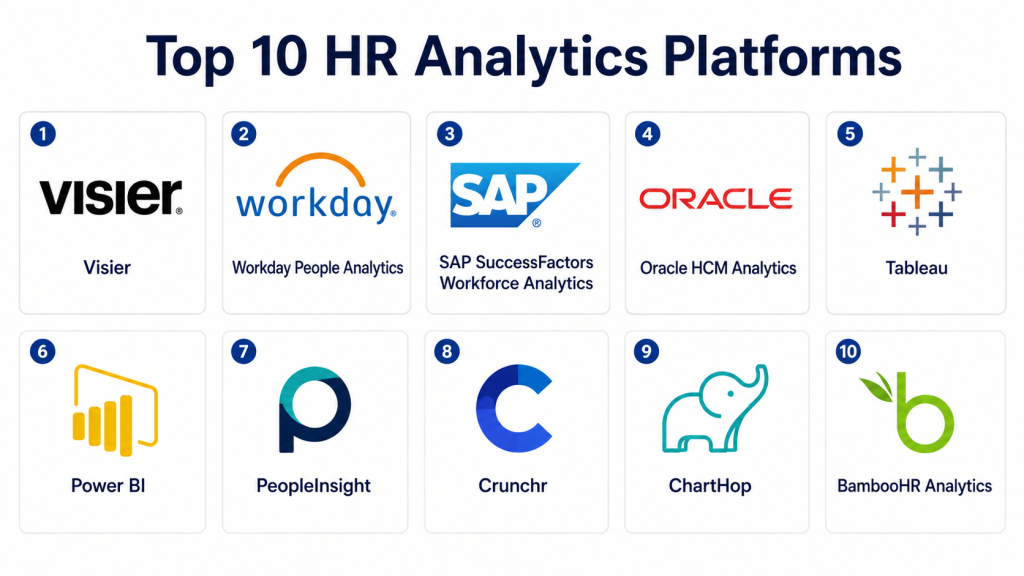
Top 10 HR Analytics Platforms
1- Visier
Short description:
Visier is one of the leading HR analytics platforms designed for enterprise workforce intelligence. It helps organizations analyze employee data across recruitment, performance, retention, and workforce planning. Visier is widely used by large enterprises to support strategic HR decision-making. It provides pre-built analytics models along with customizable dashboards. The platform focuses on people insights and predictive workforce analytics. It is especially strong for organizations needing deep workforce planning capabilities.
Key Features
- Workforce planning analytics.
- Attrition prediction models.
- Employee segmentation.
- DEI analytics dashboards.
- Pre-built HR metrics library.
- Data visualization tools.
- Benchmarking capabilities.
Pros
- Strong enterprise analytics depth.
- Advanced predictive capabilities.
- Rich HR metrics library.
Cons
- Complex for smaller teams.
- Requires data integration effort.
- Premium pricing model.
Platforms / Deployment
- Web
- Cloud
Security & Compliance
- SSO/SAML
- MFA
- Encryption
- RBAC
- Audit logs
- Compliance details vary by deployment
Integrations & Ecosystem
Visier integrates with major HR, payroll, and enterprise data systems.
- Workday
- SAP SuccessFactors
- Oracle HCM
- Payroll systems
- Data warehouses
- APIs
Support & Community
Enterprise onboarding, consulting services, and strong customer success programs.
2- Workday People Analytics
Short description:
Workday People Analytics provides workforce insights embedded directly within the Workday ecosystem. It enables HR leaders to analyze talent data, track trends, and make data-driven decisions across the employee lifecycle. It is widely used by enterprises already running Workday HCM. The platform provides built-in dashboards, reporting tools, and AI-driven insights. It is highly effective for organizations that want unified HR data and analytics in one system.
Key Features
- Embedded HR analytics dashboards.
- Workforce insights and trends.
- Talent segmentation.
- Predictive workforce insights.
- Real-time reporting.
- DEI analytics.
- HR data visualization.
Pros
- Strong Workday integration.
- Unified HR data model.
- Easy access for HR leaders.
Cons
- Best value within Workday ecosystem.
- Limited flexibility outside Workday.
- Advanced customization may require expertise.
Platforms / Deployment
- Web
- Cloud
Security & Compliance
- SSO/SAML
- MFA
- Encryption
- RBAC
- Audit logs
- Compliance aligned with Workday platform standards
Integrations & Ecosystem
Deep integration within Workday ecosystem and enterprise tools.
- Workday HCM
- Payroll systems
- Finance modules
- APIs
- Data exports
- BI tools
Support & Community
Strong enterprise support, documentation, and global customer network.
3- SAP SuccessFactors Workforce Analytics
Short description:
SAP SuccessFactors Workforce Analytics is an enterprise-grade HR analytics solution designed to provide deep insights into workforce performance, structure, and trends. It helps organizations connect HR data with business outcomes. The platform is widely used by large enterprises operating in SAP ecosystems. It provides standardized HR metrics and advanced reporting capabilities. It is particularly strong for organizations requiring compliance-heavy workforce reporting.
Key Features
- Workforce analytics dashboards.
- HR KPI tracking.
- Organizational structure analysis.
- DEI reporting.
- Predictive workforce modeling.
- Benchmarking tools.
- Custom reports.
Pros
- Strong enterprise integration.
- Deep HR analytics capabilities.
- Good for global organizations.
Cons
- Complex setup.
- Requires SAP ecosystem knowledge.
- Higher implementation effort.
Platforms / Deployment
- Web
- Cloud
Security & Compliance
- SSO/SAML
- MFA
- Encryption
- RBAC
- Audit logs
- SAP compliance framework support
Integrations & Ecosystem
Strong integration with SAP enterprise suite and external systems.
- SAP SuccessFactors HCM
- SAP ERP
- Data warehouses
- APIs
- BI tools
Support & Community
Enterprise-grade SAP support and consulting ecosystem.
4- Oracle HCM Analytics
Short description:
Oracle HCM Analytics provides workforce insights within the Oracle Cloud HCM ecosystem. It enables organizations to analyze HR data, track employee performance trends, and optimize workforce planning. It is widely used by enterprises running Oracle Cloud applications. The platform offers prebuilt dashboards and AI-driven insights. It is especially useful for large organizations with complex workforce structures.
Key Features
- Workforce analytics dashboards.
- Talent insights.
- Attrition analysis.
- Recruitment analytics.
- DEI reporting tools.
- Predictive insights.
- HR performance tracking.
Pros
- Strong Oracle ecosystem integration.
- Enterprise-grade scalability.
- Robust analytics features.
Cons
- Best suited for Oracle customers.
- Complex implementation.
- Requires training for advanced use.
Platforms / Deployment
- Web
- Cloud
Security & Compliance
- SSO/SAML
- MFA
- Encryption
- RBAC
- Audit logs
- Oracle cloud security framework
Integrations & Ecosystem
Integrates deeply within Oracle Cloud ecosystem.
- Oracle HCM Cloud
- Oracle ERP
- Data lakes
- APIs
- BI tools
- Enterprise systems
Support & Community
Strong Oracle enterprise support and consulting ecosystem.
5- Tableau (HR Analytics Use Cases)
Short description:
Tableau is a leading data visualization platform widely used for HR analytics dashboards and workforce insights. While not HR-specific, it is commonly used by people analytics teams to visualize HR data from multiple systems. Tableau enables HR teams to build interactive dashboards and explore workforce trends. It is especially useful for organizations with mature data teams. It supports advanced visualization and storytelling of HR metrics.
Key Features
- Interactive HR dashboards.
- Data visualization tools.
- Custom reporting.
- Multi-source data integration.
- Real-time analytics.
- Advanced filtering and segmentation.
- Predictive visualization support.
Pros
- Powerful visualization capabilities.
- Highly flexible dashboards.
- Strong analytics ecosystem.
Cons
- Requires data engineering skills.
- Not HR-specific out of the box.
- Setup complexity for HR teams.
Platforms / Deployment
- Web
- Windows
- macOS
- Cloud / On-premise
Security & Compliance
- SSO/SAML
- MFA
- Encryption
- RBAC
- Audit logs
- Enterprise security controls vary by setup
Integrations & Ecosystem
Tableau integrates with multiple enterprise data systems.
- HRIS systems
- Data warehouses
- Cloud platforms
- APIs
- SQL databases
- BI tools
Support & Community
Large global analytics community and strong enterprise support options.
6- Power BI (HR Analytics Use Cases)
Short description:
Power BI is Microsoft’s business intelligence platform widely used for HR analytics reporting and dashboards. It helps HR teams analyze workforce data from HRIS, payroll, and ATS systems. Power BI is popular among organizations already using Microsoft tools. It supports interactive dashboards, AI insights, and real-time reporting. It is suitable for both HR teams and data analysts working on people analytics.
Key Features
- HR dashboards and reporting.
- Data modeling and visualization.
- AI-powered insights.
- Real-time data refresh.
- Custom reporting tools.
- Integration with Microsoft ecosystem.
- Workforce analytics templates.
Pros
- Strong Microsoft integration.
- Cost-effective BI solution.
- Easy adoption for existing users.
Cons
- Requires data modeling knowledge.
- Not HR-specific platform.
- Advanced analytics needs setup.
Platforms / Deployment
- Web
- Windows
- Cloud
Security & Compliance
- SSO/SAML
- MFA
- Encryption
- RBAC
- Audit logs
- Microsoft security framework
Integrations & Ecosystem
Strong integration across Microsoft ecosystem and enterprise tools.
- Microsoft Excel
- Azure
- Workday
- HRIS systems
- SQL databases
- APIs
Support & Community
Large global user base and strong Microsoft documentation.
7- PeopleInsight
Short description:
PeopleInsight is a dedicated people analytics platform designed to centralize HR data and provide actionable workforce insights. It helps HR teams connect data from multiple systems into a unified analytics layer. The platform is widely used by mid-market and enterprise organizations. It focuses on data consolidation, reporting, and workforce intelligence. It is particularly useful for organizations with fragmented HR systems.
Key Features
- Data aggregation from HR systems.
- Workforce analytics dashboards.
- Custom HR reporting.
- DEI analytics.
- Attrition tracking.
- Predictive insights.
- HR data visualization.
Pros
- Strong HR-focused analytics.
- Easy data consolidation.
- Good for fragmented systems.
Cons
- Smaller ecosystem than major BI tools.
- Requires integration setup.
- Limited advanced AI features.
Platforms / Deployment
- Web
- Cloud
Security & Compliance
- SSO/SAML
- MFA
- Encryption
- RBAC
- Audit logs
- Not publicly stated certifications
Integrations & Ecosystem
Integrates with HR and business systems for unified analytics.
- Workday
- ATS systems
- Payroll tools
- APIs
- Data warehouses
- BI tools
Support & Community
Good customer support and onboarding assistance.
8- Crunchr
Short description:
Crunchr is a people analytics platform designed to help HR teams analyze workforce data and make strategic decisions. It provides pre-built HR metrics, dashboards, and reporting tools. Crunchr is commonly used by enterprise HR teams for workforce planning and analytics. It focuses on usability and fast deployment. It is especially strong in connecting HR data across systems.
Key Features
- Workforce analytics dashboards.
- HR metrics library.
- Attrition analysis.
- DEI reporting.
- Data integration layer.
- Workforce planning tools.
- Custom reporting.
Pros
- Easy to deploy.
- Strong HR analytics focus.
- Good visualization tools.
Cons
- Limited ecosystem compared to BI tools.
- Enterprise pricing model.
- Some customization constraints.
Platforms / Deployment
- Web
- Cloud
Security & Compliance
- SSO/SAML
- MFA
- Encryption
- RBAC
- Audit logs
- Not publicly stated certifications
Integrations & Ecosystem
Supports HR system integration and analytics workflows.
- Workday
- SAP SuccessFactors
- HRIS platforms
- APIs
- Data warehouses
- BI tools
Support & Community
Strong onboarding and enterprise customer success support.
9- ChartHop
Short description:
ChartHop is a people operations and analytics platform that combines organizational charts, workforce planning, and HR analytics. It helps companies visualize their workforce and understand employee data in real time. ChartHop is widely used by growing companies and mid-market organizations. It is especially useful for workforce planning and organizational design. The platform provides a visual and interactive approach to HR analytics.
Key Features
- Dynamic organizational charts.
- Workforce analytics dashboards.
- Compensation planning.
- Headcount planning.
- DEI analytics.
- Employee data visualization.
- Scenario modeling.
Pros
- Strong visualization capabilities.
- Good for workforce planning.
- Easy to understand org structures.
Cons
- Less deep enterprise analytics than large suites.
- Requires HR data integration.
- Advanced features may need setup.
Platforms / Deployment
- Web
- Cloud
Security & Compliance
- SSO/SAML
- MFA
- Encryption
- RBAC
- Audit logs
- Not publicly stated certifications
Integrations & Ecosystem
Integrates with HR systems and productivity tools.
- HRIS platforms
- Payroll systems
- ATS tools
- APIs
- BI tools
- Collaboration tools
Support & Community
Good support and onboarding for mid-market customers.
10- BambooHR Analytics
Short description:
BambooHR Analytics is part of the BambooHR HR platform and provides workforce reporting and insights for small and mid-sized businesses. It helps organizations track employee data, performance trends, and HR metrics. BambooHR is widely used by SMBs due to its simplicity and ease of use. It provides built-in reporting dashboards and customizable HR reports. It is ideal for companies that need basic people analytics without complex enterprise tools.
Key Features
- HR reporting dashboards.
- Employee data tracking.
- Performance reporting.
- Turnover analysis.
- Time-off analytics.
- Custom reports.
- Basic workforce insights.
Pros
- Very easy to use.
- Good for SMB HR teams.
- Built into HR platform.
Cons
- Limited advanced analytics.
- Not suitable for enterprise-scale analysis.
- Basic predictive capabilities.
Platforms / Deployment
- Web
- Cloud
Security & Compliance
- SSO/SAML
- MFA
- Encryption
- RBAC
- Audit logs
- Not publicly stated advanced certifications
Integrations & Ecosystem
Works within BambooHR ecosystem and integrations.
- BambooHR HRIS
- Payroll tools
- ATS systems
- APIs
- HR tools
- Productivity apps
Support & Community
Strong SMB-focused support and onboarding resources.
Comparison Table
| Tool Name | Best For | Platform(s) Supported | Deployment | Standout Feature | Public Rating |
|---|---|---|---|---|---|
| Visier | Enterprise people analytics | Web | Cloud | Workforce forecasting | N/A |
| Workday People Analytics | Workday users | Web | Cloud | Embedded HR insights | N/A |
| SAP SuccessFactors Analytics | SAP enterprises | Web | Cloud | Global HR metrics | N/A |
| Oracle HCM Analytics | Oracle enterprises | Web | Cloud | Integrated HR intelligence | N/A |
| Tableau | Data visualization teams | Web, Windows, macOS | Cloud/On-prem | Advanced dashboards | N/A |
| Power BI | Microsoft ecosystem | Web, Windows | Cloud | AI-driven BI analytics | N/A |
| PeopleInsight | Unified HR data | Web | Cloud | Data consolidation | N/A |
| Crunchr | HR analytics teams | Web | Cloud | Prebuilt HR metrics | N/A |
| ChartHop | Workforce planning | Web | Cloud | Org chart analytics | N/A |
| BambooHR Analytics | SMB HR teams | Web | Cloud | Simple HR reporting | N/A |
Evaluation & Scoring of HR Analytics Platforms
| Tool Name | Core (25%) | Ease (15%) | Integrations (15%) | Security (10%) | Performance (10%) | Support (10%) | Value (15%) | Weighted Total (0–10) |
|---|---|---|---|---|---|---|---|---|
| Visier | 10 | 7 | 9 | 9 | 9 | 9 | 7 | 8.7 |
| Workday People Analytics | 9 | 8 | 10 | 10 | 9 | 9 | 8 | 9.0 |
| SAP SuccessFactors Analytics | 9 | 7 | 9 | 10 | 9 | 9 | 7 | 8.6 |
| Oracle HCM Analytics | 9 | 7 | 9 | 9 | 9 | 8 | 7 | 8.4 |
| Tableau | 9 | 7 | 10 | 9 | 9 | 9 | 8 | 8.7 |
| Power BI | 9 | 8 | 10 | 9 | 9 | 9 | 9 | 9.0 |
| PeopleInsight | 8 | 8 | 8 | 8 | 8 | 8 | 8 | 8.1 |
| Crunchr | 8 | 8 | 8 | 8 | 8 | 8 | 8 | 8.0 |
| ChartHop | 8 | 9 | 8 | 8 | 8 | 8 | 8 | 8.2 |
| BambooHR Analytics | 7 | 10 | 7 | 8 | 7 | 8 | 9 | 8.0 |
These scores are comparative and depend heavily on organizational maturity, HR data infrastructure, and ecosystem alignment. Enterprise suites perform best in governance and scale, while BI tools excel in flexibility. SMB tools prioritize ease of use over advanced analytics depth.
Which HR Analytics Platform Is Right for You?
Solo / Freelancer
Most HR analytics platforms are not necessary for solo users. Basic reporting tools like Excel or lightweight BI tools are sufficient unless managing contractor workforce data.
SMB
BambooHR Analytics, ChartHop, Crunchr, and Power BI are strong choices for SMBs needing simple workforce insights without heavy infrastructure.
Mid-Market
ChartHop, Crunchr, PeopleInsight, Tableau, and Power BI offer a strong balance of analytics, visualization, and scalability.
Enterprise
Visier, Workday People Analytics, SAP SuccessFactors, Oracle HCM Analytics, and enterprise BI tools are best for large organizations with complex workforce structures.
Budget vs Premium
Budget-friendly options include BambooHR Analytics and Power BI. Premium enterprise platforms include Visier, SAP, Oracle, and Workday analytics.
Feature Depth vs Ease of Use
Visier and SAP offer deep analytics but require setup. BambooHR and ChartHop are easier to use but less advanced.
Integrations & Scalability
Power BI, Tableau, Workday, SAP, and Oracle provide strong integration ecosystems for large-scale deployments.
Security & Compliance Needs
Enterprise buyers should prioritize Workday, SAP, Oracle, and Visier due to stronger governance, auditability, and compliance alignment.
Frequently Asked Questions
1. What is an HR Analytics Platform?
It is a software tool that helps organizations analyze employee data to improve workforce planning, hiring, retention, and performance.
2. Why is HR analytics important?
It helps HR teams make data-driven decisions instead of relying on intuition, improving retention, productivity, and workforce efficiency.
3. What data do HR analytics tools use?
They use data from HRIS, ATS, payroll systems, performance reviews, engagement surveys, and workforce planning systems.
4. Can small businesses use HR analytics tools?
Yes, SMB-focused tools like BambooHR Analytics and ChartHop provide simple reporting without complex setups.
5. What is predictive HR analytics?
It uses AI and historical data to forecast outcomes like employee attrition, hiring needs, and workforce trends.
6. Do these tools integrate with HR systems?
Yes, most platforms integrate with HRIS, payroll, ATS, and productivity tools to centralize workforce data.
7. Are HR analytics tools secure?
Enterprise platforms include encryption, access controls, audit logs, and compliance features, but security varies by vendor.
8. What is the biggest challenge in HR analytics?
Data quality and integration complexity are the most common challenges for organizations implementing HR analytics.
9. Can HR analytics improve employee retention?
Yes, by identifying attrition risks and engagement issues early, organizations can take proactive retention measures.
10. How long does implementation take?
It can range from a few days for SMB tools to several months for enterprise platforms depending on integration complexity.
Conclusion
HR Analytics Platforms are becoming essential for modern workforce management, enabling organizations to move from reactive HR decisions to predictive, data-driven strategies. Tools like Visier, Workday People Analytics, SAP SuccessFactors, and Oracle HCM Analytics dominate enterprise use cases, while Power BI and Tableau offer flexible visualization capabilities. SMBs benefit from simpler tools like BambooHR Analytics and ChartHop. The right platform depends on organizational size, HR maturity, data infrastructure, and strategic goals. The best approach is to shortlist a few tools, validate data integrations, test reporting workflows, and ensure the platform aligns with long-term workforce planning and analytics needs.
