Introduction
Identity Resolution Platforms help organizations connect customer information from multiple devices, channels, and touchpoints into a unified customer profile. In simple terms, these platforms determine whether different interactions belong to the same individual, even when data comes from websites, mobile apps, CRM systems, retail stores, or advertising networks.
As privacy regulations become stricter and third-party cookies continue to decline, identity resolution has become a foundational capability for customer experience, marketing effectiveness, analytics, and personalization. Businesses increasingly need accurate first-party data strategies to understand customer journeys and deliver relevant experiences.
Real-world use cases include:
- Customer 360 and unified profiles
- Omnichannel marketing personalization
- Advertising audience targeting
- Customer journey analytics
- Fraud detection and risk management
What buyers should evaluate:
- Identity graph accuracy
- First-party data support
- Privacy and compliance capabilities
- AI and machine learning features
- Scalability
- Integration ecosystem
- Real-time processing capabilities
- Data governance controls
- Reporting and analytics
- Total cost of ownership
Best for: Enterprises, retailers, financial institutions, media companies, advertisers, customer experience teams, data engineers, and marketing organizations handling large customer datasets.
Not ideal for: Small businesses with limited customer records, organizations operating on a single channel, or companies that only need basic CRM functionality.
Key Trends in Identity Resolution Platforms
- AI-driven identity matching is becoming more accurate and automated.
- First-party data strategies are replacing cookie-dependent approaches.
- Privacy-first identity frameworks continue gaining adoption.
- Real-time identity resolution is becoming standard.
- Retail media networks increasingly depend on identity graphs.
- Cross-device identity mapping continues to improve.
- Data clean room integration is becoming a key requirement.
- Customer Data Platforms and identity platforms are converging.
- Machine learning models are reducing false identity matches.
- Flexible consumption-based pricing is becoming more common.
How We Selected These Tools
The following evaluation criteria were used to identify the leading identity resolution platforms:
- Market adoption and industry reputation
- Identity graph sophistication
- Matching accuracy and reliability
- Privacy and compliance capabilities
- Ecosystem integrations
- Customer data management capabilities
- Scalability across large datasets
- Support quality and implementation maturity
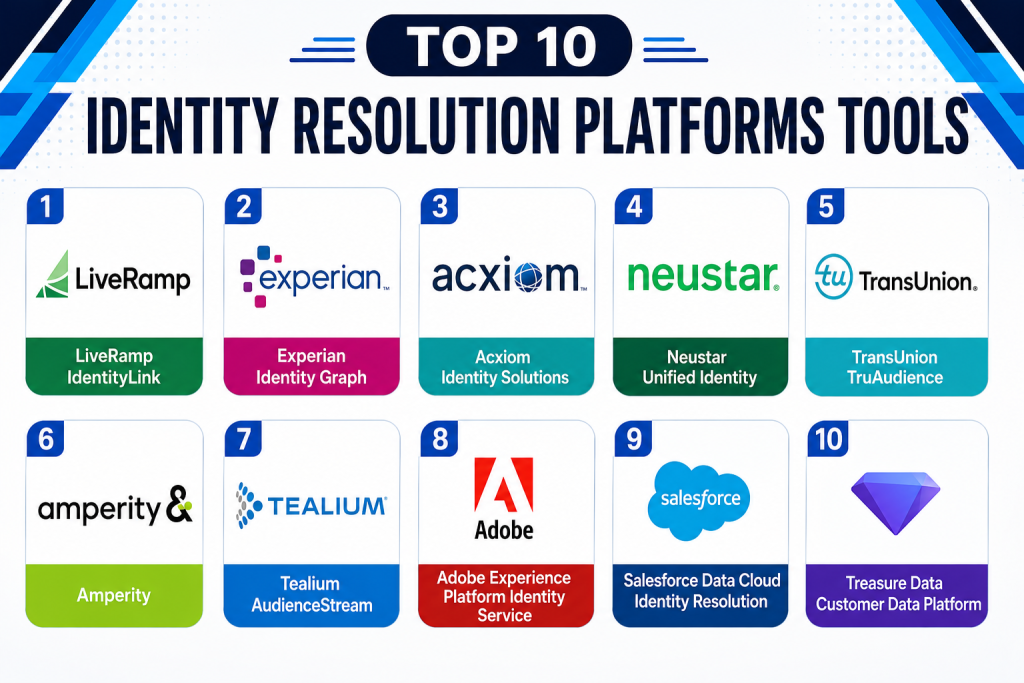
Top 10 Identity Resolution Platforms Tools
1- LiveRamp IdentityLink
Short description:
LiveRamp IdentityLink is one of the most recognized identity resolution platforms in the market. It helps organizations connect customer data across devices, channels, and marketing platforms while maintaining privacy controls. The platform is widely used by advertisers, retailers, publishers, and enterprises seeking unified customer views. Its extensive partner ecosystem makes it particularly attractive for organizations requiring large-scale audience connectivity. IdentityLink is often used for advertising, measurement, personalization, and customer intelligence initiatives.
Key Features
- Identity graph technology
- Cross-device matching
- Privacy-focused identity management
- Audience activation
- Customer profile unification
- Partner ecosystem connectivity
- Measurement support
Pros
- Large partner ecosystem
- Mature identity graph
- Strong enterprise adoption
Cons
- Enterprise-focused pricing
- Complex implementations
- May exceed SMB requirements
Platforms / Deployment
- Cloud
Security & Compliance
- Encryption
- Access controls
- Audit capabilities
- GDPR support
Integrations & Ecosystem
LiveRamp offers one of the broadest ecosystems in the identity market.
- Advertising platforms
- Data clean rooms
- Analytics platforms
- CRM systems
- APIs
Support & Community
Strong enterprise onboarding, extensive documentation, and experienced implementation teams.
2- Experian Identity Graph
Short description:
Experian Identity Graph combines consumer identity data, analytics, and matching technologies to create accurate customer profiles. It helps businesses improve customer acquisition, personalization, and fraud prevention. Financial services, retail, and enterprise organizations commonly use the platform. Its extensive data assets contribute to strong identity resolution capabilities across multiple channels and customer touchpoints.
Key Features
- Identity graph technology
- Customer profile linking
- Fraud prevention support
- Consumer intelligence
- Omnichannel matching
- Analytics capabilities
- Data enrichment
Pros
- Strong data assets
- Reliable matching capabilities
- Broad industry adoption
Cons
- Enterprise-oriented
- Data governance planning required
- Complex integration projects
Platforms / Deployment
- Cloud
Security & Compliance
- Encryption
- Access controls
- Audit support
Integrations & Ecosystem
Experian integrates with marketing, analytics, and customer data platforms.
- CRM platforms
- Marketing automation
- Analytics tools
- APIs
Support & Community
Strong support resources and established enterprise services.
3- Acxiom Identity Solutions
Short description:
Acxiom Identity Solutions helps organizations build unified customer views by connecting fragmented data sources. The platform supports audience segmentation, customer insights, and personalization initiatives. Large enterprises often use Acxiom for marketing, analytics, and identity-driven decision-making. Its data management expertise contributes to strong identity resolution performance.
Key Features
- Customer identity graph
- Audience segmentation
- Data linking
- Omnichannel identity management
- Analytics support
- Privacy controls
- Customer intelligence
Pros
- Mature identity capabilities
- Strong enterprise support
- Extensive marketing expertise
Cons
- Enterprise-focused deployment
- Requires data governance planning
- May be excessive for smaller businesses
Platforms / Deployment
- Cloud
Security & Compliance
- Encryption
- Access management
- Audit controls
Integrations & Ecosystem
Acxiom connects with major enterprise marketing environments.
- Marketing platforms
- CDPs
- Analytics systems
- APIs
Support & Community
Strong consulting and implementation services.
4- Neustar Unified Identity
Short description:
Neustar Unified Identity focuses on identity resolution, audience intelligence, and customer data activation. Organizations use it to improve targeting, attribution, and customer understanding. The platform is known for its identity graph capabilities and broad connectivity across marketing ecosystems. It serves enterprises seeking accurate customer matching and measurement.
Key Features
- Identity graph
- Audience intelligence
- Customer profile management
- Cross-channel analytics
- Data activation
- Attribution support
- Privacy controls
Pros
- Strong identity resolution
- Good audience analytics
- Enterprise-grade platform
Cons
- Complex deployments
- Premium pricing
- Learning curve
Platforms / Deployment
- Cloud
Security & Compliance
- Encryption
- Access controls
- Governance features
Integrations & Ecosystem
Supports integrations across marketing and analytics environments.
- CRM systems
- Advertising platforms
- CDPs
- APIs
Support & Community
Enterprise support with onboarding services.
5- TransUnion TruAudience
Short description:
TransUnion TruAudience combines identity resolution with audience insights and marketing activation. The platform helps organizations create consistent customer views across channels. It is widely used in advertising, retail, and customer experience programs. Its identity graph capabilities support personalization and measurement initiatives.
Key Features
- Identity resolution
- Audience insights
- Cross-channel matching
- Marketing activation
- Customer intelligence
- Analytics support
- Privacy controls
Pros
- Strong audience capabilities
- Enterprise-grade infrastructure
- Broad industry adoption
Cons
- Enterprise-focused
- Requires implementation effort
- Premium pricing structure
Platforms / Deployment
- Cloud
Security & Compliance
- Encryption
- Access controls
- Audit support
Integrations & Ecosystem
Works with multiple advertising and analytics platforms.
- CDPs
- CRM platforms
- Marketing tools
- APIs
Support & Community
Strong enterprise support resources.
6- Amperity
Short description:
Amperity specializes in customer data unification and identity resolution. Its AI-driven identity matching capabilities help organizations create customer 360 profiles from fragmented data. Retailers, hospitality brands, and consumer businesses frequently use Amperity to improve customer experiences and analytics.
Key Features
- AI-driven identity resolution
- Customer 360 profiles
- Data unification
- Predictive analytics
- Audience segmentation
- Real-time insights
- Customer intelligence
Pros
- Strong AI capabilities
- Retail-focused strengths
- Unified customer profiles
Cons
- Enterprise implementation complexity
- Premium pricing
- Requires data preparation
Platforms / Deployment
- Cloud
Security & Compliance
- SSO
- Encryption
- Access controls
Integrations & Ecosystem
Integrates with modern customer data environments.
- CRM systems
- Marketing platforms
- Analytics tools
- APIs
Support & Community
Strong onboarding and customer success programs.
7- Tealium AudienceStream
Short description:
Tealium AudienceStream combines customer data management with identity resolution and audience activation. The platform helps businesses unify customer interactions and create real-time customer profiles. It is commonly used for personalization, analytics, and customer journey optimization.
Key Features
- Real-time identity resolution
- Audience segmentation
- Customer profiles
- Event-driven architecture
- Omnichannel support
- Analytics integrations
- Personalization tools
Pros
- Strong real-time capabilities
- Extensive integrations
- Customer journey visibility
Cons
- Configuration complexity
- Enterprise-oriented
- Learning curve
Platforms / Deployment
- Cloud
Security & Compliance
- SSO
- Encryption
- Role-based access controls
Integrations & Ecosystem
Large integration ecosystem supporting customer experience initiatives.
- Marketing platforms
- Analytics tools
- CDPs
- APIs
Support & Community
Well-developed documentation and support programs.
8- Adobe Experience Platform Identity Service
Short description:
Adobe Experience Platform Identity Service helps organizations connect customer data across Adobe and non-Adobe environments. It creates unified customer profiles and supports personalization, analytics, and audience management. Large enterprises often deploy it as part of broader Adobe Experience Cloud initiatives.
Key Features
- Identity graph management
- Customer profile unification
- Real-time customer data
- Audience management
- Personalization support
- Analytics integration
- Privacy controls
Pros
- Strong Adobe ecosystem
- Enterprise scalability
- Advanced customer insights
Cons
- Adobe-centric deployment
- Premium licensing
- Implementation complexity
Platforms / Deployment
- Cloud
Security & Compliance
- SSO
- Encryption
- Audit capabilities
Integrations & Ecosystem
Deep integration across Adobe products and external systems.
- Adobe applications
- Analytics platforms
- CRM tools
- APIs
Support & Community
Strong enterprise support and training resources.
9- Salesforce Data Cloud Identity Resolution
Short description:
Salesforce Data Cloud Identity Resolution enables organizations to unify customer information across marketing, sales, commerce, and service channels. It helps businesses create comprehensive customer profiles and activate audiences across Salesforce applications. Enterprises seeking customer-centric operations frequently adopt it.
Key Features
- Customer identity resolution
- Unified profiles
- Audience activation
- Data harmonization
- Customer insights
- Real-time data processing
- Analytics support
Pros
- Strong Salesforce integration
- Comprehensive customer profiles
- Enterprise scalability
Cons
- Salesforce ecosystem dependency
- Enterprise pricing
- Setup complexity
Platforms / Deployment
- Cloud
Security & Compliance
- Encryption
- Access controls
- Audit support
Integrations & Ecosystem
Extensive ecosystem across Salesforce technologies.
- CRM systems
- Marketing platforms
- Commerce tools
- APIs
Support & Community
Large customer community and support network.
10- Treasure Data Customer Data Platform
Short description:
Treasure Data provides customer data management and identity resolution capabilities designed to unify customer interactions across channels. Organizations use it to improve personalization, customer analytics, and campaign effectiveness. The platform supports large-scale data processing and customer intelligence initiatives.
Key Features
- Identity resolution
- Customer data unification
- Audience segmentation
- Analytics support
- Customer journey tracking
- Data governance
- Real-time processing
Pros
- Strong data management capabilities
- Scalable architecture
- Broad integration support
Cons
- Enterprise implementation effort
- Learning curve
- Advanced configurations required
Platforms / Deployment
- Cloud
Security & Compliance
- Encryption
- Access controls
- Audit capabilities
Integrations & Ecosystem
Designed to integrate with modern enterprise ecosystems.
- Marketing tools
- Analytics systems
- CRM platforms
- APIs
Support & Community
Strong enterprise support and implementation guidance.
Comparison Table
| Tool Name | Best For | Platform Supported | Deployment | Standout Feature | Public Rating |
|---|---|---|---|---|---|
| LiveRamp IdentityLink | Enterprise identity graph | Web | Cloud | Large partner ecosystem | N/A |
| Experian Identity Graph | Consumer identity insights | Web | Cloud | Extensive identity data | N/A |
| Acxiom Identity Solutions | Customer intelligence | Web | Cloud | Marketing data expertise | N/A |
| Neustar Unified Identity | Audience intelligence | Web | Cloud | Identity graph capabilities | N/A |
| TransUnion TruAudience | Audience activation | Web | Cloud | Marketing-focused identity | N/A |
| Amperity | Customer 360 profiles | Web | Cloud | AI-driven matching | N/A |
| Tealium AudienceStream | Real-time identity resolution | Web | Cloud | Event-driven architecture | N/A |
| Adobe Experience Platform | Adobe-centric enterprises | Web | Cloud | Experience Cloud integration | N/A |
| Salesforce Data Cloud | Salesforce users | Web | Cloud | Customer data unification | N/A |
| Treasure Data CDP | Large-scale customer data | Web | Cloud | Scalable data processing | N/A |
Evaluation & Scoring of Identity Resolution Platforms
| Tool Name | Core | Ease | Integrations | Security | Performance | Support | Value | Weighted Total |
| LiveRamp | 9.5 | 8.0 | 9.5 | 9.0 | 9.0 | 9.0 | 8.0 | 8.9 |
| Experian | 9.0 | 8.0 | 8.5 | 9.0 | 9.0 | 8.5 | 8.0 | 8.6 |
| Acxiom | 8.5 | 7.5 | 8.5 | 8.5 | 8.5 | 8.5 | 8.0 | 8.3 |
| Neustar | 8.5 | 7.5 | 8.5 | 8.5 | 8.5 | 8.0 | 8.0 | 8.2 |
| TransUnion | 8.5 | 8.0 | 8.5 | 8.5 | 8.5 | 8.5 | 8.0 | 8.4 |
| Amperity | 9.0 | 8.5 | 8.5 | 8.5 | 8.5 | 8.5 | 8.0 | 8.6 |
| Tealium | 8.5 | 8.0 | 9.0 | 8.5 | 8.5 | 8.5 | 8.0 | 8.5 |
| Adobe | 9.0 | 7.5 | 9.0 | 9.0 | 9.0 | 8.5 | 7.5 | 8.6 |
| Salesforce | 9.0 | 8.0 | 9.5 | 9.0 | 9.0 | 9.0 | 7.5 | 8.8 |
| Treasure Data | 8.5 | 8.0 | 8.5 | 8.5 | 8.5 | 8.5 | 8.0 | 8.4 |
Identity resolution platform scoring should be viewed as a comparative framework rather than an absolute ranking. Organizations should prioritize criteria most relevant to their goals. Enterprises focused on advertising and audience activation may prioritize ecosystem reach, while customer experience teams may emphasize profile accuracy and real-time capabilities. Security, integration requirements, and implementation complexity should always be considered alongside overall scores.
Which Identity Resolution Platform Is Right for You?
Solo / Freelancer
Most solo professionals do not require enterprise-grade identity resolution platforms. CRM tools and analytics solutions are usually sufficient.
SMB
Growing businesses should evaluate Tealium AudienceStream or Treasure Data if they need customer data unification without excessive complexity.
Mid-Market
Amperity, Tealium, and Salesforce Data Cloud offer a strong balance of identity resolution, analytics, and customer profile management.
Enterprise
LiveRamp, Adobe Experience Platform, Experian Identity Graph, and Salesforce Data Cloud are often the strongest options for large-scale identity initiatives.
Budget vs Premium
Organizations with budget constraints should prioritize solutions already aligned with their existing technology stack. Premium buyers may benefit from LiveRamp, Adobe, or Experian.
Feature Depth vs Ease of Use
Amperity offers strong AI-powered capabilities, while Salesforce and Tealium often provide a more approachable experience for customer-focused teams.
Integrations & Scalability
LiveRamp, Salesforce, Adobe, and Tealium offer extensive ecosystems capable of supporting large-scale enterprise deployments.
Security & Compliance Needs
Financial services, healthcare, and regulated industries should prioritize vendors with mature governance, access controls, and privacy-focused architectures.
Frequently Asked Questions
1. What is an Identity Resolution Platform?
An Identity Resolution Platform connects customer information from multiple systems and devices to create a unified customer profile. It helps businesses understand customers across channels and touchpoints.
2. Why is identity resolution important in a privacy-first world?
As third-party cookies decline and privacy regulations increase, organizations need reliable first-party identity strategies to support personalization, analytics, and customer engagement.
3. How do identity graphs work?
Identity graphs connect identifiers such as emails, devices, cookies, customer IDs, and behavioral data to determine whether records belong to the same individual.
4. What industries benefit most from identity resolution?
Retail, media, advertising, financial services, telecommunications, travel, and healthcare organizations frequently benefit from identity resolution capabilities.
5. How long does implementation typically take?
Implementation timelines vary significantly based on data complexity, integrations, governance requirements, and organizational readiness. Large deployments may take several months.
6. Are Identity Resolution Platforms secure?
Most enterprise platforms include encryption, access controls, governance features, and auditing capabilities designed to protect sensitive customer information.
7. What common mistakes should organizations avoid?
Common mistakes include poor data quality, weak governance policies, unrealistic expectations, inadequate stakeholder alignment, and insufficient integration planning.
8. Can Identity Resolution Platforms integrate with Customer Data Platforms?
Yes. Many identity resolution solutions either integrate closely with Customer Data Platforms or provide overlapping capabilities for customer profile management.
9. How expensive are Identity Resolution Platforms?
Pricing varies significantly depending on data volume, customer records, deployment complexity, integrations, and required support levels. Enterprise platforms generally represent significant investments.
10. What alternatives exist to Identity Resolution Platforms?
Alternatives include CRM systems, Customer Data Platforms, data warehouses, and custom-built identity solutions, though they may not provide the same level of matching sophistication.
Conclusion
Identity Resolution Platforms have become essential for organizations seeking accurate customer understanding, privacy-compliant data strategies, and omnichannel personalization. Solutions such as LiveRamp IdentityLink, Experian Identity Graph, Amperity, Adobe Experience Platform Identity Service, and Salesforce Data Cloud Identity Resolution provide powerful capabilities for connecting fragmented customer information into unified profiles. The best platform ultimately depends on your existing technology ecosystem, data maturity, privacy requirements, and business objectives. Rather than choosing solely based on feature lists, organizations should evaluate integration compatibility, governance capabilities, scalability, and long-term operational fit. A practical next step is to shortlist two or three platforms, conduct a proof of concept, validate identity matching accuracy, review security requirements, and assess implementation complexity before making a final decision.
