Introduction
Deploying AI models into production is no longer a simple matter of replacing one model with another. Modern AI applications rely on continuous model updates, prompt improvements, retrieval enhancements, fine-tuned versions, and new foundation models. A single deployment mistake can impact thousands of users, increase hallucinations, reduce accuracy, or significantly increase operational costs.
Model Canary & A/B Deployment Tools help organizations safely release AI models by gradually exposing new versions to production traffic. These platforms allow teams to compare model performance, monitor business outcomes, evaluate latency and cost impacts, and roll back problematic deployments before they affect the entire user base.
, these tools have become essential for organizations running LLMs, AI agents, recommendation systems, computer vision applications, and customer-facing AI services.
Real-world use cases include:
- Comparing GPT-based models against open-source alternatives
- Testing new RAG pipelines before full deployment
- Evaluating prompt updates in production
- Deploying AI agents safely
- Measuring latency and cost impacts of model changes
- Reducing deployment risks for customer-facing AI systems
Evaluation Criteria for Buyers
When evaluating Model Canary & A/B Deployment Tools, consider:
- Traffic splitting capabilities
- Rollback automation
- Model comparison features
- Observability integration
- Multi-model support
- Experiment tracking
- Governance controls
- Performance monitoring
- Deployment flexibility
- Enterprise scalability
Best for: AI engineering teams, MLOps teams, LLMOps professionals, platform engineers, SaaS companies, and enterprises operating production AI systems.
Not ideal for: Organizations running a single static model with infrequent updates or small experimental projects without production traffic.
What’s Changed in Model Canary & A/B Deployment Tools
- AI-specific deployment strategies have become mainstream.
- Agentic workflows require more advanced deployment controls.
- Prompt-level A/B testing is increasingly common.
- Multi-model routing now complements traditional A/B testing.
- Rollback automation has become a critical requirement.
- Organizations increasingly test cost and latency impacts alongside accuracy.
- Shadow deployments are gaining popularity.
- Continuous evaluation is replacing periodic testing.
- Enterprises demand governance and auditability.
- AI observability platforms increasingly integrate deployment controls.
- Canary deployments now extend beyond models to prompts, retrieval pipelines, and agents.
- Real-time evaluation metrics are becoming standard.
Quick Buyer Checklist
- Does the platform support canary deployments?
- Can traffic be split dynamically?
- Is rollback automation available?
- Does it support shadow testing?
- Can multiple models be compared simultaneously?
- Does it integrate with observability tools?
- Can prompt and RAG deployments be tested?
- Are governance and audit controls available?
- Does it support Kubernetes environments?
- Can business KPIs be tracked alongside AI metrics?
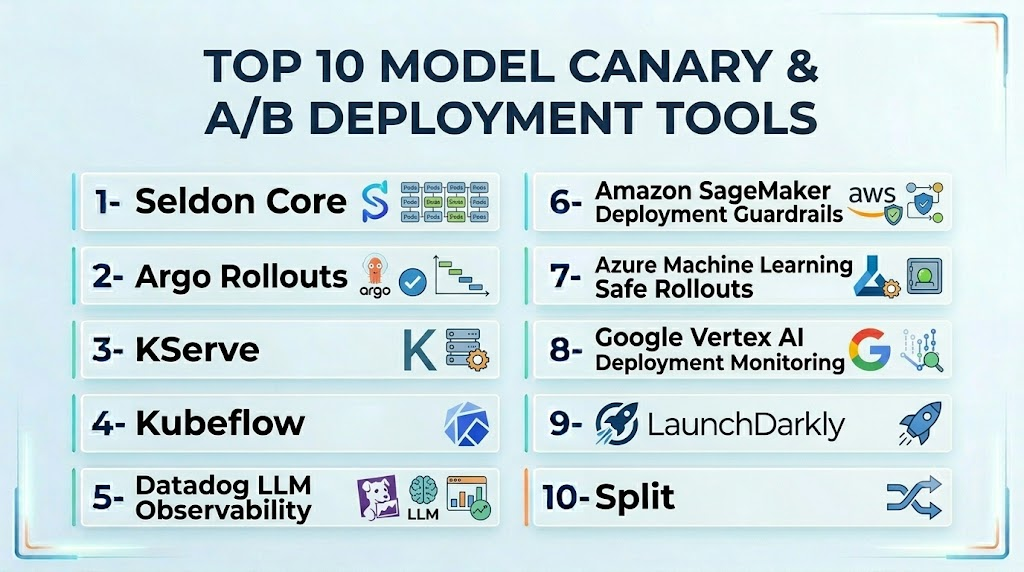
Top 10 Model Canary & A/B Deployment Tools
1- Seldon Core
One-line verdict: Best overall platform for AI canary deployments, A/B testing, and production model governance.
Short description:
Seldon Core is a Kubernetes-native MLOps platform that provides advanced deployment strategies for machine learning and AI models. It supports canary releases, A/B testing, shadow deployments, and real-time monitoring.
Standout Capabilities
- Canary deployments
- A/B testing
- Shadow deployments
- Traffic splitting
- Rollback automation
- Explainability integrations
- Enterprise governance
AI-Specific Depth
- Model support: Open-source and proprietary models
- RAG / knowledge integration: Supported through platform integrations
- Evaluation: Real-time and external evaluations
- Guardrails: Policy and governance controls
- Observability: Extensive monitoring integrations
Pros
- Mature deployment framework
- Enterprise-ready capabilities
- Strong Kubernetes integration
Cons
- Kubernetes expertise required
- Operational complexity
- Learning curve for new users
Security & Compliance
RBAC, audit logging, access controls, and enterprise governance features.
Deployment & Platforms
- Kubernetes
- Cloud
- Hybrid
- On-premises
Integrations & Ecosystem
Prometheus, Grafana, Istio, Argo, Kubeflow, OpenTelemetry.
Pricing Model
Open-source with enterprise offerings.
Best-Fit Scenarios
- Enterprise AI deployments
- Production model experimentation
- Regulated environments
2- Argo Rollouts
One-line verdict: Best open-source canary deployment solution for Kubernetes environments.
Short description:
Argo Rollouts extends Kubernetes deployment capabilities with advanced progressive delivery techniques including canary releases, blue-green deployments, and automated rollback.
Standout Capabilities
- Canary deployments
- Blue-green releases
- Progressive traffic shifting
- Automated rollback
- Traffic analysis
- Metrics-based promotion
AI-Specific Depth
- Model support: Infrastructure-agnostic
- RAG / knowledge integration: N/A
- Evaluation: Metrics-driven analysis
- Guardrails: Deployment policies
- Observability: Strong ecosystem support
Pros
- Open-source
- Mature Kubernetes ecosystem
- Flexible deployment strategies
Cons
- Infrastructure-focused
- Requires Kubernetes expertise
- Limited AI-specific analytics
Security & Compliance
Kubernetes RBAC and enterprise security integrations.
Deployment & Platforms
- Kubernetes
- Cloud
- Hybrid
Integrations & Ecosystem
Prometheus, Datadog, Grafana, Istio, Linkerd.
Pricing Model
Open-source.
Best-Fit Scenarios
- Kubernetes AI platforms
- Progressive AI deployments
- Cost-conscious organizations
3- KServe
One-line verdict: Best for serverless AI deployments with integrated canary support.
Short description:
KServe combines scalable model serving with deployment experimentation capabilities, allowing organizations to safely introduce new AI models.
Standout Capabilities
- Serverless inference
- Canary deployments
- Traffic splitting
- Autoscaling
- Multi-model serving
- Scale-to-zero
AI-Specific Depth
- Model support: Broad framework support
- RAG / knowledge integration: Supported through integrations
- Evaluation: External integrations
- Guardrails: Limited native support
- Observability: Strong Kubernetes ecosystem
Pros
- Kubernetes-native
- Strong scalability
- Open-source flexibility
Cons
- Kubernetes complexity
- Setup effort
- Requires observability tooling
Pricing Model
Open-source.
Best-Fit Scenarios
- Cloud-native AI serving
- Enterprise Kubernetes environments
- Serverless AI platforms
4- Kubeflow
One-line verdict: Best for end-to-end ML lifecycle management and deployment experimentation.
Short description:
Kubeflow provides model lifecycle management capabilities that include deployment strategies, experimentation workflows, and production monitoring.
Standout Capabilities
- Model lifecycle management
- Pipeline orchestration
- Experiment tracking
- Deployment automation
- Scalable serving
Pros
- Comprehensive platform
- Open-source ecosystem
- Large community
Cons
- Operational complexity
- Steep learning curve
- Infrastructure overhead
Best-Fit Scenarios
- Enterprise MLOps
- End-to-end ML workflows
- Research-to-production pipelines
5- Amazon SageMaker Deployment Guardrails
One-line verdict: Best for AWS-native model deployment and experimentation.
Short description:
SageMaker provides deployment guardrails, traffic shifting, and rollback capabilities that help organizations deploy AI models safely.
Standout Capabilities
- Canary deployments
- Automated rollback
- Traffic shifting
- Endpoint management
- Monitoring integration
Pros
- Managed service
- AWS ecosystem integration
- Reduced operational burden
Cons
- AWS dependency
- Pricing complexity
- Vendor lock-in considerations
Best-Fit Scenarios
- AWS customers
- Enterprise AI deployments
- Managed infrastructure
6- Azure Machine Learning Safe Rollouts
One-line verdict: Best for Microsoft-centric AI deployment workflows.
Short description:
Azure Machine Learning provides deployment strategies that support gradual rollouts, traffic management, and production monitoring.
Standout Capabilities
- Safe rollouts
- Traffic management
- Endpoint monitoring
- Governance controls
- Azure integration
Pros
- Enterprise governance
- Azure ecosystem alignment
- Managed operations
Cons
- Azure dependency
- Licensing complexity
- Platform learning curve
Best-Fit Scenarios
- Microsoft enterprises
- Regulated industries
- Enterprise AI deployments
7- Google Vertex AI Deployment Monitoring
One-line verdict: Best for GCP organizations deploying AI models at scale.
Short description:
Vertex AI provides managed deployment workflows with monitoring, traffic management, and rollback capabilities.
Standout Capabilities
- Managed deployments
- Monitoring
- Traffic splitting
- Rollback support
- GCP integration
Pros
- Managed infrastructure
- Easy scaling
- Strong cloud integration
Cons
- GCP dependency
- Vendor ecosystem reliance
- Customization limitations
Best-Fit Scenarios
- GCP customers
- Production AI systems
- Managed model serving
8- Datadog LLM Observability
One-line verdict: Best for monitoring AI deployment experiments and rollout performance.
Short description:
Datadog helps organizations monitor deployment experiments, performance metrics, latency, and business outcomes during AI rollouts.
Standout Capabilities
- Deployment monitoring
- LLM observability
- Metrics analysis
- Incident detection
- Unified dashboards
Pros
- Strong monitoring ecosystem
- Enterprise adoption
- Unified observability
Cons
- Not a deployment orchestrator
- Additional tooling required
- Cost considerations
Best-Fit Scenarios
- Existing Datadog customers
- Large-scale deployments
- Observability-focused organizations
9- LaunchDarkly
One-line verdict: Best for feature flag-driven AI model experimentation.
Short description:
LaunchDarkly enables AI teams to control model rollouts through feature flags, allowing precise experimentation and gradual deployment.
Standout Capabilities
- Feature flags
- Gradual rollouts
- User segmentation
- Rollback controls
- Experimentation support
Pros
- Easy rollout control
- Business-friendly interface
- Strong experimentation capabilities
Cons
- Not AI-specific
- Requires integration work
- Infrastructure dependencies
Best-Fit Scenarios
- AI feature experimentation
- SaaS platforms
- Controlled deployments
10- Split
One-line verdict: Best for combining feature management with AI experimentation.
Short description:
Split provides experimentation, feature flagging, and deployment control capabilities that can be used for AI model rollouts and A/B testing.
Standout Capabilities
- A/B testing
- Feature management
- Experiment analysis
- Rollback support
- User targeting
Pros
- Strong experimentation tools
- Business metric integration
- Easy rollout management
Cons
- Not AI-native
- Additional integrations required
- Enterprise pricing may vary
Best-Fit Scenarios
- Product-led AI teams
- Controlled AI releases
- Business KPI testing
Comparison Table
| Tool Name | Best For | Deployment | Model Flexibility | Strength | Watch-Out | Public Rating |
|---|---|---|---|---|---|---|
| Seldon Core | Enterprise AI deployments | Cloud/Hybrid | Multi-model | Canary + governance | Complexity | N/A |
| Argo Rollouts | Kubernetes delivery | Cloud/Hybrid | Any model | Progressive rollout | Kubernetes expertise | N/A |
| KServe | Serverless AI serving | Cloud/Hybrid | Multi-model | Scalability | Setup effort | N/A |
| Kubeflow | Full MLOps lifecycle | Cloud/Hybrid | Multi-model | End-to-end workflows | Complexity | N/A |
| SageMaker | AWS deployments | Cloud | Multi-model | Managed deployment | AWS dependency | N/A |
| Azure ML | Microsoft environments | Cloud | Multi-model | Governance | Azure dependency | N/A |
| Vertex AI | GCP deployments | Cloud | Multi-model | Managed operations | GCP dependency | N/A |
| Datadog | Deployment monitoring | Cloud | Any model | Observability | Not deployment-focused | N/A |
| LaunchDarkly | Feature-flag rollouts | Cloud | Any model | Controlled releases | Not AI-native | N/A |
| Split | Experimentation | Cloud | Any model | Business metrics | Additional integrations | N/A |
Scoring & Evaluation
This scoring is comparative rather than absolute. Scores reflect deployment safety, experimentation capabilities, observability, governance, scalability, and operational efficiency.
| Tool | Core | Reliability/Eval | Guardrails | Integrations | Ease | Perf/Cost | Security/Admin | Support | Weighted Total |
|---|---|---|---|---|---|---|---|---|---|
| Seldon Core | 10 | 9 | 9 | 9 | 6 | 8 | 9 | 8 | 8.8 |
| Argo Rollouts | 9 | 8 | 8 | 9 | 7 | 9 | 8 | 8 | 8.4 |
| KServe | 9 | 8 | 7 | 9 | 7 | 9 | 8 | 8 | 8.3 |
| Kubeflow | 9 | 8 | 7 | 9 | 6 | 8 | 8 | 8 | 8.0 |
| SageMaker | 8 | 8 | 8 | 8 | 9 | 8 | 9 | 9 | 8.3 |
| Azure ML | 8 | 8 | 9 | 8 | 8 | 8 | 9 | 8 | 8.3 |
| Vertex AI | 8 | 8 | 8 | 8 | 9 | 8 | 8 | 8 | 8.1 |
| Datadog | 8 | 8 | 7 | 10 | 8 | 8 | 9 | 9 | 8.3 |
| LaunchDarkly | 8 | 8 | 8 | 8 | 9 | 8 | 8 | 8 | 8.1 |
| Split | 8 | 8 | 8 | 8 | 8 | 8 | 8 | 8 | 8.0 |
Which Model Canary & A/B Deployment Tool Is Right for You?
Solo / Freelancer
LaunchDarkly and managed cloud deployment services provide the easiest entry point for controlled rollouts.
SMB
SageMaker, Vertex AI, and LaunchDarkly provide safe deployment capabilities with minimal operational overhead.
Mid-Market
KServe, Argo Rollouts, and Datadog offer strong deployment control and monitoring capabilities.
Enterprise
Seldon Core, Azure ML, Kubeflow, and Argo Rollouts provide governance, scalability, and advanced deployment controls.
Regulated Industries
Prioritize governance, auditability, rollback automation, RBAC, and deployment traceability.
Budget vs Premium
- Budget: Argo Rollouts, KServe, Kubeflow
- Premium: Seldon Core, Azure ML, SageMaker
Build vs Buy
Choose open-source platforms when customization and infrastructure control are important. Select managed services when operational simplicity is the priority.
Common Mistakes & How to Avoid Them
- Deploying models directly to 100% of traffic
- Ignoring rollback planning
- Measuring only accuracy while ignoring cost and latency
- Missing business KPI tracking
- Poor observability coverage
- Not validating retrieval changes separately
- Ignoring prompt-level experimentation
- Weak governance controls
- No shadow deployment testing
- Insufficient user segmentation
- Failing to automate rollout decisions
- Overlooking compliance requirements
FAQs
1. What is a model canary deployment?
A canary deployment gradually routes a small percentage of traffic to a new model version before a full rollout.
2. What is A/B testing for AI models?
A/B testing compares two or more model versions using live traffic to measure performance differences.
3. Why are canary deployments important?
They reduce deployment risk by detecting issues before they impact all users.
4. What is a shadow deployment?
A shadow deployment sends production traffic to a new model without affecting user-facing results.
5. Can these tools test prompts and RAG systems?
Yes. Modern deployment platforms increasingly support prompt, retrieval, and agent-level experimentation.
6. Which platform is best for Kubernetes?
Seldon Core, KServe, and Argo Rollouts are among the strongest Kubernetes-based options.
7. Are open-source options available?
Yes. Argo Rollouts, KServe, Kubeflow, and Seldon Core offer open-source deployment capabilities.
8. How does automated rollback work?
The system automatically reverts traffic to a previous version when predefined performance thresholds are violated.
9. Can business metrics be included in deployment decisions?
Yes. Many organizations combine technical metrics with business KPIs during rollout analysis.
10. Do these tools support LLMs?
Yes. Modern canary deployment platforms are commonly used for LLMs, AI agents, and multimodal models.
11. What is progressive delivery?
Progressive delivery gradually increases traffic to new versions while continuously monitoring performance.
12. When should organizations adopt these tools?
As soon as AI systems reach production and begin serving meaningful user traffic.
Conclusion
Model Canary & A/B Deployment Tools have become essential for modern AI operations. As organizations deploy increasingly sophisticated LLMs, AI agents, RAG systems, and multimodal applications, safely introducing changes is critical to maintaining reliability, performance, and user trust.
The ideal platform depends on infrastructure maturity, governance requirements, and operational preferences. Open-source solutions such as Seldon Core, KServe, Argo Rollouts, and Kubeflow provide flexibility and control, while managed cloud platforms offer simplicity and reduced operational overhead. Feature-flag solutions like LaunchDarkly and Split add an additional layer of experimentation and rollout control that many AI product teams find valuable.
