Introduction
Model Monitoring & Drift Detection Tools are critical components of modern MLOps and LLMOps systems that ensure machine learning models remain accurate, stable, and reliable in production over time. Once a model is deployed, its performance can degrade due to changes in real-world data, user behavior, or external environments—this is known as model drift.
These tools continuously track data drift, concept drift, prediction quality, latency, and feature behavior, alerting teams when models start to degrade. with AI systems powering real-time decisions in finance, healthcare, e-commerce, and autonomous agents, monitoring is no longer optional—it is essential infrastructure.
Unlike traditional monitoring systems, AI model monitoring platforms must handle:
- Non-deterministic outputs (especially in LLMs)
- High-dimensional feature spaces
- Real-time streaming predictions
- Multi-model environments
- Continuous learning systems
Real-World Use Cases
- Fraud detection model drift monitoring
- Recommendation system performance tracking
- Credit scoring stability monitoring
- LLM hallucination and quality drift detection
- Customer churn prediction monitoring
- Pricing and demand forecasting stability
- Autonomous agent behavior tracking
- RAG pipeline performance monitoring
Evaluation Criteria for Buyers
When evaluating Model Monitoring & Drift Detection Tools, consider:
- Data drift detection accuracy
- Concept drift detection capabilities
- Real-time monitoring support
- Feature-level observability
- Prediction quality tracking
- Alerting and anomaly detection
- Model explainability integration
- LLM-specific monitoring support
- Dashboarding and visualization
- Integration with MLOps pipelines
- Scalability for high-throughput systems
- Cost efficiency at scale
- API and SDK usability
Best for: ML engineering teams, AI platform teams, data science teams, fintech companies, and enterprises running production ML systems.
Not ideal for: Small ML experiments, offline analytics, or non-production AI prototypes.
What’s Changed in Model Monitoring & Drift Detection
- Drift detection now includes LLM behavior drift (hallucination, tone shifts)
- Real-time streaming monitoring is now standard
- Feature-level monitoring is deeply integrated into pipelines
- Automated root cause analysis is widely used
- AI-powered anomaly detection replaces static thresholds
- Multi-model monitoring dashboards are standard
- Data + concept + prediction drift are unified in single views
- Monitoring systems now track cost and latency drift
- RAG system monitoring is a core requirement
- Agent behavior monitoring is emerging
- Self-healing pipelines are being introduced
- Continuous evaluation loops are now automated
Quick Buyer Checklist
- □ Real-time drift detection capability
- □ Data + concept drift monitoring
- □ Feature-level observability
- □ LLM-specific monitoring support
- □ Alerting and anomaly detection
- □ Dashboard and visualization tools
- □ Integration with ML pipelines
- □ API/SDK support
- □ Model explainability features
- □ Scalability for production workloads
- □ Cost and latency tracking
- □ Root cause analysis tools
- □ Multi-model support
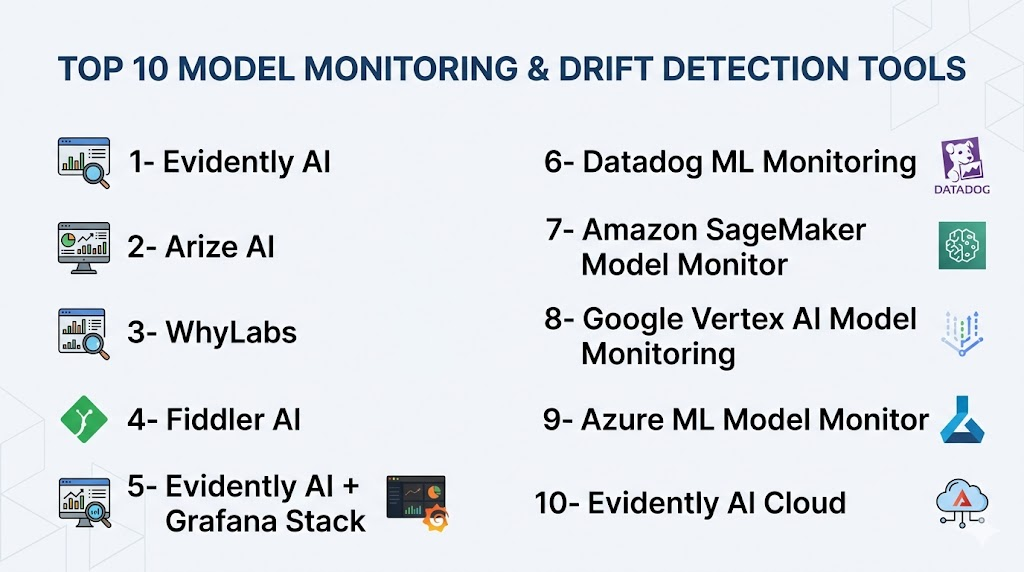
Top 10 Model Monitoring & Drift Detection Tools
1- Evidently AI
One-line verdict: Best open-source model monitoring and drift detection framework for ML and LLM systems.
Short description:
Evidently AI provides powerful tools for data drift detection, model performance monitoring, and ML observability with customizable dashboards.
Standout Capabilities
- Data drift detection (statistical tests)
- Concept drift monitoring
- Model performance tracking
- Feature distribution analysis
- Custom monitoring reports
- Real-time dashboards
- Batch evaluation pipelines
AI-Specific Depth
- Model support: Multi-framework
- RAG integration: External systems required
- Evaluation: Statistical + ML metrics
- Guardrails: Not built-in
- Observability: Feature + prediction monitoring
Pros
- Open-source and flexible
- Strong statistical drift detection
- Easy integration
Cons
- Requires setup effort
- Limited enterprise governance
- No built-in ML pipeline orchestration
Security & Compliance
Depends on deployment environment.
Deployment & Platforms
- Cloud
- Self-hosted
Integrations & Ecosystem
- Python ML stack
- MLflow
- Airflow
- Databases
Pricing Model
Open-source + enterprise offerings.
Best-Fit Scenarios
- Startup ML monitoring
- Custom drift detection systems
- Research ML pipelines
2- Arize AI
One-line verdict: Best enterprise-grade ML observability and drift detection platform.
Short description:
Arize AI provides full-stack monitoring for ML and LLM systems with advanced drift detection and explainability.
Standout Capabilities
- Real-time drift detection
- Feature importance tracking
- Model performance monitoring
- LLM observability
- Root cause analysis
- Data quality monitoring
- Alerting system
AI-Specific Depth
- Model support: Multi-model
- RAG integration: Strong support
- Evaluation: Built-in evaluation tools
- Guardrails: Policy-based controls
- Observability: Deep ML + LLM tracing
Pros
- Enterprise-ready platform
- Strong LLM monitoring support
- Excellent observability tools
Cons
- Higher cost
- Complex setup for small teams
- Vendor lock-in risk
Security & Compliance
Enterprise RBAC, encryption, audit logs.
Deployment & Platforms
- Cloud
Integrations & Ecosystem
- ML pipelines
- Vector databases
- Data warehouses
- LLM frameworks
Pricing Model
Enterprise subscription.
Best-Fit Scenarios
- Enterprise AI systems
- LLM monitoring
- Real-time ML pipelines
3- WhyLabs
One-line verdict: Best privacy-focused model monitoring and data drift detection platform.
Short description:
WhyLabs focuses on scalable monitoring of ML models and datasets with strong emphasis on privacy and compliance.
Standout Capabilities
- Data drift detection
- Model performance monitoring
- Feature monitoring
- Anomaly detection
- Data privacy-first architecture
- Real-time alerting
- LLM observability support
AI-Specific Depth
- Model support: Multi-model
- RAG integration: Supported
- Evaluation: Statistical + ML metrics
- Guardrails: Policy-based controls
- Observability: Feature + model tracking
Pros
- Strong privacy architecture
- Lightweight deployment
- Good scalability
Cons
- Less advanced visualization
- Limited customization in some areas
- Enterprise features vary
Security & Compliance
Strong privacy-first design with enterprise controls.
Deployment & Platforms
- Cloud
- Hybrid
Integrations & Ecosystem
- MLflow
- AWS/GCP/Azure
- Python ML stack
- Data pipelines
Pricing Model
Usage-based + enterprise plans.
Best-Fit Scenarios
- Regulated industries
- Privacy-sensitive ML systems
- Production ML monitoring
4- Fiddler AI
One-line verdict: Best explainable AI monitoring and drift detection platform.
Short description:
Fiddler AI provides model monitoring with strong focus on explainability and fairness alongside drift detection.
Standout Capabilities
- Drift detection dashboards
- Explainable AI insights
- Model fairness monitoring
- Feature importance tracking
- Data quality monitoring
- Real-time alerts
- Performance tracking
AI-Specific Depth
- Model support: Multi-framework
- RAG integration: Limited support
- Evaluation: Built-in explainability metrics
- Guardrails: Bias detection controls
- Observability: Full ML monitoring
Pros
- Strong explainability features
- Enterprise-grade monitoring
- Good fairness tools
Cons
- Less LLM-specific focus
- Higher cost
- Complex onboarding
Security & Compliance
Enterprise RBAC, encryption, audit logs.
Deployment & Platforms
- Cloud
Integrations & Ecosystem
- ML pipelines
- BI tools
- Data warehouses
- APIs
Pricing Model
Enterprise subscription.
Best-Fit Scenarios
- Regulated ML systems
- Explainable AI use cases
- Enterprise monitoring
5- Evidently AI + Grafana Stack
One-line verdict: Best open-source customizable monitoring stack for ML observability.
Short description:
This stack combines Evidently AI with Grafana for visualization and monitoring dashboards.
Standout Capabilities
- Drift detection pipelines
- Custom dashboards
- Real-time monitoring
- Feature analysis
- Model performance tracking
- Alerting via Grafana
- Flexible architecture
AI-Specific Depth
- Model support: Multi-framework
- RAG integration: External systems
- Evaluation: Statistical monitoring
- Guardrails: Not built-in
- Observability: Custom dashboards
Pros
- Highly flexible
- Cost-efficient
- Open-source ecosystem
Cons
- Requires engineering setup
- No unified platform
- Maintenance overhead
Security & Compliance
Depends on deployment stack.
Deployment & Platforms
- Cloud
- Self-hosted
Integrations & Ecosystem
- Grafana
- Prometheus
- ML pipelines
- Python stack
Pricing Model
Open-source.
Best-Fit Scenarios
- Custom ML observability
- Startup monitoring systems
- Engineering-heavy teams
6- Datadog ML Monitoring
One-line verdict: Best unified observability platform with ML monitoring extensions.
Short description:
Datadog provides infrastructure and application monitoring with added ML model performance tracking capabilities.
Standout Capabilities
- Model performance monitoring
- Data pipeline observability
- Real-time alerts
- Infrastructure + ML unified view
- Anomaly detection
- Dashboarding tools
- Log correlation
AI-Specific Depth
- Model support: External ML systems
- RAG integration: Limited
- Evaluation: Metric-based monitoring
- Guardrails: Not ML-specific
- Observability: Strong system-level tracking
Pros
- Unified observability platform
- Strong infrastructure integration
- Scalable monitoring
Cons
- Not ML-native tool
- Expensive at scale
- Requires customization
Security & Compliance
Enterprise-grade security and compliance features.
Deployment & Platforms
- Cloud
Integrations & Ecosystem
- Kubernetes
- Cloud platforms
- ML pipelines
- APIs
Pricing Model
Usage-based subscription.
Best-Fit Scenarios
- Enterprise observability
- Unified monitoring systems
- Cloud-native ML systems
7- Amazon SageMaker Model Monitor
One-line verdict: Best AWS-native model drift detection system.
Short description:
SageMaker Model Monitor automatically detects data drift and model quality degradation in AWS ML systems.
Standout Capabilities
- Data drift detection
- Feature monitoring
- Baseline comparison
- Real-time alerts
- Model quality tracking
- Integration with SageMaker pipelines
- Automated reporting
AI-Specific Depth
- Model support: AWS ML models
- RAG integration: AWS services
- Evaluation: Built-in metrics
- Guardrails: IAM policies
- Observability: CloudWatch integration
Pros
- Fully managed AWS service
- Strong scalability
- Easy integration
Cons
- AWS lock-in
- Limited flexibility
- Cost complexity
Security & Compliance
Enterprise AWS security and IAM controls.
Deployment & Platforms
- Cloud (AWS)
Integrations & Ecosystem
- SageMaker
- S3
- CloudWatch
- AWS ML pipelines
Pricing Model
Usage-based.
Best-Fit Scenarios
- AWS ML systems
- Enterprise monitoring pipelines
- Production ML models
8- Google Vertex AI Model Monitoring
One-line verdict: Best GCP-native drift detection system for ML pipelines.
Short description:
Vertex AI provides model monitoring with drift detection and prediction analysis within Google Cloud.
Standout Capabilities
- Data drift detection
- Prediction skew monitoring
- Feature monitoring
- Alerting system
- Model performance tracking
- Pipeline integration
- Real-time dashboards
AI-Specific Depth
- Model support: Multi-framework
- RAG integration: GCP ecosystem
- Evaluation: Built-in metrics
- Guardrails: IAM-based controls
- Observability: Cloud monitoring
Pros
- Strong GCP integration
- Fully managed service
- Scalable architecture
Cons
- GCP lock-in
- Limited customization
- Pricing complexity
Security & Compliance
Enterprise Google Cloud security.
Deployment & Platforms
- Cloud (GCP)
Integrations & Ecosystem
- BigQuery
- Vertex AI
- Dataflow
- Cloud Storage
Pricing Model
Usage-based.
Best-Fit Scenarios
- GCP ML workloads
- Enterprise AI pipelines
- Real-time ML systems
9- Azure ML Model Monitor
One-line verdict: Best enterprise model monitoring for Microsoft ecosystem.
Short description:
Azure ML Model Monitor provides drift detection and performance tracking for ML systems in Azure environments.
Standout Capabilities
- Data drift detection
- Feature monitoring
- Model performance tracking
- Alerting system
- Pipeline integration
- Explainability features
- Monitoring dashboards
AI-Specific Depth
- Model support: Multi-framework
- RAG integration: Azure ecosystem
- Evaluation: Metric-based monitoring
- Guardrails: Azure AD policies
- Observability: Azure Monitor
Pros
- Strong enterprise governance
- Deep Microsoft integration
- Hybrid support
Cons
- Azure dependency
- Complex configuration
- Cost variability
Security & Compliance
Enterprise Azure security and compliance stack.
Deployment & Platforms
- Cloud
- Hybrid
Integrations & Ecosystem
- Azure ML
- Databricks
- Power BI
- Azure Data Factory
Pricing Model
Usage-based + enterprise licensing.
Best-Fit Scenarios
- Microsoft ecosystem users
- Enterprise ML systems
- Regulated industries
10- Evidently AI Cloud
One-line verdict: Best lightweight managed drift detection platform for startups.
Short description:
Evidently AI Cloud provides hosted monitoring dashboards and drift detection without heavy infrastructure setup.
Standout Capabilities
- Drift detection dashboards
- Feature monitoring
- Model quality tracking
- Alerts and notifications
- Data profiling tools
- Simple deployment
- Lightweight integration
AI-Specific Depth
- Model support: Multi-framework
- RAG integration: Limited
- Evaluation: Statistical metrics
- Guardrails: Not built-in
- Observability: Basic monitoring
Pros
- Easy to use
- Fast setup
- Cost-efficient
Cons
- Limited enterprise features
- Less customization
- Smaller ecosystem
Security & Compliance
Varies by plan.
Deployment & Platforms
- Cloud
Integrations & Ecosystem
- Python ML stack
- APIs
- ML pipelines
Pricing Model
Subscription-based.
Best-Fit Scenarios
- Startups
- Small ML teams
- Lightweight monitoring needs
Comparison Table
| Tool Name | Best For | Deployment | Drift Detection | Strength | Watch-Out | Public Rating |
|---|---|---|---|---|---|---|
| Evidently AI | Open-source ML monitoring | Cloud/Self-hosted | High | Flexibility | Setup effort | N/A |
| Arize AI | Enterprise ML observability | Cloud | Very high | LLM monitoring | Cost | N/A |
| WhyLabs | Privacy-focused ML monitoring | Cloud/Hybrid | High | Data privacy | Limited UI depth | N/A |
| Fiddler AI | Explainable AI monitoring | Cloud | High | Explainability | Cost | N/A |
| Grafana Stack | Custom monitoring | Cloud/Self-hosted | High | Flexibility | Engineering effort | N/A |
| Datadog | Unified observability | Cloud | Medium | Infrastructure view | Not ML-native | N/A |
| SageMaker Monitor | AWS ML monitoring | Cloud | High | Managed AWS service | Lock-in | N/A |
| Vertex AI Monitor | GCP ML monitoring | Cloud | High | GCP integration | Lock-in | N/A |
| Azure ML Monitor | Microsoft ML monitoring | Cloud/Hybrid | High | Enterprise governance | Complexity | N/A |
| Evidently Cloud | Lightweight SaaS | Cloud | Medium | Simplicity | Limited features | N/A |
Scoring & Evaluation
| Tool | Core | Reliability | Guardrails | Integrations | Ease | Perf/Cost | Security | Support | Weighted Total |
|---|---|---|---|---|---|---|---|---|---|
| Evidently AI | 9 | 8 | 7 | 8 | 9 | 9 | 8 | 8 | 8.3 |
| Arize AI | 9 | 9 | 9 | 9 | 8 | 8 | 9 | 9 | 8.8 |
| WhyLabs | 8 | 9 | 8 | 8 | 8 | 9 | 9 | 8 | 8.4 |
| Fiddler AI | 8 | 9 | 9 | 8 | 7 | 8 | 9 | 8 | 8.3 |
| Grafana Stack | 8 | 8 | 7 | 8 | 7 | 9 | 7 | 8 | 7.9 |
| Datadog | 8 | 9 | 8 | 9 | 9 | 7 | 9 | 9 | 8.4 |
| SageMaker | 9 | 9 | 9 | 9 | 8 | 8 | 9 | 8 | 8.7 |
| Vertex AI | 9 | 9 | 9 | 9 | 8 | 8 | 9 | 8 | 8.7 |
| Azure ML | 9 | 9 | 9 | 9 | 8 | 8 | 9 | 8 | 8.7 |
| Evidently Cloud | 8 | 8 | 7 | 8 | 9 | 9 | 8 | 8 | 8.2 |
Which Model Monitoring Tool Is Right for You?
Solo / Freelancer
Evidently AI or Evidently Cloud for lightweight drift detection.
SMB
WhyLabs and Evidently AI for scalable monitoring.
Mid-Market
Arize AI and Datadog for observability and drift detection.
Enterprise
SageMaker, Vertex AI, and Azure ML for governed ML systems.
Regulated Industries
Focus on explainability, privacy, and auditability.
Budget vs Premium
Open-source tools reduce cost; enterprise tools improve governance.
Build vs Buy
Build for flexibility; buy for scalability and compliance.
Common Mistakes & How to Avoid Them
- Ignoring data drift early signals
- No baseline dataset definition
- Weak alerting configuration
- No feature-level monitoring
- Missing LLM monitoring
- Over-reliance on static thresholds
- No explainability layer
- Poor integration with ML pipelines
- No cost tracking
- Ignoring concept drift
- Lack of real-time monitoring
- No feedback loop
FAQs
1- What is model drift?
Model drift is when model performance degrades due to changes in real-world data.
2- What is data drift?
It is a change in input feature distribution over time.
3- What is concept drift?
It occurs when relationships between inputs and outputs change.
4- Why is monitoring important?
To ensure ML models remain accurate in production.
5- Do these tools support LLMs?
Yes, modern tools support LLM behavior monitoring.
6- What is real-time monitoring?
Continuous tracking of model performance during inference.
7- Are these tools cloud-only?
No, many support hybrid and self-hosted deployments.
8- What is anomaly detection?
Identifying unusual model or data behavior.
9- What is feature monitoring?
Tracking changes in individual input variables.
10- What is explainability in monitoring?
Understanding why models behave the way they do.
11- Can monitoring reduce ML failures?
Yes, it helps detect issues before they impact users.
12- What is the future of model monitoring?
AI-driven self-healing monitoring systems.
Conclusion
Model Monitoring & Drift Detection Tools are essential for maintaining trust, reliability, and accuracy in production AI systems. As AI becomes more dynamic and agentic, monitoring systems must evolve to handle not just data drift, but also behavioral drift in LLMs and autonomous agents.
Platforms like Arize AI, SageMaker Model Monitor, and Vertex AI dominate enterprise ecosystems, while Evidently AI and WhyLabs provide flexible and cost-effective solutions for modern ML teams.
The future of model monitoring lies in autonomous, self-healing systems that detect drift, diagnose root causes, and automatically trigger remediation workflows across the ML lifecycle
