Introduction
Multi-Agent Coordination Platforms help teams design, connect, monitor, and control multiple AI agents working together on complex tasks. Instead of one AI assistant handling everything, these platforms let specialized agents plan, research, write, review, execute tools, call APIs, retrieve knowledge, and hand work to each other in a structured workflow.
This matters now because businesses are moving from simple AI chatbots to agentic systems that can automate real business processes. Multi-agent coordination is useful for customer support, IT operations, software engineering, research automation, sales workflows, document processing, compliance review, and enterprise knowledge assistants.
Buyers should evaluate model flexibility, workflow control, tool calling, RAG support, evaluation features, guardrails, observability, cost controls, security, deployment options, human review, and ecosystem maturity.
Best for: AI engineers, CTOs, platform teams, automation leaders, enterprise architects, DevOps teams, support operations, financial services, healthcare, IT services, and software companies building AI workflows at scale.
Not ideal for: teams that only need a simple chatbot, basic content generation, one-off AI experiments, or traditional workflow automation without LLM-based reasoning.
What’s Changed in Multi-Agent Coordination Platforms
- Multi-agent systems are shifting from experiments to production-ready business workflows.
- Tool calling is now a core requirement, not an advanced feature.
- Human-in-the-loop approval is becoming essential for sensitive decisions.
- Evaluation and regression testing are becoming mandatory before deployment.
- Prompt injection defense is now a serious buyer concern.
- Observability now includes traces, tool calls, latency, token usage, and cost metrics.
- Model routing helps teams balance speed, quality, and cost.
- BYO model support is increasingly important to reduce vendor lock-in.
- RAG and knowledge integration are now central to enterprise agent workflows.
- Governance teams expect audit logs, RBAC, retention controls, and policy enforcement.
- Multimodal agents are expanding coordination beyond text into files, images, audio, and video.
- Long-running agent workflows need state management, memory, retries, and error recovery.
Quick Buyer Checklist
Use this checklist to shortlist tools quickly:
- Supports multi-agent workflows and role-based coordination
- Works with hosted, BYO, and open-source models
- Offers strong tool calling and API integration
- Supports RAG, vector databases, and enterprise knowledge sources
- Includes evaluation, testing, and regression workflows
- Provides guardrails for unsafe outputs and prompt injection risks
- Tracks traces, tokens, latency, cost, and failures
- Supports human approval for risky actions
- Offers RBAC, audit logs, and admin controls
- Provides cloud, self-hosted, or hybrid deployment options
- Avoids heavy vendor lock-in where possible
- Has active documentation, community, and ecosystem support
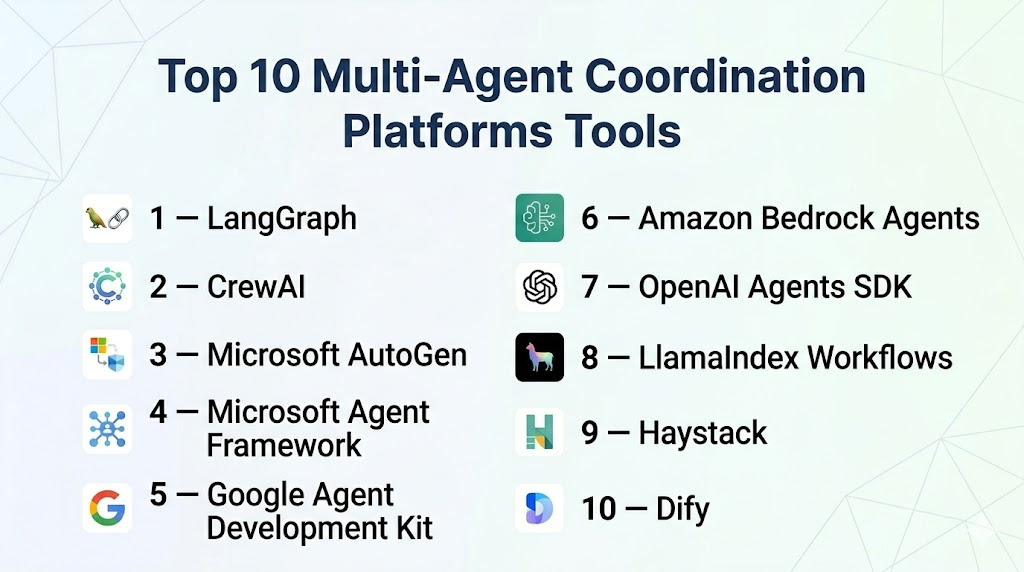
Top 10 Multi-Agent Coordination Platforms Tools
1 — LangGraph
One-line verdict: Best for engineering teams building reliable, stateful, production-grade multi-agent workflows.
Short description:
LangGraph is a graph-based orchestration framework for building stateful AI agents and multi-agent systems. It is especially useful for developers who need control over workflow logic, memory, branching, retries, and human review.
Standout Capabilities
- Graph-based agent coordination
- Stateful and long-running workflows
- Human-in-the-loop checkpoints
- Support for agent handoffs and routing
- Strong fit for production-grade applications
- Works well with RAG and tool calling
- Flexible workflow design
- Strong developer ecosystem
AI-Specific Depth
- Model support: Multi-model, BYO model, open-source model support varies by setup
- RAG / knowledge integration: Strong vector database and retrieval integration through ecosystem
- Evaluation: Supported through related tooling and custom evaluation workflows
- Guardrails: Custom guardrails supported; advanced controls vary by implementation
- Observability: Tracing, state inspection, debugging, and workflow monitoring available
Pros
- Excellent for complex agent workflows
- Strong control over state and execution paths
- Good fit for enterprise engineering teams
Cons
- Requires developer expertise
- More complex than low-code platforms
- Production setup needs careful architecture
Security & Compliance
Security depends on deployment architecture. Enterprise setups can include SSO, RBAC, encryption, audit logging, and retention controls through surrounding infrastructure. Certifications are Not publicly stated at the framework level.
Deployment & Platforms
- Windows, macOS, Linux
- Cloud, self-hosted, hybrid
- Python-focused developer environment
Integrations & Ecosystem
LangGraph benefits from the broader LangChain ecosystem and works well with modern AI infrastructure.
- LLM providers
- Vector databases
- APIs and tools
- LangSmith-style observability
- Enterprise data sources
- Custom workflow components
Pricing Model
Open-source framework with enterprise and platform costs varying by deployment.
Best-Fit Scenarios
- Stateful enterprise AI workflows
- Human-reviewed automation
- Complex multi-agent business processes
2 — CrewAI
One-line verdict: Best for teams building role-based multi-agent collaboration with faster setup.
Short description:
CrewAI focuses on creating teams of AI agents with specific roles, goals, tools, and tasks. It is popular among developers and automation teams that want a clear structure for collaborative agents.
Standout Capabilities
- Role-based agent design
- Agent crews and task delegation
- Visual and code-first workflow options
- Memory and knowledge features
- Tool usage and task execution
- Good for rapid prototyping
- Growing multi-agent ecosystem
- Clear mental model for business workflows
AI-Specific Depth
- Model support: Multi-model support
- RAG / knowledge integration: Supported through knowledge and tool integrations
- Evaluation: Varies / N/A
- Guardrails: Guardrails available; depth varies by setup
- Observability: Observability features available; depth varies by plan and deployment
Pros
- Easy to understand multi-agent structure
- Faster to prototype than many low-level frameworks
- Strong fit for business workflow automation
Cons
- Advanced enterprise governance may require extra setup
- Complex workflows can still need engineering support
- Platform maturity varies by use case
Security & Compliance
Security capabilities depend on deployment and plan. SSO, RBAC, audit logs, and retention controls should be verified before enterprise rollout. Certifications are Not publicly stated.
Deployment & Platforms
- Web, Windows, macOS, Linux
- Cloud and self-hosted options vary
- Python developer ecosystem
Integrations & Ecosystem
CrewAI integrates with LLMs, tools, APIs, and business workflows.
- LLM providers
- Custom tools
- APIs
- Knowledge sources
- Python ecosystem
- Automation workflows
Pricing Model
Open-source plus commercial or managed options. Exact pricing varies.
Best-Fit Scenarios
- Role-based agent teams
- Research and content workflows
- Business process automation pilots
3 — Microsoft AutoGen
One-line verdict: Best for developers experimenting with conversational and cooperative multi-agent systems.
Short description:
Microsoft AutoGen is an open-source framework for creating multi-agent AI applications where agents can cooperate, call tools, and include human input. It is widely known in the agent research and developer community.
Standout Capabilities
- Multi-agent conversations
- Human-in-the-loop workflows
- Tool execution support
- Flexible agent communication patterns
- Useful for research and experimentation
- Developer-first Python framework
- Supports autonomous and assisted workflows
- Strong historical influence in agent orchestration
AI-Specific Depth
- Model support: Multi-model support
- RAG / knowledge integration: Possible through custom integrations
- Evaluation: Custom evaluation required
- Guardrails: Varies / N/A
- Observability: Basic or custom observability depending on implementation
Pros
- Flexible for research and experimentation
- Strong multi-agent conversation model
- Useful for custom agent architectures
Cons
- Production readiness depends heavily on implementation
- Enterprise features may require additional engineering
- Newer successor frameworks may be preferred for future projects
Security & Compliance
Security is deployment-dependent. Enterprise security features such as SSO, RBAC, audit logs, encryption, and retention controls require surrounding platform implementation. Certifications are Not publicly stated.
Deployment & Platforms
- Windows, macOS, Linux
- Self-hosted or cloud depending on implementation
- Python-based development
Integrations & Ecosystem
AutoGen can be extended through custom tools, APIs, and model integrations.
- LLM providers
- Custom tools
- Python libraries
- APIs
- Human review workflows
- Research prototypes
Pricing Model
Open-source framework. Infrastructure and model usage costs vary.
Best-Fit Scenarios
- Agent research
- Multi-agent conversation prototypes
- Custom developer-led experiments
4 — Microsoft Agent Framework
One-line verdict: Best for Microsoft-aligned enterprises standardizing agent development and coordination.
Short description:
Microsoft Agent Framework brings together concepts from AutoGen and Semantic Kernel for building single-agent and multi-agent applications. It is designed for developers who want enterprise-grade agent patterns within the Microsoft ecosystem.
Standout Capabilities
- Single-agent and multi-agent patterns
- Session-based state management
- Enterprise-oriented architecture
- Model and embedding support
- Telemetry support
- Type safety and filters
- Microsoft ecosystem alignment
- Suitable for structured business workflows
AI-Specific Depth
- Model support: Multi-model and BYO model support varies by setup
- RAG / knowledge integration: Supported through Microsoft and custom integrations
- Evaluation: Varies / N/A
- Guardrails: Filters and custom controls supported
- Observability: Telemetry support available
Pros
- Strong fit for Microsoft environments
- Better enterprise structure than experimental frameworks
- Supports agentic workflow standardization
Cons
- Best suited to Microsoft-centric teams
- Still requires developer expertise
- Ecosystem maturity should be evaluated before large rollout
Security & Compliance
Enterprise security may be supported through Microsoft identity, RBAC, audit logging, encryption, and cloud governance services. Certifications depend on deployment environment and service usage.
Deployment & Platforms
- Windows, macOS, Linux
- Cloud and hybrid deployment patterns
- Microsoft developer ecosystem
Integrations & Ecosystem
Designed to work well with enterprise and Microsoft-aligned AI stacks.
- Azure services
- Microsoft identity
- Model providers
- Embedding services
- APIs
- Enterprise applications
Pricing Model
Framework usage may be open-source or platform-based; cloud and model usage costs vary.
Best-Fit Scenarios
- Microsoft enterprise AI programs
- Internal copilots and agents
- Governed multi-agent development
5 — Google Agent Development Kit
One-line verdict: Best for Google Cloud teams building scalable multi-agent systems.
Short description:
Google Agent Development Kit helps developers build, debug, evaluate, and deploy AI agents, including multi-agent systems. It is especially relevant for teams already using Google Cloud and Gemini-related services.
Standout Capabilities
- Multi-agent orchestration
- Graph-based workflows
- Tool calling
- Evaluation support
- Deployment to enterprise cloud services
- Debugging capabilities
- Strong Google Cloud alignment
- Scalable architecture
AI-Specific Depth
- Model support: Google models and multi-model support vary by implementation
- RAG / knowledge integration: Supported through Google Cloud and custom integrations
- Evaluation: Evaluation capabilities available
- Guardrails: Available through platform and custom controls
- Observability: Cloud monitoring and debugging support available
Pros
- Strong fit for Google Cloud environments
- Supports modern agent development patterns
- Good path from prototype to production
Cons
- Best value inside Google ecosystem
- Requires cloud architecture knowledge
- Feature maturity may vary across regions and services
Security & Compliance
Security capabilities may include IAM, logging, encryption, access controls, and cloud governance through Google Cloud. Certifications depend on the services used. Exact compliance details should be verified.
Deployment & Platforms
- Web and developer tooling
- Cloud and hybrid patterns
- Google Cloud-focused deployment
Integrations & Ecosystem
Google ADK fits naturally with Google Cloud and AI services.
- Google Cloud services
- Gemini ecosystem
- APIs and tools
- Cloud Run
- Enterprise data systems
- Monitoring services
Pricing Model
Usage-based cloud and model pricing. Exact costs vary by services used.
Best-Fit Scenarios
- Google Cloud AI projects
- Scalable enterprise agents
- Multi-agent cloud workflows
6 — Amazon Bedrock Agents
One-line verdict: Best for AWS enterprises wanting managed AI agent coordination and knowledge integration.
Short description:
Amazon Bedrock Agents help teams build managed AI agents that can use foundation models, call APIs, and work with knowledge bases. It is a strong choice for organizations already standardized on AWS.
Standout Capabilities
- Managed agent orchestration
- Foundation model access through Bedrock
- Knowledge base integration
- API and tool execution
- AWS security ecosystem
- Enterprise cloud scalability
- Serverless-friendly architecture
- Strong fit for governed AWS workloads
AI-Specific Depth
- Model support: Multi-model through Bedrock-supported models
- RAG / knowledge integration: Native knowledge base support
- Evaluation: Varies / N/A
- Guardrails: Guardrail capabilities available through Bedrock ecosystem
- Observability: AWS monitoring and logging integrations available
Pros
- Managed service reduces infrastructure burden
- Strong AWS ecosystem integration
- Good for enterprise-scale cloud workloads
Cons
- AWS dependency
- Less flexible than open-source frameworks
- Pricing can become complex with scale
Security & Compliance
Security features depend on AWS configuration and services used. IAM, encryption, logging, and governance controls are available through AWS. Certifications depend on AWS service scope and should be verified.
Deployment & Platforms
- Cloud
- AWS-managed
- API-based access
Integrations & Ecosystem
Amazon Bedrock Agents are strongest when connected to AWS-native services.
- AWS Lambda
- Amazon S3
- Knowledge bases
- IAM
- CloudWatch
- Enterprise APIs
Pricing Model
Usage-based cloud pricing. Exact costs depend on models, tokens, tools, storage, and usage patterns.
Best-Fit Scenarios
- AWS-native enterprises
- Managed AI agent deployments
- Secure knowledge-based automation
7 — OpenAI Agents SDK
One-line verdict: Best for teams building OpenAI-centered agents with tool calling and simple developer workflows.
Short description:
OpenAI Agents SDK helps developers build agentic applications that can use models, tools, instructions, and workflows. It is useful for teams that want a direct path to building agents around OpenAI models.
Standout Capabilities
- OpenAI-native agent development
- Tool calling support
- Simple developer experience
- Good fit for assistant-style applications
- API-first architecture
- Fast prototyping
- Works well with OpenAI model ecosystem
- Suitable for productized AI features
AI-Specific Depth
- Model support: Primarily OpenAI models; external model support varies
- RAG / knowledge integration: Supported through custom retrieval and tool integrations
- Evaluation: Varies / N/A
- Guardrails: Guardrail implementation varies by application
- Observability: Basic monitoring and custom tracing vary by setup
Pros
- Fast to start building agents
- Strong model quality access
- Simple for product teams already using OpenAI
Cons
- Vendor lock-in risk
- Less neutral than open-source orchestration frameworks
- Advanced governance may need custom implementation
Security & Compliance
Security and privacy controls vary by API plan, configuration, and deployment architecture. Enterprise requirements such as retention controls, audit logs, and admin policies should be verified. Certifications are Not publicly stated here.
Deployment & Platforms
- Cloud API
- Web-based developer usage
- Application deployment depends on customer stack
Integrations & Ecosystem
The SDK connects well with modern product and developer environments.
- OpenAI APIs
- Function and tool calls
- Custom APIs
- Retrieval systems
- Application backends
- Product workflows
Pricing Model
Usage-based model and API pricing. Exact costs vary by model, token usage, and workload volume.
Best-Fit Scenarios
- AI assistants
- Product copilots
- OpenAI-first agent applications
8 — LlamaIndex Workflows
One-line verdict: Best for knowledge-heavy multi-agent workflows powered by enterprise data and RAG.
Short description:
LlamaIndex Workflows supports building structured AI workflows around data, retrieval, and agentic applications. It is a strong option for teams building knowledge assistants and research-heavy systems.
Standout Capabilities
- Strong RAG foundation
- Workflow-based orchestration
- Data connector ecosystem
- Agent and tool support
- Good for knowledge-intensive applications
- Flexible model support
- Works with vector databases
- Developer-friendly architecture
AI-Specific Depth
- Model support: Multi-model and BYO model support
- RAG / knowledge integration: Strong retrieval and data integration support
- Evaluation: Supported through ecosystem and custom workflows
- Guardrails: Varies / N/A
- Observability: Available through integrations and custom monitoring
Pros
- Excellent for data-connected agents
- Strong retrieval ecosystem
- Good flexibility for developers
Cons
- Requires technical implementation
- Not always ideal for simple automation
- Governance depth depends on architecture
Security & Compliance
Security depends on deployment model and connected infrastructure. SSO, RBAC, audit logs, encryption, and retention controls require implementation through the surrounding stack. Certifications are Not publicly stated at framework level.
Deployment & Platforms
- Windows, macOS, Linux
- Cloud, self-hosted, hybrid
- Python-focused
Integrations & Ecosystem
LlamaIndex is strong for connecting agents to knowledge systems.
- Vector databases
- Document stores
- APIs
- Cloud storage
- LLM providers
- Enterprise knowledge sources
Pricing Model
Open-source with commercial services and infrastructure costs varying by deployment.
Best-Fit Scenarios
- Knowledge assistants
- Research automation
- Enterprise RAG workflows
9 — Haystack
One-line verdict: Best for open-source teams building RAG-first agents with deployment control.
Short description:
Haystack is an open-source framework for building search, RAG, and agentic AI applications. It is useful for teams that need control over data pipelines, retrieval, and deployment environments.
Standout Capabilities
- RAG pipeline design
- Open-source architecture
- Agentic workflow support
- Strong retrieval foundation
- Flexible deployment options
- Works with multiple model providers
- Good fit for self-hosted environments
- Custom pipeline construction
AI-Specific Depth
- Model support: Open-source, proprietary, and BYO model options
- RAG / knowledge integration: Strong RAG and document retrieval support
- Evaluation: Supported through custom and ecosystem approaches
- Guardrails: Varies / N/A
- Observability: Custom monitoring and integrations vary by implementation
Pros
- Strong open-source flexibility
- Good fit for privacy-conscious teams
- Excellent for retrieval-heavy applications
Cons
- More engineering effort required
- Managed experience may be limited
- Multi-agent coordination may need custom design
Security & Compliance
Security depends on how Haystack is deployed. Self-hosting can support strict data control, but SSO, RBAC, audit logging, and retention policies require implementation. Certifications are Not publicly stated at framework level.
Deployment & Platforms
- Windows, macOS, Linux
- Cloud, self-hosted, hybrid
- Python ecosystem
Integrations & Ecosystem
Haystack integrates with search systems, databases, and LLM providers.
- Vector databases
- Search engines
- Document stores
- LLM providers
- APIs
- Custom pipelines
Pricing Model
Open-source framework with infrastructure and optional commercial service costs.
Best-Fit Scenarios
- Self-hosted AI search
- RAG-first agent workflows
- Privacy-sensitive knowledge systems
10 — Dify
One-line verdict: Best for low-code teams building AI apps, workflows, and agents quickly.
Short description:
Dify is a low-code AI application platform for building chatbots, workflows, agents, and RAG-powered applications. It is useful for teams that want faster development without building everything from scratch.
Standout Capabilities
- Low-code AI app builder
- Agent and workflow creation
- RAG support
- Multi-model support
- Visual workflow design
- API-based deployment
- Useful for business and developer teams
- Self-hosting option available
AI-Specific Depth
- Model support: Multi-model support
- RAG / knowledge integration: Built-in knowledge base and retrieval support
- Evaluation: Varies / N/A
- Guardrails: Varies / N/A
- Observability: Basic workflow visibility; advanced monitoring varies
Pros
- Easy to adopt
- Good for fast pilots
- Useful for teams with mixed technical skills
Cons
- Less flexible than code-first frameworks
- Complex agent logic may need custom development
- Enterprise governance should be verified
Security & Compliance
Security depends on cloud or self-hosted deployment. Admin controls, access policies, encryption, and retention should be reviewed before production use. Certifications are Not publicly stated.
Deployment & Platforms
- Web
- Cloud and self-hosted
- API-based deployment
Integrations & Ecosystem
Dify connects AI workflows with models, data, and applications.
- LLM providers
- Knowledge bases
- APIs
- Workflow tools
- Web applications
- Business systems
Pricing Model
Open-source plus cloud or commercial plans. Exact pricing varies.
Best-Fit Scenarios
- Low-code AI workflow pilots
- Internal business assistants
- RAG-powered applications
Comparison Table
| Tool Name | Best For | Deployment | Model Flexibility | Strength | Watch-Out | Public Rating |
|---|---|---|---|---|---|---|
| LangGraph | Production-grade agent workflows | Cloud/Self-hosted/Hybrid | Multi-model / BYO | Stateful orchestration | Requires engineering skill | N/A |
| CrewAI | Role-based agent teams | Cloud/Self-hosted | Multi-model | Fast multi-agent setup | Enterprise controls vary | N/A |
| Microsoft AutoGen | Research and experimentation | Self-hosted/Hybrid | Multi-model | Agent conversations | Production maturity varies | N/A |
| Microsoft Agent Framework | Microsoft enterprise teams | Cloud/Hybrid | Multi-model / BYO | Enterprise agent structure | Microsoft alignment preferred | N/A |
| Google ADK | Google Cloud agent systems | Cloud/Hybrid | Hosted / Multi-model | Cloud-scale deployment | Ecosystem dependency | N/A |
| Amazon Bedrock Agents | AWS enterprise agents | Cloud | Multi-model | Managed AWS orchestration | AWS lock-in risk | N/A |
| OpenAI Agents SDK | OpenAI-first applications | Cloud | Hosted | Simple developer workflow | Vendor lock-in risk | N/A |
| LlamaIndex Workflows | Knowledge-heavy agents | Cloud/Self-hosted/Hybrid | Multi-model / BYO | RAG and data workflows | Technical setup needed | N/A |
| Haystack | Open-source RAG agents | Cloud/Self-hosted/Hybrid | Open-source / BYO | Deployment control | More DIY effort | N/A |
| Dify | Low-code AI workflows | Cloud/Self-hosted | Multi-model | Fast app creation | Less code-level control | N/A |
Scoring & Evaluation
The scoring below is comparative, not absolute. It reflects practical fit for multi-agent coordination, reliability, evaluation, ecosystem maturity, deployment flexibility, cost control, and enterprise readiness. Scores can change depending on your stack, model provider, data sensitivity, and engineering maturity. A tool with a lower score may still be the best option for a specific use case. Always validate with a pilot before making a platform decision.
Which Multi-Agent Coordination Platform Tool Is Right for You?
Solo / Freelancer
Solo builders should prioritize speed, simplicity, and low setup effort. Dify is a strong option for low-code development, while OpenAI Agents SDK is useful for developers already building around OpenAI models. CrewAI is a good choice if you want to experiment with role-based agent teams without designing a complex orchestration layer from scratch.
SMB
SMBs usually need practical automation without heavy platform engineering. CrewAI, Dify, and OpenAI Agents SDK are good starting points because they support faster pilots and easier adoption. If the business depends heavily on internal documents and search, LlamaIndex Workflows is also a strong candidate.
Mid-Market
Mid-market teams should balance flexibility, governance, and scalability. LangGraph is strong when workflows are complex and need state management. LlamaIndex Workflows is a good choice for data-heavy use cases. Google ADK or Amazon Bedrock Agents may be better if the company is already standardized on Google Cloud or AWS.
Enterprise
Enterprises should prioritize governance, observability, security, deployment control, evaluation, and integration maturity. LangGraph, Amazon Bedrock Agents, Microsoft Agent Framework, and Google ADK are strong candidates. The right choice depends heavily on cloud strategy, compliance needs, model policy, and internal engineering capacity.
Regulated Industries
Finance, healthcare, and public sector teams should avoid deploying multi-agent workflows without auditability, human review, data controls, and security validation. Self-hosted or hybrid options such as LangGraph, Haystack, and LlamaIndex Workflows may provide more control. Cloud-managed platforms can also work if the organization verifies compliance, retention, encryption, access control, and residency requirements.
Budget vs Premium
Budget-focused teams should consider open-source frameworks such as LangGraph, CrewAI, Haystack, and LlamaIndex Workflows, but they must account for engineering and infrastructure costs. Premium buyers may prefer managed platforms such as Amazon Bedrock Agents, Google ADK-based deployments, or enterprise Microsoft environments to reduce operational burden.
Build vs Buy
Build when your agent workflows are strategic, highly customized, or tied to proprietary business logic. Buy or use managed platforms when speed, governance, scalability, and operational simplicity matter more than full control. A hybrid strategy often works best: use a framework for core logic, managed services for models and infrastructure, and custom evaluation layers for reliability.
Implementation Playbook
Pilot and Success Metrics
- Select one narrow, measurable use case
- Define success metrics such as accuracy, time saved, cost per task, and human escalation rate
- Build a small proof of concept with 2–4 agents
- Add basic tool calling and RAG only where needed
- Create a simple evaluation dataset
- Track failures, hallucinations, latency, and token cost
- Add human review for risky outputs
- Document prompts, tools, model settings, and workflow assumptions
Security, Evaluation, and Rollout
- Add role-based access control where applicable
- Create prompt and workflow version control
- Expand evaluation coverage with regression tests
- Test prompt injection and unsafe tool use
- Add logging, tracing, and cost dashboards
- Define incident handling for incorrect or unsafe actions
- Run a controlled rollout with limited users
- Review data retention and privacy settings
Optimize, Govern, and Scale
- Optimize model routing for cost and latency
- Improve agent memory and state handling
- Add policy-based guardrails
- Formalize approval workflows
- Create governance documentation
- Expand integrations with business systems
- Monitor quality trends over time
- Scale only after reliability and security controls are proven
Common Mistakes & How to Avoid Them
- Building multi-agent systems when one well-designed agent is enough
- Giving agents too many tools without permission controls
- Skipping evaluation and relying only on manual testing
- Ignoring prompt injection risks in RAG and web-connected workflows
- Allowing agents to take high-risk actions without human approval
- Not tracking token usage, latency, and cost per task
- Using sensitive data without retention and privacy controls
- Failing to version prompts, tools, and workflow logic
- Overlooking audit logs and compliance needs
- Choosing a platform based only on demos
- Underestimating engineering effort for production deployment
- Creating agents with unclear roles and responsibilities
- Scaling before reliability is proven
- Locking into one model provider without abstraction
FAQs
What is a Multi-Agent Coordination Platform?
A Multi-Agent Coordination Platform helps multiple AI agents work together on complex tasks. Each agent can have a role, goal, tool access, and workflow responsibility.
How is it different from an AI chatbot?
A chatbot usually responds to user messages. A multi-agent platform coordinates planning, delegation, tool use, retrieval, review, and execution across multiple agents.
Do I always need multiple agents?
No. Many use cases work better with one strong agent and the right tools. Multi-agent coordination is useful when tasks need specialization, review, parallel work, or complex handoffs.
Can these platforms use my own model?
Many platforms support BYO models or multiple model providers, but support varies. Always verify hosted, open-source, and private model compatibility before choosing.
Are these tools safe for enterprise data?
They can be safe if configured correctly, but security depends on deployment, access controls, retention settings, encryption, and governance. Sensitive workflows need careful review.
What is the role of RAG in multi-agent systems?
RAG helps agents use trusted knowledge sources instead of relying only on model memory. It is useful for enterprise search, support automation, compliance review, and research workflows.
How do I evaluate agent reliability?
Use test datasets, regression tests, human review, red-team testing, failure tracking, and workflow-level metrics. Do not rely only on successful demos.
What are guardrails?
Guardrails are controls that reduce unsafe outputs, policy violations, tool misuse, and prompt injection risks. They may include rules, filters, approval flows, and monitoring.
Can I self-host these platforms?
Some frameworks support self-hosting, especially open-source options. Managed cloud services may offer less deployment control but reduce infrastructure burden.
Which tool is best for developers?
LangGraph, CrewAI, LlamaIndex Workflows, Haystack, and AutoGen are strong developer-focused options. The best choice depends on workflow complexity and data needs.
Which tool is best for enterprises?
LangGraph, Amazon Bedrock Agents, Microsoft Agent Framework, and Google ADK are strong enterprise candidates. Final selection should depend on cloud strategy, governance, and security needs.
How do costs increase in multi-agent systems?
Costs rise when workflows use many agents, long context windows, repeated model calls, expensive models, and inefficient tool loops. Cost monitoring is essential.
Can I switch platforms later?
Yes, but migration can be difficult if prompts, tools, memory, and workflows are tightly coupled to one platform. Use abstraction layers where possible.
What are alternatives to multi-agent platforms?
Alternatives include single-agent frameworks, RAG platforms, workflow automation tools, LLMOps platforms, custom Python services, and traditional rules-based automation.
Conclusion
Multi-Agent Coordination Platforms are becoming a key foundation for advanced AI automation. They help teams move beyond simple chatbots into structured systems where multiple agents can plan, retrieve knowledge, use tools, review outputs, and complete business workflows. The best platform depends on your technical maturity, cloud strategy, security needs, data sensitivity, and use case complexity.
For production-grade engineering teams, LangGraph is one of the strongest choices. For role-based agent collaboration, CrewAI is practical and easy to understand. For cloud-first enterprises, Amazon Bedrock Agents, Google ADK, and Microsoft Agent Framework are strong options. For knowledge-heavy workflows, LlamaIndex Workflows and Haystack are especially useful. For low-code adoption, Dify can help teams move faster.
