Introduction
Online Feature Store Platforms are centralized systems used in machine learning to store, manage, and serve real-time features for model inference. A feature store ensures that the same data transformations used during training are consistently available during production inference, eliminating training-serving skew and improving model reliability., feature stores have become a critical part of modern MLOps and real-time AI systems. With AI models powering fraud detection, recommendations, personalization, and LLM-enhanced applications, organizations need low-latency, highly consistent, and scalable feature delivery systems. Online feature stores solve this by acting as the real-time serving layer for ML features.
Unlike traditional databases, feature stores are optimized for:
- Sub-millisecond retrieval
- Real-time streaming ingestion
- Feature versioning
- Offline-online consistency
- Model-ready transformations
Real-World Use Cases
- Fraud detection in financial transactions
- Real-time recommendation systems
- Customer personalization engines
- Dynamic pricing systems
- Ad targeting and ranking models
- Risk scoring and credit underwriting
- LLM-enhanced retrieval systems using structured features
Evaluation Criteria for Buyers
When evaluating Online Feature Store Platforms, consider:
- Real-time latency performance
- Offline + online consistency
- Streaming ingestion support
- Feature versioning and lineage
- Integration with MLOps pipelines
- Scalability for high-throughput systems
- Data freshness guarantees
- Multi-cloud or hybrid support
- Observability and monitoring
- Security and governance controls
- API simplicity and SDK support
- Cost efficiency at scale
Best for: Enterprises running real-time ML systems, fintech companies, e-commerce platforms, ad-tech companies, and AI teams building production-grade prediction systems.
Not ideal for: Small ML projects, offline-only analytics systems, or teams without real-time inference requirements.
What’s Changed in Online Feature Store Platforms
- Real-time streaming feature ingestion is now standard
- Feature stores are tightly integrated with vector databases and LLM systems
- Event-driven architectures dominate feature pipelines
- Online + offline stores are fully synchronized automatically
- Feature computation is increasingly serverless
- AI-driven feature selection is emerging
- Multi-model feature reuse is now common
- Feature drift detection is built into platforms
- Low-latency (<10ms) serving is expected by default
- Feature lineage tracking is mandatory for compliance
- Embedded feature stores in MLOps stacks are increasing
- Hybrid and edge feature stores are emerging
Quick Buyer Checklist
Before selecting a feature store, verify:
- □ Real-time feature ingestion support
- □ Sub-10ms online serving latency
- □ Offline + online consistency guarantees
- □ Streaming data pipeline integration
- □ Feature versioning and lineage tracking
- □ MLOps tool compatibility
- □ Multi-cloud or hybrid support
- □ Security and access controls
- □ Scalability under high QPS
- □ API and SDK availability
- □ Monitoring and observability tools
- □ Cost efficiency at scale
- □ Data freshness guarantees
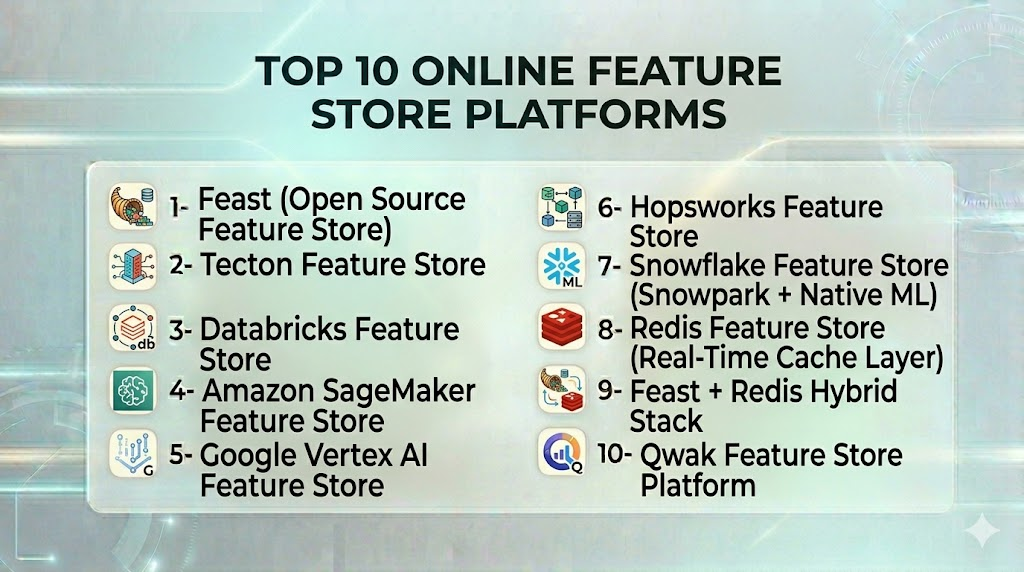
Top 10 Online Feature Store Platforms
1- Feast (Open Source Feature Store)
One-line verdict: Best open-source feature store standard for production ML systems.
Short description:
Feast is a widely adopted open-source feature store that provides real-time and batch feature serving with strong integration across modern ML stacks.
Standout Capabilities
- Offline + online feature synchronization
- Real-time feature serving
- Batch feature materialization
- Multi-cloud support
- Feature versioning
- Streaming ingestion support
- Kubernetes-native deployment
AI-Specific Depth
- Model support: Any ML framework
- RAG integration: External systems required
- Evaluation: Not built-in
- Guardrails: Not applicable
- Observability: Basic logging + external tools
Pros
- Open-source and flexible
- Strong community adoption
- Cloud-agnostic design
Cons
- Requires engineering setup
- Limited built-in observability
- Needs external infrastructure
Security & Compliance
Depends on deployment environment.
Deployment & Platforms
- Cloud
- Kubernetes
- Self-hosted
Integrations & Ecosystem
- Databricks
- Snowflake
- BigQuery
- Kafka
- Spark
Pricing Model
Open-source.
Best-Fit Scenarios
- Production ML systems
- Real-time feature pipelines
- Custom MLOps stacks
2- Tecton Feature Store
One-line verdict: Best enterprise-grade real-time feature store for high-scale production ML.
Short description:
Tecton is a fully managed feature store designed for real-time ML applications with strong reliability, scalability, and governance.
Standout Capabilities
- Real-time feature computation
- Streaming ingestion pipelines
- Feature monitoring and drift detection
- Offline + online consistency
- Low-latency serving
- Feature transformation pipelines
- Enterprise governance
AI-Specific Depth
- Model support: Multi-framework
- RAG integration: External connectors
- Evaluation: Feature quality monitoring
- Guardrails: Enterprise policies
- Observability: Full feature lineage tracking
Pros
- Enterprise-ready
- Extremely low latency
- Strong reliability guarantees
Cons
- Expensive
- Vendor lock-in risk
- Complex onboarding
Security & Compliance
Enterprise-grade RBAC, encryption, audit logs.
Deployment & Platforms
- Cloud (managed)
Integrations & Ecosystem
- Snowflake
- Databricks
- Kafka
- Spark
- Airflow
Pricing Model
Enterprise subscription.
Best-Fit Scenarios
- Fintech systems
- Large-scale ML platforms
- Real-time personalization
3- Databricks Feature Store
One-line verdict: Best unified feature store for Lakehouse-based ML workflows.
Short description:
Databricks Feature Store integrates tightly with the Lakehouse architecture, enabling unified data + feature + ML pipelines.
Standout Capabilities
- Lakehouse-native feature management
- Real-time + batch feature serving
- MLflow integration
- Feature lineage tracking
- Collaborative workflows
- Streaming ingestion support
- Unified governance
AI-Specific Depth
- Model support: Multi-framework
- RAG integration: Lakehouse + vector systems
- Evaluation: MLflow-based evaluation
- Guardrails: Workspace controls
- Observability: Unified telemetry
Pros
- Strong ecosystem integration
- Unified data + ML platform
- Scalable architecture
Cons
- Vendor lock-in
- Cost complexity
- Requires Databricks stack
Security & Compliance
Enterprise RBAC, encryption, governance tools.
Deployment & Platforms
- Cloud
- Hybrid
Integrations & Ecosystem
- Spark
- MLflow
- Delta Lake
- Cloud warehouses
Pricing Model
Usage-based enterprise pricing.
Best-Fit Scenarios
- Data-heavy ML systems
- Lakehouse architectures
- Enterprise AI pipelines
4- Amazon SageMaker Feature Store
One-line verdict: Best AWS-native feature store for scalable ML infrastructure.
Short description:
SageMaker Feature Store provides fully managed storage and serving of ML features integrated deeply into AWS ecosystem.
Standout Capabilities
- Real-time feature ingestion
- Batch feature processing
- Feature versioning
- Low-latency retrieval
- Secure data storage
- ML pipeline integration
- Scalable architecture
AI-Specific Depth
- Model support: AWS ecosystem models
- RAG integration: AWS data services
- Evaluation: External tools required
- Guardrails: IAM policies
- Observability: CloudWatch integration
Pros
- Fully managed
- High scalability
- Strong AWS integration
Cons
- AWS lock-in
- Cost complexity
- Limited flexibility
Security & Compliance
Enterprise AWS security, IAM, encryption.
Deployment & Platforms
- Cloud (AWS)
Integrations & Ecosystem
- SageMaker
- S3
- Glue
- Lambda
- Redshift
Pricing Model
Usage-based.
Best-Fit Scenarios
- AWS ML workloads
- Enterprise AI systems
- Real-time inference pipelines
5- Google Vertex AI Feature Store
One-line verdict: Best feature store for Google Cloud-native AI systems.
Short description:
Vertex AI Feature Store enables real-time and batch feature management tightly integrated with Google Cloud data systems.
Standout Capabilities
- Real-time feature serving
- Batch + streaming ingestion
- Feature monitoring
- Scalable architecture
- Data freshness tracking
- Multi-model support
- Integrated ML pipelines
AI-Specific Depth
- Model support: Multi-framework
- RAG integration: BigQuery + GCP services
- Evaluation: Vertex AI tools
- Guardrails: IAM-based controls
- Observability: Cloud logging
Pros
- Strong GCP integration
- Fully managed system
- Scalable infrastructure
Cons
- GCP lock-in
- Pricing complexity
- Limited customization
Security & Compliance
Enterprise Google Cloud security.
Deployment & Platforms
- Cloud (GCP)
Integrations & Ecosystem
- BigQuery
- Dataflow
- Pub/Sub
- Vertex AI
Pricing Model
Usage-based.
Best-Fit Scenarios
- GCP ML systems
- Data-intensive pipelines
- Enterprise AI workflows
6- Hopsworks Feature Store
One-line verdict: Best open-source feature store with strong ML and data science focus.
Short description:
Hopsworks provides a scalable feature store with strong support for real-time and batch ML pipelines.
Standout Capabilities
- Feature engineering pipelines
- Real-time feature serving
- Data lineage tracking
- Batch + streaming support
- ML pipeline integration
- Feature validation
- Collaboration tools
AI-Specific Depth
- Model support: Multi-framework
- RAG integration: External systems
- Evaluation: Feature validation tools
- Guardrails: Policy-based controls
- Observability: Feature monitoring
Pros
- Open-source flexibility
- Strong ML integration
- Good feature governance
Cons
- Requires setup effort
- Smaller ecosystem
- Operational complexity
Security & Compliance
Varies by deployment.
Deployment & Platforms
- Cloud
- On-prem
- Kubernetes
Integrations & Ecosystem
- Spark
- Kafka
- Python ML stack
- Databases
Pricing Model
Open-source + enterprise version.
Best-Fit Scenarios
- Research + production ML
- Custom feature pipelines
- Data science teams
7- Snowflake Feature Store (Snowpark + Native ML)
One-line verdict: Best for data warehouse-native feature engineering and serving.
Short description:
Snowflake enables feature store capabilities using Snowpark and data warehouse-native transformations.
Standout Capabilities
- SQL-based feature engineering
- Real-time data access
- Secure data sharing
- Scalable compute
- ML integration
- Data governance
- Feature reuse
AI-Specific Depth
- Model support: Multi-framework
- RAG integration: Warehouse-based retrieval
- Evaluation: External tools
- Guardrails: Role-based access
- Observability: Query monitoring
Pros
- Strong data warehouse integration
- Easy SQL-based workflows
- Scalable infrastructure
Cons
- Not a dedicated feature store
- Limited real-time optimization
- Cost at scale
Security & Compliance
Enterprise-grade data governance.
Deployment & Platforms
- Cloud
Integrations & Ecosystem
- Snowflake ecosystem
- BI tools
- ML frameworks
Pricing Model
Usage-based.
Best-Fit Scenarios
- Warehouse-centric ML
- BI + ML hybrid systems
- Data engineering teams
8- Redis Feature Store (Real-Time Cache Layer)
One-line verdict: Best ultra-low latency feature serving layer.
Short description:
Redis is widely used as a real-time feature store backend due to its ultra-fast in-memory data access.
Standout Capabilities
- Sub-millisecond feature retrieval
- Real-time caching
- High-throughput serving
- Stream processing support
- Key-value feature storage
- Pub/sub event handling
- Scalable clustering
AI-Specific Depth
- Model support: External ML systems
- RAG integration: External systems
- Evaluation: Not built-in
- Guardrails: Not applicable
- Observability: Basic metrics
Pros
- Extremely fast
- Simple architecture
- Highly scalable
Cons
- Not full feature store
- Requires external systems
- No built-in ML tooling
Security & Compliance
Enterprise Redis supports RBAC and encryption.
Deployment & Platforms
- Cloud
- Self-hosted
Integrations & Ecosystem
- Kafka
- Spark
- ML pipelines
- APIs
Pricing Model
Open-source + enterprise Redis.
Best-Fit Scenarios
- Real-time inference systems
- Low-latency ML features
- Caching layer for ML
9- Feast + Redis Hybrid Stack
One-line verdict: Best flexible open-source feature store architecture.
Short description:
Feast combined with Redis provides a scalable, low-latency hybrid feature store architecture.
Standout Capabilities
- Offline + online sync
- Redis-based serving layer
- Batch + streaming ingestion
- Feature versioning
- Multi-database support
- Cloud-agnostic design
- Extensible architecture
AI-Specific Depth
- Model support: Multi-framework
- RAG integration: External systems
- Evaluation: External tools
- Guardrails: Not built-in
- Observability: External monitoring
Pros
- Highly flexible
- Cost-efficient
- Strong open-source ecosystem
Cons
- Requires engineering setup
- Operational complexity
- No managed support
Security & Compliance
Depends on deployment stack.
Deployment & Platforms
- Cloud
- Self-hosted
Integrations & Ecosystem
- Redis
- Kafka
- Spark
- Databases
Pricing Model
Open-source.
Best-Fit Scenarios
- Custom ML stacks
- Startup ML systems
- Flexible architectures
10- Qwak Feature Store Platform
One-line verdict: Best end-to-end ML + feature store platform for production AI.
Short description:
Qwak provides a full ML platform including feature store, model deployment, and monitoring in one system.
Standout Capabilities
- Integrated feature store
- Model deployment
- Pipeline orchestration
- Real-time serving
- Monitoring tools
- CI/CD for ML
- Governance controls
AI-Specific Depth
- Model support: Multi-framework
- RAG integration: External systems
- Evaluation: Built-in metrics
- Guardrails: Enterprise policies
- Observability: Full ML tracking
Pros
- Full-stack ML platform
- Strong automation
- Production-ready
Cons
- Vendor lock-in risk
- Smaller ecosystem
- Pricing not transparent
Security & Compliance
Enterprise-grade controls (varies).
Deployment & Platforms
- Cloud
Integrations & Ecosystem
- ML frameworks
- Data warehouses
- APIs
Pricing Model
Enterprise subscription.
Best-Fit Scenarios
- End-to-end ML systems
- Production AI pipelines
- Fast deployment teams
Comparison Table
| Tool Name | Best For | Deployment | Real-Time Capability | Strength | Watch-Out | Public Rating |
|---|---|---|---|---|---|---|
| Feast | Open-source ML | Cloud/Self-hosted | Yes | Flexibility | Needs infra | N/A |
| Tecton | Enterprise real-time ML | Cloud | Very high | Performance | Cost | N/A |
| Databricks | Lakehouse ML | Cloud | High | Unified stack | Lock-in | N/A |
| SageMaker | AWS ML | Cloud | High | Managed service | AWS lock-in | N/A |
| Vertex AI | GCP ML | Cloud | High | Integration | GCP lock-in | N/A |
| Hopsworks | Open ML platform | Cloud/K8s | High | Governance | Complexity | N/A |
| Snowflake | Data warehouse ML | Cloud | Medium | SQL-based ML | Not dedicated | N/A |
| Redis | Real-time caching | Cloud/Self-hosted | Very high | Latency | Not full feature store | N/A |
| Feast+Redis | Hybrid stack | Cloud/Self-hosted | Very high | Flexibility | Ops overhead | N/A |
| Qwak | End-to-end ML | Cloud | High | Full platform | Vendor lock-in | N/A |
Scoring & Evaluation
| Tool | Core | Reliability | Guardrails | Integrations | Ease | Perf/Cost | Security | Support | Weighted Total |
|---|---|---|---|---|---|---|---|---|---|
| Feast | 9 | 8 | 7 | 9 | 8 | 8 | 7 | 8 | 8.0 |
| Tecton | 9 | 9 | 9 | 9 | 7 | 8 | 9 | 8 | 8.6 |
| Databricks | 9 | 9 | 8 | 9 | 8 | 8 | 9 | 8 | 8.5 |
| SageMaker | 9 | 9 | 9 | 9 | 8 | 8 | 9 | 8 | 8.7 |
| Vertex AI | 9 | 9 | 9 | 9 | 8 | 8 | 9 | 8 | 8.7 |
| Hopsworks | 8 | 8 | 8 | 8 | 7 | 8 | 8 | 8 | 8.0 |
| Snowflake | 8 | 8 | 7 | 9 | 9 | 8 | 9 | 8 | 8.2 |
| Redis | 8 | 8 | 6 | 9 | 9 | 9 | 8 | 8 | 8.1 |
| Feast+Redis | 9 | 8 | 7 | 9 | 7 | 9 | 7 | 8 | 8.1 |
| Qwak | 9 | 9 | 8 | 9 | 8 | 8 | 8 | 8 | 8.4 |
Which Feature Store Platform Is Right for You?
Solo / Freelancer
Redis or Feast for lightweight real-time feature handling.
SMB
Feast and Hopsworks provide scalable open-source feature stores.
Mid-Market
Databricks, Qwak, and Snowflake balance scalability and integration.
Enterprise
Tecton, SageMaker, and Vertex AI provide fully managed, real-time systems.
Regulated Industries
Prioritize lineage tracking, audit logs, and consistency guarantees.
Budget vs Premium
Open-source stacks are cost-efficient; managed platforms offer reliability.
Build vs Buy
Build when flexibility is needed; buy when latency, governance, and scale are critical.
Common Mistakes & How to Avoid Them
- Ignoring offline-online skew
- Poor feature versioning strategy
- No streaming ingestion design
- Weak observability
- Overloading real-time systems
- No lineage tracking
- Missing data freshness checks
- Not optimizing latency paths
- Vendor lock-in without abstraction
- Poor feature reuse strategy
- No cost monitoring
- Inconsistent transformations
FAQs
1- What is a feature store?
It is a system that stores and serves ML features for training and real-time inference.
2- Why do we need a feature store?
To ensure consistency between training and production data.
3- What is an online feature store?
A low-latency system that serves real-time features for inference.
4- What is offline vs online feature store?
Offline stores historical data; online stores real-time features.
5- What is feature drift?
It is when feature distributions change over time affecting model performance.
6- Is Redis a feature store?
It is commonly used as a real-time feature store layer but not a full system.
7- Do feature stores support streaming?
Yes, modern systems support Kafka, Pub/Sub, and streaming ingestion.
8- Are feature stores cloud-only?
No, many support hybrid and on-prem deployments.
9- What is feature versioning?
Tracking changes in feature definitions over time.
10- Can feature stores work with LLMs?
Yes, they can provide structured features for LLM applications.
11- What is feature lineage?
Tracking the origin and transformations of features.
12- What is the future of feature stores?
They will integrate deeply with real-time AI and agentic systems.
Conclusion
Online Feature Store Platforms are foundational to real-time machine learning systems, ensuring consistent, low-latency, and reliable feature delivery across training and inference environments. Tools like Feast, Tecton, and Databricks dominate modern ML infrastructure, while Redis and Hopsworks provide flexible, scalable alternatives.
