Introduction
Payment Fraud Scoring APIs help businesses evaluate the risk level of a payment, transaction, account, device, card, or customer action in real time. In simple terms, they return a fraud score or decision signal so teams can approve, block, review, or challenge suspicious activity before money is lost.
These APIs matter more now because digital payments, instant checkout, account takeover, synthetic identity fraud, refund abuse, promo abuse, bot attacks, and chargebacks are becoming more complex. Modern fraud teams need faster decisions, better automation, and fewer false declines without creating friction for genuine customers.
Real-world use cases include:
- Scoring card-not-present payments during checkout
- Detecting account takeover before payment completion
- Flagging suspicious refunds, returns, and chargeback behavior
- Screening marketplace sellers, buyers, and high-risk accounts
- Combining device, identity, behavioral, and transaction signals
Evaluation Criteria for Buyers:
- Real-time scoring accuracy
- API latency and uptime
- Custom rules and model flexibility
- False-positive reduction
- Chargeback and dispute support
- Device fingerprinting and identity signals
- Integrations with payment gateways and commerce platforms
- Case management and review workflows
- Compliance, privacy, and audit controls
- Pricing transparency and usage scalability
Best for: Payment Fraud Scoring APIs are best for fintech companies, e-commerce brands, marketplaces, payment processors, digital banks, SaaS platforms, gaming companies, travel businesses, and high-volume merchants that need automated risk decisions before approving payments or customer actions.
Not ideal for: These APIs may not be ideal for very small businesses with low transaction volume, companies that already rely fully on a payment processor’s built-in fraud tools, or businesses that do not have the operational process to review flagged transactions. In those cases, a simpler fraud dashboard, payment gateway fraud rule set, or managed fraud service may be enough.
Key Trends in Payment Fraud Scoring APIs
- AI-native fraud scoring is becoming standard: Vendors are using machine learning, behavioral analytics, graph intelligence, and anomaly detection to score transactions faster and more accurately.
- Real-time decisioning is now expected: Businesses want instant approve, decline, review, or step-up decisions without slowing checkout or payment authorization.
- False-positive reduction is a major priority: Fraud teams are not only trying to block fraud; they also want to avoid rejecting legitimate customers.
- Account takeover and payment fraud are merging: Fraud scoring APIs increasingly combine login behavior, device signals, account history, and payment patterns.
- Device intelligence is more important: Device fingerprinting, IP reputation, VPN detection, emulator signals, and session behavior are becoming key risk inputs.
- Graph-based fraud detection is growing: APIs are getting better at identifying connected fraud rings across accounts, cards, addresses, devices, emails, and merchants.
- Compliance and privacy controls are under more scrutiny: Buyers are reviewing data handling, retention, auditability, access controls, and regional privacy rules more carefully.
- Orchestration is becoming common: Many enterprises combine multiple fraud scores, payment gateway rules, identity verification, and manual review queues into one decision engine.
- Fraud teams want explainability: Black-box scores are less useful unless they include reason codes, risk signals, and clear investigation context.
- Pricing is shifting toward value and volume: Vendors may charge by transaction, API call, protected revenue, risk event, or custom enterprise contract.
How We Selected These Tools Methodology
- Selected platforms widely recognized in fraud prevention, payment risk scoring, transaction monitoring, or digital trust.
- Prioritized tools with API-first or API-supported fraud scoring capabilities.
- Considered market adoption across e-commerce, fintech, marketplaces, banking, SaaS, and digital payments.
- Evaluated feature completeness across risk scoring, rules, device intelligence, identity signals, and case review.
- Considered integration strength with payment gateways, commerce platforms, APIs, webhooks, and data pipelines.
- Reviewed practical fit across SMB, mid-market, enterprise, developer-first, and high-volume transaction environments.
- Considered fraud model maturity, real-time performance expectations, and operational decision support.
- Avoided invented ratings, certifications, or unsupported compliance claims.
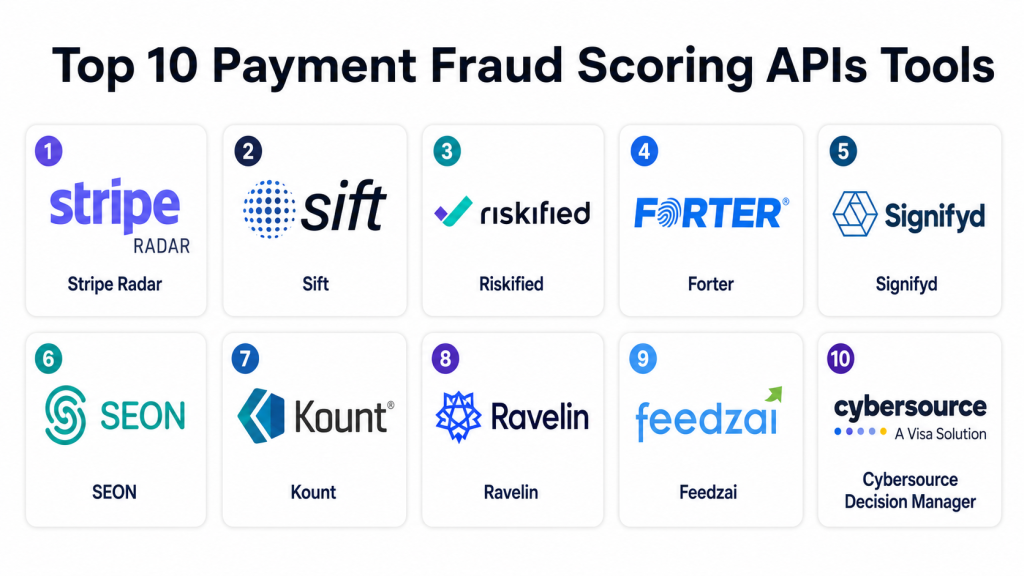
Top 10 Payment Fraud Scoring APIs Tools
1- Stripe Radar
Short description: Stripe Radar is a fraud detection and payment risk scoring solution built into the Stripe payments ecosystem. It helps businesses detect suspicious card payments using machine learning, rules, risk signals, and Stripe’s transaction network. It is best for companies already using Stripe that want fraud scoring without building a separate fraud stack from scratch. Radar works well for SaaS companies, e-commerce sellers, marketplaces, subscriptions, and digital businesses that need fast setup. Advanced teams can create custom rules to control how payments are blocked, reviewed, or allowed. Its biggest strength is native integration with Stripe, but businesses outside Stripe’s ecosystem may need a different or additional fraud API.
Key Features
- Machine-learning-based payment fraud detection
- Built-in risk scoring for Stripe payments
- Custom fraud rules for advanced control
- Review workflows for suspicious payments
- Chargeback and dispute-related risk support
- Payment and checkout-level fraud signals
- Native integration with Stripe payment flows
Pros
- Very easy to adopt for businesses already using Stripe
- Strong fit for card payment fraud detection
- Reduces the need for separate fraud infrastructure in many use cases
Cons
- Less suitable for businesses not using Stripe payments
- Advanced fraud orchestration may require additional tooling
- Customization depth may not match specialized enterprise fraud platforms
Platforms / Deployment
Web
Cloud
Security & Compliance
Stripe provides strong payment infrastructure security, fraud controls, encryption, access management, and compliance capabilities for payment processing. Specific Radar-related controls should be verified during procurement.
SOC 2: Not publicly stated for this specific tool
ISO 27001: Not publicly stated for this specific tool
GDPR: Relevant in applicable regions
MFA: Available for Stripe accounts
RBAC and audit logs: Available in Stripe account environments depending on configuration
Integrations & Ecosystem
Stripe Radar fits naturally into the Stripe ecosystem, making it useful for teams that want payment processing and fraud prevention under one operational layer.
- Stripe Payments
- Stripe Checkout
- Stripe Billing
- Stripe Connect
- Stripe APIs and webhooks
- E-commerce and SaaS payment workflows
Support & Community
Stripe provides extensive developer documentation, API references, dashboard support, and implementation resources. Support options vary by account type, business size, and contract. Developer community strength is high because Stripe is widely used by startups, SaaS teams, and digital commerce businesses.
2- Sift
Short description: Sift is a digital fraud prevention platform that offers risk scoring APIs for payment fraud, account abuse, chargebacks, account takeover, and other trust and safety use cases. It is well suited for marketplaces, fintechs, e-commerce platforms, digital goods companies, and on-demand services with complex user behavior. Sift can analyze many event types, not just payment transactions, which helps teams build broader fraud decisions. It is useful when fraud risk is connected across accounts, devices, identities, orders, and payment methods. Fraud teams can use scores, workflows, and investigation tools to reduce manual review effort. Its strength is broad fraud intelligence, but implementation requires clean event tracking and thoughtful data mapping.
Key Features
- Real-time fraud risk scoring APIs
- Payment fraud and chargeback protection workflows
- Account takeover and account abuse detection
- Event-based fraud modeling
- Case management and review tools
- Risk signals and explainability
- Custom rules and automated decisioning
Pros
- Strong fit for complex digital fraud environments
- Covers more than only payment fraud
- Useful for marketplaces and platforms with many user actions
Cons
- Requires strong event instrumentation for best results
- May be more than small merchants need
- Pricing and implementation details are typically business-specific
Platforms / Deployment
Web
Cloud
Security & Compliance
Sift supports enterprise security expectations such as controlled platform access and fraud data protection. Specific certifications, contractual controls, and compliance coverage should be validated directly.
SOC 2: Not publicly stated
ISO 27001: Not publicly stated
GDPR: Relevant in applicable regions
SSO/SAML: Varies / N/A
MFA: Varies / N/A
Audit logs and RBAC: Varies / N/A
Integrations & Ecosystem
Sift integrates through APIs and event tracking, allowing businesses to send user, transaction, device, and behavioral data into its risk engine.
- REST APIs
- Event tracking
- Webhooks
- Payment and commerce workflows
- Marketplace and platform data streams
- Case management workflows
Support & Community
Sift provides documentation, implementation support, and customer success resources. The platform is stronger for teams that can invest in proper data integration. Support depth may vary by contract, volume, and business complexity.
3- Riskified
Short description: Riskified is an e-commerce fraud prevention and risk decisioning platform designed to help merchants approve more legitimate orders while reducing fraud and chargeback exposure. It is commonly used by online retailers, travel brands, ticketing companies, marketplaces, and high-volume merchants. Riskified focuses heavily on payment fraud decisions, order approval optimization, and fraud operations. It can be valuable for merchants that experience false declines, manual review bottlenecks, or costly chargebacks. The platform is especially relevant when order risk needs to be evaluated quickly at checkout or after authorization. Its biggest advantage is e-commerce fraud decisioning depth, but small merchants may find it more advanced than necessary.
Key Features
- E-commerce transaction risk scoring
- Order approval and fraud decisioning
- Chargeback risk reduction workflows
- Machine-learning-based fraud analysis
- Merchant dashboard and reporting
- Policy and decision automation
- Support for high-volume order review
Pros
- Strong fit for e-commerce fraud prevention
- Helpful for reducing false declines and manual review
- Useful for merchants with high chargeback exposure
Cons
- May be less relevant outside commerce and order fraud
- Commercial terms can be enterprise-oriented
- Requires operational alignment with order management workflows
Platforms / Deployment
Web
Cloud
Security & Compliance
Riskified handles sensitive transaction and fraud data, so buyers should review its security documentation, privacy controls, access controls, and contractual compliance terms.
SOC 2: Not publicly stated
ISO 27001: Not publicly stated
GDPR: Relevant in applicable regions
SSO/SAML: Varies / N/A
MFA: Varies / N/A
Audit logs and RBAC: Varies / N/A
Integrations & Ecosystem
Riskified integrates with e-commerce, order management, and payment workflows to evaluate order risk and support fraud decisions.
- E-commerce platform integrations
- Payment gateway workflows
- Order management systems
- APIs and webhooks
- Merchant dashboards
- Fraud operations workflows
Support & Community
Riskified provides merchant onboarding, implementation guidance, and support resources. It is typically best suited for businesses that need managed fraud expertise, operational alignment, and stronger account-level support.
4- Forter
Short description: Forter is a digital commerce fraud prevention platform that focuses on identity-based decisions, payment fraud protection, account abuse detection, and customer trust. It is commonly used by enterprise retailers, marketplaces, travel platforms, and high-volume digital businesses. Forter helps companies make fast decisions across checkout, login, account creation, returns, and other customer journey points. Its risk scoring approach is useful for businesses that want to approve good customers confidently while blocking suspicious behavior. Forter is especially relevant where fraud is not limited to payment transactions but appears across the full customer journey. Its enterprise orientation means buyers should plan carefully for integration, pricing, and operational workflows.
Key Features
- Real-time fraud decisions
- Payment fraud scoring and decisioning
- Account protection and abuse detection
- Identity-based risk intelligence
- Returns and policy abuse support
- Merchant analytics and operational insights
- Automated approve, decline, and review workflows
Pros
- Strong fit for enterprise commerce and marketplaces
- Covers multiple fraud points across the customer journey
- Useful for reducing friction for trusted customers
Cons
- May be too advanced for very small businesses
- Implementation planning is important
- Pricing and contract structure may be enterprise-focused
Platforms / Deployment
Web
Cloud
Security & Compliance
Forter works with sensitive identity and transaction data. Buyers should verify security controls, privacy terms, access management, and compliance documentation directly during procurement.
SOC 2: Not publicly stated
ISO 27001: Not publicly stated
GDPR: Relevant in applicable regions
SSO/SAML: Varies / N/A
MFA: Varies / N/A
Audit logs and RBAC: Varies / N/A
Integrations & Ecosystem
Forter integrates into commerce and customer journey workflows to support real-time risk decisions across multiple business events.
- APIs
- E-commerce integrations
- Payment and checkout workflows
- Account creation and login flows
- Returns and policy workflows
- Fraud operations dashboards
Support & Community
Forter provides enterprise-focused onboarding, documentation, and support resources. Merchants should confirm technical implementation timelines, service levels, and account management options before rollout.
5- Signifyd
Short description: Signifyd is a fraud protection and commerce protection platform focused on helping online retailers reduce fraud, increase order approvals, and manage chargeback risk. It is especially relevant for e-commerce merchants that want automated order decisions and fraud protection across checkout and post-purchase workflows. Signifyd is often used by retailers looking to reduce manual review and improve conversion by approving more legitimate orders. It supports fraud teams, operations leaders, and e-commerce executives that need a clearer risk decisioning layer. The platform is useful when payment fraud, chargebacks, abuse, and order approval are business-critical. Smaller businesses should check whether its depth and pricing match their transaction volume.
Key Features
- E-commerce fraud prevention
- Order risk scoring and decisioning
- Chargeback protection workflows
- Machine-learning-driven order analysis
- Merchant dashboard and reporting
- Automated approval and review support
- Commerce protection use cases beyond basic fraud
Pros
- Strong fit for online retail fraud prevention
- Helps reduce manual review workload
- Useful for improving order approval confidence
Cons
- May be less flexible for non-commerce fraud use cases
- Best value often comes at higher transaction volume
- Integration requires alignment with order and payment systems
Platforms / Deployment
Web
Cloud
Security & Compliance
Signifyd handles transaction and fraud data, so merchants should review vendor-provided security documentation, access controls, privacy terms, and compliance coverage.
SOC 2: Not publicly stated
ISO 27001: Not publicly stated
GDPR: Relevant in applicable regions
SSO/SAML: Varies / N/A
MFA: Varies / N/A
Audit logs and RBAC: Varies / N/A
Integrations & Ecosystem
Signifyd integrates with commerce platforms and order workflows to score risk and automate fraud decisions.
- E-commerce integrations
- Payment and checkout workflows
- Order management systems
- APIs
- Webhooks
- Merchant dashboards and reporting
Support & Community
Signifyd offers onboarding and support resources for merchants. Support depth may depend on merchant size, contract type, and implementation scope. Retailers should verify escalation process, dispute handling, and operational support expectations.
6- SEON
Short description: SEON is a fraud prevention platform known for API-based fraud detection, digital footprint analysis, device intelligence, email and phone intelligence, IP checks, and transaction risk scoring. It is popular with fintechs, iGaming companies, online lenders, marketplaces, crypto businesses, payment companies, and digital platforms. SEON is useful for teams that want fast fraud signals and flexible API integration without relying only on payment processor rules. It can support payment fraud, account fraud, bonus abuse, multi-accounting, and onboarding checks. Its strength is flexible data enrichment and risk scoring across many digital risk scenarios. Buyers should evaluate whether its signals match their fraud type and regional data needs.
Key Features
- Fraud detection APIs
- Email, phone, IP, and device intelligence
- Transaction risk scoring
- Rules engine and scoring workflows
- Digital footprint analysis
- Velocity and behavioral checks
- Dashboard and manual review support
Pros
- Flexible API-first fraud detection
- Strong fit for fintech, iGaming, marketplaces, and digital platforms
- Useful for identity and device-based risk scoring
Cons
- Best results require thoughtful rule tuning
- May need to be combined with payment-specific chargeback tools
- Some advanced use cases require internal fraud expertise
Platforms / Deployment
Web
Cloud
Security & Compliance
SEON provides fraud prevention infrastructure and handles risk-related data. Specific certifications, compliance scope, and access control details should be verified with the vendor.
SOC 2: Not publicly stated
ISO 27001: Not publicly stated
GDPR: Relevant in applicable regions
SSO/SAML: Varies / N/A
MFA: Varies / N/A
Audit logs and RBAC: Varies / N/A
Integrations & Ecosystem
SEON is designed for API-based fraud checks and can be integrated into onboarding, payment, login, withdrawal, and transaction workflows.
- REST APIs
- Webhooks
- Device fingerprinting tools
- Email and phone enrichment
- IP intelligence
- Fraud dashboard and rules engine
Support & Community
SEON provides technical documentation, fraud resources, and onboarding support. It is suitable for teams that want developer-friendly implementation and configurable fraud checks. Support options vary by plan and contract.
7- Kount
Short description: Kount is a fraud prevention and digital identity trust platform used by merchants, financial services companies, and digital businesses to detect risky transactions and customer behavior. It supports payment fraud prevention, account protection, bot detection, chargeback reduction, and identity trust use cases. Kount is commonly considered by businesses that need enterprise-grade fraud scoring and decisioning across digital channels. It can help fraud teams combine device data, identity signals, transaction context, and risk rules. Its value is strongest for businesses with high transaction volume or complex fraud patterns. Buyers should validate integrations, deployment requirements, and pricing fit before adoption.
Key Features
- Payment fraud scoring and decisioning
- Digital identity trust signals
- Device and behavioral risk insights
- Rules and policy controls
- Chargeback and transaction risk support
- Bot and account abuse detection
- Fraud analytics and reporting
Pros
- Strong fit for enterprise fraud prevention
- Covers payment and identity-related fraud signals
- Useful for complex fraud operations
Cons
- May be too complex for small merchants
- Implementation may require fraud and technical resources
- Pricing details are typically business-specific
Platforms / Deployment
Web
Cloud
Security & Compliance
Kount operates in digital fraud and identity trust workflows. Buyers should verify current security certifications, privacy terms, access controls, and compliance documentation directly.
SOC 2: Not publicly stated
ISO 27001: Not publicly stated
GDPR: Relevant in applicable regions
SSO/SAML: Varies / N/A
MFA: Varies / N/A
Audit logs and RBAC: Varies / N/A
Integrations & Ecosystem
Kount supports fraud decisioning across payment, account, and digital interaction workflows.
- APIs
- Payment gateway integrations
- E-commerce workflows
- Device intelligence
- Rules engine
- Fraud reporting dashboards
Support & Community
Kount provides business support, documentation, and onboarding resources. Enterprise buyers should confirm account management, support SLAs, technical implementation help, and fraud strategy assistance.
8- Ravelin
Short description: Ravelin is a fraud detection platform focused on online businesses such as marketplaces, delivery platforms, mobility companies, e-commerce firms, and digital services. It helps teams detect payment fraud, account takeover, promo abuse, refund abuse, and connected fraud behavior. Ravelin is known for using graph-style analysis, rules, machine learning, and risk decisions to help businesses understand relationships between users, devices, payments, and orders. It is useful when fraudsters operate through linked accounts or repeated abuse patterns. The platform is best for companies with enough transaction and user behavior data to support meaningful modeling. Smaller businesses may need simpler tools unless fraud is already a major issue.
Key Features
- Payment fraud detection
- Account takeover and account abuse support
- Graph-based fraud relationship analysis
- Machine learning and rules-based decisioning
- Device and behavioral intelligence
- Case review and investigation tools
- API-based data integration
Pros
- Strong for connected fraud and abuse patterns
- Useful for marketplaces and digital platforms
- Supports fraud decisions beyond payment-only scoring
Cons
- Requires good data quality for best results
- May need more implementation effort than basic fraud plugins
- Not ideal for very low-volume businesses
Platforms / Deployment
Web
Cloud
Security & Compliance
Ravelin handles fraud, behavioral, and payment-related data. Security certifications and detailed compliance controls should be verified directly with the vendor.
SOC 2: Not publicly stated
ISO 27001: Not publicly stated
GDPR: Relevant in applicable regions
SSO/SAML: Varies / N/A
MFA: Varies / N/A
Audit logs and RBAC: Varies / N/A
Integrations & Ecosystem
Ravelin integrates with business systems through APIs and event data, allowing teams to score payments and user behavior across multiple points.
- APIs
- Event data pipelines
- Payment workflows
- Account and login workflows
- Marketplace and delivery platform systems
- Fraud investigation dashboards
Support & Community
Ravelin provides documentation, onboarding help, and fraud expertise for implementation. Buyers should validate support coverage, integration timelines, and data requirements before choosing it.
9- Feedzai
Short description: Feedzai is an AI-driven financial crime and fraud prevention platform often used by banks, payment providers, fintechs, and large financial institutions. It supports real-time fraud detection, transaction monitoring, payment risk scoring, scam detection, and broader financial crime prevention workflows. Feedzai is especially relevant for organizations that need enterprise-grade fraud models across multiple payment types and channels. It can support complex fraud operations where transaction volume, regulation, explainability, and risk governance matter. Its strength is depth in financial services and large-scale payment risk environments. It may be too advanced for small merchants that only need basic checkout fraud rules.
Key Features
- AI-based fraud and financial crime prevention
- Real-time transaction risk scoring
- Payment fraud and scam detection
- Model governance and decisioning workflows
- Case management and investigation support
- Cross-channel fraud monitoring
- Enterprise reporting and analytics
Pros
- Strong fit for banks, fintechs, and payment providers
- Enterprise-grade fraud and financial crime focus
- Useful for complex, high-volume risk environments
Cons
- May be too heavy for standard e-commerce merchants
- Implementation can require significant planning
- Pricing and deployment details are typically enterprise-specific
Platforms / Deployment
Web
Cloud / Hybrid / Varies by enterprise agreement
Security & Compliance
Feedzai operates in financial services risk environments where security, governance, and compliance are major requirements. Buyers should verify current certifications, controls, deployment options, and regulatory support directly.
SOC 2: Not publicly stated
ISO 27001: Not publicly stated
GDPR: Relevant in applicable regions
SSO/SAML: Varies / N/A
MFA: Varies / N/A
Audit logs and RBAC: Varies / N/A
Integrations & Ecosystem
Feedzai integrates with financial institution systems, payment rails, transaction monitoring workflows, and fraud operations environments.
- Banking and payment systems
- Transaction data pipelines
- APIs
- Case management workflows
- Risk model operations
- Enterprise reporting systems
Support & Community
Feedzai is enterprise-oriented, with implementation, support, and account management typically aligned to large financial services customers. Buyers should confirm deployment model, data onboarding, support SLAs, and model governance support.
10- Cybersource Decision Manager
Short description: Cybersource Decision Manager is a fraud management and risk decisioning solution connected to the broader Cybersource payment management ecosystem. It helps businesses screen payments, manage risk rules, reduce fraud, and support payment decisioning. It is particularly relevant for merchants and enterprises already using Cybersource or Visa-linked payment infrastructure. Decision Manager can be useful for e-commerce brands, global merchants, travel companies, and businesses that need fraud checks close to payment processing. Its strength is payment ecosystem alignment and rules-based risk control. Buyers should evaluate whether the platform’s fraud capabilities match their need for real-time scoring, automation, and analytics.
Key Features
- Payment fraud screening
- Risk rules and decision controls
- Transaction review workflows
- Integration with Cybersource payment ecosystem
- Merchant fraud management dashboard
- Global payment risk support
- Reporting and decision analytics
Pros
- Strong fit for merchants using Cybersource
- Useful for payment-centric fraud management
- Supports rules-based decisioning and transaction review
Cons
- Less attractive for teams outside the Cybersource ecosystem
- Advanced flexibility may depend on configuration and contract
- May require payment operations expertise for best results
Platforms / Deployment
Web
Cloud
Security & Compliance
Cybersource is part of a large payment infrastructure environment and supports payment security expectations. Specific Decision Manager controls and certifications should be verified during procurement.
SOC 2: Not publicly stated for this specific tool
ISO 27001: Not publicly stated for this specific tool
GDPR: Relevant in applicable regions
SSO/SAML: Varies / N/A
MFA: Varies / N/A
Audit logs and RBAC: Varies / N/A
Integrations & Ecosystem
Cybersource Decision Manager integrates closely with payment processing, merchant risk workflows, and transaction screening.
- Cybersource payment ecosystem
- Payment APIs
- Merchant dashboards
- Risk rules
- Transaction review workflows
- Enterprise payment operations
Support & Community
Cybersource provides merchant documentation, support, and enterprise payment resources. Support depth may vary by merchant size, payment volume, and contract. Buyers should confirm onboarding, fraud strategy guidance, and technical support expectations.
Comparison Table Top 10
| Tool Name | Best For | Platform Supported | Deployment | Standout Feature | Public Rating |
|---|---|---|---|---|---|
| Stripe Radar | Stripe-based merchants and SaaS payments | Web | Cloud | Native Stripe fraud scoring | N/A |
| Sift | Marketplaces and digital platforms | Web | Cloud | Broad event-based fraud intelligence | N/A |
| Riskified | E-commerce order fraud prevention | Web | Cloud | Order approval optimization | N/A |
| Forter | Enterprise commerce and identity-based fraud | Web | Cloud | Full customer journey risk decisions | N/A |
| Signifyd | Retail fraud and chargeback protection | Web | Cloud | Commerce protection workflows | N/A |
| SEON | API-first fraud checks and digital footprint scoring | Web | Cloud | Flexible enrichment and scoring APIs | N/A |
| Kount | Enterprise digital identity and payment fraud | Web | Cloud | Identity trust and transaction risk scoring | N/A |
| Ravelin | Marketplaces, delivery, and connected fraud | Web | Cloud | Graph-based fraud relationship detection | N/A |
| Feedzai | Banks, fintechs, and payment providers | Web | Cloud / Hybrid | AI-driven financial crime risk decisions | N/A |
| Cybersource Decision Manager | Cybersource payment ecosystem merchants | Web | Cloud | Payment-linked fraud rules and screening | N/A |
Evaluation & Scoring of Payment Fraud Scoring APIs
| Tool Name | Core 25% | Ease 15% | Integrations 15% | Security 10% | Performance 10% | Support 10% | Value 15% | Weighted Total 0–10 |
| Stripe Radar | 8 | 9 | 9 | 8 | 9 | 8 | 9 | 8.55 |
| Sift | 9 | 8 | 8 | 8 | 8 | 8 | 8 | 8.30 |
| Riskified | 9 | 8 | 8 | 8 | 8 | 8 | 8 | 8.30 |
| Forter | 9 | 8 | 8 | 8 | 9 | 8 | 8 | 8.40 |
| Signifyd | 9 | 8 | 8 | 8 | 8 | 8 | 8 | 8.30 |
| SEON | 8 | 9 | 8 | 7 | 8 | 8 | 9 | 8.20 |
| Kount | 8 | 7 | 8 | 8 | 8 | 8 | 7 | 7.75 |
| Ravelin | 8 | 7 | 8 | 8 | 8 | 8 | 7 | 7.75 |
| Feedzai | 9 | 7 | 8 | 9 | 9 | 8 | 7 | 8.15 |
| Cybersource Decision Manager | 8 | 7 | 8 | 8 | 8 | 8 | 7 | 7.75 |
These scores are comparative and should be used for shortlisting, not as final vendor rankings. A higher score means stronger general fit across common buyer criteria, but your best platform may differ based on transaction volume, geography, payment processor, fraud type, and internal fraud operations. Always validate performance using your own historical transactions, approval rates, false positives, chargebacks, and review workflows.
Which Payment Fraud Scoring API Tool Is Right for You?
Solo / Freelancer
Solo sellers usually do not need a full enterprise fraud scoring API unless they process high-risk payments. If you already use Stripe, Stripe Radar is usually the simplest option because it is built into the payment workflow. For a small store using another payment provider, built-in gateway fraud rules may be enough before adopting a separate API.
SMB
SMBs should focus on easy implementation, clear pricing, low operational overhead, and practical fraud controls. Stripe Radar, SEON, and Sift can be good options depending on payment stack and fraud complexity. If your main problem is risky orders, chargebacks, or suspicious customer behavior, a dedicated fraud API can help you move beyond basic payment rules.
Mid-Market
Mid-market companies need a stronger balance between automation, review workflows, integrations, and false-positive control. Sift, Riskified, Signifyd, Forter, SEON, and Kount are worth comparing based on use case. E-commerce brands may prefer Riskified or Signifyd, while marketplaces and digital platforms may benefit from Sift, SEON, or Ravelin.
Enterprise
Enterprise buyers should prioritize scalability, data governance, model performance, explainability, account management, and integration flexibility. Forter, Riskified, Signifyd, Kount, Ravelin, Feedzai, and Cybersource Decision Manager can be strong candidates depending on industry. Banks, fintechs, and payment providers should give special attention to Feedzai and other financial-crime-focused platforms.
Budget vs Premium
Budget-focused teams should start with the fraud tools already available in their payment gateway, then add a specialized API when losses, manual review, or false declines justify the cost. Premium platforms may provide better automation, deeper signals, stronger workflows, and managed expertise. The right choice should compare fraud loss reduction, approval lift, operational savings, and customer experience.
Feature Depth vs Ease of Use
Stripe Radar and SEON are often easier to start with for many teams, while platforms like Feedzai, Forter, Kount, and Ravelin can provide deeper enterprise decisioning. E-commerce-focused tools like Riskified and Signifyd may be better when order fraud and chargeback reduction are the main goals. Choose depth only when your fraud patterns require it.
Integrations & Scalability
Integration quality is critical because fraud scoring must happen at the right moment. Buyers should confirm API latency, webhooks, SDKs, payment gateway support, event tracking, data export, and case management workflows. Scalable platforms should handle peak checkout traffic without delaying legitimate payments or creating review bottlenecks.
Security & Compliance Needs
Fraud APIs process sensitive customer, transaction, identity, and behavioral data. Buyers should review encryption, access controls, data retention, privacy terms, auditability, and regional compliance requirements. Banks and fintechs should also evaluate model governance, explainability, and regulatory reporting needs before selecting a vendor.
Frequently Asked Questions FAQs
1- What is a Payment Fraud Scoring API?
A Payment Fraud Scoring API analyzes transaction, customer, device, payment, and behavioral data to estimate fraud risk. It usually returns a score, risk level, reason codes, or decision recommendation. Businesses use this output to approve, block, challenge, or review payments.
2- How does fraud scoring work?
Fraud scoring combines rules, machine learning, device signals, identity data, transaction history, velocity checks, and behavioral patterns. The API compares a transaction against known risk patterns and returns a score. Higher-risk transactions can then be blocked or sent to manual review.
3- Are Payment Fraud Scoring APIs only for e-commerce?
No. They are used by e-commerce stores, fintechs, banks, marketplaces, SaaS platforms, gaming companies, travel businesses, and digital wallets. Any business that accepts online payments or processes risky financial actions can use fraud scoring. The best tool depends on industry and fraud type.
4- What pricing models do fraud scoring APIs use?
Pricing may be based on API calls, transaction volume, protected revenue, monthly platform fees, chargeback guarantee models, or custom enterprise contracts. Some vendors also price by product module or risk event. Buyers should compare total cost against fraud loss reduction and operational savings.
5- How long does implementation take?
Simple integrations can be completed quickly when plugins or native payment integrations exist. Enterprise implementations may take longer because they require event mapping, historical data, rules configuration, testing, and operational training. Teams should plan for both technical setup and fraud workflow design.
6- What are common mistakes when choosing a fraud API?
Common mistakes include choosing based only on price, ignoring false positives, sending poor-quality data, and failing to define review workflows. Some teams also add a fraud tool too late in the checkout journey. The best results come when fraud scoring is placed at the right decision point.
7- Can fraud APIs reduce chargebacks?
Yes, fraud scoring APIs can help reduce chargebacks by identifying risky transactions before fulfillment or payment completion. However, results depend on data quality, model fit, rules, product category, and operational response. Businesses should track chargeback rates before and after implementation.
8- Do fraud scoring APIs create customer friction?
They can create friction if rules are too strict or if too many legitimate users are challenged. Good fraud tools help reduce unnecessary friction by separating trusted users from suspicious ones. The goal is not only to block fraud but also to approve more genuine customers safely.
9- Should I use multiple fraud scoring APIs?
Some enterprises use multiple tools for layered defense, especially in high-risk payments, fintech, marketplaces, and global commerce. However, using too many tools can increase cost and operational complexity. Most businesses should start with one strong platform and add orchestration only when needed.
10- What data does a fraud scoring API need?
Common data includes payment details, order value, customer account history, email, phone, IP address, device information, shipping address, billing address, session behavior, and past transaction outcomes. Better data usually improves scoring quality. Businesses should also follow privacy and data minimization principles.
Conclusion
Payment Fraud Scoring APIs are now essential for businesses that need real-time risk decisions across payments, accounts, devices, and customer behavior. Stripe Radar is strong for Stripe-based businesses, Sift and SEON are flexible for digital platforms, Riskified and Signifyd are strong for e-commerce order fraud, Forter and Kount suit enterprise digital trust needs, Ravelin is useful for connected fraud patterns, Feedzai is a strong fit for banks and fintechs, and Cybersource Decision Manager works well for merchants in the Cybersource ecosystem. The best tool depends on your payment stack, transaction volume, fraud type, compliance needs, and internal review capacity. A practical next step is to shortlist two or three tools, test them on historical and live transaction data, compare false positives and chargeback reduction, then validate integrations, security, and support before scaling.
