Introduction
Prompt Versioning Systems are tools that help teams create, track, test, manage, and deploy prompts used in large language model applications. In modern AI systems, prompts behave like source code—small changes can significantly impact accuracy, tone, safety, cost, and reliability. Because of this, managing prompts without version control leads to inconsistent outputs and production instability.
prompt versioning has become a core part of LLMOps. These platforms support Git-like prompt history, rollback, A/B testing, evaluation pipelines, and collaboration workflows for AI teams building chatbots, copilots, agents, and RAG-based systems.
Unlike traditional software version control, prompt versioning systems must handle non-deterministic outputs, multi-model environments, and continuous evaluation loops.
Real-World Use Cases
- Version control for LLM prompts in production apps
- A/B testing prompt variations for chatbot performance
- Managing prompts in RAG-based enterprise assistants
- AI copilots for HR, legal, finance, and support systems
- Agent workflow prompt chaining and orchestration
- Prompt safety tuning and jailbreak mitigation
- Cost optimization by refining prompt efficiency
Evaluation Criteria for Buyers
When evaluating Prompt Versioning Systems, consider:
- Prompt version history and rollback
- A/B testing and experimentation support
- Multi-model compatibility
- Evaluation frameworks for output quality
- Collaboration and workflow tools
- CI/CD integration for LLM apps
- Dataset-based testing
- Observability and logging
- Security and access control
- Prompt lifecycle governance
- Cost and latency tracking
- API/SDK usability
Best for: AI engineering teams, LLM application developers, SaaS companies building AI features, and enterprises deploying production-grade AI systems.
Not ideal for: Simple chatbot prototypes, static prompts with no iteration, or non-production AI use cases.
What’s Changed in Prompt Versioning Systems in
- Prompts are now treated as first-class deployable assets
- Git-style branching and merging for prompts is standard
- Automated prompt evaluation pipelines are widely used
- Multi-model prompt portability is required
- Real-time prompt monitoring is standard in production
- Prompt injection testing is integrated into CI pipelines
- Cost optimization is tied directly to prompt changes
- Prompt datasets are used for regression testing
- Human feedback loops are embedded into workflows
- Agent-based prompt chains require version orchestration
- Prompt safety checks are automated
- Prompt observability includes latency and token metrics
Quick Buyer Checklist
- □ Prompt version control (Git-like history)
- □ A/B testing and experimentation tools
- □ Evaluation framework for prompt quality
- □ Multi-model support
- □ Dataset-based testing support
- □ Rollback and staging environments
- □ Logging and observability
- □ CI/CD integration for LLM apps
- □ Security and access control
- □ Cost and latency tracking
- □ Feedback loop integration
- □ API/SDK support
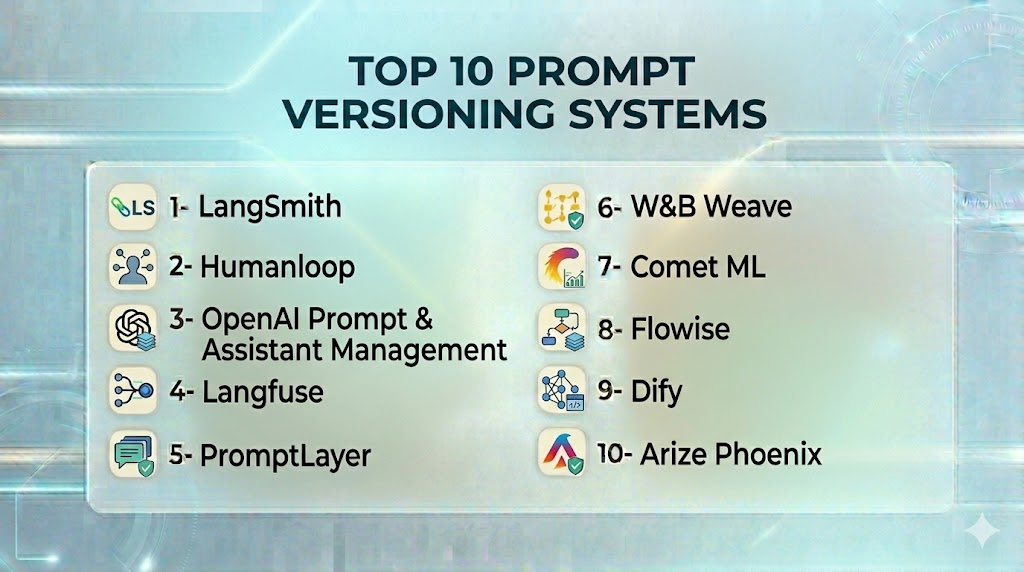
Top 10 Prompt Versioning Systems
1- LangSmith
One-line verdict: Best enterprise-grade prompt versioning and observability platform for LLM applications.
Short description:
LangSmith provides end-to-end prompt lifecycle management including versioning, tracing, evaluation, and deployment tracking for LangChain-based and multi-model LLM systems.
Standout Capabilities
- Prompt version history and rollback
- LLM tracing and debugging
- Dataset-based evaluation pipelines
- A/B testing for prompt variants
- Performance monitoring dashboards
- Feedback loop collection
- Workflow debugging for agents
AI-Specific Depth
- Model support: Multi-model (OpenAI, Anthropic, open-source)
- RAG integration: Native LangChain + vector DB support
- Evaluation: Built-in LLM evaluation suite
- Guardrails: External integrations required
- Observability: Deep trace-level visibility
Pros
- Strong evaluation system
- Excellent debugging tools
- Deep ecosystem integration
Cons
- Best inside LangChain ecosystem
- Requires engineering setup
- Not fully standalone
Security & Compliance
Enterprise features available depending on deployment.
Deployment & Platforms
- Cloud
- API-based integration
Integrations & Ecosystem
- LangChain
- Vector databases
- OpenAI / Anthropic APIs
- RAG pipelines
Pricing Model
Usage-based + enterprise plans.
Best-Fit Scenarios
- LLM debugging workflows
- RAG-based applications
- Agent-based AI systems
2- Humanloop
One-line verdict: Best dedicated prompt lifecycle management and experimentation platform.
Short description:
Humanloop focuses specifically on prompt versioning, testing, evaluation, and human feedback for production LLM systems.
Standout Capabilities
- Prompt version control system
- A/B testing for prompts
- Human feedback loops
- Evaluation dashboards
- Prompt deployment tracking
- Model comparison tools
- Collaboration workflows
AI-Specific Depth
- Model support: Multi-model support
- RAG integration: External systems
- Evaluation: Strong evaluation framework
- Guardrails: Policy-based controls
- Observability: Prompt-level monitoring
Pros
- Purpose-built for prompts
- Strong experimentation features
- Easy collaboration
Cons
- Smaller ecosystem
- Limited orchestration depth
- Enterprise adoption still evolving
Security & Compliance
Enterprise-grade features available (varies).
Deployment & Platforms
- Cloud
Integrations & Ecosystem
- OpenAI
- Anthropic
- LangChain
- APIs
Pricing Model
Subscription-based.
Best-Fit Scenarios
- Prompt engineering teams
- AI product experimentation
- LLM optimization workflows
3- OpenAI Prompt & Assistant Management
One-line verdict: Best native prompt versioning system within OpenAI ecosystem.
Short description:
OpenAI provides prompt and instruction management through Assistants API and structured configuration workflows.
Standout Capabilities
- Instruction version management
- Assistant configuration tracking
- Tool calling workflows
- Evaluation APIs
- Usage analytics
- Safety tuning controls
- Model behavior configuration
AI-Specific Depth
- Model support: OpenAI models only
- RAG integration: External vector DB required
- Evaluation: Built-in evaluation APIs
- Guardrails: Strong safety system
- Observability: Usage dashboards
Pros
- High-quality models
- Simple integration
- Strong ecosystem
Cons
- Vendor lock-in
- Limited multi-model support
- Less flexible versioning system
Security & Compliance
Enterprise controls available (varies by plan).
Deployment & Platforms
- Cloud API
Integrations & Ecosystem
- OpenAI API
- Assistants API
- Tool calling frameworks
Pricing Model
Usage-based token pricing.
Best-Fit Scenarios
- GPT-based applications
- Rapid AI deployment
- Copilot systems
4- Langfuse
One-line verdict: Best open-source prompt versioning and observability platform.
Short description:
Langfuse provides prompt tracking, versioning, and observability for LLM applications with full developer control.
Standout Capabilities
- Prompt version tracking
- LLM tracing system
- Dataset evaluation
- Cost tracking per prompt
- Feedback logging
- Debugging dashboards
- Analytics insights
AI-Specific Depth
- Model support: Multi-model
- RAG integration: External systems
- Evaluation: Built-in evaluation tools
- Guardrails: Custom implementation
- Observability: Full trace system
Pros
- Open-source flexibility
- Strong observability
- Easy integration
Cons
- Requires self-hosting for full control
- Limited enterprise governance
- Smaller ecosystem
Security & Compliance
Depends on deployment setup.
Deployment & Platforms
- Cloud
- Self-hosted
Integrations & Ecosystem
- OpenAI
- LangChain
- Vector databases
- APIs
Pricing Model
Open-source + hosted plans.
Best-Fit Scenarios
- Startup AI systems
- Developer tools
- Prompt debugging
5- PromptLayer
One-line verdict: Best lightweight prompt logging and version tracking tool.
Short description:
PromptLayer provides simple and fast prompt logging, version tracking, and API monitoring for LLM applications.
Standout Capabilities
- Prompt logging system
- Version history tracking
- API request tracing
- Cost monitoring
- Usage analytics
- Debugging tools
- Collaboration features
AI-Specific Depth
- Model support: Multi-model
- RAG integration: External systems
- Evaluation: Basic support
- Guardrails: Not built-in
- Observability: Request-level tracking
Pros
- Very simple to use
- Fast integration
- Lightweight system
Cons
- Limited enterprise features
- Not full lifecycle platform
- Basic evaluation support
Security & Compliance
Varies by deployment.
Deployment & Platforms
- Cloud
Integrations & Ecosystem
- OpenAI
- LangChain
- APIs
Pricing Model
Freemium + subscription.
Best-Fit Scenarios
- Small teams
- Prototype AI apps
- Prompt debugging workflows
6- W&B Weave
One-line verdict: Best experiment-driven prompt versioning system for ML + LLM teams.
Short description:
Weave extends Weights & Biases into LLMOps with prompt tracking, evaluation, and dataset management.
Standout Capabilities
- Prompt experiment tracking
- Versioned datasets
- Evaluation pipelines
- LLM tracing
- Benchmark comparisons
- Collaboration dashboards
- Performance analytics
AI-Specific Depth
- Model support: Multi-model
- RAG integration: External systems
- Evaluation: Strong evaluation tooling
- Guardrails: External implementation
- Observability: Deep experiment tracking
Pros
- Strong ML + LLM synergy
- Excellent tracking system
- Good for research workflows
Cons
- Not prompt-specific platform
- Requires setup effort
- Enterprise features vary
Security & Compliance
Varies by deployment.
Deployment & Platforms
- Cloud
- Self-hosted
Integrations & Ecosystem
- ML frameworks
- LLM APIs
- CI/CD tools
- Vector databases
Pricing Model
Freemium + enterprise plans.
Best-Fit Scenarios
- AI research teams
- Prompt experimentation
- Evaluation-heavy workflows
7- Comet ML
One-line verdict: Best collaborative prompt and experiment tracking platform for ML teams.
Short description:
Comet ML provides prompt versioning and tracking integrated with ML experiment management and collaboration tools.
Standout Capabilities
- Prompt version tracking
- Experiment comparison
- Dataset logging
- Performance analytics
- Collaboration dashboards
- Model evaluation tracking
- Visualization tools
AI-Specific Depth
- Model support: Multi-model
- RAG integration: External systems
- Evaluation: Experiment-based evaluation
- Guardrails: Role-based access
- Observability: Full tracking system
Pros
- Strong collaboration tools
- Easy integration
- Good experiment tracking
Cons
- Not fully prompt-native
- Limited orchestration features
- Smaller ecosystem
Security & Compliance
Enterprise features available (varies).
Deployment & Platforms
- Cloud
- Self-hosted
Integrations & Ecosystem
- ML frameworks
- APIs
- CI/CD tools
- LLM pipelines
Pricing Model
Freemium + enterprise plans.
Best-Fit Scenarios
- ML + LLM hybrid teams
- Prompt collaboration
- Experiment tracking
8- Flowise
One-line verdict: Best low-code prompt workflow and versioning system.
Short description:
Flowise provides visual prompt workflow design with versioning and LLM orchestration capabilities.
Standout Capabilities
- Visual prompt workflows
- Prompt versioning
- LLM chaining
- API deployment
- Drag-and-drop builder
- Multi-model support
- Workflow automation
AI-Specific Depth
- Model support: Multi-model
- RAG integration: Built-in nodes
- Evaluation: Basic tools
- Guardrails: Limited
- Observability: Workflow logs
Pros
- No-code interface
- Fast prototyping
- Easy workflow design
Cons
- Limited enterprise features
- Not highly scalable
- Requires customization for production
Security & Compliance
Varies by deployment.
Deployment & Platforms
- Cloud
- Self-hosted
Integrations & Ecosystem
- LangChain
- OpenAI
- APIs
- Vector DBs
Pricing Model
Open-source + hosted plans.
Best-Fit Scenarios
- AI prototyping
- Workflow automation
- Non-technical users
9- Dify
One-line verdict: Best open-source full-stack LLM app platform with prompt versioning.
Short description:
Dify provides an end-to-end LLM application platform with prompt versioning, workflows, and deployment tools.
Standout Capabilities
- Prompt version control
- LLM app builder
- Workflow automation
- Dataset management
- API deployment
- RAG integration
- Model routing
AI-Specific Depth
- Model support: Multi-model
- RAG integration: Built-in support
- Evaluation: Basic evaluation tools
- Guardrails: Policy controls
- Observability: App-level tracking
Pros
- Full-stack LLM platform
- Easy deployment
- Strong open-source ecosystem
Cons
- Limited granular prompt control
- Still evolving ecosystem
- Less enterprise maturity
Security & Compliance
Varies by deployment.
Deployment & Platforms
- Cloud
- Self-hosted
Integrations & Ecosystem
- OpenAI
- LangChain
- Vector databases
- APIs
Pricing Model
Open-source + enterprise plans.
Best-Fit Scenarios
- LLM app builders
- Startup AI products
- RAG applications
10- Arize Phoenix
One-line verdict: Best observability-driven prompt versioning and evaluation system.
Short description:
Phoenix provides deep observability, tracing, and evaluation for prompt-based LLM systems.
Standout Capabilities
- Prompt tracing system
- Version comparison tools
- Evaluation dashboards
- Root cause analysis
- Dataset analysis
- Performance monitoring
- Debugging tools
AI-Specific Depth
- Model support: Multi-model
- RAG integration: Strong support
- Evaluation: Advanced evaluation system
- Guardrails: External systems required
- Observability: Deep trace analysis
Pros
- Excellent observability
- Strong debugging tools
- Enterprise-grade analytics
Cons
- Not full prompt lifecycle system
- Requires integration effort
- Focused more on observability
Security & Compliance
Enterprise features available depending on deployment.
Deployment & Platforms
- Cloud
- Self-hosted
Integrations & Ecosystem
- LLM frameworks
- Vector databases
- APIs
- ML pipelines
Pricing Model
Open-source + enterprise offerings.
Best-Fit Scenarios
- LLM debugging
- Prompt evaluation systems
- Enterprise observability
Comparison Table
| Tool Name | Best For | Deployment | Model Flexibility | Strength | Watch-Out | Public Rating |
|---|---|---|---|---|---|---|
| LangSmith | LLM debugging | Cloud | Multi-model | Observability | LangChain dependency | N/A |
| Humanloop | Prompt lifecycle | Cloud | Multi-model | Experimentation | Smaller ecosystem | N/A |
| OpenAI | GPT apps | Cloud | OpenAI only | Model quality | Lock-in | N/A |
| Langfuse | Open-source tracking | Cloud/Self-hosted | Multi-model | Observability | Limited governance | N/A |
| PromptLayer | Lightweight tracking | Cloud | Multi-model | Simplicity | Limited features | N/A |
| W&B Weave | Experiment tracking | Cloud/Self-hosted | Multi-model | Evaluation depth | Not prompt-only | N/A |
| Comet ML | Collaboration | Cloud/Self-hosted | Multi-model | Team workflows | Limited scale | N/A |
| Flowise | Visual workflows | Cloud/Self-hosted | Multi-model | No-code design | Limited governance | N/A |
| Dify | Full LLM apps | Cloud/Self-hosted | Multi-model | End-to-end system | Evolving ecosystem | N/A |
| Arize Phoenix | Observability | Cloud/Self-hosted | Multi-model | Debugging depth | Not full platform | N/A |
Scoring & Evaluation
| Tool | Core | Reliability | Guardrails | Integrations | Ease | Perf/Cost | Security | Support | Weighted Total |
|---|---|---|---|---|---|---|---|---|---|
| LangSmith | 9 | 9 | 8 | 9 | 8 | 8 | 8 | 8 | 8.5 |
| Humanloop | 8 | 8 | 8 | 8 | 9 | 8 | 8 | 8 | 8.1 |
| OpenAI | 9 | 9 | 9 | 8 | 9 | 8 | 9 | 8 | 8.7 |
| Langfuse | 8 | 8 | 8 | 8 | 9 | 8 | 8 | 8 | 8.1 |
| PromptLayer | 7 | 7 | 6 | 8 | 9 | 9 | 7 | 7 | 7.6 |
| W&B Weave | 8 | 8 | 8 | 9 | 8 | 8 | 8 | 8 | 8.1 |
| Comet ML | 8 | 8 | 7 | 8 | 9 | 8 | 8 | 8 | 8.0 |
| Flowise | 7 | 7 | 6 | 8 | 9 | 9 | 7 | 7 | 7.7 |
| Dify | 8 | 8 | 7 | 8 | 9 | 8 | 8 | 8 | 8.0 |
| Arize Phoenix | 8 | 9 | 8 | 8 | 8 | 8 | 8 | 8 | 8.2 |
Which Prompt Versioning System Is Right for You?
Solo / Freelancer
PromptLayer or Langfuse for lightweight tracking.
SMB
Humanloop and Dify for structured prompt workflows.
Mid-Market
LangSmith and W&B Weave for evaluation-heavy systems.
Enterprise
Arize Phoenix, LangSmith, and W&B for governance and observability.
Regulated Industries
Focus on audit logs, versioning, and evaluation pipelines.
Budget vs Premium
Open-source tools are cost-efficient; enterprise tools offer governance and scale.
Build vs Buy
Build if prompts are highly customized; buy if you need evaluation and governance at scale.
Common Mistakes & How to Avoid Them
- No prompt version control
- Ignoring evaluation systems
- Missing A/B testing
- No rollback strategy
- Lack of observability
- Weak cost tracking
- No dataset testing
- Poor governance
- Over-reliance on single prompt
- Ignoring injection risks
- No feedback loops
- Not tracking model changes
FAQs
1- What is prompt versioning?
It is the practice of tracking and managing changes in LLM prompts over time.
2- Why is prompt versioning important?
Because prompt changes can significantly alter LLM behavior and output quality.
3- Do prompt versioning tools support A/B testing?
Yes, most platforms support experimentation workflows.
4- Can prompts be rolled back?
Yes, version control allows rollback to previous prompts.
5- Are these tools cloud-only?
No, many support self-hosted and hybrid deployments.
6- Do they support multiple LLMs?
Yes, most support multi-model environments.
7- What is prompt evaluation?
It is the process of scoring prompt outputs for quality and safety.
8- What is prompt observability?
Tracking how prompts perform in real-world usage.
9- Are prompt logs secure?
Enterprise platforms offer encryption and access controls.
10- Do these systems support RAG?
Yes, many integrate with vector databases.
11- What is prompt injection risk?
It is when malicious input manipulates LLM behavior.
12- What is the future of prompt versioning?
It will evolve into autonomous, self-optimizing prompt systems.
Conclusion
Prompt Versioning Systems are now a critical part of modern LLM application infrastructure. They transform prompts from static instructions into fully managed, testable, and deployable assets with lifecycle control.
Tools like LangSmith, Humanloop, and Arize Phoenix lead enterprise adoption, while Langfuse, PromptLayer, and Dify provide flexible, lightweight solutions for developers and startups.
As AI systems become more agentic and autonomous, prompt versioning will evolve into dynamic prompt optimization systems driven by real-time evaluation, feedback loops, and automated tuning
