Introduction
Secure Email Gateway Protection Tools, commonly called SEGs, are email security systems that inspect messages before they reach users’ inboxes or leave the organization. In plain English, they act like a security checkpoint for email traffic, filtering spam, phishing, malware, ransomware, suspicious links, harmful attachments, spoofed senders, and data leakage risks. They matter now because email remains one of the most common ways attackers target employees, executives, finance teams, vendors, and customers.
Real-world use cases include:
- Blocking spam, phishing, and malicious attachments
- Protecting Microsoft 365 and Google Workspace environments
- Detecting business email compromise and impersonation
- Enforcing outbound DLP and encryption policies
- Supporting quarantine, investigation, and email continuity
What buyers should evaluate:
- Spam and phishing detection quality
- BEC and impersonation protection
- Attachment sandboxing and URL rewriting
- Microsoft 365 and Google Workspace integration
- Deployment model: cloud, gateway, hybrid, or API
- Admin dashboard and reporting
- DLP, encryption, archiving, and continuity
- SIEM, SOAR, and identity integrations
- User reporting and awareness workflows
- Pricing, support, and scalability
Best for: Secure Email Gateway tools are best for IT teams, security teams, MSPs, enterprises, schools, healthcare providers, financial firms, legal firms, government teams, and any business that needs stronger email protection than basic inbox filtering.
Not ideal for: SEG tools may not be ideal for individuals, very small teams with low email risk, or organizations that are fully satisfied with native Gmail or Microsoft 365 filtering. In those cases, built-in email protection, MFA, and domain authentication may be enough.
Key Trends in Secure Email Gateway Protection Tools
- Cloud-native SEG deployment is becoming standard: Many organizations now prefer cloud SEG or API-based email security because Microsoft 365 and Google Workspace dominate business email environments.
- AI-driven phishing detection is becoming essential: Attackers use polished writing, personalization, and convincing impersonation, so SEGs increasingly rely on machine learning, behavior analysis, and threat intelligence.
- Business email compromise protection is a top priority: Modern attacks often contain no malware or obvious malicious link, so SEG tools need sender identity analysis, relationship mapping, and payment request detection.
- Post-delivery remediation is now expected: Security teams want tools that can remove malicious emails after delivery when threat intelligence changes or users report suspicious messages.
- Secure email gateways are expanding into collaboration security: Threats now arrive through shared files, links, chat notifications, and cloud collaboration platforms, not only traditional email.
- Domain authentication is becoming more important: SPF, DKIM, and DMARC alignment help reduce spoofing, brand abuse, and impersonation risk.
- Outbound DLP and encryption remain important: Organizations need to stop sensitive data from leaving through email and secure messages that contain regulated information.
- MSP-friendly management is growing: Managed service providers need multi-tenant dashboards, policy templates, reporting, delegated admin, and easy customer onboarding.
- Integration with broader security stacks is critical: Buyers want SEG data to connect with SIEM, SOAR, endpoint security, identity tools, ticketing systems, and incident response workflows.
- User experience and false positives matter more: Blocking too aggressively can disrupt business, so buyers increasingly evaluate quarantine quality, release workflows, and message trace visibility.
How We Selected These Tools
- Selected tools with strong recognition in secure email gateway, email security, spam filtering, phishing defense, and cloud email protection.
- Prioritized platforms used by SMBs, mid-market businesses, enterprises, regulated organizations, and MSPs.
- Evaluated coverage across spam, phishing, malware, ransomware, BEC, impersonation, URL protection, and attachment scanning.
- Considered support for Microsoft 365, Google Workspace, Exchange, hybrid mail, and gateway-based deployment.
- Reviewed operational capabilities such as quarantine management, reporting, message trace, post-delivery remediation, and admin controls.
- Considered broader security ecosystem integrations such as SIEM, SOAR, identity, endpoint, DLP, and security awareness tools.
- Avoided guessed public ratings, certifications, pricing, or compliance claims where details are not clearly known.
- Balanced enterprise-grade tools, cloud-native solutions, MSP-friendly options, and hybrid email security products.
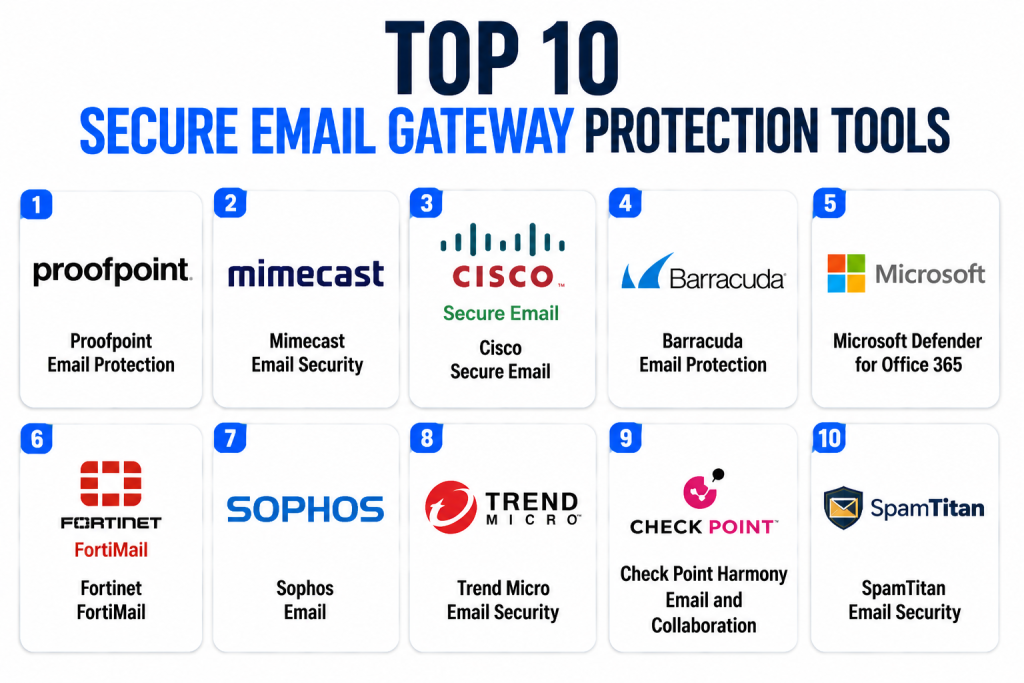
Top 10 Secure Email Gateway Protection Tools
1 — Proofpoint Email Protection
Short description: Proofpoint Email Protection is a widely recognized secure email gateway and email threat protection platform built for organizations that face advanced phishing, spam, malware, ransomware, and business email compromise risks. It is especially strong for enterprises, regulated industries, and security teams that need deep visibility into targeted email attacks. Proofpoint helps inspect inbound and outbound email, apply policies, quarantine suspicious messages, analyze URLs and attachments, and support investigation workflows. It is often selected by organizations that need advanced email threat intelligence and strong controls around risky users. The platform can also connect with broader security awareness, DLP, and user risk programs. It is best for mature security teams that want layered protection and detailed email threat visibility.
Key Features
- Spam, phishing, malware, and ransomware filtering
- Business email compromise and impersonation defense
- URL protection and attachment analysis
- Inbound and outbound email policy controls
- Quarantine, reporting, and message investigation tools
- Integration options for Microsoft 365 and Google Workspace
- Security awareness and user risk ecosystem options
Pros
- Strong enterprise-grade email threat protection.
- Useful for advanced phishing, BEC, and targeted attack defense.
- Good fit for organizations with mature security operations.
Cons
- May be more complex than needed for small businesses.
- Policy tuning and investigation workflows require skilled admins.
- Pricing and packaging may vary by selected modules and scale.
Platforms / Deployment
Web / Cloud / Hybrid
Security & Compliance
Supports email threat filtering, policy controls, quarantine workflows, admin controls, reporting, encryption-related options, and DLP-related capabilities depending on product package. Specific certifications, SSO, MFA, RBAC, audit logs, and compliance coverage should be verified directly during procurement.
Integrations & Ecosystem
Proofpoint integrates with cloud email platforms, identity tools, SIEM, SOAR, endpoint security, DLP workflows, and security awareness programs. Its ecosystem is strongest for organizations that want email security connected with broader cyber risk management.
- Microsoft 365
- Google Workspace
- SIEM and SOAR platforms
- Identity and user risk tools
- Security awareness platforms
- Threat intelligence workflows
Support & Community
Proofpoint provides enterprise documentation, support tiers, implementation resources, and security expertise. Community strength is strong among enterprise email security and threat protection teams.
2 — Mimecast Email Security
Short description: Mimecast Email Security is a secure email gateway and cloud email protection platform designed to defend organizations from spam, phishing, malware, ransomware, impersonation, and business email compromise. It is popular among mid-market businesses, enterprises, and regulated organizations that need email security combined with continuity, archiving, and policy management. Mimecast can protect Microsoft 365, Google Workspace, and hybrid email environments while offering quarantine workflows, URL protection, attachment inspection, and admin reporting. It is especially useful for organizations that view email resilience as part of security strategy. Mimecast helps reduce risk from inbound threats while also supporting outbound controls and operational continuity. It is best for teams that need strong email protection plus business continuity features.
Key Features
- Spam, phishing, malware, and ransomware protection
- Impersonation and BEC protection
- URL rewriting and attachment scanning
- Email continuity and archiving options
- Inbound and outbound policy controls
- Microsoft 365 and Google Workspace support
- Admin reporting and quarantine workflows
Pros
- Strong fit for email security, archiving, and continuity needs.
- Practical for mid-market and enterprise environments.
- Useful where email uptime and resilience are major priorities.
Cons
- Full value may require multiple modules.
- Configuration can require careful policy planning.
- Small teams may find the platform broader than necessary.
Platforms / Deployment
Web / Cloud / Hybrid
Security & Compliance
Supports email filtering, policy management, archiving, continuity, encryption-related workflows, and admin reporting. Specific certifications, SSO, MFA, RBAC, audit logs, and compliance coverage should be verified directly.
Integrations & Ecosystem
Mimecast integrates with Microsoft 365, Google Workspace, SIEM tools, security awareness programs, archiving workflows, and email clients. It is often selected where email continuity and security operations need to work together.
- Microsoft 365
- Google Workspace
- SIEM platforms
- Security awareness tools
- Email archiving workflows
- Admin reporting systems
Support & Community
Mimecast offers documentation, onboarding support, customer success, training resources, and support tiers. Community strength is solid among IT administrators, email security teams, and compliance-focused organizations.
3 — Cisco Secure Email
Short description: Cisco Secure Email is a secure email gateway platform designed to protect organizations from spam, phishing, ransomware, malware, business email compromise, spoofing, and data loss. It is suitable for enterprises, regulated organizations, and security teams already using Cisco security products. Cisco Secure Email supports cloud, gateway, and hybrid deployment options depending on the organization’s architecture. It uses layered detection, policy controls, threat intelligence, and integration with the broader Cisco security ecosystem. The platform is particularly valuable for organizations that need gateway-style control with advanced malware and URL protection. It is best for teams that want email security aligned with network, endpoint, and threat intelligence workflows.
Key Features
- Spam, phishing, ransomware, and malware protection
- Business email compromise and spoofing defense
- URL filtering and attachment threat analysis
- Data loss prevention and encryption-related policy options
- Cloud, gateway, and hybrid deployment models
- Reporting, tracking, and quarantine management
- Integration with Cisco security ecosystem
Pros
- Strong fit for Cisco-centered enterprise security environments.
- Flexible deployment options for cloud and hybrid organizations.
- Useful for organizations that want gateway-level email control.
Cons
- May require more administration than simpler cloud-native tools.
- Best value is achieved when aligned with Cisco’s security stack.
- Smaller teams may prefer easier-to-manage alternatives.
Platforms / Deployment
Web / Cloud / Hybrid / Self-hosted
Security & Compliance
Supports email filtering, admin controls, policy enforcement, encryption-related workflows, reporting, and DLP-related options. Specific certifications, SSO, MFA, audit logs, RBAC, and compliance details should be verified directly.
Integrations & Ecosystem
Cisco Secure Email integrates with Cisco threat intelligence, SIEM tools, network security platforms, endpoint protection, cloud email systems, and enterprise security operations. It is useful for organizations that already rely on Cisco security architecture.
- Microsoft 365
- Google Workspace
- Cisco security tools
- SIEM platforms
- Threat intelligence workflows
- Enterprise mail systems
Support & Community
Cisco provides product documentation, enterprise support, partner services, technical resources, and community forums. Support strength is high for organizations already familiar with Cisco products.
4 — Barracuda Email Protection
Short description: Barracuda Email Protection is a secure email gateway and cloud email security suite that helps protect organizations from spam, phishing, malware, ransomware, account takeover, impersonation, and business email compromise. It is widely used by SMBs, mid-market companies, schools, and MSPs that need practical email protection with manageable administration. Barracuda combines prevention, detection, response, backup, archiving, and continuity options depending on package. It is especially useful for Microsoft 365 environments and organizations that want email protection plus cyber resilience. The platform is known for being accessible to smaller IT teams while still offering layered security features. It is best for organizations that need effective email protection without excessive complexity.
Key Features
- Spam, phishing, malware, and ransomware defense
- Impersonation and BEC protection
- Account takeover protection options
- Backup, archiving, and continuity capabilities
- Incident response and post-delivery remediation support
- Microsoft 365-focused protection options
- MSP-friendly management capabilities
Pros
- Strong fit for SMBs, mid-market teams, schools, and MSPs.
- Combines email security with backup and resilience features.
- Easier to manage than some enterprise-heavy SEG platforms.
Cons
- Advanced threat hunting depth may not match top enterprise platforms.
- Package differences should be reviewed carefully.
- Some features may vary by region or bundle.
Platforms / Deployment
Web / Cloud / Hybrid
Security & Compliance
Supports email filtering, policy controls, admin management, backup, archiving, encryption-related options, and incident response workflows. Specific certifications, SSO, MFA, audit logs, RBAC, and compliance details should be verified directly.
Integrations & Ecosystem
Barracuda integrates with Microsoft 365, email systems, MSP workflows, backup tools, incident response processes, and security dashboards. It is especially useful for organizations that want combined email security and operational resilience.
- Microsoft 365
- MSP management workflows
- Email backup systems
- Archiving systems
- Incident response tools
- Security dashboards
Support & Community
Barracuda provides documentation, onboarding resources, partner programs, support options, and MSP-focused services. Community strength is strong among SMB administrators and managed service providers.
5 — Microsoft Defender for Office 365
Short description: Microsoft Defender for Office 365 is Microsoft’s cloud email and collaboration security platform for organizations using Microsoft 365. While it is not always deployed as a traditional SEG in front of mail flow, it is a major email protection tool for Exchange Online environments. It protects users from spam, phishing, malware, malicious links, unsafe attachments, impersonation, and account compromise risks. It integrates deeply with Microsoft Defender XDR, Entra ID, Sentinel, Outlook, Teams, SharePoint, and OneDrive. Defender for Office 365 is especially valuable for Microsoft-first organizations that want native protection and integrated investigation workflows. It is best for companies standardized on Microsoft 365 and looking for cloud-native email security.
Key Features
- Anti-spam, anti-phishing, and anti-malware protection
- Safe Links and Safe Attachments capabilities
- Impersonation and spoofing protection
- Threat Explorer and investigation workflows
- Automated investigation and response options
- Microsoft Defender XDR integration
- Strong fit for Exchange Online and Microsoft 365 environments
Pros
- Excellent fit for Microsoft 365 organizations.
- Deep integration with Microsoft identity and security ecosystem.
- Useful for cloud-native email protection and investigation.
Cons
- Best value is within the Microsoft ecosystem.
- Advanced features may depend on license level.
- Some organizations may still add third-party SEG tools for layered defense.
Platforms / Deployment
Web / Windows / macOS / iOS / Android / Cloud
Security & Compliance
Supports Microsoft 365 email security controls, anti-phishing policies, admin roles, audit-related workflows, investigation tools, and integration with Microsoft compliance features. Specific certifications and compliance coverage should be validated based on Microsoft 365 plan and tenant configuration.
Integrations & Ecosystem
Microsoft Defender for Office 365 integrates with Microsoft 365, Exchange Online, Outlook, Teams, SharePoint, OneDrive, Defender XDR, Sentinel, and Entra ID. It is strongest in organizations already using Microsoft security and productivity tools.
- Microsoft 365
- Exchange Online
- Outlook
- Microsoft Defender XDR
- Microsoft Sentinel
- Microsoft Entra ID
Support & Community
Microsoft provides documentation, admin guides, learning resources, partner support, and enterprise support plans. Community support is strong because Microsoft 365 and Defender are widely used.
6 — Fortinet FortiMail
Short description: Fortinet FortiMail is a secure email gateway platform designed to protect organizations from spam, phishing, malware, ransomware, impersonation, and data loss threats. It supports cloud, virtual, physical appliance, and hybrid deployment models, making it useful for organizations with flexible infrastructure needs. FortiMail is especially relevant for enterprises, service providers, MSSPs, and organizations already using Fortinet’s broader security fabric. The platform provides email filtering, URL inspection, attachment scanning, data protection, and integration with Fortinet’s security ecosystem. It is a strong choice where gateway control, multi-tenancy, and integrated security architecture matter. Buyers should evaluate whether Fortinet’s broader ecosystem aligns with their security roadmap.
Key Features
- Spam, phishing, malware, and ransomware filtering
- URL and attachment threat inspection
- Data loss prevention and email encryption support
- Cloud, virtual, physical, and hybrid deployment options
- Microsoft 365 and Google Workspace protection options
- Multi-tenancy support for service providers
- Fortinet Security Fabric integration
Pros
- Flexible deployment options for varied infrastructure needs.
- Good fit for Fortinet-centered security environments.
- Useful for MSSPs and organizations needing multi-tenant email security.
Cons
- Best value comes when aligned with Fortinet ecosystem.
- Appliance or hybrid models may require more administration.
- Buyers should verify product fit against cloud-native alternatives.
Platforms / Deployment
Web / Cloud / Hybrid / Self-hosted
Security & Compliance
Supports email filtering, DLP-related controls, encryption-related workflows, admin policies, quarantine, and reporting. Specific certifications, SSO, MFA, RBAC, audit logs, and compliance details should be verified directly.
Integrations & Ecosystem
FortiMail integrates with Microsoft 365, Google Workspace, Exchange, Fortinet Security Fabric, threat intelligence, SIEM tools, and managed security workflows. It is especially strong for Fortinet customers and MSSPs.
- Microsoft 365
- Google Workspace
- Exchange environments
- Fortinet Security Fabric
- SIEM platforms
- MSSP workflows
Support & Community
Fortinet provides documentation, training, support plans, partner resources, and a large security community. Support strength is strong for organizations already using Fortinet products.
7 — Sophos Email
Short description: Sophos Email is a cloud-based email security platform that protects organizations from spam, phishing, malware, impersonation, malicious attachments, and data loss risks. It is best suited for SMBs, mid-market companies, and organizations already using Sophos Central, Sophos Endpoint, or Sophos MDR. The platform supports Microsoft 365 and Google Workspace protection and offers policy controls, attachment scanning, URL protection, and encryption-related options. Sophos Email is practical for teams that want integrated security management without building a large email security operations function. It is easier to manage than many enterprise SEG platforms and fits well into the Sophos ecosystem. It is a strong option for companies that want email security as part of a broader SMB-friendly cybersecurity stack.
Key Features
- Spam, phishing, malware, and impersonation protection
- Attachment and URL scanning
- Microsoft 365 and Google Workspace support
- Email encryption and DLP-related options
- Centralized management through Sophos Central
- Admin reporting and policy controls
- Integration with Sophos security ecosystem
Pros
- Practical for SMB and mid-market email protection.
- Strong fit for organizations already using Sophos products.
- Centralized management helps smaller IT teams.
Cons
- Large enterprises may need deeper email threat analytics.
- Best value comes with broader Sophos ecosystem adoption.
- Some advanced features may depend on selected package.
Platforms / Deployment
Web / Cloud
Security & Compliance
Supports email filtering, policy controls, encryption-related features, DLP-related options, and admin reporting. Specific certifications, SSO, MFA, audit logs, RBAC, and compliance details should be verified directly.
Integrations & Ecosystem
Sophos Email integrates with Microsoft 365, Google Workspace, Sophos Central, endpoint security tools, MDR workflows, and security dashboards. It is strongest where Sophos is already part of the security stack.
- Microsoft 365
- Google Workspace
- Sophos Central
- Sophos Endpoint
- MDR workflows
- Security reporting systems
Support & Community
Sophos provides documentation, support resources, partner support, and managed security options. Community strength is solid among SMB IT teams, security administrators, and Sophos partners.
8 — Trend Micro Email Security
Short description: Trend Micro Email Security is a cloud and hybrid email security platform that protects businesses from spam, phishing, ransomware, malware, suspicious URLs, malicious attachments, and business email compromise. It is useful for SMBs, mid-market companies, and enterprises that want email security connected with endpoint, cloud, and threat intelligence tools. Trend Micro’s email security platform supports Microsoft 365, Google Workspace, and hybrid mail environments depending on configuration. It is especially relevant for organizations already using Trend Micro security products. The tool provides layered protection for inbound, outbound, and internal email risks. It is best for buyers that want SEG-style protection connected to a broader cybersecurity platform.
Key Features
- Anti-spam, anti-phishing, and malware filtering
- URL and attachment analysis
- Business email compromise protection
- Ransomware and advanced threat detection support
- Microsoft 365 and Google Workspace protection
- DLP and policy controls depending on package
- Integration with Trend Micro security ecosystem
Pros
- Strong fit for organizations using Trend Micro security tools.
- Covers common and advanced email-borne threats.
- Useful for layered security with endpoint and cloud protection.
Cons
- Best value may depend on broader Trend Micro adoption.
- Advanced tuning may require security expertise.
- Product packaging should be reviewed carefully.
Platforms / Deployment
Web / Cloud / Hybrid
Security & Compliance
Supports email threat filtering, policy management, reporting, and security controls. Specific certifications, encryption, SSO, MFA, audit logs, RBAC, and compliance details should be verified directly with the vendor.
Integrations & Ecosystem
Trend Micro Email Security integrates with Microsoft 365, Google Workspace, endpoint protection, cloud security platforms, threat intelligence, and security operations workflows. It is strongest where Trend Micro is part of the broader stack.
- Microsoft 365
- Google Workspace
- Endpoint security tools
- Cloud security platforms
- SIEM workflows
- Threat intelligence systems
Support & Community
Trend Micro provides documentation, onboarding resources, enterprise support, partner programs, and security research resources. Community strength is strong among security teams using Trend Micro products.
9 — Check Point Harmony Email and Collaboration
Short description: Check Point Harmony Email and Collaboration is a cloud email and collaboration security platform that protects users from phishing, malware, spam, account takeover, impersonation, malicious files, and data loss risks. It is especially useful for Microsoft 365 and Google Workspace environments where threats appear in email, shared files, and collaboration apps. Unlike traditional MX-based SEGs, it can operate through API-based cloud integration, making it relevant for organizations moving toward cloud-native email security. The platform provides prevention, detection, policy enforcement, and visibility across cloud collaboration workflows. It is a strong option for organizations already using Check Point security products or seeking email plus collaboration protection. Buyers should validate exact coverage for their collaboration tools.
Key Features
- Email phishing, spam, and malware protection
- Cloud collaboration security coverage
- API-based Microsoft 365 and Google Workspace integration
- Account takeover and impersonation protection
- Threat prevention for links and attachments
- DLP and policy enforcement options
- Centralized visibility and security management
Pros
- Strong fit for cloud email and collaboration environments.
- Useful when threats extend beyond inbox messages.
- API-based deployment can simplify some cloud security workflows.
Cons
- Best value may come with broader Check Point adoption.
- Teams should validate exact app and collaboration coverage.
- Policy tuning may require security expertise.
Platforms / Deployment
Web / Cloud
Security & Compliance
Supports cloud email security, threat prevention, account protection, policy controls, and DLP-related workflows. Specific certifications, encryption, SSO, MFA, audit logs, RBAC, and compliance coverage should be verified directly.
Integrations & Ecosystem
Check Point Harmony integrates with Microsoft 365, Google Workspace, collaboration platforms, identity systems, security operations workflows, and broader Check Point tools. It is best for cloud-first organizations that want email and collaboration protection together.
- Microsoft 365
- Google Workspace
- Cloud collaboration platforms
- Check Point security tools
- Identity systems
- Security operations workflows
Support & Community
Check Point provides documentation, support options, partner services, security research, and enterprise resources. Community strength is strongest among Check Point customers and security professionals.
10 — SpamTitan Email Security
Short description: SpamTitan Email Security is a spam filtering and secure email gateway tool designed for SMBs, schools, MSPs, and organizations that need effective email protection without heavy enterprise complexity. It helps block spam, phishing, malware, viruses, and unwanted email while providing quarantine management, policy controls, and reporting. SpamTitan is often considered by managed service providers because of its practical administration and customer management approach. It can support cloud and gateway-style email filtering use cases depending on product setup. It is best for organizations that need straightforward email filtering and manageable SEG capabilities. While it may not match the broad enterprise ecosystem of larger platforms, it remains practical for focused email protection.
Key Features
- Spam, phishing, malware, and virus filtering
- Cloud and gateway-style email protection options
- Quarantine management and policy controls
- Reporting and admin visibility
- MSP-friendly management capabilities
- Support for business email environments
- Filtering-focused protection for SMBs and schools
Pros
- Practical option for SMBs, schools, and MSPs.
- Focused email filtering without excessive complexity.
- Good value for organizations needing manageable spam protection.
Cons
- May lack some advanced enterprise threat intelligence capabilities.
- Smaller ecosystem than major enterprise security platforms.
- Buyers should validate fit for advanced BEC or collaboration threats.
Platforms / Deployment
Web / Cloud / Hybrid / Varies / N/A
Security & Compliance
Supports email filtering, quarantine workflows, policy controls, and admin management. Specific certifications, encryption, SSO, MFA, audit logs, RBAC, and compliance details should be verified directly.
Integrations & Ecosystem
SpamTitan integrates with business email environments, Microsoft 365, Google Workspace, mail servers, MSP workflows, and admin reporting processes. It is strongest for organizations that need focused spam filtering and easy administration.
- Microsoft 365
- Google Workspace
- Business mail servers
- MSP environments
- Quarantine workflows
- Admin reporting tools
Support & Community
SpamTitan provides documentation, technical support, and partner-oriented resources. Community strength is strongest among SMB administrators, schools, and MSPs.
Comparison Table
| Tool Name | Best For | Platform(s) Supported | Deployment | Standout Feature | Public Rating |
|---|---|---|---|---|---|
| Proofpoint Email Protection | Enterprise email threat defense | Web | Cloud / Hybrid | Advanced phishing, BEC, and targeted attack protection | N/A |
| Mimecast Email Security | Email security, continuity, and archiving | Web | Cloud / Hybrid | SEG protection plus resilience features | N/A |
| Cisco Secure Email | Cisco-centered enterprise security | Web | Cloud / Hybrid / Self-hosted | Flexible SEG deployment with Cisco ecosystem integration | N/A |
| Barracuda Email Protection | SMBs, mid-market, schools, and MSPs | Web | Cloud / Hybrid | Email security with backup and incident response options | N/A |
| Microsoft Defender for Office 365 | Microsoft 365 organizations | Web / Windows / macOS / iOS / Android | Cloud | Native Microsoft 365 email and collaboration protection | N/A |
| Fortinet FortiMail | Hybrid enterprises and MSSPs | Web | Cloud / Hybrid / Self-hosted | Flexible SEG deployment and Fortinet Security Fabric integration | N/A |
| Sophos Email | SMB and mid-market security stacks | Web | Cloud | Email protection managed through Sophos Central | N/A |
| Trend Micro Email Security | Layered endpoint and cloud security users | Web | Cloud / Hybrid | Email threat defense connected with Trend Micro ecosystem | N/A |
| Check Point Harmony Email and Collaboration | Cloud email and collaboration security | Web | Cloud | API-based protection for email and collaboration apps | N/A |
| SpamTitan Email Security | SMBs, schools, and MSPs | Web | Cloud / Hybrid / Varies | Focused spam filtering and MSP-friendly management | N/A |
Evaluation & Scoring of Secure Email Gateway Protection Tools
| Tool Name | Core (25%) | Ease (15%) | Integrations (15%) | Security (10%) | Performance (10%) | Support (10%) | Value (15%) | Weighted Total (0–10) |
| Proofpoint Email Protection | 9.5 | 7.8 | 9.1 | 9.1 | 9.0 | 8.6 | 7.8 | 8.70 |
| Mimecast Email Security | 8.9 | 8.0 | 8.8 | 8.8 | 8.6 | 8.4 | 8.0 | 8.51 |
| Cisco Secure Email | 8.8 | 7.5 | 8.6 | 8.9 | 8.7 | 8.5 | 7.7 | 8.38 |
| Barracuda Email Protection | 8.7 | 8.5 | 8.5 | 8.5 | 8.5 | 8.3 | 8.4 | 8.50 |
| Microsoft Defender for Office 365 | 9.0 | 8.6 | 9.3 | 8.8 | 8.8 | 8.4 | 8.6 | 8.80 |
| Fortinet FortiMail | 8.6 | 7.7 | 8.7 | 8.7 | 8.6 | 8.3 | 8.0 | 8.42 |
| Sophos Email | 8.1 | 8.4 | 8.0 | 8.3 | 8.2 | 8.2 | 8.3 | 8.22 |
| Trend Micro Email Security | 8.4 | 8.0 | 8.3 | 8.5 | 8.4 | 8.2 | 8.0 | 8.27 |
| Check Point Harmony Email and Collaboration | 8.6 | 8.0 | 8.5 | 8.7 | 8.5 | 8.1 | 7.9 | 8.36 |
| SpamTitan Email Security | 7.8 | 8.5 | 7.6 | 8.0 | 8.0 | 8.0 | 8.6 | 8.02 |
These scores are comparative and should not be treated as official ratings. A higher score means the tool is broadly strong across the selected criteria, but the best choice depends on email platform, deployment model, security maturity, compliance needs, and budget. Microsoft Defender for Office 365 scores strongly for Microsoft-first organizations, while Proofpoint, Mimecast, Cisco, Fortinet, and Barracuda are stronger fits when gateway control, layered defense, and broader email security operations are priorities. SMBs and MSPs may value ease of use and pricing more than enterprise-grade analytics.
Which Secure Email Gateway Tool Is Right for You?
Solo / Freelancer
Solo professionals usually do not need a full secure email gateway. Built-in Gmail, Outlook, or Microsoft 365 filtering may be enough for personal and small business use. However, freelancers handling client invoices, contracts, admin access, or sensitive files should still enable MFA, configure SPF, DKIM, and DMARC, and use a secure business email platform.
If spam and phishing volume becomes difficult to manage, a lightweight business email security tool may help. Still, a full SEG is usually more useful once there are multiple users, shared domains, and admin-managed policies.
SMB
SMBs need SEG tools that are effective, affordable, and easy to manage. Barracuda Email Protection, Sophos Email, SpamTitan, Microsoft Defender for Office 365, and Google-native protection can be practical starting points depending on the email platform. SMBs should prioritize phishing defense, malware filtering, impersonation protection, quarantine management, and simple reporting.
A smaller company should avoid tools that require heavy configuration unless it has an MSP or internal security team. The best SEG for SMBs is often the one that protects users reliably without creating daily admin burden.
Mid-Market
Mid-market companies usually need stronger filtering, better reporting, post-delivery remediation, user reporting, DLP support, and SIEM integration. Mimecast, Barracuda, Proofpoint, Trend Micro, Fortinet FortiMail, Check Point Harmony, and Microsoft Defender for Office 365 are strong candidates. The right choice depends on whether the organization prefers cloud-native API protection, gateway mail routing, or hybrid deployment.
Mid-market buyers should test false positives, quarantine workflows, BEC detection, executive impersonation protection, and Microsoft 365 or Google Workspace integration. A good pilot should include real email traffic and high-risk users.
Enterprise
Enterprises need scalable SEG protection with advanced phishing detection, BEC defense, DLP, encryption, reporting, archiving, continuity, auditability, delegated administration, and security operations integration. Proofpoint, Mimecast, Cisco Secure Email, Fortinet FortiMail, Microsoft Defender for Office 365, Check Point Harmony, and Trend Micro are strong candidates for enterprise environments.
Enterprise buyers should evaluate architecture carefully. Traditional SEGs, API-based email security, and native cloud email protection each have different strengths. The best enterprise strategy may combine native controls with layered third-party protection for high-risk users and sensitive workflows.
Budget vs Premium
Budget-focused buyers should start with built-in Microsoft 365 or Google Workspace security and add focused tools like SpamTitan, Sophos, or Barracuda if risks increase. Premium buyers with advanced phishing, compliance, executive impersonation, and targeted attack concerns may prefer Proofpoint, Mimecast, Cisco, Fortinet, Check Point, or Trend Micro.
Budget should include more than license cost. Buyers should consider phishing losses, downtime, helpdesk tickets, false positives, investigation time, compliance exposure, and user productivity.
Feature Depth vs Ease of Use
SpamTitan, Sophos Email, and Barracuda are practical when ease of use and manageable administration matter most. Microsoft Defender for Office 365 is easy to adopt for Microsoft-first organizations. Proofpoint, Mimecast, Cisco Secure Email, Fortinet FortiMail, Trend Micro, and Check Point offer deeper feature sets but may require stronger administration.
Choose ease of use when the IT team is small. Choose feature depth when the organization faces advanced threats, strict compliance, complex mail routing, or large-scale security operations.
Integrations & Scalability
SEG tools should integrate with Microsoft 365, Google Workspace, Exchange, SIEM, SOAR, endpoint security, identity platforms, security awareness tools, ticketing systems, and DLP workflows. Microsoft Defender is strongest in the Microsoft ecosystem, while Check Point, Trend Micro, Cisco, Fortinet, Proofpoint, Mimecast, and Barracuda provide broader security stack integration options.
Scalability also includes quarantine management, policy consistency, delegated administration, multi-tenant management, reporting performance, mail flow reliability, and support responsiveness.
Security & Compliance Needs
Regulated organizations should evaluate encryption, DLP, retention, archiving, audit logs, eDiscovery support, admin roles, access controls, and data residency requirements. They should also review domain authentication, outbound filtering, message trace, and incident response workflows.
For industries such as finance, healthcare, legal, government, and education, SEG protection should be part of a layered email security program that includes MFA, endpoint protection, user training, identity security, and incident response.
Frequently Asked Questions
1- What is a Secure Email Gateway?
A Secure Email Gateway is a security system that filters inbound and outbound email traffic. It helps block spam, phishing, malware, ransomware, suspicious links, harmful attachments, spoofing, and data leakage. It acts as a checkpoint between email senders, recipients, and business mail systems.
2- Is a Secure Email Gateway different from normal spam filtering?
Yes. Spam filtering mainly focuses on unwanted junk email, while a Secure Email Gateway covers broader threats such as phishing, business email compromise, malware, ransomware, impersonation, DLP, encryption, and policy enforcement. Modern SEGs are complete email security systems, not just spam blockers.
3- Do Microsoft 365 and Google Workspace still need SEG tools?
Many organizations rely on native Microsoft or Google protections, but some add SEG tools for layered defense, advanced phishing protection, better reporting, continuity, archiving, DLP, or specialized BEC detection. The need depends on risk level, compliance requirements, and internal security maturity.
4- What pricing models do SEG tools use?
Pricing commonly depends on user count, mailbox count, selected modules, deployment model, support level, archiving storage, encryption, continuity, or advanced threat protection add-ons. Some vendors bundle features, while others sell them separately. Buyers should request a complete quote before comparing.
5- How long does SEG implementation take?
Implementation time depends on mail routing, DNS changes, Microsoft 365 or Google Workspace integration, policy design, quarantine setup, user communication, and testing. API-based tools may be faster in some cloud environments, while gateway deployments may require more planning.
6- What are common mistakes when choosing SEG software?
Common mistakes include choosing only by price, ignoring false positives, skipping DMARC setup, not testing BEC detection, failing to review outbound DLP, and overlooking admin usability. Another mistake is deploying the tool without training users or defining incident response workflows.
7- Can a Secure Email Gateway stop business email compromise?
A strong SEG can help detect many BEC attempts by analyzing sender identity, domain spoofing, reply-to mismatch, suspicious language, payment requests, and impersonation patterns. However, BEC often uses social engineering, so SEG protection should be combined with MFA, user training, and payment verification processes.
8- What integrations should buyers look for?
Important integrations include Microsoft 365, Google Workspace, Exchange, SIEM, SOAR, identity providers, endpoint security, DLP tools, security awareness platforms, ticketing tools, and incident response systems. Good integrations help security teams investigate and respond faster.
9- What is post-delivery remediation?
Post-delivery remediation means removing, quarantining, or neutralizing malicious emails after they already reached inboxes. This is useful when new threat intelligence identifies a message as dangerous after initial delivery or when users report suspicious emails.
10- Are cloud SEGs better than on-premise SEGs?
Cloud SEGs are easier to manage for many organizations using Microsoft 365 or Google Workspace. On-premise or hybrid SEGs may still be useful for organizations with complex mail routing, regulatory constraints, or legacy infrastructure. The best choice depends on architecture and security requirements.
Conclusion
Secure Email Gateway Protection Tools remain important for organizations that need stronger control over inbound and outbound email threats. The best tool depends on business size, email platform, deployment preference, security maturity, and compliance needs. Proofpoint and Mimecast are strong for enterprise-grade email defense, Cisco Secure Email and Fortinet FortiMail fit organizations that need flexible gateway and hybrid deployment, Barracuda and SpamTitan are practical for SMBs and MSPs, Microsoft Defender for Office 365 is strong for Microsoft-first environments, Sophos and Trend Micro fit broader security ecosystems, and Check Point Harmony is useful for cloud email and collaboration security. The best next step is to shortlist two or three tools, test them with real mail flow, validate phishing and BEC detection, review false positives, confirm integrations, and then roll out gradually with user training and monitoring.
