Introduction
Cyber threats are no longer just rogue hackers writing scripts manually. Today, organizations face highly coordinated, automated, and sophisticated attacks that move much faster than human defenders can naturally react. This is where artificial intelligence steps in as a highly transformative cybersecurity technology. By analyzing massive datasets in real time, AI can identify hidden patterns, predict attacks before they execute, and automate complex incident responses. For security professionals, IT managers, and business leaders looking to stay ahead of the curve, platforms like AIUniverse.xyz provide deep insights into how these advanced intelligent systems operate and scale.
Understanding AI in Cybersecurity
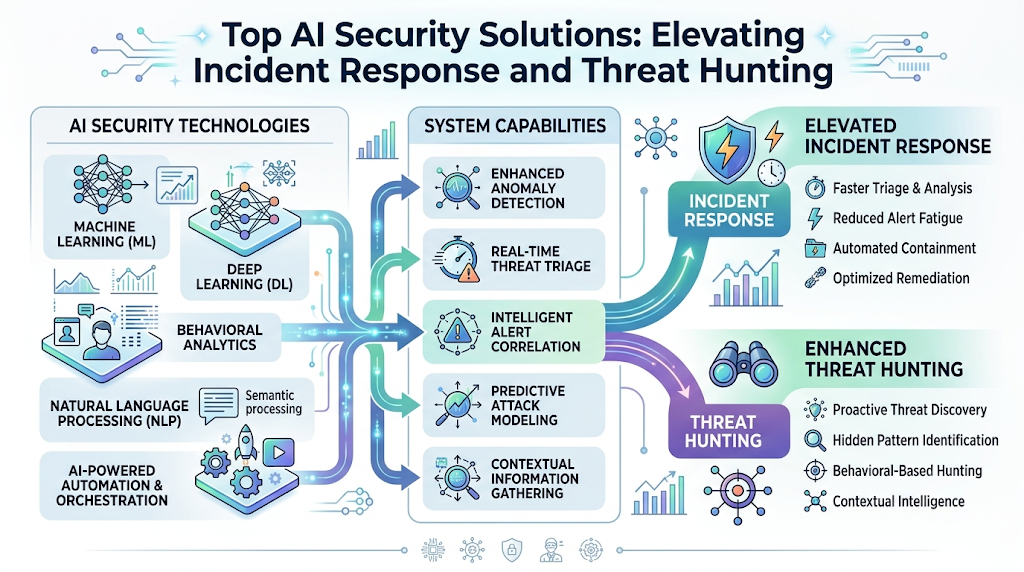
Artificial Intelligence in cybersecurity refers to the use of machine learning, deep learning, and behavioral algorithms to detect, analyze, and respond to cyber threats autonomously. Instead of relying on pre-programmed rules, AI learns from vast amounts of network data to recognize what “normal” looks like and flags deviations.
The evolution of AI-driven security began with simple spam filters and basic anomaly detection. Today, it has evolved into complex neural networks capable of dissecting malicious code, tracking lateral movement within a network, and isolating compromised devices without human intervention.
Organizations are rapidly adopting AI because the attack surface has expanded exponentially with cloud computing, remote work, and IoT devices. Human teams simply cannot monitor everything simultaneously.
The core security objectives of integrating AI include reducing the time it takes to detect a breach, lowering the rate of false positive alerts, and automating repetitive triage tasks so human analysts can focus on strategic threat hunting.
Why Cybersecurity Needs Artificial Intelligence
Increasing Threat Volumes
Enterprise networks generate terabytes of log data daily. Attackers launch thousands of automated phishing campaigns and brute-force attacks every hour. Human teams cannot manually sift through this mountain of data to find the one anomaly that indicates a breach.
Sophisticated Attack Techniques
Modern adversaries use polymorphic malware that constantly changes its code to evade traditional antivirus software. They also use “living off the land” techniques, abusing legitimate system tools to move silently. AI is required to spot these subtle, behavioral deviations.
Faster Detection Requirements
In ransomware attacks, the time between initial compromise and file encryption can be just minutes. Human incident response workflows are too slow. Organizations need AI systems that can detect and block malicious encryption processes the millisecond they begin.
Security Talent Shortages
The cybersecurity industry faces a massive global shortage of skilled professionals. Security Operations Centers (SOCs) are understaffed. AI acts as a force multiplier, handling the workload of Tier-1 analysts by automatically gathering context and correlating alerts.
Large-Scale Data Analysis Challenges
Identifying an advanced persistent threat (APT) often requires connecting a suspicious login from an unusual location with a minor privilege escalation that occurred days later. AI excels at analyzing large-scale datasets over long periods to connect these seemingly unrelated dots.
Core AI Technologies Used in Cybersecurity
Machine Learning (ML)
Machine learning algorithms train on historical security data to recognize patterns and predict future outcomes. In security, ML is heavily used to classify files as benign or malicious based on their characteristics, rather than waiting for a vendor to create a static signature.
Deep Learning
Deep learning uses artificial neural networks inspired by the human brain. It excels at analyzing unstructured data. For example, deep learning can analyze raw network traffic packets in real-time to identify the command-and-control communication patterns of advanced malware.
Natural Language Processing (NLP)
NLP allows computers to understand and process human language. In cybersecurity, NLP is deployed to scan millions of emails, understanding the context and intent of the messages to identify sophisticated spear-phishing attempts that don’t contain obvious malicious links.
Behavioral Analytics
Instead of looking for known bad files, behavioral analytics monitors entities (users, devices, applications) to establish a baseline of normal activity. If a user in marketing suddenly tries to access an encrypted engineering database at 3 AM, the system flags it instantly.
Predictive Analytics
Predictive analytics uses statistical algorithms and machine learning to identify the likelihood of future outcomes based on historical data. Security teams use this to forecast which vulnerabilities are most likely to be exploited by attackers in the wild, allowing them to prioritize patching.
How AI Enhances Cybersecurity
Threat Detection
AI vastly improves threat detection by shifting the focus from “known bads” to abnormal behaviors. Machine learning models analyze thousands of network parameters simultaneously, spotting stealthy data exfiltration attempts that traditional intrusion detection systems miss entirely.
Malware Analysis
Traditional sandboxing takes time. AI can analyze the DNA of an executable file—looking at its structure, API calls, and entropy—to determine if it is malware in milliseconds, even if it is a completely new variant.
Intrusion Detection
AI-powered intrusion detection systems (IDS) analyze network traffic flows contextually. Instead of firing an alert for every blocked port scan, the AI correlates events to understand if the scan is part of a larger, coordinated attack narrative.
User Behavior Analytics (UBA)
UBA algorithms build a dynamic profile for every user. If an employee’s credentials are stolen, the attacker will likely interact with the network differently than the legitimate user. UBA detects this anomaly—such as unusual mouse movements or atypical file access—and triggers a security challenge.
Phishing Prevention
By combining NLP and machine learning, AI email security gateways analyze sender reputation, domain age, language urgency, and hidden tracking pixels. This allows them to quarantine highly targeted business email compromise (BEC) attacks before they reach the inbox.
Fraud Detection
In financial services, AI evaluates transaction parameters in real-time. It looks at geolocation, device fingerprinting, and purchasing habits to instantly approve legitimate transactions while blocking fraudulent ones, minimizing financial loss.
Vulnerability Management
Scanning a large enterprise network reveals thousands of software vulnerabilities. AI enhances this process by enriching scan results with external cyber threat intelligence, telling security teams exactly which five vulnerabilities need patching today to prevent an active attack.
Automated Incident Response
When AI detects a high-confidence threat, it doesn’t just send an alert—it takes action. Through security orchestration, the AI can automatically disable compromised user accounts, isolate infected endpoints from the network, and update firewall rules to block the attacker’s IP address.
AI-Powered Cybersecurity Architecture
Building an AI-driven defense requires a modern architectural approach that moves beyond siloed security tools.
- Data Collection: The system ingests logs, network flows, and endpoint telemetry into a centralized data lake.
- Threat Intelligence: External data feeds provide context on global attack trends and known malicious infrastructure.
- Security Analytics: Machine learning models process the normalized data, filtering out noise and grouping related events.
- AI Decision Engine: The core brain evaluates the context, scores the risk, and determines if the activity is malicious.
- Incident Response Workflows: Based on predefined playbooks, the system executes containment and remediation steps.
- Continuous Monitoring: The AI constantly learns from new data and the outcomes of previous incidents to refine its accuracy over time.
Benefits of AI in Cybersecurity
- Faster Threat Detection: AI algorithms process data at machine speed, identifying anomalies in milliseconds rather than hours or days.
- Reduced Response Time: Automated playbooks contain threats instantly, preventing lateral movement and minimizing potential damage.
- Improved Accuracy: By analyzing deeper context, AI reduces false positive alerts, ensuring analysts only investigate genuine threats.
- Lower Operational Workload: Automating routine triage and data gathering frees up security teams to focus on complex investigations.
- Enhanced Risk Management: Predictive analytics allow organizations to proactively harden their defenses against the most likely attack vectors.
- Better Security Visibility: AI correlates data across endpoints, cloud environments, and networks, providing a unified view of the attack surface.
- Scalable Protection: As network traffic and device counts grow, AI systems can dynamically scale their processing power without requiring proportional increases in human headcount.
Real-World Use Cases
Enterprise Security Operations Centers (SOC)
Modern SOCs use AI-driven SIEM (Security Information and Event Management) platforms to aggregate millions of daily logs into just a handful of actionable incidents, automatically mapping them to the MITRE ATT&CK framework.
Financial Services Security
Banks utilize deep learning to analyze millions of daily credit card transactions, identifying subtle geographical and timing anomalies to block fraudulent transfers before funds leave the institution.
Healthcare Security
Hospitals deploy AI network monitoring to secure unpatched, legacy medical devices (like MRI machines). The AI establishes strict behavioral baselines, instantly blocking any device that attempts to communicate outside its normal parameters.
Cloud Security
Cloud engineers use AI-powered posture management tools to continuously monitor thousands of cloud storage buckets and serverless functions, automatically correcting misconfigurations that could expose sensitive data.
E-Commerce Protection
Retailers rely on AI bot-management solutions to differentiate between legitimate human shoppers and automated credential-stuffing bots attempting to hijack customer accounts during peak shopping seasons.
Government and Public Sector Security
Defense agencies use advanced AI threat hunting platforms to analyze global network traffic, identifying state-sponsored threat actors and advanced persistent threats (APTs) hidden in encrypted traffic.
AI and Cyber Threat Intelligence
Cyber threat intelligence relies on processing massive amounts of unstructured data from the dark web, hacker forums, and security feeds. AI drastically accelerates this process.
- Threat Hunting: AI assists proactive threat hunters by automatically querying vast datasets for indicators of compromise (IoCs) and presenting visualized attack timelines.
- Threat Prediction: By analyzing chatter on underground forums and global attack trends, AI can predict which industries or technologies are likely to be targeted next.
- Risk Assessment: AI models continuously evaluate an organization’s internal vulnerabilities against external threat intelligence to calculate real-time risk scores.
- Security Intelligence Automation: NLP engines scrape and read thousands of security blogs and threat reports daily, extracting actionable IoCs and automatically pushing them to enterprise firewalls.
Challenges and Limitations of AI in Cybersecurity
While highly effective, AI is not a silver bullet. Organizations must navigate several inherent challenges.
- False Positives: If an AI model is trained on poor data, it can flag legitimate business processes as malicious, causing operational disruption and frustrating end-users.
- Adversarial AI Attacks: Hackers are now using AI to attack AI. They subtly manipulate malware code to trick the defender’s machine learning models into classifying the malicious file as safe.
- Data Quality Concerns: An AI system is only as good as the data it ingests. Incomplete, noisy, or biased network logs will result in highly inaccurate threat detection.
- Implementation Complexity: Deploying enterprise AI security requires significant architectural changes, clean data pipelines, and specialized engineering skills to tune the models.
- Ethical Considerations: Extensive behavioral monitoring raises employee privacy concerns. Organizations must balance robust security with respecting user privacy and ensuring transparent data handling.
Best Practices for Implementing AI Security Solutions
- Strong Data Governance: Ensure your organization is collecting high-quality, normalized, and comprehensive log data before deploying AI models.
- Continuous Model Training: Cyber threats evolve constantly. Security teams must continuously retrain AI models with the latest threat intelligence to prevent model drift.
- Human Oversight: Never fully remove the human from the loop for critical decisions. Use AI to augment analysts, not replace them entirely.
- Integration with Existing Controls: Ensure your AI tools can communicate seamlessly via APIs with your existing firewalls, endpoint agents, and identity management systems.
- Performance Monitoring: Regularly audit the AI system’s false positive and false negative rates to ensure it is actually reducing risk and not just creating noise.
AI vs Traditional Cybersecurity Approaches
Understanding the shift requires comparing the old paradigm with the new intelligent approach.
| Feature | Traditional Cybersecurity | AI-Enhanced Cybersecurity |
| Detection Method | Signature-based (Known threats) | Behavior-based (Unknown threats) |
| Response Speed | Manual, often hours or days | Automated, milliseconds to minutes |
| Data Analysis | Limited to predefined rules | Contextual, analyzing massive datasets |
| Scalability | Requires more humans as data grows | Scales dynamically with compute power |
| Focus | Reactive (Waiting for an alert) | Proactive (Hunting and predicting) |
| Adaptability | Static, requires manual updates | Dynamic, learns and adapts over time |
Future of AI in Cybersecurity
Autonomous Security Operations
We are moving toward SOCs where AI handles the entire lifecycle of routine incidents—from initial detection to forensic gathering and complete remediation—without human intervention.
Predictive Threat Intelligence
Future AI systems will evolve from recognizing current threats to accurately forecasting specific attacks against specific companies, allowing defenders to patch vulnerabilities weeks before an exploit is written.
AI-Powered Security Automation
Generative AI will allow security analysts to query their network using natural language. Instead of writing complex SQL queries, an analyst can simply ask, “Show me all users who accessed sensitive HR files from an external IP today.”
Zero Trust Enhancements
AI will become the dynamic policy engine of Zero Trust architectures, continuously calculating user trust scores in real-time based on behavior, location, and device health to grant or revoke access instantly.
Advanced Behavioral Analytics
Behavioral models will become granular enough to recognize an authorized user’s keystroke dynamics. If a user is logged in, but their typing speed and rhythm change drastically, the AI will lock the session, assuming physical device theft.
Career Opportunities
The intersection of artificial intelligence and cybersecurity has created highly lucrative and specialized career paths.
- AI Security Engineer: Builds and tunes the machine learning models that detect anomalies within enterprise networks.
- Cybersecurity Analyst (AI-Augmented): Uses AI platforms to quickly investigate complex alerts and orchestrate automated response playbooks.
- Security Data Scientist: Analyzes vast amounts of security telemetry to discover new attack patterns and design predictive algorithms.
- Threat Intelligence Specialist: Leverages AI tools to scrape and analyze dark web data, identifying emerging global threat campaigns.
- Security Architect: Designs the overarching enterprise infrastructure that allows AI tools, data lakes, and security controls to communicate effectively.
Common Misconceptions About AI in Cybersecurity
Myth: AI will completely replace human cybersecurity analysts.
Reality: AI replaces repetitive tasks, not human judgment. The most effective security operations combine the speed of AI with the contextual understanding and strategic thinking of experienced human professionals.
Myth: Buying an AI tool instantly secures your network.
Reality: AI is not a plug-and-play solution. It requires a mature security architecture, clean data pipelines, and continuous tuning by skilled engineers to be effective.
Myth: AI is only for large enterprises.
Reality: Cloud-based security platforms and managed detection and response (MDR) providers have democratized AI, making enterprise-grade automated security accessible to small and medium-sized businesses.
FAQ Section
1. How exactly does AI help in detecting unknown malware?
Traditional antivirus looks for known file signatures. AI analyzes the actual behavior, structure, and intent of the code to recognize malicious activity, even if the file has never been seen before.
2. Can AI stop a ransomware attack in progress?
Yes. AI-powered endpoint protection monitors for the rapid file encryption processes characteristic of ransomware and can instantly kill the process and isolate the device before damage spreads.
3. What is the difference between AI and machine learning in security?
AI is the broader concept of machines simulating human intelligence. Machine learning is a specific subset of AI where systems learn from historical security data to improve their threat detection accuracy over time.
4. Does implementing AI security mean we can fire our IT staff?
No. AI is designed to augment your IT and security teams by automating the tedious data analysis, allowing your staff to focus on strategic security improvements and complex incident investigations.
5. How do hackers use AI against organizations?
Cybercriminals use AI to automate the discovery of vulnerabilities, write highly convincing phishing emails using NLP, and create polymorphic malware that constantly shifts its code to evade detection.
6. What is User Behavior Analytics (UBA)?
UBA is an AI technology that establishes a baseline of normal activity for every user. If a user suddenly behaves strangely—like downloading massive amounts of data at odd hours—the system flags it as a potential insider threat or compromised account.
7. Are false positives common with AI security tools?
In the early stages of deployment, yes. The AI needs time to learn the specific nuances of your network. Continuous tuning and high-quality data ingestion will significantly reduce false positives over time.
8. Do small businesses need AI cybersecurity?
Yes. Cybercriminals increasingly target small businesses because they often have weaker defenses. Cloud-based AI security tools provide small businesses with automated, enterprise-level protection without needing a large security team.
9. How does AI improve email security?
AI analyzes the language, tone, sender reputation, and context of emails to identify sophisticated spear-phishing and social engineering attacks that do not contain obvious malicious links or attachments.
10. What role does human oversight play in AI security?
Humans provide the strategic context that AI lacks. While AI can detect anomalies and automate initial containment, human experts are needed to validate complex threats, manage communications, and refine security policies.
Final Summary
As cyber threats continue to grow in volume, speed, and sophistication, traditional, manual security operations are no longer sufficient. Artificial intelligence has fundamentally transformed how organizations defend their digital frontiers. By leveraging machine learning, behavioral analytics, and automated response capabilities, AI enables security teams to detect stealthy attacks in milliseconds and neutralize them before data is compromised. While challenges like adversarial AI and data quality exist, the benefits of faster detection, reduced analyst burnout, and predictive threat intelligence far outweigh the hurdles. The future of enterprise defense lies in combining the processing power of AI with human strategic expertise.
