As businesses adopt cloud-native applications, microservices, and DevOps, managing Kubernetes environments efficiently becomes crucial. Red Hat OpenShift is an enterprise-grade Kubernetes platform that simplifies container orchestration, security, automation, and hybrid cloud deployments.
OpenShift extends Kubernetes capabilities with enhanced security, developer-friendly workflows, and automation features, making it an ideal container platform for enterprises.
This blog will explore what Red Hat OpenShift is, its key use cases, features, architecture, installation process, and step-by-step tutorials for getting started.
What is Red Hat OpenShift?
Red Hat OpenShift is a fully managed, enterprise Kubernetes platform that provides a secure, scalable, and automated environment for running containerized applications. It is based on Kubernetes but adds security, automation, developer tools, and operational consistency across on-premises, cloud, and hybrid environments.
Why OpenShift?
- Enterprise Kubernetes with built-in security, automation, and compliance.
- Hybrid and Multi-Cloud Compatibility with support for AWS, Azure, Google Cloud, and on-premise data centers.
- CI/CD Integration for faster application deployment and DevOps enablement.
- Developer-Centric Features with support for OpenShift Pipelines, Operators, and Helm charts.
OpenShift enables enterprises to manage Kubernetes clusters at scale while ensuring compliance, governance, and developer productivity.
Top 10 Use Cases of Red Hat OpenShift
1. Enterprise Kubernetes Orchestration
OpenShift provides enterprise-grade Kubernetes with security policies, role-based access control (RBAC), and networking solutions to manage workloads efficiently.
2. Hybrid & Multi-Cloud Deployments
OpenShift runs seamlessly across public clouds (AWS, Azure, GCP), private data centers, and hybrid cloud environments, providing a consistent platform.
3. Microservices and Cloud-Native Applications
OpenShift simplifies microservices development by providing containers, Istio service mesh, and Operators to manage application lifecycles.
4. DevOps & Continuous Integration/Continuous Deployment (CI/CD)
With OpenShift Pipelines (Tekton), Jenkins, and ArgoCD, OpenShift supports automated deployments, testing, and rollbacks.
5. Artificial Intelligence & Machine Learning (AI/ML)
OpenShift integrates with TensorFlow, Kubeflow, and Jupyter Notebooks to enable AI/ML model training and deployment.
6. Edge Computing & IoT
Lightweight OpenShift clusters can run on edge devices and remote locations, supporting 5G, IoT, and low-latency applications.
7. Security and Compliance
OpenShift provides built-in security policies, RBAC, SELinux enforcement, and automated compliance audits for enterprises needing SOC2, PCI-DSS, HIPAA, or GDPR compliance.
8. Stateful Applications & Database Management
Unlike traditional Kubernetes, OpenShift has persistent storage support for databases like MySQL, PostgreSQL, MongoDB, and Redis.
9. Serverless Computing with Knative
OpenShift supports Knative-based serverless workloads, enabling developers to run event-driven applications with minimal resource usage.
10. Kubernetes-as-a-Service (KaaS)
OpenShift allows organizations to offer self-service Kubernetes clusters to developers with governance and security controls.
What Are the Features of Red Hat OpenShift?
1. Enterprise-Ready Kubernetes
- Built on Kubernetes with added security, automation, and support for production workloads.
2. Developer-Focused Experience
- Provides a self-service developer portal with Red Hat CodeReady Workspaces, Helm charts, and OpenShift Pipelines (Tekton).
3. Security & Compliance
- Built-in RBAC, Security Context Constraints (SCC), SELinux, compliance scanning, and policy enforcement.
4. OpenShift Pipelines & GitOps
- Supports Tekton CI/CD pipelines and ArgoCD GitOps workflows for automated deployments.
5. OpenShift Operators
- Automates deployment, scaling, and management of applications and services.
6. Multi-Cloud & Hybrid Cloud Support
- Runs seamlessly on on-prem, AWS, Azure, Google Cloud, and OpenStack.
7. Networking & Service Mesh
- Supports OpenShift SDN, Istio service mesh, and Calico networking for high-performance Kubernetes networking.
8. Automated Scaling & Load Balancing
- Uses Horizontal Pod Autoscaler (HPA) and Cluster Autoscaler to manage workloads efficiently.
9. Persistent Storage for Stateful Applications
- Supports Ceph, GlusterFS, AWS EBS, Azure Disks, Google Persistent Disks.
10. Monitoring & Logging
- Integrates with Prometheus, Grafana, and Elasticsearch for Kubernetes observability and logging.
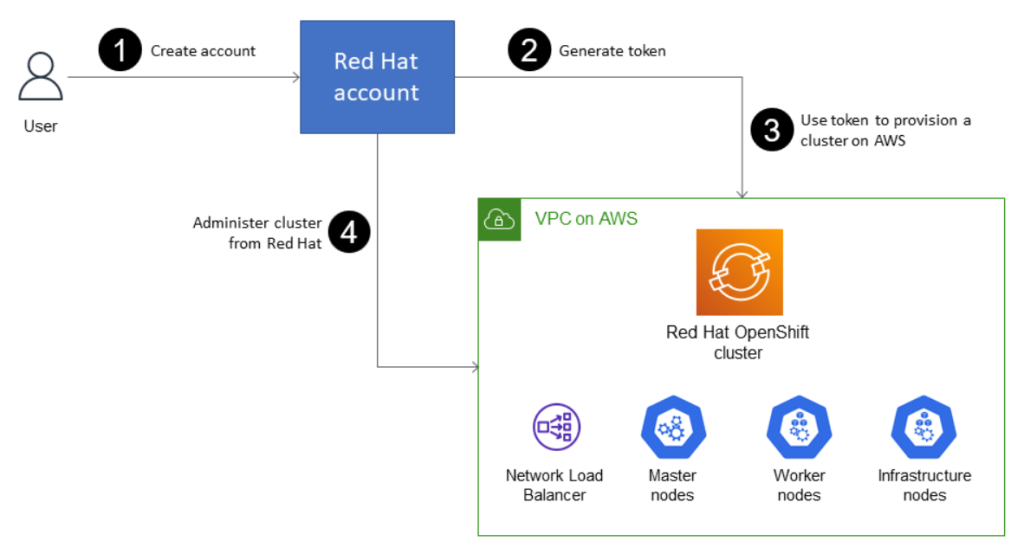
How Red Hat OpenShift Works and Architecture
How OpenShift Works
Red Hat OpenShift extends Kubernetes with added security, automation, and developer tools, making it easier to deploy and manage containerized applications at scale.
Red Hat OpenShift Architecture
1. OpenShift Control Plane (Master Nodes)
- API Server: Handles communication between OpenShift components.
- Controller Manager: Manages cluster lifecycle events.
- etcd: Stores Kubernetes cluster data.
- Scheduler: Assigns workloads to worker nodes.
2. Worker Nodes (Compute Nodes)
- Kubelet: Manages container execution.
- CRI-O: OpenShift’s lightweight container runtime.
- SDN & Service Mesh: Provides networking and service-to-service communication.
3. OpenShift Platform Services
- Authentication & RBAC: Manages user access and security policies.
- Logging & Monitoring: Uses Prometheus and Elasticsearch for observability.
How to Install Red Hat OpenShift
Installation Methods
- OpenShift Local (CRC) for development
- OpenShift on Bare Metal or Virtual Machines
- OpenShift on Public Cloud (AWS, Azure, GCP)
Installing OpenShift Using CRC (For Local Development)
Step 1: Download OpenShift CRC
curl -LO https://mirror.openshift.com/pub/openshift-v4/clients/crc/latest/crc-linux-amd64.tar.xzStep 2: Extract and Install CRC
tar -xvf crc-linux-amd64.tar.xz
sudo mv crc /usr/local/bin/
Step 3: Start OpenShift Cluster
crc setup
crc start
Step 4: Access OpenShift Web Console
crc consoleBasic Tutorials of Red Hat OpenShift: Getting Started
1. Deploying an Application on OpenShift
oc new-app nginx --name=myapp- Deploys an Nginx web server inside an OpenShift cluster.
2. Exposing a Service (Ingress / Route)
oc expose svc myapp --port=80 --type=NodePort- Makes the application accessible via external routes.
3. Scaling an Application
oc scale deployment myapp --replicas=5- Increases the number of pods for the application.
4. Deploying a Helm Chart
helm install mychart bitnami/nginx- Deploys an Nginx server using Helm charts.
5. Checking Running Pods
oc get pods