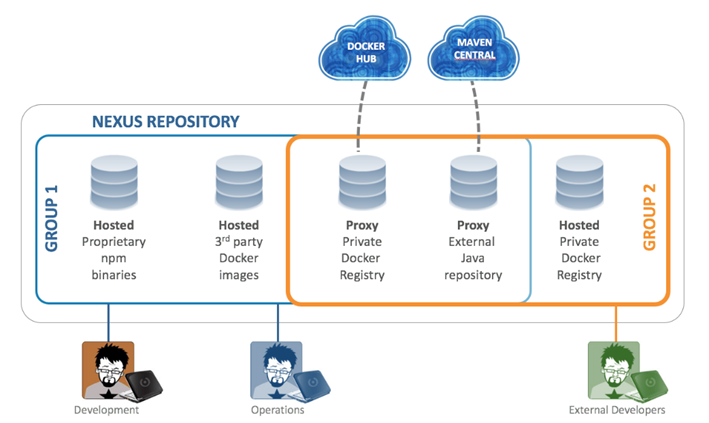
Nexus is a repository manager functions as stores, organizes, and distributes Artifacts needed for the development.
This tool is one of the finest ways to continuously control binary, packages and build Artifacts. But this repository is not something like a Git repository where you store the source code, this repository is basically for packages, binaries that you build, like apt packages, yum packages, android packages, NPM packages, Docker packages, etc.
There are two types of version one is the community version and 2nd is the pro version which you called a professional version. The professional version is for paid and the enterprise community version is free with very limited functions.
From Nexus, developers can fully control access to, and deployment of, every Artifact in a company from a single location, making it easier to allocate software. Internally, you configure your build to issue Artifacts to Nexus, so they come out there to rest developers. Nexus Repository helps organizations build better, safer software even quicker for free. It’s the only repository manager with free support for all popular formats, like Java, Docker, JavaScript, Ruby, Python, NET, GitLFS, etc.
Why Nexus is used for?
Basically, it is repository management and is used to store any kind of packages. But there is another use of nexus as well, which is the availability of packages.
When you store the packages in the tools like nexus, they will be available to the entire team. Because of this coordination time is reduced.
Now the security of the packages is very important here. Security of packages means only a few persons should be having the right access or few CI tools. Most of the times CI tools will have the right access to make the nexus. But the rest of the people will not have the right access because the security of the package is also a major concern.
Now if you look at the kind of places where we deploy our applications, most of the applications we are using everywhere are cloud-based applications like making my trip, yatra.com, Swiggy, Ola, FB, etc, software as a service, so security is very important.
If one wrong package gets deployed into the system, operations, production, which will create a lot of problems so not only the support security and runtime security is important but package security is also important. So that’s one of the reasons where we can use nexus where the security can be enforced.
Storage over the period of time will die but if you store the packages in tools like nexus and Artifactory, etc. they will make sure that the packages they store in a sort of object format, they maintain the integrity of packages, so that way it will not get corrupted over the period of time, so that is a thing which will be taking care by tools is nexus.
What are the benefits of nexus?
Given below are few points on the benefits of nexus are–
- Speedier Builds
- Your own bandwidth savings
- Predictability and Stability
- Ability to deploy 3rd-party Artifacts
- Control and Auditing
- Ability to Host Internal Repositories
- Ability to Host Public Repositories
- Easy administration and management
Who should enroll for Nexus Certification Course?
The person who wants to be a professional on nexus tool and wants to learn what and how repository manager works as nexus and to take the advantage of nexus advanced features who let a user search, use fields, use lookups, and create basic statistical reports and dashboards in the Nexus Intermediate Enterprise or Nexus Intermediate Cloud Platforms.
It enhances the value of your resume and you can get leading job posts with the help of this certification in leading MNC’s of the world. The certification is only provided after the successful completion of training and practical-based projects.
What are the alternatives of Nexus?
Given below are the few tools which is an alternative to Nexus.
- Archiva
- Nuget gallery
- PopScrap Pro
- ScrapRight
- ScrapYardPro
- RecyclerGuard
- RazorERP
- RecycleManager
- Makor ERP
- Waste Logics
- Waste & Recycling One
- JFrog Artifactory.
- CircleCI.
- Postman.
- GitHub.
- Amazon Elastic Container Registry (ECR)
- Jenkins.
- CloudBees CI.
- Github Package Registry.
What are the pre-requisites to learn Nexus
For essential nexus training
- Basic understanding of Linux/Unix system concepts
- Familiarity with Command Line Interface (CLI)
- Familiarity with a Text Editor
- Experience with managing systems/applications/infrastructure or with deployments/automation
For intermediate nexus training
- An understanding of basic marketing concepts.
- Should have a keen interest in engaging in social media constructively.
- Enthusiasm and commanding communication skills
For advanced nexus training
- Basic knowledge of Elastic search/Nexus and would like to expand on their knowledge
- Basic Knowledge of JSON
- Basic of Linux and windows
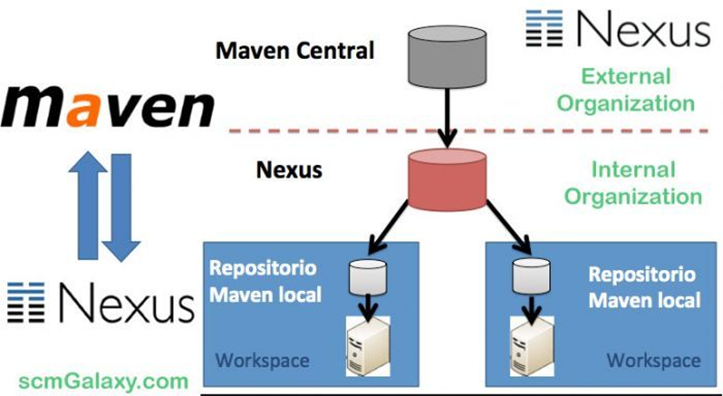
How to learn Nexus?
Through a certified course and training from well-trained trainers and from a popular and well-known platform like DevOpsSchool which makes the trainee is a perfect use of this Nexus tool.
DevOpsSchool is the best supply of Nexus courses, training, and certification. Their Nexus trainers and specialists are highly educated with a good rich experience in the Software industry. DevOps has captured a stimulating position within the IT world and has become an important part of software engineering methodology. For enhancing the software quality, reducing cost, and increasing the agility for a quicker release, DevOps and Nexus is playing a very important role therefore finding the best Nexus trainers and training seller is very necessary.
The Nexus courses are designed in certain methods where participants can get advantages with a lot of content in less span of time. DevOpsSchool gives its services of Nexus training and courses online and classroom mode in India and abroad. DevOpsSchool tends to run several public classrooms training programs within Bangalore, Hyderabad, Pune, Mumbai, India, Netherlands, etc.
