Introduction
Academic Credentialing Platforms are software solutions designed to issue, manage, and verify academic credentials digitally. They streamline the process of verifying qualifications, ensuring authenticity, and maintaining a centralized record of certificates, diplomas, and other academic achievements. In and beyond, the digital transformation of education and professional learning has made these platforms increasingly important for institutions, learners, and employers alike.
Organizations use these platforms to reduce fraud, simplify credential management, and support lifelong learning initiatives. For example, universities can issue diplomas digitally, online learning platforms can certify course completion, and employers can quickly verify the authenticity of academic records during hiring.
Real-world use cases:
- Universities issuing verifiable digital diplomas and transcripts.
- Professional certification bodies managing and validating credentials.
- Corporate learning departments tracking employee training and certifications.
- Online course platforms providing instant certification for learners.
- Government agencies verifying educational backgrounds for employment or immigration.
Buyer evaluation criteria:
- Security and compliance features
- Ease of issuing and verifying credentials
- Integration with existing LMS or HR systems
- Support for blockchain or tamper-proof credentials
- User experience for administrators and recipients
- Scalability for large organizations
- Reporting and analytics capabilities
- Pricing and licensing models
- Platform reliability and uptime
Best for: Higher education institutions, professional associations, online course providers, corporate training departments.
Not ideal for: Organizations with minimal credentialing needs or those relying solely on informal recognition methods.
Key Trends in Academic Credentialing Platforms
- Adoption of blockchain technology for tamper-proof credential verification.
- Integration of AI-driven verification to streamline fraud detection and validation.
- Increased interoperability with Learning Management Systems (LMS) and HR platforms.
- Growing demand for micro-credentials and stackable badges for skill recognition.
- Compliance with global standards such as GDPR, SOC 2, and ISO 27001.
- Enhanced mobile-first experiences for credential recipients.
- Support for decentralized identity wallets for personal credential management.
- Flexible pricing and deployment models, including SaaS and hybrid solutions.
- Expansion of API ecosystems for seamless credential exchange and verification.
- Focus on analytics and reporting to track credential issuance, usage, and verification trends.
How We Selected These Tools (Methodology)
- Evaluated market adoption and recognition across industries.
- Assessed feature completeness including issuance, verification, and reporting.
- Reviewed reliability and performance signals from enterprise and SMB use cases.
- Analyzed security posture including encryption, audit logs, and compliance certifications.
- Considered integrations with LMS, HR, and other enterprise systems.
- Evaluated ecosystem flexibility for API and developer support.
- Reviewed customer fit across diverse organization sizes and learning models.
- Balanced innovation, usability, and scalability for long-term adoption.
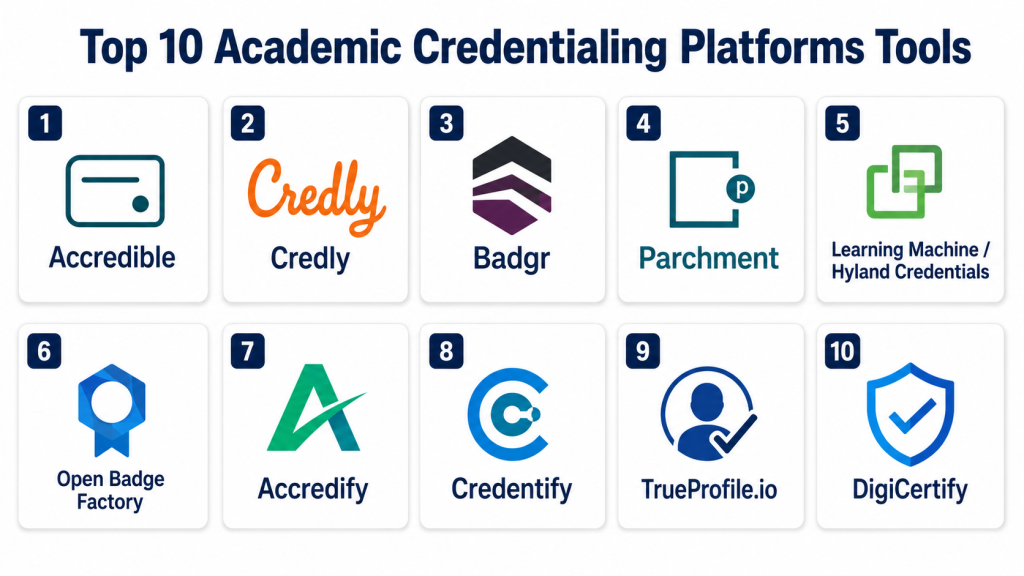
Top 10 Academic Credentialing Platforms Tools
#1 — Accredible
Short description: Accredible is a robust platform for issuing and managing digital certificates and badges. It serves educational institutions, online course providers, and professional organizations.
Key Features
- Digital certificates and blockchain-based credentialing
- Customizable branding for certificates and badges
- Automated issuance workflows
- Credential verification via shareable links or QR codes
- Analytics dashboards for tracking engagement and usage
- API support for integration with LMS and HR platforms
Pros
- Tamper-proof digital credentialing
- Strong analytics and reporting
- Seamless integration with learning platforms
Cons
- Some advanced features require premium subscription
- Limited offline verification options
Platforms / Deployment
- Web / Windows / macOS / Linux / iOS / Android
- Cloud
Security & Compliance
- SOC 2, GDPR, encryption, MFA, audit logs
Integrations & Ecosystem
- LMS and HR system integrations
- REST APIs for custom workflows
- Zapier support for automation
Support & Community
- Extensive documentation, onboarding guides, email and chat support
- Active community forums for administrators
#2 — Credly
Short description: Credly allows organizations to issue digital badges and certificates to recognize skills, achievements, and learning outcomes.
Key Features
- Digital badges and certifications
- Blockchain verification for authenticity
- Integration with LinkedIn for sharing credentials
- Reporting on badge issuance and acceptance
- API and LMS integration capabilities
- Custom branding options
Pros
- Widely recognized digital credentialing network
- Supports skill verification and micro-credentials
- Strong social sharing capabilities
Cons
- Premium plans can be costly for smaller institutions
- Some integrations require technical setup
Platforms / Deployment
- Web / iOS / Android
- Cloud
Security & Compliance
- Not publicly stated (varies per plan)
Integrations & Ecosystem
- LMS integration, HR software connectors
- API access for credential management
- Integration with certification management tools
Support & Community
- Knowledge base, webinars, customer support tiers
- Community forums available
#3 — Badgr
Short description: Badgr focuses on issuing open badges and supporting micro-credentials for learners across academic and professional settings.
Key Features
- Open Badge standard compliance
- Stackable credential paths
- Badge verification via URLs and QR codes
- Integration with LMS systems
- Analytics dashboard for issuer and recipient tracking
Pros
- Strong focus on open standards and interoperability
- Supports learning pathways
- Flexible badge design options
Cons
- Advanced analytics features limited in free plan
- Less enterprise support compared to larger platforms
Platforms / Deployment
- Web / iOS / Android
- Cloud / Self-hosted
Security & Compliance
- Not publicly stated
Integrations & Ecosystem
- API support for automation
- LMS integration (Moodle, Canvas)
- Open standards for interoperability
Support & Community
- Documentation, community forums
- Email support
#4 — Parchment
Short description: Parchment provides secure credential management and verification for educational institutions, focusing on transcripts and diplomas.
Key Features
- Digital transcripts and diplomas
- Secure verification portal for employers
- Integration with SIS (Student Information Systems)
- Reporting tools for credential activity
- Email and link-based sharing
Pros
- Trusted by academic institutions
- Simplifies transcript verification for employers
- Easy recipient sharing
Cons
- Limited badge and micro-credential support
- Platform can be complex for small organizations
Platforms / Deployment
- Web
- Cloud
Security & Compliance
- SOC 2, encryption, MFA
Integrations & Ecosystem
- SIS system integration
- API access for automated credential workflows
Support & Community
- Documentation, email, and phone support
#5 — Learning Machine / Hyland Credentials
Short description: Learning Machine provides blockchain-based digital credentialing solutions for higher education and professional certification bodies.
Key Features
- Blockchain-backed diplomas and certificates
- Mobile wallet for credential storage
- Verification tools for employers and institutions
- Integration with LMS and HR systems
- API support for custom workflows
Pros
- Strong security with blockchain
- Easy verification for recipients
- Mobile-friendly credential storage
Cons
- Implementation can be technical
- Cost may be high for smaller institutions
Platforms / Deployment
- Web / iOS / Android
- Cloud / Hybrid
Security & Compliance
- Blockchain, encryption, MFA
- ISO 27001
Integrations & Ecosystem
- LMS integrations
- API access for verification and management
- Employer verification portal
Support & Community
- Documentation, training webinars
- Dedicated customer support
#6 — Open Badge Factory
Short description: Open Badge Factory specializes in issuing open badges and supports institutions in creating skill-based credential pathways.
Key Features
- Open Badge compliant digital credentials
- Badge design and management tools
- Pathways for stackable skills
- LMS integration
- Analytics for issuer insights
Pros
- Supports open standards
- Stackable credential pathways
- Easy badge customization
Cons
- Enterprise support limited
- Some advanced reporting features not included
Platforms / Deployment
- Web / iOS / Android
- Cloud
Security & Compliance
- Not publicly stated
Integrations & Ecosystem
- LMS integration (Moodle, Canvas)
- API support for badge issuance
- Zapier for automation
Support & Community
- Email support, knowledge base
- Community forums
#7 — Accredify
Short description: Accredify provides digital credentialing and verification solutions, focusing on professional certifications and corporate learning programs.
Key Features
- Blockchain-based certificates and diplomas
- Real-time verification tools
- Mobile wallet support
- Reporting and analytics
- LMS integration
Pros
- Tamper-proof blockchain verification
- Mobile-friendly credential management
- Scalable for enterprises
Cons
- Premium features can be costly
- Smaller institutions may find setup complex
Platforms / Deployment
- Web / iOS / Android
- Cloud
Security & Compliance
- Blockchain, encryption, MFA, SOC 2
- GDPR compliance
Integrations & Ecosystem
- LMS and HR system integrations
- API for automated workflows
- Custom branding for certificates
Support & Community
- Documentation, webinars, email support
#8 — Credentify
Short description: Credentify offers digital certification and verification tools suitable for online learning platforms and professional development programs.
Key Features
- Digital badges and certificates
- Verification via QR codes and URLs
- Custom branding and templates
- Analytics and reporting
- API integration
Pros
- Fast credential issuance
- Simple verification process
- Good for online learning environments
Cons
- Limited advanced analytics
- Less enterprise-grade feature depth
Platforms / Deployment
- Web / iOS / Android
- Cloud
Security & Compliance
- Not publicly stated
Integrations & Ecosystem
- LMS integration
- REST API support
- Badge sharing on social platforms
Support & Community
- Documentation and email support
- Limited community engagement
#9 — TrueProfile.io
Short description: TrueProfile.io allows professionals to store and share verified academic and professional credentials digitally.
Key Features
- Credential verification
- Blockchain-backed storage
- Mobile credential wallet
- API support for verification
- Reporting dashboards
Pros
- Strong verification and security
- Mobile-friendly credential sharing
- Blockchain integration
Cons
- Platform more focused on individual professionals than institutions
- Limited enterprise features
Platforms / Deployment
- Web / iOS / Android
- Cloud
Security & Compliance
- Blockchain, encryption, MFA
- GDPR compliance
Integrations & Ecosystem
- LMS and HR integrations
- API support for verification
- Exportable credential formats
Support & Community
- Documentation, email support
- Small but active user community
#10 — DigiCertify
Short description: DigiCertify offers digital credentialing for academic institutions and professional learning organizations, emphasizing verification and portability.
Key Features
- Digital diplomas and certificates
- Verification portal for employers
- Analytics and reporting
- LMS integration
- Mobile credential wallets
Pros
- Reliable verification features
- Supports mobile credential access
- User-friendly interface
Cons
- Limited badge and micro-credential options
- Smaller customization flexibility
Platforms / Deployment
- Web / iOS / Android
- Cloud
Security & Compliance
- Encryption, MFA
- SOC 2 compliance
Integrations & Ecosystem
- LMS integrations
- API support for credential issuance
- Employer verification tools
Support & Community
- Documentation, onboarding guides
- Email support
Comparison Table (Top 10)
| Tool Name | Best For | Platform(s) Supported | Deployment | Standout Feature | Public Rating |
|---|---|---|---|---|---|
| Accredible | Universities, Online Courses | Web / Windows / macOS / Linux / iOS / Android | Cloud | Blockchain-backed certificates | N/A |
| Credly | Professional Certifications | Web / iOS / Android | Cloud | Social sharing & badges | N/A |
| Badgr | Micro-credentials & Stackable Skills | Web / iOS / Android | Cloud / Self-hosted | Open Badge compliance | N/A |
| Parchment | Academic Transcripts | Web | Cloud | Secure verification portal | N/A |
| Learning Machine / Hyland | Higher Ed, Professional Certs | Web / iOS / Android | Cloud / Hybrid | Blockchain verification | N/A |
| Open Badge Factory | Open badges | Web / iOS / Android | Cloud | Open standards & stackable pathways | N/A |
| Accredify | Corporate Learning & Certifications | Web / iOS / Android | Cloud | Real-time blockchain verification | N/A |
| Credentify | Online Learning Platforms | Web / iOS / Android | Cloud | QR code verification | N/A |
| TrueProfile.io | Professionals & Credential Sharing | Web / iOS / Android | Cloud | Blockchain-backed storage | N/A |
| DigiCertify | Academic Institutions | Web / iOS / Android | Cloud | Verification portal for employers | N/A |
Evaluation & Scoring of Academic Credentialing Platforms
| Tool Name | Core (25%) | Ease (15%) | Integrations (15%) | Security (10%) | Performance (10%) | Support (10%) | Value (15%) | Weighted Total (0–10) |
|---|---|---|---|---|---|---|---|---|
| Accredible | 9 | 8 | 8 | 9 | 8 | 8 | 7 | 8.5 |
| Credly | 8 | 9 | 7 | 8 | 8 | 8 | 7 | 8.2 |
| Badgr | 7 | 8 | 7 | 7 | 7 | 7 | 8 | 7.5 |
| Parchment | 8 | 7 | 7 | 8 | 8 | 7 | 7 | 7.8 |
| Learning Machine | 9 | 7 | 8 | 9 | 8 | 7 | 7 | 8.3 |
| Open Badge Factory | 7 | 8 | 7 | 7 | 7 | 7 | 8 | 7.5 |
| Accredify | 8 | 8 | 8 | 9 | 8 | 8 | 7 | 8.3 |
| Credentify | 7 | 8 | 7 | 7 | 7 | 7 | 8 | 7.5 |
| TrueProfile.io | 8 | 7 | 7 | 9 | 8 | 7 | 7 | 7.9 |
| DigiCertify | 7 | 8 | 7 | 8 | 7 | 7 | 7 | 7.5 |
Interpretation: Scores are comparative. A higher weighted total indicates a stronger overall balance across core features, security, usability, and value. Organizations should consider their specific requirements when selecting a platform.
Which Academic Credentialing Tool Is Right for You?
Solo / Freelancer
For individual professionals seeking verifiable credentials, TrueProfile.io or Credly provide simple, mobile-friendly solutions.
SMB
Small learning organizations benefit from platforms with easy integrations and cost-effective plans like Badgr or Credentify.
Mid-Market
Mid-sized institutions require scalability and verification; Accredible or Accredify offer strong blockchain-based features.
Enterprise
Large universities and professional associations will find Learning Machine or Parchment ideal for enterprise-grade security and SIS integrations.
Budget vs Premium
Budget-conscious buyers can start with Badgr or Credentify, while premium options like Accredible and Learning Machine offer advanced analytics, blockchain verification, and enterprise support.
Feature Depth vs Ease of Use
Ease-of-use platforms like Credly and DigiCertify are ideal for minimal IT overhead, while Accredible and Learning Machine deliver depth in verification and analytics.
Integrations & Scalability
Organizations needing LMS, HR, and API integration should prioritize Accredible, Learning Machine, or Accredify for robust integration ecosystems.
Security & Compliance Needs
For highly regulated environments, platforms with SOC 2, ISO 27001, GDPR compliance, and blockchain verification such as Accredible, Learning Machine, or Accredify are recommended.
Frequently Asked Questions (FAQs)
1. What is an Academic Credentialing Platform?
An Academic Credentialing Platform digitally issues, stores, and verifies academic qualifications and achievements. It ensures authenticity, reduces fraud, and simplifies management of certificates, diplomas, and badges.
2. How much do these platforms typically cost?
Costs vary by features, scale, and deployment. Some platforms offer free or entry-level plans for small institutions, while enterprise-grade solutions with blockchain and analytics can be premium-priced.
3. Can I verify credentials issued by these platforms externally?
Yes. Most platforms offer QR codes, shareable links, or blockchain verification for employers and third parties to confirm authenticity.
4. How long does setup take?
Setup depends on organization size and integration needs. Small organizations can deploy in a few days, while large institutions with LMS/SIS integrations may take several weeks.
5. Are these platforms secure?
Top platforms implement encryption, MFA, audit logs, and SOC 2/GDPR compliance. Blockchain-backed platforms provide tamper-proof credential verification.
6. Can I integrate these platforms with existing systems?
Yes. Most support LMS, HR software, SIS systems, and offer APIs for custom workflows and automated credential issuance.
7. What is a micro-credential?
A micro-credential is a small, skill-specific certification that can be stacked with others to show competency in multiple areas.
8. Can learners share credentials on social media?
Platforms like Credly and Accredible allow learners to share verified badges and certificates on LinkedIn and other social channels.
9. Are blockchain credentials necessary?
Blockchain credentials ensure tamper-proof verification and are especially valuable for higher education and professional certification in regulated industries.
10. How do I choose the right platform?
Consider factors like organization size, credential volume, verification needs, LMS/HR integrations, security requirements, and budget to select the best platform.
Conclusion
Academic Credentialing Platforms are essential for modern education, professional learning, and skill verification. The “best” platform depends on your specific context—solo professional, small institution, or enterprise. Start by shortlisting platforms, running pilots, and validating integration and security features. These tools not only simplify credential issuance but also enhance credibility and trust for learners and employers.
