Introduction
Sleep tracking apps are digital tools designed to monitor, analyze, and optimize an individual’s sleep patterns. These apps leverage sensors, wearable devices, or smartphone technology to provide insights on sleep duration, quality, and cycles. As wellness and biohacking gain traction in 2026, sleep tracking apps have become essential for improving productivity, mental health, and overall well-being.
Real-world use cases include:
- Monitoring sleep quality for chronic health conditions such as insomnia or sleep apnea.
- Supporting athletes and fitness enthusiasts in optimizing recovery cycles.
- Tracking sleep trends to identify lifestyle factors affecting rest.
- Integrating with health platforms for holistic wellness programs.
- Helping parents or caregivers track children’s sleep schedules.
Best for: Individuals, fitness enthusiasts, wellness coaches, healthcare providers, and corporate wellness programs. Works across small, medium, and enterprise-scale health and wellness initiatives.
Not ideal for: Users without compatible devices, those uninterested in sleep optimization, or individuals preferring manual sleep tracking methods.
Key Trends in Sleep Tracking Apps
- AI-driven sleep analysis providing personalized insights and predictive patterns.
- Integration with smart home devices to optimize room conditions for better sleep.
- Increased focus on mental health correlations, offering stress and mood analytics.
- Cloud-based data storage with advanced privacy and compliance safeguards.
- Multi-device interoperability across wearables, smartphones, and IoT sensors.
- Real-time feedback with sleep coaching recommendations.
- Subscription-based models blending app functionality with connected hardware.
- Gamification elements to improve user engagement and long-term adherence.
- Integration with corporate wellness programs and insurance incentives.
- Advanced reporting with longitudinal data trends for medical and research use.
How We Selected These Tools (Methodology)
- Evaluated market adoption and user base across different regions.
- Analyzed completeness of features, including AI recommendations and integrations.
- Considered reliability and performance, including sensor compatibility and data accuracy.
- Assessed security posture, privacy policies, and compliance with GDPR/HIPAA where applicable.
- Reviewed available integrations with fitness platforms, health dashboards, and IoT devices.
- Factored in customer fit across solo users, SMBs, mid-market, and enterprise health initiatives.
- Considered usability, interface design, and learning curve.
- Balanced innovation and roadmap potential for future wellness features.
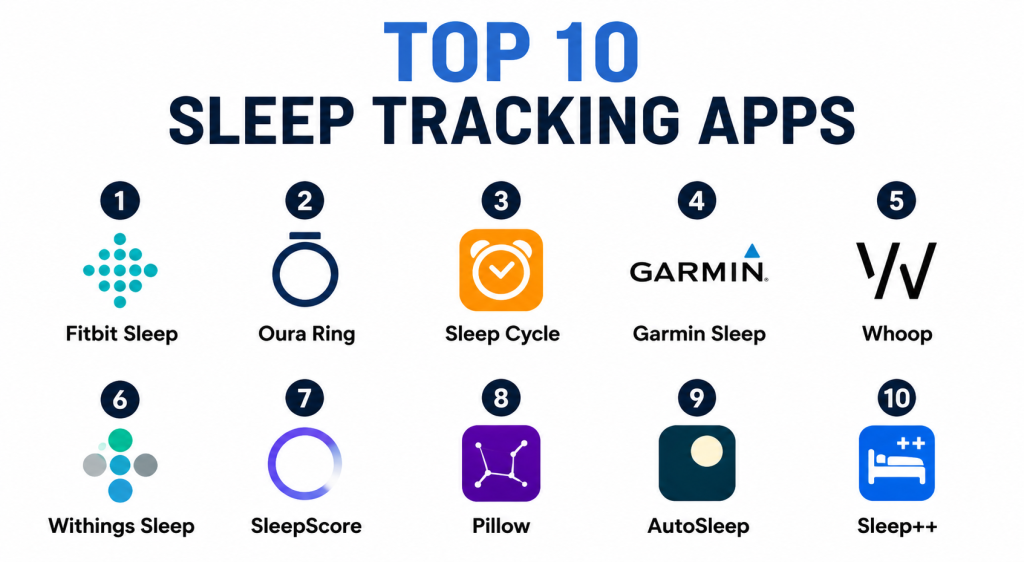
Top 10 Sleep Tracking Apps
1- Fitbit Sleep
Short description: Fitbit Sleep monitors sleep stages, heart rate, and movement patterns for users of Fitbit wearable devices. Ideal for health-conscious individuals and fitness enthusiasts.
Key Features
- Sleep stage tracking (light, deep, REM)
- Heart rate and SpO2 monitoring
- Smart alarm and sleep score
- Integration with Fitbit ecosystem and health dashboards
- AI-based sleep improvement insights
- Data visualization and trend reports
Pros
- Accurate data from validated sensors
- Seamless integration with Fitbit app ecosystem
Cons
- Requires Fitbit hardware
- Limited customization for advanced users
Platforms / Deployment
- iOS / Android / Fitbit devices
- Cloud-based app
Security & Compliance
- Data encryption in transit and at rest
- GDPR compliant
Integrations & Ecosystem
- Fitbit health ecosystem
- Apple Health and Google Fit
- Third-party fitness apps
- API support for data export
Support & Community
- Comprehensive documentation
- Community forums and customer support tiers
- Regular firmware updates
2- Oura Ring
Short description: Oura Ring offers wearable-based sleep and readiness tracking for users seeking detailed physiological insights, including temperature and HRV analysis.
Key Features
- Sleep staging and duration monitoring
- Readiness and activity score
- Heart rate variability (HRV) analysis
- Temperature sensor for illness detection
- Longitudinal trend reports
Pros
- Highly accurate biometric data
- Discreet wearable form factor
Cons
- Expensive hardware purchase
- Limited third-party app integrations
Platforms / Deployment
- iOS / Android / Oura Ring
- Cloud-based dashboards
Security & Compliance
- End-to-end encryption
- Varies / N/A for HIPAA compliance
Integrations & Ecosystem
- Apple Health
- Google Fit
- Basic API access for custom dashboards
Support & Community
- Customer support via app and email
- Active online community and FAQs
3- Sleep Cycle
Short description: Sleep Cycle uses smartphone sensors to analyze sleep patterns, wake users during optimal sleep phases, and provide AI-based recommendations.
Key Features
- Smart alarm based on sleep phases
- Sleep analysis via sound and motion sensors
- Personalized sleep insights
- Long-term trend visualization
- Optional premium features for coaching
Pros
- No wearable required
- Intelligent wake-up algorithm
Cons
- Accuracy may vary without wearables
- Subscription needed for advanced analytics
Platforms / Deployment
- iOS / Android
- Cloud-based storage
Security & Compliance
- Not publicly stated
Integrations & Ecosystem
- Apple Health
- Google Fit
- Limited API access
Support & Community
- In-app tutorials
- Email support
- Community forums for tips
4- Garmin Sleep
Short description: Garmin Sleep integrates with Garmin wearables to provide sleep stage analysis, heart rate, and movement tracking for athletes and wellness enthusiasts.
Key Features
- Sleep stage tracking
- Heart rate and stress monitoring
- Fitness and recovery integration
- Sleep score and trend analytics
- Customizable sleep goals
Pros
- Integrates with Garmin fitness ecosystem
- Accurate sensor data
Cons
- Requires Garmin device
- Premium features are device-dependent
Platforms / Deployment
- iOS / Android / Garmin devices
- Cloud sync via Garmin Connect
Security & Compliance
- Not publicly stated
Integrations & Ecosystem
- Garmin Connect
- Third-party fitness apps
- Basic API for health data
Support & Community
- Knowledge base and support tiers
- Active user community
5- Whoop
Short description: Whoop provides advanced sleep and recovery tracking for athletes and professionals focused on performance optimization.
Key Features
- Sleep stage and recovery analysis
- Strain and performance tracking
- HRV and resting heart rate monitoring
- AI-driven sleep recommendations
- Cloud-based trend reports
Pros
- Detailed recovery insights
- Excellent for high-performance users
Cons
- Subscription-based model
- Requires Whoop wearable
Platforms / Deployment
- iOS / Android / Whoop Strap
- Cloud-based app
Security & Compliance
- Not publicly stated
Integrations & Ecosystem
- Apple Health
- Strava
- Basic API support
Support & Community
- Email and live chat support
- Active fitness community
6- Withings Sleep
Short description: Withings Sleep is a mat-based sensor that tracks sleep cycles, heart rate, and snoring patterns, ideal for home wellness monitoring.
Key Features
- Sleep cycle tracking
- Heart rate and snore detection
- Sleep score and trend reports
- Smart home integrations
- Data visualization dashboards
Pros
- Non-wearable solution
- Integrates with smart home devices
Cons
- Requires bedside mat installation
- Limited portability
Platforms / Deployment
- iOS / Android
- Cloud-based
Security & Compliance
- Not publicly stated
Integrations & Ecosystem
- Apple Health
- Google Fit
- Smart home devices
- API access limited
Support & Community
- Online support and manuals
- Community forums available
7- SleepScore
Short description: SleepScore app leverages sonar technology to measure sleep stages and offers personalized guidance to improve sleep quality.
Key Features
- Sonar-based sleep detection
- Sleep optimization recommendations
- Trend tracking and analytics
- Smart alarm integration
- AI-based coaching
Pros
- No wearable required
- Personalized guidance
Cons
- Smartphone-dependent accuracy
- Premium features subscription-based
Platforms / Deployment
- iOS / Android
- Cloud-based
Security & Compliance
- Not publicly stated
Integrations & Ecosystem
- Apple Health
- Google Fit
- Limited API support
Support & Community
- Email support and help guides
- Online community for advice
8- Pillow
Short description: Pillow combines wearable and smartphone-based tracking to monitor sleep cycles, heart rate, and daytime naps, targeting wellness-conscious users.
Key Features
- Sleep stage analysis
- Heart rate tracking
- Nap tracking
- Smart alarm and notifications
- Personalized sleep insights
Pros
- Integrates with multiple devices
- Easy-to-use interface
Cons
- Limited data without wearable
- Subscription for advanced analytics
Platforms / Deployment
- iOS / Android / Apple Watch
- Cloud-based
Security & Compliance
- Not publicly stated
Integrations & Ecosystem
- Apple Health
- Google Fit
- Limited third-party integrations
Support & Community
- Email support
- Tutorials within the app
- Community-driven tips
9- AutoSleep
Short description: AutoSleep is an Apple Watch-centric sleep tracking app that monitors sleep quality, duration, and heart metrics, ideal for iOS users.
Key Features
- Automatic sleep detection
- Sleep quality scoring
- Heart rate and HRV monitoring
- Trend reporting and insights
- Custom sleep goals
Pros
- Fully automated tracking
- Integrates seamlessly with Apple Watch
Cons
- iOS-only app
- Limited platform interoperability
Platforms / Deployment
- iOS / Apple Watch
- Cloud-based
Security & Compliance
- Not publicly stated
Integrations & Ecosystem
- Apple Health
- Third-party iOS fitness apps
- Basic API for analytics
Support & Community
- Documentation and tutorials
- Email support available
- Active Apple-centric user community
10- Sleep++
Short description: Sleep++ is an Apple Watch-based app providing automated sleep tracking, insights, and trends for iOS users seeking simple monitoring.
Key Features
- Auto sleep detection
- Sleep stage analysis
- Trend visualization
- Customizable sleep goals
- Lightweight and battery-efficient
Pros
- Simple and user-friendly
- No additional hardware required
Cons
- iOS only
- Basic analytics compared to premium apps
Platforms / Deployment
- iOS / Apple Watch
- Cloud-based
Security & Compliance
- Not publicly stated
Integrations & Ecosystem
- Apple Health
- Limited third-party integrations
- API not publicly documented
Support & Community
- In-app support and FAQ
- Community forums for tips
Comparison Table (Top 10)
| Tool Name | Best For | Platform(s) Supported | Deployment | Standout Feature | Public Rating |
|---|---|---|---|---|---|
| Fitbit Sleep | Fitness enthusiasts | iOS / Android / Fitbit | Cloud | Sleep staging and score | N/A |
| Oura Ring | Biohackers / health tracking | iOS / Android / Oura | Cloud | Readiness score & HRV | N/A |
| Sleep Cycle | Smartphone users | iOS / Android | Cloud | Smart alarm based on sleep phases | N/A |
| Garmin Sleep | Athletes & fitness users | iOS / Android / Garmin | Cloud | Integration with Garmin ecosystem | N/A |
| Whoop | High-performance users | iOS / Android / Whoop | Cloud | Recovery tracking and analytics | N/A |
| Withings Sleep | Home wellness monitoring | iOS / Android | Cloud | Non-wearable sleep mat | N/A |
| SleepScore | Users preferring non-wearable | iOS / Android | Cloud | Sonar-based sleep detection | N/A |
| Pillow | General wellness users | iOS / Android / Apple Watch | Cloud | Nap tracking and smart alarms | N/A |
| AutoSleep | Apple Watch users | iOS / Apple Watch | Cloud | Automated sleep scoring | N/A |
| Sleep++ | iOS casual users | iOS / Apple Watch | Cloud | Lightweight, battery-efficient | N/A |
Evaluation & Scoring of Sleep Tracking Apps
| Tool Name | Core (25%) | Ease (15%) | Integrations (15%) | Security (10%) | Performance (10%) | Support (10%) | Value (15%) | Weighted Total |
|---|---|---|---|---|---|---|---|---|
| Fitbit Sleep | 9 | 8 | 8 | 8 | 9 | 8 | 7 | 8.45 |
| Oura Ring | 9 | 8 | 7 | 8 | 9 | 8 | 6 | 8.25 |
| Sleep Cycle | 8 | 9 | 7 | 7 | 8 | 7 | 7 | 7.85 |
| Garmin Sleep | 8 | 8 | 7 | 7 | 8 | 7 | 7 | 7.70 |
| Whoop | 9 | 8 | 7 | 7 | 9 | 8 | 6 | 8.10 |
| Withings Sleep | 8 | 8 | 6 | 7 | 8 | 7 | 7 | 7.50 |
| SleepScore | 7 | 8 | 6 | 7 | 7 | 7 | 6 | 7.05 |
| Pillow | 7 | 8 | 6 | 7 | 7 | 6 | 6 | 6.95 |
| AutoSleep | 8 | 8 | 6 | 7 | 8 | 7 | 6 | 7.40 |
| Sleep++ | 6 | 8 | 5 | 7 | 7 | 6 | 6 | 6.60 |
Interpretation: Scores reflect comparative performance across core features, usability, integrations, security, reliability, support, and value. Higher weighted totals indicate more complete and reliable sleep tracking solutions.
Which Sleep Tracking Tool Is Right for You?
Solo / Freelancer
- Sleep Cycle or Pillow for easy smartphone or wearable-based tracking.
- Lightweight apps with minimal setup and subscription costs.
SMB
- Fitbit Sleep or Withings Sleep for employee wellness initiatives.
- Provides dashboards for multiple users and corporate wellness insights.
Mid-Market
- Garmin Sleep or Whoop for performance-driven health monitoring.
- Strong integration with wearable devices and fitness ecosystems.
Enterprise
- Oura Ring or Fitbit Sleep with analytics dashboards for large-scale wellness programs.
- Ability to track and report trends across hundreds or thousands of users.
Budget vs Premium
- Budget: Sleep++, SleepScore, AutoSleep – basic tracking, minimal hardware.
- Premium: Oura Ring, Whoop, Fitbit Sleep – advanced metrics, AI insights, and full ecosystem integrations.
Feature Depth vs Ease of Use
- Feature Depth: Whoop, Oura Ring, Garmin Sleep – detailed biometric tracking, recovery scores, HRV.
- Ease of Use: Sleep Cycle, Sleep++, Pillow – minimal setup, automated tracking, intuitive dashboards.
Integrations & Scalability
- High: Fitbit Sleep, Garmin Sleep, Oura Ring – integrate with fitness apps, health dashboards, corporate programs.
- Moderate: SleepScore, Pillow, Sleep++ – limited third-party integrations.
Security & Compliance Needs
- Ensure apps comply with GDPR and encrypt personal health data.
- Enterprise users should prefer cloud-based solutions with SSO/MFA and audit logging.
Frequently Asked Questions (FAQs)
1- What types of devices do sleep tracking apps support?
Most support smartphones, wearables (Fitbit, Apple Watch, Garmin), or non-wearable mats. Compatibility varies by app and operating system.
2- Are these apps accurate without a wearable?
Accuracy improves with wearables; apps using smartphone sensors may provide general trends but lack precise biometric data.
3- How do subscription models work?
Many apps offer free basic tracking; premium subscriptions unlock advanced metrics, AI insights, and long-term trend reports.
4- Can I integrate sleep data with other health apps?
Most top apps integrate with Apple Health, Google Fit, or proprietary dashboards. API support is limited for some apps.
5- Is personal sleep data secure?
Top apps use encryption, but enterprise-grade compliance varies. GDPR adherence is common; HIPAA compliance is limited or Not publicly stated.
6- How long before I see trends?
Apps typically require 1–2 weeks of consistent tracking to produce meaningful insights, longer for AI-driven recommendations.
7- Can multiple users track sleep on one app?
Some apps support family or corporate accounts (Fitbit, Withings); others are single-user focused.
8- What are common mistakes when using these apps?
Inconsistent device usage, ignoring app calibration, not reviewing trends, or relying solely on app recommendations without lifestyle changes.
9- Can sleep tracking help with health conditions?
Yes, tracking sleep cycles, HRV, and trends can support clinical decisions or self-management of sleep disorders, under medical guidance.
10- Are non-wearable options reliable?
Mat-based or sonar-based apps (Withings Sleep, SleepScore) are reasonably accurate, but may not capture all biometrics like wearables.
Conclusion
Sleep tracking apps have evolved into essential tools for personal and corporate wellness, providing actionable insights into sleep quality, recovery, and overall health. Selecting the right app depends on your goals, device ecosystem, and desired features. Solo users may prefer lightweight smartphone-based solutions, whereas enterprises benefit from wearable-integrated dashboards with AI recommendations. Start by shortlisting 2–3 tools aligned with your needs, pilot them for a few weeks, validate data accuracy and integrations, and then scale usage for maximum benefit. With informed choices, users can significantly improve sleep quality, daily performance, and long-term health outcomes.
