Introduction
AI Inference Serving Platforms, also called Model Serving platforms, are software systems designed to deploy trained machine learning models into production. These platforms provide scalable, reliable, and low-latency environments for real-time or batch inference. They are critical for enterprises running AI in production environments, enabling applications such as real-time recommendations, fraud detection, natural language processing, computer vision, and predictive analytics.
In, model serving has evolved to include cloud-native architectures, GPU acceleration, serverless deployments, and edge inference. AI teams now require platforms that support multiple frameworks, provide monitoring and observability, and ensure reproducibility, security, and compliance.
Real-world use cases include:
- Real-time recommendation systems in e-commerce platforms
- Fraud detection and risk analysis in financial services
- Computer vision pipelines for manufacturing or autonomous systems
- Natural language APIs for chatbots, search, or analytics
- Healthcare diagnostics delivering predictions from imaging models
Best for: AI/ML engineers, data scientists, MLOps teams, and enterprises deploying production AI models at scale.
Not ideal for: Small-scale experiments or users who only train models locally without production inference needs.
Key Trends in AI Inference Serving Platforms
- Multi-framework support for TensorFlow, PyTorch, ONNX, XGBoost, and JAX
- Hardware acceleration with GPU, TPU, FPGA, and AI-specific accelerators
- Serverless inference and pay-per-invocation models
- Edge serving for low-latency, offline-capable AI applications
- Autoscaling and predictive scaling for dynamic workloads
- Observability and monitoring with dashboards, alerts, and logging
- Model versioning and canary deployments for safe rollouts
- Security and governance with encryption, RBAC, and auditing
- Integration with CI/CD pipelines for automated testing and deployment
- Hybrid and multi-cloud support enabling flexibility in deployment environments
How We Selected These Tools (Methodology)
- Evaluated market adoption and enterprise mindshare
- Assessed framework and hardware compatibility
- Reviewed scalability, latency, and throughput performance
- Considered real-time, batch, and edge inference support
- Examined security, compliance, and governance features
- Analyzed developer experience and APIs
- Studied integration with CI/CD, orchestration, and observability tools
- Reviewed community, documentation, and enterprise support options
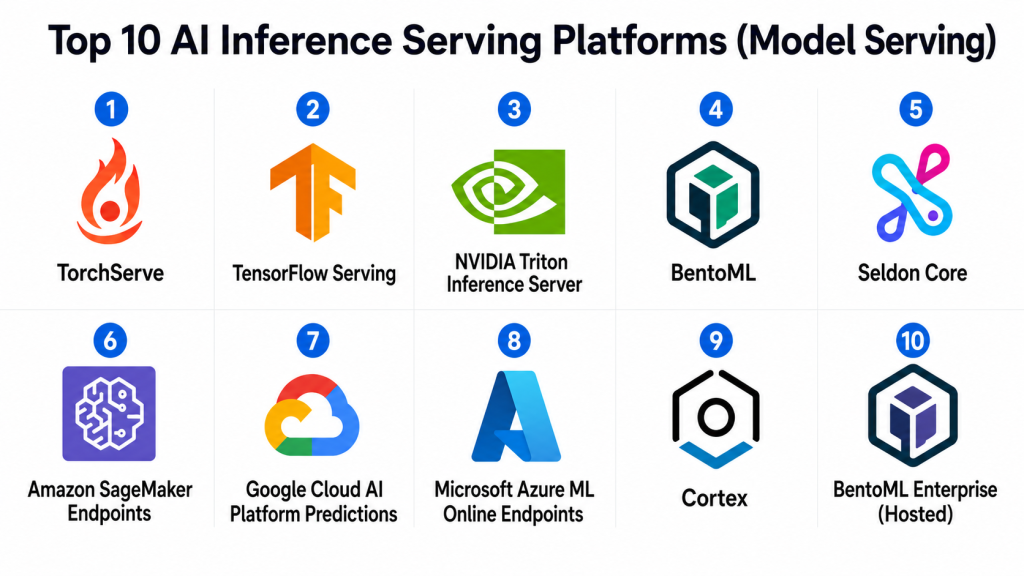
Top 10 AI Inference Serving Platforms (Model Serving)
1 — TorchServe
Short description: TorchServe is a PyTorch-native serving framework enabling scalable deployment of PyTorch models with REST and gRPC endpoints, metrics, and multi-model support.
Key Features
- Multi-model serving and versioning
- REST/gRPC APIs
- GPU acceleration
- Metrics via Prometheus
- Hot model reloading
- Logging and observability support
Pros
- Tight integration with PyTorch
- Open-source and widely used
Cons
- Limited multi-framework support
- Observability depends on external tools
Platforms / Deployment
- Linux, Docker / Cloud / On-Prem
Security & Compliance
- Not publicly stated
Integrations & Ecosystem
- AWS ECS/EKS, CI/CD pipelines, Prometheus & Grafana
Support & Community
- Open-source community support and documentation
2 — TensorFlow Serving
Short description: TensorFlow Serving is a high-performance serving system for TensorFlow models with dynamic model loading, versioning, and batching capabilities.
Key Features
- Model versioning and hot reload
- REST and gRPC interfaces
- Dynamic batching for latency optimization
- High-performance C++ core
- Metrics for monitoring
Pros
- Stable and widely used in production
- Excellent model version control
Cons
- Primarily supports TensorFlow
- Less flexible for non-TF frameworks
Platforms / Deployment
- Linux, Docker / Cloud / On-Prem
Security & Compliance
- Not publicly stated
Integrations & Ecosystem
- TensorFlow Extended (TFX), Kubernetes, Prometheus
Support & Community
- Active community, official tutorials, and docs
3 — NVIDIA Triton Inference Server
Short description: Triton is a multi-framework, high-performance model serving platform supporting TensorFlow, PyTorch, ONNX, and more with GPU optimization and dynamic batching.
Key Features
- Multi-framework support
- Concurrent model execution
- Dynamic batching
- GPU/DLA acceleration
- Metrics and logging
- HTTP/gRPC APIs
Pros
- Exceptional GPU performance
- Supports multiple AI frameworks
Cons
- Requires understanding of GPU optimization
- Setup complexity for small teams
Platforms / Deployment
- Linux, Docker / Cloud / On-Prem / Edge
Security & Compliance
- Not publicly stated
Integrations & Ecosystem
- Kubernetes, Prometheus, Grafana, NVIDIA hardware
Support & Community
- Official NVIDIA tutorials and community support
4 — BentoML
Short description: BentoML is an open-source framework for packaging, deploying, and serving ML models across frameworks with standardized APIs.
Key Features
- Pack models as REST/gRPC services
- Multi-framework support
- Model repository and versioning
- CI/CD integration
- Containerization support
Pros
- Framework-agnostic
- Developer-friendly APIs
Cons
- Advanced autoscaling requires orchestration
- Not fully managed in cloud
Platforms / Deployment
- Linux, Docker / Cloud / On-Prem
Security & Compliance
- Not publicly stated
Integrations & Ecosystem
- Kubernetes, CI/CD, Prometheus, Grafana
Support & Community
- Documentation and active open-source community
5 — Seldon Core
Short description: Seldon Core is Kubernetes-native serving software enabling production-scale AI with multi-tenant support, A/B testing, and monitoring.
Key Features
- Kubernetes CRD-based deployment
- Canary and A/B model rollouts
- Metrics and tracing integration
- Multi-framework containerized models
- Autoscaling with KEDA
Pros
- Enterprise-grade deployment patterns
- Strong deployment controls
Cons
- Kubernetes expertise required
- Setup complexity
Platforms / Deployment
- Kubernetes / Cloud / On-Prem
Security & Compliance
- Not publicly stated
Integrations & Ecosystem
- Prometheus, Grafana, Istio, Linkerd
Support & Community
- Open-source community with tutorials
6 — Amazon SageMaker Endpoints
Short description: Managed inference service within AWS SageMaker providing auto-scaling, monitoring, and multi-framework support for production AI.
Key Features
- Real-time and batch endpoints
- Autoscaling and high availability
- CloudWatch monitoring
- Multi-framework container support
- CI/CD integration
Pros
- Fully managed and scalable
- Strong AWS ecosystem integration
Cons
- AWS vendor lock-in
- Cost depends on scale
Platforms / Deployment
- AWS Cloud
Security & Compliance
- IAM, encryption, audit logs
Integrations & Ecosystem
- AWS Lambda, API Gateway, SageMaker pipelines
Support & Community
- AWS support tiers and docs
7 — Google Cloud AI Platform Predictions
Short description: Managed AI inference service supporting online and batch predictions integrated with Vertex AI and Google Cloud ecosystem.
Key Features
- Online/batch inference
- Autoscaling
- Feature store integration
- Monitoring and logging
- Multi-framework support
Pros
- Tight Google Cloud integration
- Easy deployment from Vertex AI
Cons
- Cloud-only solution
- Pricing depends on usage
Platforms / Deployment
- Google Cloud
Security & Compliance
- IAM, audit logs
Integrations & Ecosystem
- Vertex AI, BigQuery, CI/CD pipelines
Support & Community
- Google Cloud documentation and support tiers
8 — Microsoft Azure ML Online Endpoints
Short description: Azure ML Online Endpoints enable real-time AI inference with autoscaling, monitoring, and enterprise-grade security.
Key Features
- Real-time endpoints
- Autoscaling
- Model versioning
- Logging and monitoring
- Multi-framework support
Pros
- Enterprise-ready with Azure integration
- Secure RBAC support
Cons
- Azure-specific ecosystem
- Cost complexity
Platforms / Deployment
- Azure Cloud
Security & Compliance
- RBAC, enterprise compliance
Integrations & Ecosystem
- Azure Monitor, pipelines, feature store
Support & Community
- Documentation and enterprise support tiers
9 — Cortex
Short description: Cortex is a cloud-agnostic serving platform for scalable, multi-tenant AI inference with monitoring and autoscaling capabilities.
Key Features
- Autoscaling
- Multi-tenant deployments
- Real-time APIs
- Monitoring and logging
- Framework-agnostic support
Pros
- Cloud-agnostic
- Multi-tenant support
Cons
- Advanced setup required
- Smaller community
Platforms / Deployment
- Cloud / On-Prem
Security & Compliance
- Not publicly stated
Integrations & Ecosystem
- CI/CD pipelines, observability tools, containerized models
Support & Community
- Documentation and community support
10 — BentoML Enterprise (Hosted)
Short description: Managed BentoML service offering enterprise support, governance, monitoring, and model registry features.
Key Features
- Managed model serving
- Governance and RBAC
- Observability dashboards
- API lifecycle management
- Integration with CI/CD
Pros
- Enterprise SLAs and support
- Governance and monitoring features
Cons
- Hosted subscription cost
- Integration required
Platforms / Deployment
- Cloud Hosted
Security & Compliance
- RBAC and logging
Integrations & Ecosystem
- CI/CD pipelines, observability tools, model registry
Support & Community
- Enterprise support and documentation
Comparison Table (Top 10)
| Tool Name | Best For | Platform(s) Supported | Deployment | Standout Feature | Public Rating |
|---|---|---|---|---|---|
| TorchServe | PyTorch model serving | Linux, Docker | Cloud / On-Prem | Multi-model REST/gRPC endpoints | N/A |
| TensorFlow Serving | TensorFlow production | Linux, Docker | Cloud / On-Prem | Dynamic model versioning & batching | N/A |
| NVIDIA Triton Inference Server | GPU-accelerated inference | Linux, Docker | Cloud / On-Prem / Edge | Multi-framework concurrent execution | N/A |
| BentoML | Framework-agnostic deployment | Linux, Docker | Cloud / On-Prem | Pack models as REST/gRPC services | N/A |
| Seldon Core | Kubernetes-native serving | Kubernetes | Cloud / On-Prem | Canary/A-B deployments & monitoring | N/A |
| Amazon SageMaker Endpoints | Managed production AI | AWS Cloud | Cloud | Auto-scaling, multi-framework | N/A |
| Google Cloud AI Predictions | Vertex AI integration | Google Cloud | Cloud | Online/batch inference with autoscale | N/A |
| Azure ML Online Endpoints | Enterprise ML serving | Azure Cloud | Cloud | Real-time endpoints & versioning | N/A |
| Cortex | Cloud-agnostic AI | Cloud / On-Prem | Cloud / On-Prem | Multi-tenant and autoscaling | N/A |
| BentoML Enterprise | Enterprise hosted ML | Cloud Hosted | Cloud | Governance, monitoring, API lifecycle | N/A |
Evaluation & Scoring
| Tool Name | Core (25%) | Ease (15%) | Integrations (15%) | Security (10%) | Performance (10%) | Support (10%) | Value (15%) | Weighted Total |
|---|---|---|---|---|---|---|---|---|
| TorchServe | 9 | 8 | 8 | 7 | 8 | 8 | 8 | 8.1 |
| TensorFlow Serving | 9 | 7 | 8 | 7 | 8 | 7 | 8 | 7.9 |
| NVIDIA Triton | 9 | 7 | 9 | 8 | 9 | 8 | 8 | 8.4 |
| BentoML | 8 | 8 | 8 | 7 | 8 | 8 | 8 | 8.0 |
| Seldon Core | 8 | 7 | 8 | 7 | 8 | 7 | 8 | 7.8 |
| SageMaker Endpoints | 9 | 8 | 8 | 8 | 8 | 8 | 8 | 8.2 |
| Google AI Predictions | 8 | 8 | 8 | 7 | 8 | 7 | 8 | 7.9 |
| Azure ML Online | 8 | 8 | 8 | 8 | 8 | 7 | 8 | 8.0 |
| Cortex | 8 | 7 | 7 | 7 | 8 | 7 | 7 | 7.5 |
| BentoML Enterprise | 8 | 8 | 8 | 8 | 8 | 8 | 8 | 8.0 |
Interpretation: Weighted scores reflect comparative performance across core serving features, ease of use, framework integrations, security, reliability, support, and value. Scores are relative — higher scores indicate platforms that balance performance, flexibility, and developer productivity.
Which AI Inference Serving Platform Is Right for You?
Solo / Freelancer
- Best choices: BentoML, TorchServe
- Lightweight deployment, local testing, flexible framework support
SMB
- Best choices: BentoML Enterprise, Seldon Core
- Reliable multi-model serving with basic monitoring
Mid-Market
- Best choices: NVIDIA Triton, SageMaker Endpoints
- Multi-framework, GPU acceleration, cloud integration
Enterprise
- Best choices: Seldon Core, Azure ML Online, Google Cloud AI Predictions
- Multi-tenant, autoscaling, governance, monitoring, and compliance support
Budget vs Premium
- Open-source tools like TorchServe, BentoML, and Seldon Core offer flexible entry points.
- Managed solutions (SageMaker, Azure ML, Google AI) provide higher reliability and enterprise support at a premium cost.
Feature Depth vs Ease of Use
- Triton, Seldon Core, and SageMaker excel in advanced performance features.
- BentoML and TorchServe focus on simplicity and developer productivity.
Integrations & Scalability
- Managed cloud platforms integrate seamlessly with CI/CD, observability, and enterprise workflows.
- Open-source frameworks excel in flexibility but require orchestration expertise.
Security & Compliance Needs
- Enterprises should select platforms with RBAC, encryption, and audit logging (Seldon Core, Azure ML, SageMaker) for regulated industries.
Frequently Asked Questions (FAQs)
1 — What deployment options are available?
Most platforms support cloud, on-premises, or hybrid. Kubernetes-based tools like Seldon Core are ideal for scalable production deployments.
2 — Can I serve multiple models simultaneously?
Yes — platforms like TorchServe, Triton, and BentoML support multi-model endpoints with versioning.
3 — Do these platforms support GPUs and TPUs?
Yes — NVIDIA Triton and cloud services like SageMaker, Azure ML, and Google AI Predictions provide GPU/TPU acceleration.
4 — How do I monitor model performance?
Metrics and logging are provided via Prometheus, Grafana, CloudWatch, or built-in dashboards depending on the platform.
5 — Is real-time inference supported?
Yes — all top 10 platforms provide REST/gRPC APIs for low-latency real-time inference.
6 — Can I deploy models from multiple frameworks?
Yes — Triton, BentoML, Cortex, and managed cloud solutions support multiple frameworks like TensorFlow, PyTorch, and ONNX.
7 — Are there options for edge deployment?
Yes — Triton and Cortex support edge inference for low-latency applications and IoT devices.
8 — How is security handled?
RBAC, encryption, and audit logging are included in enterprise-grade platforms. Open-source frameworks rely on infrastructure security.
9 — Do these platforms integrate with CI/CD pipelines?
Yes — BentoML, Seldon Core, SageMaker, and cloud providers offer CI/CD integration for automated model deployment.
10 — Which platform is best for beginners?
BentoML and TorchServe are developer-friendly for initial experimentation. Managed cloud platforms provide simplified setup for production.
Conclusion
AI Inference Serving Platforms in provide scalable, reliable, and flexible deployment for production models. TorchServe and BentoML are ideal for developers seeking flexibility, NVIDIA Triton and SageMaker Endpoints excel for high-performance GPU workloads, while Seldon Core and Azure ML Online Endpoints cater to enterprise multi-tenant and governance requirements. Choosing the right platform depends on team expertise, deployment environment, performance requirements, and security/compliance needs. Buyers should shortlist 2–3 platforms, test model deployment and monitoring workflows, and validate scaling and integration capabilities to ensure production readiness
