Introduction
AI Evaluation & Benchmarking Frameworks are specialized software platforms that allow organizations, researchers, and developers to systematically measure the performance, accuracy, fairness, robustness, and efficiency of artificial intelligence models. These frameworks provide standardized datasets, metrics, and reporting tools to ensure AI systems meet desired objectives, remain compliant with regulations, and can be trusted in production environments.
In, with AI becoming central to enterprise operations, healthcare, finance, and marketing, organizations are under increasing pressure to benchmark and evaluate their models rigorously. Proper evaluation ensures models perform consistently, avoids unintended biases, and aligns with regulatory standards such as GDPR or AI governance policies.
Real-world use cases include:
- Enterprise AI governance: Ensuring all deployed models meet company-wide accuracy, fairness, and performance benchmarks.
- Research validation: Academic and industrial AI researchers comparing new models against standardized datasets.
- MLOps integration: Continuous evaluation of models in production pipelines to detect drift or degradation.
- Vendor comparisons: Selecting third-party AI solutions based on rigorous benchmarking data.
- Regulatory compliance: Demonstrating fairness, robustness, and explainability to regulatory bodies.
What buyers should evaluate:
- Coverage of evaluation metrics (accuracy, fairness, robustness, efficiency)
- Supported AI model types (ML, NLP, vision, multimodal)
- Integration with ML pipelines and CI/CD
- Dataset availability and standardization
- Reporting and visualization capabilities
- Security and compliance features
- Ease of use and learning curve
- Support for cloud, on-prem, and hybrid environments
- Extensibility and API availability
- Community and documentation strength
Best for: AI researchers, MLOps engineers, data scientists, enterprise AI teams, regulatory compliance officers. Particularly valuable for mid-market and enterprise organizations with multiple AI deployments.
Not ideal for: Small startups or individual developers experimenting with one-off models without production-scale evaluation needs. Simpler benchmarking scripts may suffice for lightweight use cases.
Key Trends in AI Evaluation & Benchmarking Frameworks
- Automated benchmarking pipelines that integrate directly into MLOps workflows.
- AI fairness and bias metrics built-in by default for all major model types.
- Explainability dashboards providing model interpretability alongside performance scores.
- Cloud-native frameworks supporting scalable, distributed benchmarking.
- Open-source collaboration driving community-curated datasets and metrics.
- Multimodal model evaluation across text, vision, and speech.
- Regulatory alignment with emerging AI governance standards.
- Performance monitoring in production with drift detection and retraining triggers.
- Integration with CI/CD tools for automated evaluation on each model release.
- Cost-optimized evaluation using synthetic datasets and benchmarking-as-a-service models.
How We Selected These Tools (Methodology)
- Market adoption and mindshare in AI research and enterprise contexts.
- Completeness of evaluation features across model types and metrics.
- Reliability and performance of benchmarking computations.
- Security posture including access control, audit logging, and compliance readiness.
- Integration capabilities with ML frameworks, MLOps pipelines, and CI/CD.
- Ecosystem support including open-source community contributions.
- Vendor responsiveness, support tiers, and documentation quality.
- Customer fit across segments: enterprise, SMB, and developer-focused deployments.
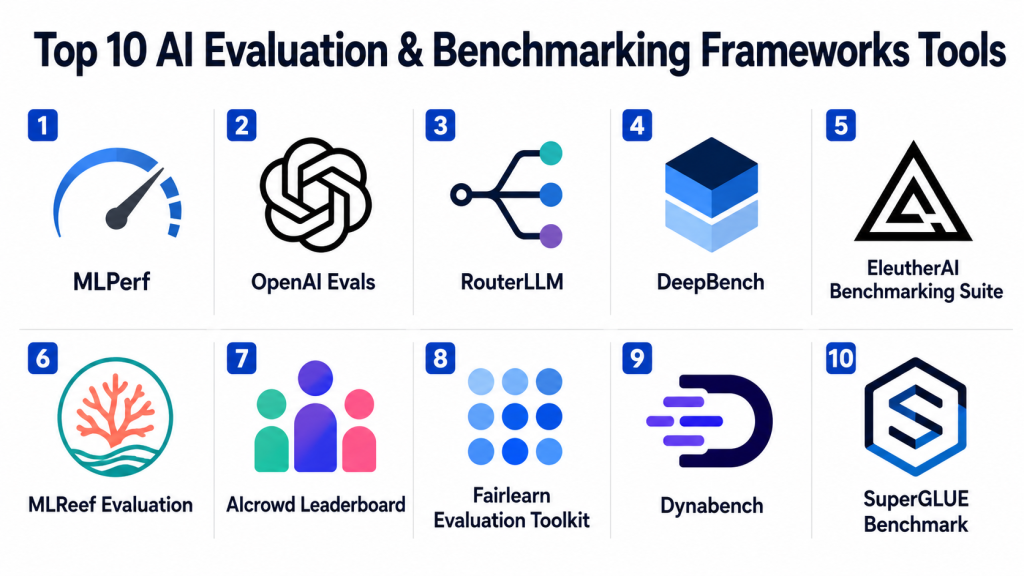
Top 10 AI Evaluation & Benchmarking Frameworks Tools
1- MLPerf
Short description: MLPerf is a leading open-source benchmarking framework that measures AI performance across multiple domains including vision, language, and reinforcement learning. It is widely adopted by researchers, hardware vendors, and enterprises seeking standardized performance comparisons.
Key Features
- Standardized benchmark suites for multiple AI workloads
- Hardware and software performance profiling
- Open-source and community-supported
- Leaderboards showcasing global results
- Metrics for accuracy, throughput, and latency
- Cross-platform support (CPU, GPU, TPU)
Pros
- Widely recognized industry benchmark
- Transparent and reproducible evaluation
- Strong community and ongoing updates
Cons
- Limited customization for niche models
- Heavy initial setup for large-scale benchmarking
Platforms / Deployment
- Linux / Cloud / On-prem
Security & Compliance
- Not publicly stated
Integrations & Ecosystem
MLPerf integrates with popular ML frameworks such as TensorFlow, PyTorch, and JAX.
- TensorFlow
- PyTorch
- JAX
- Kubernetes for distributed testing
- NVIDIA and AMD GPUs
Support & Community
- Strong open-source community, documentation, and forums
2- OpenAI Evals
Short description: OpenAI Evals provides a framework for automated evaluation of language models. It enables developers to assess model outputs against custom benchmarks, focusing on correctness, alignment, and safety.
Key Features
- Customizable evaluation tasks and datasets
- Automated scoring and feedback loops
- Focus on alignment, fairness, and bias
- Supports human-in-the-loop evaluations
- JSON-based output for integration
Pros
- Flexible and customizable for LLMs
- Strong support for alignment and safety testing
Cons
- Primarily focused on NLP models
- Limited prebuilt datasets outside language tasks
Platforms / Deployment
- Web / Cloud
Security & Compliance
- Not publicly stated
Integrations & Ecosystem
Supports integration with Python pipelines and MLOps tools.
- Python SDK
- Hugging Face Transformers
- CI/CD workflows
- Slack/Teams notifications
Support & Community
- Strong documentation, examples, and active GitHub community
3- H2O AI Benchmark
Short description: H2O AI Benchmark evaluates machine learning models across speed, accuracy, and resource efficiency. It targets tabular, NLP, and image models in enterprise and research environments.
Key Features
- AutoML compatibility
- Multi-language support (Python, R, Java)
- Performance and memory profiling
- Predefined and custom datasets
- Detailed reporting and visualizations
Pros
- Supports broad ML model types
- Strong AutoML integration
Cons
- On-prem deployment can require significant hardware
- Learning curve for complex custom metrics
Platforms / Deployment
- Linux / Windows / Cloud / Hybrid
Security & Compliance
- Not publicly stated
Integrations & Ecosystem
- Python/R API
- H2O AutoML
- Apache Spark
- Kubernetes for scaling
Support & Community
- Professional support tiers and active community forums
4- DeepBench
Short description: DeepBench benchmarks deep learning operations like matrix multiplication, convolution, and communication patterns across hardware and frameworks. It is aimed at AI researchers and infrastructure engineers.
Key Features
- Low-level operation benchmarks
- Multi-GPU and multi-node evaluation
- Hardware abstraction support
- Open-source framework
- Supports profiling of ML frameworks (TensorFlow, PyTorch)
Pros
- Provides detailed hardware-level insights
- Supports research on optimization strategies
Cons
- Not focused on end-to-end model evaluation
- Requires technical expertise
Platforms / Deployment
- Linux / Cloud / On-prem
Security & Compliance
- Not publicly stated
Integrations & Ecosystem
- TensorFlow
- PyTorch
- NVIDIA CUDA libraries
- ROCm support
Support & Community
- Open-source community, documentation varies
5- EleutherAI Benchmarking Suite
Short description: Designed for LLM benchmarking, EleutherAI provides evaluation scripts and datasets for large language models. Focuses on performance, reasoning, and multi-turn dialogue assessment.
Key Features
- Open-source benchmark scripts
- NLP-focused metrics
- Supports multi-turn dialogue evaluation
- Human-evaluation modules
- Model output scoring
Pros
- Free and community-driven
- Extensive language benchmarks
Cons
- NLP-only; no vision or tabular support
- Requires manual dataset handling
Platforms / Deployment
- Linux / Cloud / Self-hosted
Security & Compliance
- Not publicly stated
Integrations & Ecosystem
- Python-based
- Hugging Face datasets
- Jupyter notebooks
Support & Community
- Active GitHub discussions, community support
6- MLReef Evaluation
Short description: MLReef offers benchmarking tools for diverse AI models, emphasizing reproducibility and MLOps integration. Ideal for teams deploying multiple AI pipelines.
Key Features
- Pipeline integration
- Version-controlled datasets
- Metric dashboards
- Automated reporting
- Reproducibility tracking
Pros
- Supports team-based MLOps evaluation
- Facilitates reproducibility
Cons
- Limited adoption compared to MLPerf
- Learning curve for complex pipelines
Platforms / Deployment
- Cloud / Hybrid
Security & Compliance
- Not publicly stated
Integrations & Ecosystem
- Git-based versioning
- Python SDK
- REST API
- CI/CD integrations
Support & Community
- Documentation available, moderate community
7- AIcrowd Leaderboard
Short description: AIcrowd provides AI benchmarking via competitions, leaderboards, and evaluation scripts. Useful for comparing models in standardized challenge settings.
Key Features
- Public leaderboards
- Standardized evaluation metrics
- Competition datasets
- Support for multiple model types
- Automatic scoring and submission
Pros
- Transparent benchmarking
- Encourages community participation
Cons
- Competition-focused; less suited for internal evaluations
- Limited control over datasets
Platforms / Deployment
- Web / Cloud
Security & Compliance
- Not publicly stated
Integrations & Ecosystem
- GitHub submissions
- API for automated evaluation
- Python SDK
Support & Community
- Active competition community, extensive documentation
8- Fairlearn Evaluation Toolkit
Short description: Fairlearn focuses on fairness evaluation of AI models. Provides metrics, dashboards, and mitigation suggestions to detect and reduce bias.
Key Features
- Fairness metrics
- Bias mitigation suggestions
- Dashboard visualizations
- Python integration
- Supports multiple model types
Pros
- Essential for regulatory compliance
- Flexible metrics
Cons
- Not focused on performance benchmarking
- Requires ML knowledge
Platforms / Deployment
- Linux / Cloud / Self-hosted
Security & Compliance
- Not publicly stated
Integrations & Ecosystem
- Python API
- Scikit-learn integration
- Pandas and NumPy support
Support & Community
- Open-source community, active GitHub
9- Dynabench
Short description: Dynabench provides dynamic benchmarking for NLP models with human-in-the-loop data generation and evaluation. Focuses on model robustness and generalization.
Key Features
- Human-in-the-loop benchmarks
- Adaptive evaluation
- Real-time leaderboard updates
- NLP task variety
- Data collection and analysis tools
Pros
- High-quality human-evaluated benchmarks
- Adaptive and evolving datasets
Cons
- NLP-only
- Requires human evaluators for full benefit
Platforms / Deployment
- Web / Cloud
Security & Compliance
- Not publicly stated
Integrations & Ecosystem
- Python SDK
- API for submissions
- Hugging Face datasets
Support & Community
- Active research community
10- SuperGLUE Benchmark
Short description: SuperGLUE is a widely recognized benchmark for evaluating natural language understanding tasks across multiple dimensions including reasoning, reading comprehension, and inference.
Key Features
- Multi-task evaluation
- Standardized datasets
- Automatic scoring
- Leaderboards for comparison
- Focus on high-level language reasoning
Pros
- Recognized standard for NLP
- Facilitates cross-model comparison
Cons
- Restricted to NLP
- Requires model adaptation for full evaluation
Platforms / Deployment
- Linux / Cloud
Security & Compliance
- Not publicly stated
Integrations & Ecosystem
- Python frameworks
- Hugging Face
- Benchmarking scripts
Support & Community
- Active research and open-source support
Comparison Table (Top 10)
| Tool Name | Best For | Platform(s) Supported | Deployment | Standout Feature | Public Rating |
|---|---|---|---|---|---|
| MLPerf | Enterprise AI / Researchers | Linux | Cloud / On-prem | Multi-domain benchmarking | N/A |
| OpenAI Evals | NLP-focused AI teams | Web | Cloud | Alignment & safety evaluation | N/A |
| H2O AI Benchmark | Enterprise / AutoML | Linux, Windows | Cloud / Hybrid | AutoML support | N/A |
| DeepBench | AI infrastructure teams | Linux | Cloud / On-prem | Hardware-level benchmarks | N/A |
| EleutherAI Benchmarking Suite | LLM researchers | Linux | Cloud / Self-hosted | Open-source NLP evaluation | N/A |
| MLReef Evaluation | MLOps teams | Cloud | Hybrid | Reproducibility tracking | N/A |
| AIcrowd Leaderboard | Research competitions | Web | Cloud | Leaderboard & competition benchmarks | N/A |
| Fairlearn Evaluation Toolkit | AI fairness teams | Linux | Cloud / Self-hosted | Bias detection & mitigation | N/A |
| Dynabench | NLP robustness testing | Web | Cloud | Human-in-the-loop evaluation | N/A |
| SuperGLUE Benchmark | NLP model researchers | Linux | Cloud | Multi-task NLU evaluation | N/A |
Evaluation & Scoring of AI Evaluation & Benchmarking Frameworks
| Tool Name | Core (25%) | Ease (15%) | Integrations (15%) | Security (10%) | Performance (10%) | Support (10%) | Value (15%) | Weighted Total (0–10) |
|---|---|---|---|---|---|---|---|---|
| MLPerf | 9 | 7 | 8 | 7 | 9 | 8 | 8 | 8.2 |
| OpenAI Evals | 8 | 8 | 7 | 7 | 8 | 8 | 8 | 7.8 |
| H2O AI Benchmark | 8 | 7 | 7 | 7 | 8 | 7 | 7 | 7.5 |
| DeepBench | 7 | 6 | 6 | 6 | 8 | 6 | 7 | 6.7 |
| EleutherAI Benchmark | 7 | 6 | 6 | 6 | 7 | 6 | 7 | 6.6 |
| MLReef Evaluation | 7 | 7 | 7 | 6 | 7 | 6 | 7 | 6.9 |
| AIcrowd Leaderboard | 6 | 7 | 6 | 6 | 7 | 6 | 6 | 6.5 |
| Fairlearn Evaluation | 6 | 7 | 6 | 8 | 6 | 6 | 7 | 6.7 |
| Dynabench | 7 | 7 | 6 | 6 | 7 | 6 | 7 | 6.8 |
| SuperGLUE Benchmark | 7 | 7 | 6 | 6 | 7 | 6 | 7 | 6.8 |
Interpretation: Weighted totals provide a comparative view. Scores closer to 10 indicate stronger overall suitability based on core features, ease of use, integrations, security, performance, support, and value. Use this to shortlist candidates for specific organizational needs.
Which AI Evaluation & Benchmarking Framework Tool Is Right for You?
Solo / Freelancer
- Focus on open-source options like MLPerf or EleutherAI Benchmark.
- Lightweight setup with minimal hardware needs.
SMB
- Use MLReef or OpenAI Evals for scalable but manageable evaluation.
- Cloud deployment preferred.
Mid-Market
- MLPerf or H2O AI Benchmark for multi-model evaluation and reporting.
- Hybrid deployment for integration with existing pipelines.
Enterprise
- Comprehensive solutions including MLPerf, H2O, and DeepBench.
- Full CI/CD integration, reproducibility tracking, and compliance alignment.
Budget vs Premium
- Open-source frameworks (MLPerf, EleutherAI) are cost-effective.
- Premium solutions (H2O, DeepBench) offer dedicated support and advanced analytics.
Feature Depth vs Ease of Use
- MLPerf and H2O for feature-rich benchmarking.
- OpenAI Evals and Fairlearn for ease-of-use and specialized evaluation.
Integrations & Scalability
- Select frameworks with strong Python APIs and CI/CD support.
- Cloud-native frameworks scale more easily than on-prem solutions.
Security & Compliance Needs
- For regulated environments, prioritize frameworks with audit logging, SSO, and enterprise support.
- Open-source options may require additional configuration for compliance.
Frequently Asked Questions (FAQs)
1. How much does an AI evaluation framework cost?
Costs vary; open-source options like MLPerf are free. Enterprise solutions may have subscription or licensing fees. Always check deployment and support pricing.
2. How long does it take to set up benchmarking?
Simple setups take a few hours. Complex enterprise deployments with multiple datasets can take several days.
3. Are these frameworks suitable for all AI models?
Most frameworks support popular model types, but some specialize in NLP, vision, or tabular models. Select based on your model domain.
4. Can these frameworks detect model bias?
Yes, tools like Fairlearn or OpenAI Evals include fairness metrics. Others may require custom scripts.
5. How do these tools integrate with MLOps pipelines?
They typically offer Python SDKs, REST APIs, or CI/CD integration, allowing automated evaluation on model updates.
6. Are cloud and on-prem deployments both supported?
Many frameworks offer flexible deployment, but confirm hardware requirements for on-prem setups.
7. Can benchmarking be automated?
Yes, most modern frameworks support automated evaluation pipelines for continuous monitoring and regression detection.
8. How do I compare results across models?
Frameworks provide standardized metrics, leaderboards, or dashboards to enable cross-model comparisons.
9. Is support available for open-source frameworks?
Support varies; open-source relies on community forums. Enterprise versions offer dedicated support tiers.
10. Can I customize evaluation metrics?
Yes, frameworks like OpenAI Evals and MLReef allow custom metrics and datasets for specialized evaluation needs.
Conclusion
AI Evaluation & Benchmarking Frameworks are essential for ensuring AI models are accurate, fair, robust, and aligned with business objectives. Selection should consider model type, organizational scale, deployment preference, and regulatory requirements. For small teams, open-source options suffice; mid-market and enterprise organizations benefit from more comprehensive frameworks with automation, integration, and compliance features. Next steps include shortlisting 2–3 frameworks, running pilot evaluations, and validating integration with production pipelines and security protocols to ensure sustained model reliability.
