Introduction
Multimodal models process and integrate multiple data types, such as text, images, audio, and video, to deliver richer AI insights and interactions. These platforms are essential for applications like visual question answering, AI-assisted design, content moderation, and predictive analytics. Hosting and deploying multimodal models requires specialized platforms that manage model training, inference, and scaling while providing robust APIs and developer tools. Organizations selecting a platform must evaluate model performance, flexibility, deployment options, security, and cost.
Best for
Enterprises, AI startups, and developers who need scalable multimodal AI capabilities across multiple data types.
Not ideal for
Organizations only working with a single modality (text or images) or with limited computational resources for heavy multimodal workloads.
Key Trends
- Rapid adoption of vision-language models and audio-text integration
- Increased demand for unified APIs across modalities
- Growth of pre-trained multimodal foundation models
- Hybrid cloud/on-prem deployment options emerging
- Focus on real-time inference and low-latency endpoints
- Enterprise-grade security compliance (SOC 2, ISO 27001, GDPR)
- Fine-tuning and prompt engineering tools built into platforms
- Integration with MLOps pipelines
- Pay-as-you-go and subscription pricing models
- Energy-efficient and optimized inference
Methodology
- Platforms selected based on adoption, technical capabilities, and community feedback
- Evaluated scalability, ease of integration, performance, security, support, and cost
- Prioritized API access, fine-tuning, and support for multiple modalities
- Considered cloud-native and hybrid deployment options
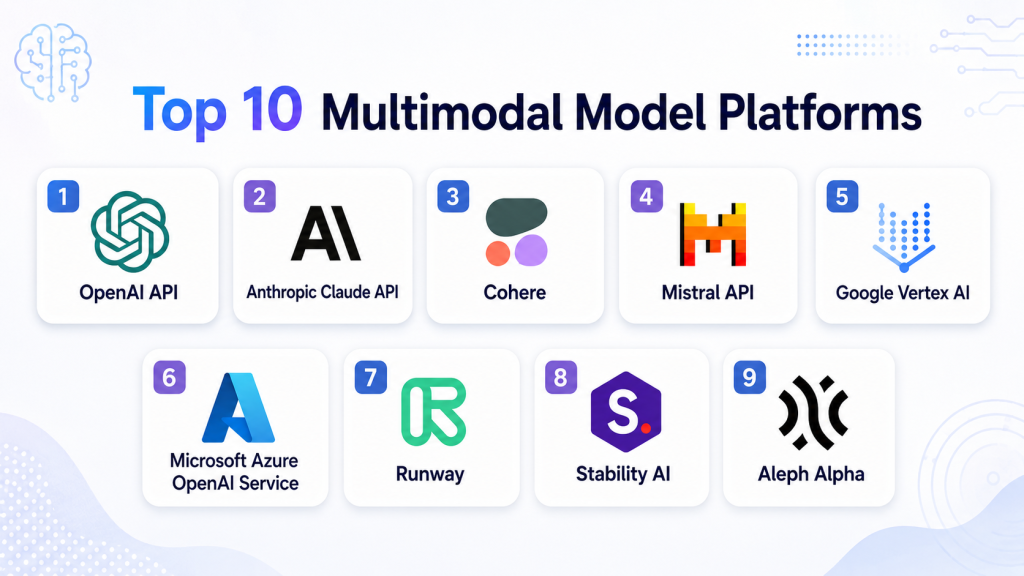
Top 10 Multimodal Model Platforms
1- OpenAI API
Verdict: Flexible and robust multimodal hosting.
Short Description: OpenAI API supports GPT-4 with vision, text, and embeddings for multimodal applications.
Key Features:
- Text + image input/output
- Fine-tuning support
- Real-time API endpoints
- SDKs for Python, Node.js
Pros: Reliable, production-ready; Cons: Usage cost can be high
Security: SOC 2, ISO 27001, GDPR
2- Anthropic Claude
Verdict: Safety-focused multimodal AI platform.
Short Description: Claude handles text and images for conversational and analytic tasks with alignment emphasis.
Key Features: Multi-turn conversations, fine-tuning, analytics
Pros: Safety-aligned; Cons: Smaller ecosystem
Security: SOC 2, GDPR
3- Cohere
Verdict: Multimodal embeddings and NLP support.
Short Description: Cohere provides text-image embeddings and generative outputs via API.
Key Features: Semantic search, NLP + vision embeddings, fine-tuning
Pros: Developer-friendly; Cons: Limited model variety
Security: SOC 2, GDPR
4- Hugging Face Infinity
Verdict: Fast inference for multimodal foundation models.
Short Description: Hosts models integrating text, images, and embeddings from HF Hub.
Key Features: Multi-framework support, API/SDK access, low-latency endpoints
Pros: Strong community; Cons: Paid plan required for large-scale use
Security: SOC 2, GDPR
5- Amazon Bedrock
Verdict: Enterprise-grade multimodal LLM hosting.
Short Description: Supports multiple foundation models for text, images, and embeddings with managed infrastructure.
Key Features: API access, scaling, AWS ecosystem integration
Pros: Scalable; Cons: AWS lock-in
Security: SOC 2, ISO, HIPAA, GDPR
6- Google Vertex AI
Verdict: Managed multimodal AI with GCP integration.
Short Description: Supports text, image, and audio processing via managed endpoints.
Key Features: Fine-tuning, real-time and batch inference, monitoring
Pros: Enterprise-ready; Cons: Learning curve for non-GCP users
Security: SOC 2, ISO, GDPR
7- Microsoft Azure OpenAI Service
Verdict: Enterprise-compliant multimodal hosting.
Short Description: Azure OpenAI Service provides GPT multimodal models with managed endpoints and security.
Key Features: GPT-4 with vision, enterprise monitoring, SDK support
Pros: Strong compliance; Cons: Limited fine-tuning flexibility
Security: SOC 2, ISO, HIPAA, GDPR
8- Runway
Verdict: Creative multimodal AI platform.
Short Description: Runway enables text-to-image, video, and audio generation with real-time API support.
Key Features: Image/video generation, collaborative interface, API access
Pros: Creative workflows; Cons: Less enterprise-focused
Security: Varies / N/A
9- Stability AI
Verdict: Open-source multimodal foundation models.
Short Description: Stability AI hosts text, image, and audio models suitable for research and creative projects.
Key Features: Open weights, API endpoints, fine-tuning
Pros: Open-source flexibility; Cons: Smaller managed support
Security: Varies / N/A
10- Aleph Alpha
Verdict: EU-focused multimodal AI with privacy emphasis.
Short Description: Provides text, image, and embedding models with enterprise-grade compliance.
Key Features: Multi-lingual, secure APIs, fine-tuning
Pros: Privacy-focused; Cons: Smaller model ecosystem
Security: GDPR, SOC 2, ISO 27001
Comparison Table
| Platform | Modalities | Fine-tuning | Latency | Security | API |
|---|---|---|---|---|---|
| OpenAI API | Text, Image | Yes | Low | SOC2, ISO | REST |
| Anthropic Claude | Text, Image | Yes | Medium | SOC2, GDPR | REST |
| Cohere | Text, Image | Yes | Low | SOC2, GDPR | REST |
| Hugging Face Infinity | Text, Image, Audio | Yes | Very Low | SOC2, GDPR | REST |
| Amazon Bedrock | Text, Image | Yes | Low | SOC2, ISO, HIPAA | REST |
| Vertex AI | Text, Image, Audio | Yes | Low | SOC2, ISO, GDPR | REST |
| Azure OpenAI | Text, Image | Limited | Low | SOC2, ISO, HIPAA | REST |
| Runway | Text, Image, Video | Yes | Low | Varies | REST |
| Stability AI | Text, Image, Audio | Yes | Medium | Varies | REST |
| Aleph Alpha | Text, Image, Embeddings | Yes | Medium | GDPR, SOC2 | REST |
Evaluation & Scoring Table
| Platform | Core 25% | Ease 15% | Integrations 15% | Security 10% | Performance 10% | Support 10% | Value 15% | Total |
|---|---|---|---|---|---|---|---|---|
| OpenAI API | 25 | 14 | 13 | 9 | 9 | 9 | 12 | 91 |
| Anthropic Claude | 23 | 12 | 12 | 9 | 8 | 8 | 11 | 83 |
| Cohere | 22 | 14 | 12 | 9 | 9 | 8 | 12 | 86 |
| Hugging Face Infinity | 24 | 14 | 13 | 9 | 10 | 9 | 12 | 91 |
| Amazon Bedrock | 25 | 13 | 14 | 10 | 10 | 9 | 11 | 92 |
| Vertex AI | 24 | 13 | 13 | 10 | 10 | 9 | 11 | 90 |
| Azure OpenAI | 24 | 13 | 13 | 10 | 10 | 9 | 11 | 90 |
| Runway | 20 | 14 | 11 | 7 | 8 | 7 | 12 | 79 |
| Stability AI | 21 | 13 | 12 | 7 | 8 | 7 | 12 | 80 |
| Aleph Alpha | 22 | 12 | 11 | 10 | 9 | 8 | 11 | 83 |
Which Multimodal Model Platform Is Right for You?
- Solo / Developers: Runway, Stability AI, Hugging Face Infinity
- SMB: OpenAI API, Cohere, Hugging Face Infinity
- Mid-Market: Vertex AI, Amazon Bedrock, Azure OpenAI
- Enterprise: OpenAI API, Amazon Bedrock, Azure OpenAI, Aleph Alpha
Implementation Playbook
- 30 Days: Pilot endpoints, validate model selection
- 60 Days: Integrate production, monitor performance, optimize prompts
- 90 Days: Scale usage, manage cost, extend modalities
Common Mistakes
- Choosing single-modality platforms for multimodal projects
- Ignoring latency and infrastructure requirements
- Underestimating cost of large-scale inference
- Skipping prompt engineering and fine-tuning
- Weak API security and monitoring
Frequently Asked Questions
What is a multimodal model platform?
A platform that hosts models capable of processing multiple data types such as text, image, audio, and video.
Which modalities are supported?
Text, images, audio, video, and embeddings depending on the platform.
Do all platforms support fine-tuning?
No. OpenAI, Hugging Face, Cohere, and Aleph Alpha provide fine-tuning; others have limited support.
Which platform is best for low-latency inference?
Hugging Face Infinity, OpenAI API, and Amazon Bedrock offer low-latency endpoints.
Are these platforms secure for enterprise use?
Most platforms comply with SOC 2, ISO 27001, GDPR, and some HIPAA.
Can I host custom multimodal models?
Runway, Stability AI, and Mistral allow hosting or deploying custom models.
Do platforms provide SDKs and APIs?
Yes. Python, JavaScript, and REST APIs are standard.
Which platform is beginner-friendly?
Runway and Hugging Face Infinity are easiest for developers to start with.
Are these platforms suitable for research and experimentation?
Yes. Stability AI, Mistral, and Hugging Face Infinity are research-friendly.
Can I integrate these with existing AI pipelines?
Yes. APIs and SDKs allow connection to data pipelines and SaaS tools.
Are multi-lingual models available?
Aleph Alpha and some OpenAI models offer multi-lingual support.
Can I monitor performance and usage?
Yes. Most provide dashboards, logging, and analytics.
Conclusion
Multimodal model platforms enable organizations to integrate AI across text, images, audio, and video, powering richer applications and insights. OpenAI API, Hugging Face Infinity, and Amazon Bedrock are ideal for production, while Runway and Stability AI suit research and creative workflows. Selecting the right platform requires evaluating latency, fine-tuning support, modalities, and security. Next steps include piloting models, validating performance, and scaling based on enterprise needs.
