Introduction
Freelance Management Systems (FMS) are comprehensive software platforms designed to help organizations manage the full lifecycle of contingent work — from sourcing freelancers and onboarding to project tracking, invoicing, compliance, and payments. Unlike simple freelance marketplaces, FMS solutions provide centralized governance and visibility across a distributed workforce, whether that includes independent contractors, consultants, gig workers, or agencies.
In , organizations of all sizes increasingly rely on freelance talent for specialized skills, flexible resourcing, and project‑based work. This shift has made centralized freelance management indispensable, particularly for compliance, budgeting, visibility, and performance measurement. A strong FMS ensures businesses can scale contingent work without operational risk or administrative burden.
Real‑world use cases include:
- Enterprise contingent workforce governance: Tracking spend and engagement across hundreds of freelancers.
- Project resourcing systems: Aligning freelancers to defined work pipelines and deliverables.
- Compliance and risk management: Standardizing contracts, data protection, and tax compliance processes.
- Integrated finance and payments: Automating invoicing, payouts, and expense reconciliation.
- Performance tracking: Monitoring productivity, quality, and contractor engagement.
What buyers should evaluate:
- Talent sourcing vs. curated pools
- Onboarding and compliance workflows
- Project and task management capabilities
- Payment automation and accounting integration
- Reporting and analytics dashboards
- Integration with HR/HRIS and ERP systems
- Contract and document management
- Global contractor management and local compliance
- Security, authentication, and access controls
- Workflow customization and extensibility
Best for: Large enterprises, HR and procurement teams, professional service providers, staffing agencies, and organizations scaling contingent work.
Not ideal for: Companies with very limited freelance engagements or those that rely solely on basic marketplace hiring without enterprise governance requirements.
Key Trends in Freelance Management Systems
- AI‑driven talent matching and recommendation engines
- Embedded compliance workflows for multi‑jurisdiction contractor policies
- Integrated payment automation with global payout support
- Skill profiling and talent benchmarking
- Unified dashboards for spend, retention, and productivity
- Workflow orchestration across HRIS/ERP systems
- Secure identity and credential management
- Mobile access and real‑time notifications
- Self‑service contractor portals for contracts and tax documentation
- Data‑driven performance insights and predictive analytics
How We Selected These Tools (Methodology)
- Enterprise adoption and industry recognition
- Depth and breadth of management features
- Integration capabilities with HR, finance, and ERP systems
- Compliance, security, and governance functionality
- Performance, reliability, and scalability
- Reporting and analytics sophistication
- Support, onboarding, and professional services quality
- Global workforce coverage and payout automation
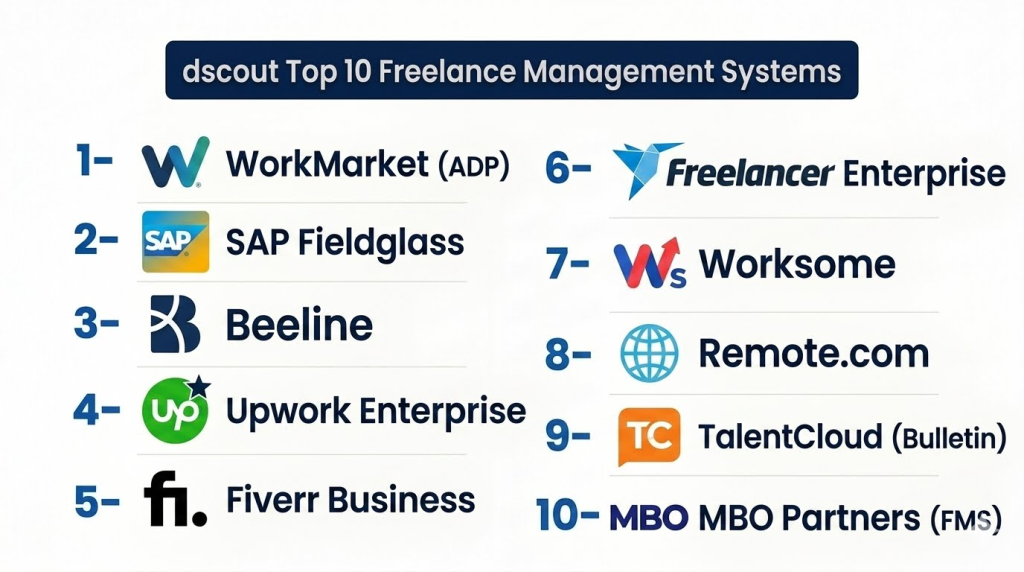
Top 10 Freelance Management Systems
1- WorkMarket (ADP)
Short description: WorkMarket, part of ADP, is a leading enterprise‑grade freelance management system that centralizes talent, compliance, engagement, and payments across a distributed workforce.
Key Features
- Centralized talent and engagement dashboards
- Contract and compliance workflows
- Global payment and payout automation
- Integration with HR/ERP systems
- Document and credential storage
- Reporting and analytics
Pros
- Strong governance and compliance controls
- Scales across global contingent workforces
Cons
- Enterprise price point
- Requires HR/IT integration effort
Platforms / Deployment
- Web / Cloud / Enterprise
Security & Compliance
Not publicly stated
Integrations & Ecosystem
- HRIS and payroll
- ERP systems
- Accounting tools
- Document management platforms
Support & Community
Enterprise support, professional services, and onboarding teams
2- SAP Fieldglass
Short description: SAP Fieldglass is a robust VMS (Vendor Management System) widely used for managing external workforce and services procurement, including freelancers, contractors, and statement‑of‑work engagements.
Key Features
- Workforce lifecycle management
- Rate cards and budgeting
- Supplier and contractor governance
- Integration with SAP ERP and finance systems
- Compliance and risk modules
- Analytics and dashboards
Pros
- Deep enterprise integration
- Comprehensive compliance and governance
Cons
- High complexity and implementation costs
- Best suited for large enterprises
Platforms / Deployment
- Web / Cloud / Enterprise
Security & Compliance
Not publicly stated
Integrations & Ecosystem
- SAP ecosystem
- Finance and procurement systems
- HRIS and payroll
Support & Community
Professional services and enterprise support networks
3- Beeline
Short description: Beeline is an enterprise workforce management platform that supports contingent talent governance, including freelance engagements, MSP workflows, and compliance controls.
Key Features
- Contingent workforce planning
- Vendor and supplier management
- Talent onboarding and tracking
- Workforce analytics
- Compliance and audit trails
Pros
- Proven enterprise track record
- Strong analytics and governance
Cons
- Complexity can be high for smaller programs
- Implementation lead time
Platforms / Deployment
- Web / Cloud
Security & Compliance
Not publicly stated
Integrations & Ecosystem
- HRIS and payroll
- Finance systems
- ATS and vendor feeds
Support & Community
Enterprise onboarding and professional services
4- Upwork Enterprise
Short description: Upwork Enterprise combines the global talent pool of Upwork with enterprise governance tools, compliance services, and consolidated spend visibility across freelance engagements.
Key Features
- Global freelance access
- Consolidated billing and spend analytics
- Compliance and vendor governance
- Centralized contract workflows
- Performance tracking
Pros
- Combines marketplace scale with management controls
- Great for organizations already using freelance talent
Cons
- Platform fees and governance costs
- Best for hybrid marketplace + management use cases
Platforms / Deployment
- Web / Cloud
Security & Compliance
Not publicly stated
Integrations & Ecosystem
- Finance systems
- HRIS connectors
- Analytics dashboards
Support & Community
Enterprise account teams and support
5- Fiverr Business
Short description: Fiverr Business is Fiverr’s enterprise offering, providing vetted freelance talent with business workflows, team management tools, and consolidated spending insights.
Key Features
- Business‑level talent curation
- Team project spaces
- Central billing and invoicing
- Collaboration tools
- Performance tracking and reporting
Pros
- Simple access to freelance talent
- Business‑focused workflows
Cons
- Less enterprise governance than VMS solutions
- Best for mid‑market freelance sourcing
Platforms / Deployment
- Web / Cloud
Security & Compliance
Not publicly stated
Integrations & Ecosystem
- Team collaboration
- Analytics and reporting
Support & Community
Business support tiers and onboarding
6- Freelancer Enterprise
Short description: Freelancer Enterprise provides consolidated management of freelance talent sourced through Freelancer.com with enhanced compliance and enterprise workflows.
Key Features
- Team hiring and project workflows
- Billing and invoice consolidation
- Enhanced search and talent vetting
- Reporting and dashboards
Pros
- Cost‑effective compared to VMS
- Scales across departments
Cons
- Less robust compliance engines
- Marketplace dependency
Platforms / Deployment
- Web / Cloud
Security & Compliance
Not publicly stated
Integrations & Ecosystem
- Billing systems
- Messaging tools
- Analytics exports
Support & Community
Enterprise support and onboarding resources
7- Worksome
Short description: Worksome is a modern freelance workforce platform that emphasizes compliance, onboarding automation, and integrated payments for global freelance management.
Key Features
- Automated onboarding and compliance
- Global payments with tax handling
- Talent pools and managed workflows
- Contract and document storage
Pros
- Strong compliance automation
- Integrated payment flows
Cons
- Feature depth can vary by region
- Emerging enterprise profile
Platforms / Deployment
- Web / Cloud
Security & Compliance
Not publicly stated
Integrations & Ecosystem
- HR and payroll interfaces
- Document management
- Analytics tools
Support & Community
Support center and documentation
8- Remote.com
Short description: Remote.com specializes in managing global freelance and employee engagements including payroll, compliance, benefits, and tax considerations for distributed workforces.
Key Features
- Global contractor compliance
- Payroll and payments automation
- Contract templates and onboarding
- Benefits and taxation workflows
Pros
- Strong global compliance support
- End‑to‑end payment handling
Cons
- Enterprise focus may exceed small needs
- Cost structures reflect depth
Platforms / Deployment
- Web / Cloud
Security & Compliance
Not publicly stated
Integrations & Ecosystem
- Payroll and HR systems
- Finance and tax tools
- Contract management
Support & Community
Dedicated support and compliance advisory
9- TalentCloud (Bulletin)
Short description: TalentCloud provides freelance and contingent workforce management with workflows to discover talent, engage them, and streamline administrative processes.
Key Features
- Talent pools and skill profiling
- Engagement workflows
- Compliance checks
- Centralized spend reporting
Pros
- Strong talent visibility
- Workflow automation
Cons
- Less global ecosystem than some competitors
- Integration options vary
Platforms / Deployment
- Web / Cloud
Security & Compliance
Not publicly stated
Integrations & Ecosystem
- HRIS connectors
- Analytics platforms
- Contract repositories
Support & Community
Professional support and documentation
10- MBO Partners (FMS)
Short description: MBO Partners provides a freelance workforce platform focused on compliance, engagement lifecycle, and contractor management, with a strong presence in enterprise contingent workforce programs.
Key Features
- Compliance and contractor risk mitigation
- Onboarding and contractor services
- Payment and financial management
- Reporting and analytics
- Workforce governance
Pros
- Deep compliance and governance
- Enterprise readiness
Cons
- Best for large programs
- Higher implementation overhead
Platforms / Deployment
- Web / Cloud / Enterprise
Security & Compliance
Not publicly stated
Integrations & Ecosystem
- Finance and HR systems
- Contract repositories
- Analytics stacks
Support & Community
Enterprise client success and professional services
Comparison Table (Top 10)
| Tool Name | Best For | Platform(s) Supported | Deployment | Standout Feature | Public Rating |
|---|---|---|---|---|---|
| WorkMarket | Enterprise governance | Web / Cloud | Enterprise | Compliance & spend visibility | N/A |
| SAP Fieldglass | Large enterprise | Web / Cloud | Enterprise | Enterprise workflows | N/A |
| Beeline | Contingent workforce | Web / Cloud | Enterprise | Analytics & governance | N/A |
| Upwork Enterprise | Hybrid marketplace + FMS | Web / Cloud | Cloud | Marketplace scale + controls | N/A |
| Fiverr Business | Mid‑market freelance teams | Web / Cloud | Cloud | Team management | N/A |
| Freelancer Enterprise | Department‑wide freelancer mgmt | Web / Cloud | Cloud | Consolidated workflows | N/A |
| Worksome | Compliance & payments | Web / Cloud | Cloud | Onboarding automation | N/A |
| Remote.com | Global compliance | Web / Cloud | Cloud | Global payroll & tax | N/A |
| TalentCloud | Workforce visibility | Web / Cloud | Cloud | Talent profiling | N/A |
| MBO Partners | Enterprise contingent mgmt | Web / Cloud | Enterprise | Compliance & governance | N/A |
Evaluation & Scoring of Freelance Management Systems
| Tool Name | Core (25%) | Ease (15%) | Integrations (15%) | Security (10%) | Performance (10%) | Support (10%) | Value (15%) | Weighted Total (0–10) |
|---|---|---|---|---|---|---|---|---|
| WorkMarket | 9 | 8 | 8 | 8 | 9 | 8 | 8 | 8.5 |
| SAP Fieldglass | 9 | 7 | 9 | 8 | 9 | 8 | 7 | 8.4 |
| Beeline | 9 | 7 | 8 | 8 | 9 | 8 | 7 | 8.3 |
| Upwork Enterprise | 8 | 8 | 8 | 7 | 8 | 8 | 7 | 8.0 |
| Fiverr Business | 7 | 9 | 7 | 7 | 7 | 8 | 7 | 7.6 |
| Freelancer Enterprise | 7 | 8 | 7 | 7 | 7 | 8 | 7 | 7.5 |
| Worksome | 8 | 8 | 8 | 7 | 8 | 7 | 7 | 7.8 |
| Remote.com | 8 | 7 | 8 | 8 | 8 | 8 | 7 | 8.0 |
| TalentCloud | 8 | 7 | 7 | 7 | 8 | 7 | 7 | 7.6 |
| MBO Partners | 9 | 7 | 8 | 8 | 9 | 8 | 7 | 8.3 |
Interpretation:
Weighted totals reflect how well each system balances core management capabilities, usability, integrations, performance, support, and overall enterprise value. High scores indicate strong suitability for organization‑wide freelance governance.
Which Freelance Management System Is Right for You?
Solo / Small Teams
- Fiverr Business and Freelancer Enterprise deliver lightweight governance with consolidated billing and team workflows.
SMB / Mid‑Market
- Worksome and Remote.com offer strong onboarding and compliance with growing workforce needs.
Mid‑Market to Enterprise
- Upwork Enterprise and TalentCloud balance marketplace access with management controls.
Large Enterprise
- WorkMarket, SAP Fieldglass, and Beeline excel at governance, analytics, compliance, and integration into finance and HR systems.
Budget vs Premium
- Fiverr Business offers cost‑effective team freelance workflows.
- WorkMarket and SAP Fieldglass provide deep governance and compliance — premium systems for scale.
Feature Depth vs Ease of Use
- SAP Fieldglass and WorkMarket deliver deep capabilities with learning curves.
- Fiverr Business and Worksome focus on rapid adoption with simplified configuration.
Integrations & Scalability
- Choose systems with strong HRIS, payroll, finance, and analytics connectors for enterprise deployment.
Security & Compliance Needs
- Platforms like Remote.com, WorkMarket, and MBO Partners emphasize compliance, payroll, and risk workflows.
Frequently Asked Questions (FAQs)
1. What is a Freelance Management System?
A Freelance Management System centralizes the hiring, onboarding, compliance, payment, and governance of independent contractors and contingent workers.
2. How is FMS different from a marketplace?
Marketplaces connect talent and clients. FMS governs, tracks, and automates workflows for freelance engagements beyond sourcing.
3. Do FMS platforms include payment processing?
Yes — most provide escrow, invoicing, automated payouts, and integration with finance systems.
4. Can FMS integrate with HR systems?
Leading systems integrate with HRIS, ERP, payroll, and ATS solutions.
5. Is compliance support included?
Many platforms offer compliance workflows for contracts, tax documentation, and regional regulations.
6. Do FMS tools track performance?
Yes — dashboards often report productivity, quality signals, and engagement metrics.
7. Are FMS tools suitable for small businesses?
Some, like Fiverr Business, scale to smaller programs; enterprise‑grade tools may be overkill for minimal workloads.
8. Do systems support global freelancers?
Platforms like Remote.com and WorkMarket support international compliance and payouts.
9. How easy is implementation?
Ease varies — enterprise systems may require professional services and integration effort.
10. What features matter most in 2026?
AI matching, compliance automation, integrated payments, analytics, and HR/ERP integration are key differentiators.
Conclusion
Freelance Management Systems are essential for organizations that depend on flexible talent at scale. While platforms like Fiverr Business or Freelancer Enterprise offer accessible entry points, enterprise‑oriented solutions like WorkMarket, SAP Fieldglass, and Beeline provide comprehensive governance, compliance, and analytics. Selecting the right system depends on workforce size, integration needs, compliance complexity, and global reach. Start with a pilot, evaluate integration points, and align FMS workflows with HR and finance systems to ensure seamless, scalable freelance workforce management.
