Introduction
Marketplace seller tools help individuals and businesses efficiently manage online storefronts, optimize product listings, handle inventory, process orders, and analyze performance across multiple e-commerce platforms. With the global online marketplace ecosystem expanding rapidly in , sellers face growing demands for automation, real-time analytics, and multichannel management.
These tools simplify selling across platforms such as Amazon, eBay, Etsy, Shopify, and more, enabling sellers to save time, increase revenue, and maintain high customer satisfaction. Marketplace seller tools are especially valuable for small businesses, independent sellers, and multi-channel merchants who need centralized control over operations.
Real-world use cases include:
- Multi-platform listing management to reduce manual entry.
- Inventory synchronization across e-commerce channels.
- Pricing optimization based on competitor and market trends.
- Automated order processing and shipping label generation.
- Sales analytics for data-driven marketing and product decisions.
Best for: Independent sellers, SMBs, e-commerce agencies, multi-platform merchants, and enterprises managing numerous SKUs.
Not ideal for: Businesses with minimal online sales volume, single-product sellers, or those using a single proprietary platform where built-in tools suffice.
Key Trends in Marketplace Seller Tools
- AI-powered product recommendations and automated pricing adjustments.
- Cross-channel listing and inventory synchronization.
- Integration with logistics, shipping, and fulfillment networks.
- Real-time sales analytics and performance dashboards.
- Automated order and returns management.
- Enhanced SEO and marketplace algorithm optimization.
- Mobile-first management interfaces.
- Increased focus on multi-language and multi-currency support.
- Advanced security and compliance for data and payment protection.
- Subscription and service-based selling models expansion.
How We Selected These Tools (Methodology)
- Market adoption and reputation across marketplaces.
- Breadth and depth of key features for multi-channel selling.
- Reliability and system performance signals.
- Security and compliance posture for sensitive data handling.
- Integrations and ecosystem support with shipping, accounting, and analytics tools.
- Scalability and suitability across business sizes and industries.
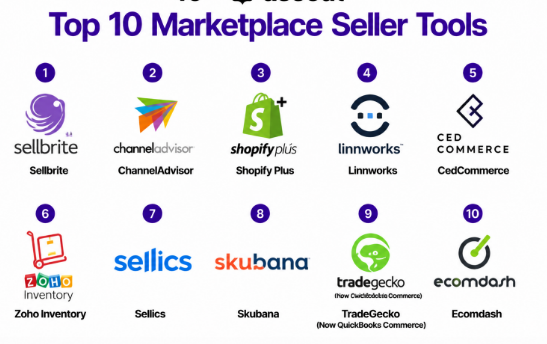
Top 10 Marketplace Seller Tools
1- Sellbrite
Short description: Sellbrite enables sellers to manage inventory, listings, and orders across multiple marketplaces from a single dashboard, ideal for SMBs and growing e-commerce businesses.
Key Features
- Centralized listing management across Amazon, eBay, Walmart, and Etsy.
- Inventory syncing and low-stock alerts.
- Automated order routing to fulfillment services.
- Bulk product import/export.
- Analytics for sales and marketplace performance.
Pros
- Simplifies multi-channel operations.
- Reduces overselling and stock discrepancies.
Cons
- Learning curve for complex workflows.
- Limited advanced pricing tools.
Platforms / Deployment
- Web
- Cloud
2- ChannelAdvisor
Short description: A robust enterprise-level platform for managing large-scale multi-channel e-commerce operations, supporting marketplaces, webstores, and digital marketing channels.
Key Features
- Marketplace and webstore integration.
- Order management and fulfillment automation.
- Marketing campaign integration.
- Advanced analytics and reporting.
- Pricing and repricing automation.
Pros
- Scales for enterprise operations.
- Comprehensive integration ecosystem.
Cons
- High cost for smaller businesses.
- May be complex for beginners.
Platforms / Deployment
- Web
- Cloud / Hybrid
3- Shopify Plus
Short description: An advanced version of Shopify designed for high-volume merchants, offering robust multi-channel selling, automation, and analytics.
Key Features
- Multi-channel sales across social, marketplaces, and POS.
- Customizable automation workflows.
- Centralized order and inventory management.
- Analytics dashboard and reporting.
- API access for integrations.
Pros
- Excellent ecosystem and app marketplace.
- Scalable for growing businesses.
Cons
- Higher subscription fees.
- Limited out-of-the-box marketplace-specific automation.
Platforms / Deployment
- Web / iOS / Android
- Cloud
4- Linnworks
Short description: Linnworks provides inventory, order, and fulfillment automation across marketplaces and sales channels, suitable for mid-market and enterprise sellers.
Key Features
- Multi-channel inventory management.
- Automated order processing.
- Shipping label generation.
- Workflow automation for repetitive tasks.
- Marketplace analytics.
Pros
- Highly customizable automation workflows.
- Reduces manual processing.
Cons
- Setup complexity.
- Interface may feel dated.
Platforms / Deployment
- Web
- Cloud / Hybrid
5- CedCommerce
Short description: CedCommerce specializes in multi-channel e-commerce integration, connecting sellers with marketplaces like Amazon, eBay, Walmart, and Flipkart.
Key Features
- Marketplace connector modules.
- Inventory and order synchronization.
- Shipping and logistics integration.
- Automated repricing.
- Multi-language support.
Pros
- Supports a wide range of marketplaces.
- Flexible and modular setup.
Cons
- Additional fees for some marketplace connectors.
- Limited built-in analytics.
Platforms / Deployment
- Web
- Cloud
6- Zoho Inventory
Short description: Zoho Inventory provides SMBs with inventory management, order fulfillment, and multi-channel selling capabilities.
Key Features
- Inventory tracking and stock alerts.
- Order management across marketplaces.
- Integration with Zoho suite (CRM, accounting).
- Shipping label generation.
- Analytics and reporting.
Pros
- Affordable for small businesses.
- Easy integration with Zoho ecosystem.
Cons
- Limited advanced automation for large-scale operations.
- Fewer marketplace-specific features.
Platforms / Deployment
- Web / iOS / Android
- Cloud
7- Sellics
Short description: Sellics offers a suite of tools for Amazon sellers including inventory, PPC, SEO, and review management.
Key Features
- Amazon inventory management.
- Keyword research and SEO optimization.
- PPC campaign tracking.
- Review and feedback management.
- Sales analytics dashboard.
Pros
- Comprehensive Amazon-focused solution.
- Provides actionable insights for optimization.
Cons
- Limited support for non-Amazon channels.
- Pricing scales with volume.
Platforms / Deployment
- Web
- Cloud
8- Skubana
Short description: Skubana is a multi-channel operations platform unifying inventory, order, and analytics workflows for high-volume sellers.
Key Features
- Centralized inventory and order management.
- Advanced analytics and forecasting.
- Workflow automation for fulfillment.
- Integrations with marketplaces and shipping providers.
- Multi-warehouse support.
Pros
- Strong analytics and operational visibility.
- Supports complex workflows.
Cons
- Can be costly for SMBs.
- Learning curve for setup.
Platforms / Deployment
- Web
- Cloud
9- TradeGecko (Now QuickBooks Commerce)
Short description: TradeGecko streamlines inventory, orders, and multi-channel sales for small and medium-sized businesses.
Key Features
- Inventory management.
- Order processing and fulfillment.
- Multi-channel listing sync.
- API integrations with accounting and shipping tools.
- Reporting and analytics.
Pros
- Affordable for SMBs.
- User-friendly interface.
Cons
- Limited enterprise-level features.
- Some integrations may require custom setup.
Platforms / Deployment
- Web
- Cloud
10- Ecomdash
Short description: Ecomdash helps SMB sellers automate listings, inventory, orders, and fulfillment across multiple marketplaces.
Key Features
- Multi-channel listing management.
- Inventory tracking and alerts.
- Automated order routing.
- Shipping label generation.
- Analytics and reporting.
Pros
- Cost-effective solution for SMBs.
- Reduces manual listing and processing.
Cons
- Interface can be overwhelming for beginners.
- Limited marketplace integrations outside US-centric platforms.
Platforms / Deployment
- Web
- Cloud
Comparison Table (Top 10)
| Tool Name | Best For | Platform(s) Supported | Deployment | Standout Feature | Public Rating |
|---|---|---|---|---|---|
| Sellbrite | SMBs / Multi-channel | Web | Cloud | Centralized multi-channel management | N/A |
| ChannelAdvisor | Enterprise sellers | Web | Cloud / Hybrid | Marketplace & webstore integration | N/A |
| Shopify Plus | High-volume merchants | Web / iOS / Android | Cloud | Multi-channel scalability | N/A |
| Linnworks | Mid-market/Enterprise | Web | Cloud / Hybrid | Automation workflows | N/A |
| CedCommerce | Marketplace connectors | Web | Cloud | Modular marketplace integration | N/A |
| Zoho Inventory | SMBs | Web / iOS / Android | Cloud | Integration with Zoho suite | N/A |
| Sellics | Amazon sellers | Web | Cloud | All-in-one Amazon solution | N/A |
| Skubana | High-volume sellers | Web | Cloud | Advanced analytics & forecasting | N/A |
| TradeGecko | SMBs | Web | Cloud | Easy inventory & order management | N/A |
| Ecomdash | SMBs / US sellers | Web | Cloud | Automated listings & fulfillment | N/A |
Weighted Evaluation & Scoring Table
| Criteria | Weight | Score (0–10) | Weighted Total |
|---|---|---|---|
| Core Features | 25% | 9 | 2.25 |
| Ease of Use | 15% | 8 | 1.2 |
| Integrations | 15% | 8 | 1.2 |
| Security | 10% | 8 | 0.8 |
| Performance | 10% | 9 | 0.9 |
| Support | 10% | 8 | 0.8 |
| Value | 15% | 8 | 1.2 |
| Total | 100% | — | 8.35 / 10 |
Interpretation: Tools like Sellbrite and Skubana excel in core features and multi-channel management, while Zoho Inventory and Ecomdash offer cost-effective solutions for smaller sellers. Enterprise-focused tools like ChannelAdvisor provide scalability and integration breadth.
Which Marketplace Seller Tool Is Right for You?
- Solo / Small sellers: Zoho Inventory, Ecomdash, Sellbrite.
- Mid-market / growing brands: Linnworks, CedCommerce, TradeGecko.
- Enterprise / high-volume sellers: ChannelAdvisor, Shopify Plus, Skubana.
- Platform specialization: Sellics for Amazon-centric operations.
- Ease vs Feature Depth: Sellbrite and Ecomdash balance simplicity with multi-channel reach.
- Security & Compliance: All tools provide secure payment and data handling mechanisms; validate compliance for enterprise contracts.
Common Mistakes to Avoid
- Overcomplicating workflows with unnecessary integrations.
- Ignoring marketplace-specific optimization requirements.
- Failing to monitor inventory across channels.
- Selecting a tool without considering scalability.
- Underestimating training and onboarding requirements.
FAQs
- What is a marketplace seller tool?
A software platform that helps sellers manage listings, inventory, orders, and analytics across online marketplaces efficiently. - Do these tools support multiple marketplaces?
Most top tools like Sellbrite, Linnworks, and Skubana support multiple marketplaces, but some specialize in Amazon or regional platforms. - Can I automate order fulfillment?
Yes, many tools allow automated routing, shipping label creation, and integration with fulfillment centers. - Are these tools suitable for SMBs?
Yes, tools like Zoho Inventory and Ecomdash are specifically designed for small and medium businesses. - Do they provide analytics?
All top tools provide dashboards and reporting for sales performance, inventory, and marketplace metrics. - Is integration with accounting software possible?
Yes, many platforms offer APIs or built-in connections with accounting and ERP systems. - Are these tools cloud-based?
Most are cloud-native, though some enterprise solutions offer hybrid deployment. - How do pricing models work?
Pricing often depends on monthly subscription, number of SKUs, and additional marketplace connectors. - Do they support international marketplaces?
Some tools like CedCommerce and ChannelAdvisor support global marketplaces and multi-currency operations. - How to choose the right tool?
Consider your business size, marketplace coverage, desired automation level, budget, and analytics needs.
Conclusion
Marketplace seller tools streamline operations, reduce manual workload, and provide actionable insights for e-commerce success. SMBs can start with cost-effective options like Zoho Inventory and Ecomdash, while high-volume merchants benefit from advanced platforms such as ChannelAdvisor, Skubana, or Shopify Plus. By choosing the right tool, sellers can optimize inventory, increase sales efficiency, and enhance customer satisfaction. Next steps include evaluating trial versions, prioritizing integrations with existing systems, and scaling as business needs evolve.
