Introduction
AI Agent Orchestration Frameworks are platforms and development frameworks that help organizations build, coordinate, manage, monitor, and scale AI agents that work together to complete complex tasks. Instead of relying on a single prompt-response interaction, these frameworks enable multi-step workflows, tool usage, memory management, planning, reasoning, and collaboration among multiple AI agents.
As enterprises move beyond chatbots toward autonomous and semi-autonomous AI systems, orchestration has become a critical layer of the AI stack. Modern AI applications increasingly require agents to access tools, retrieve information, execute workflows, interact with APIs, collaborate with other agents, and operate under governance controls.
Common use cases include:
- Customer support automation
- IT operations and incident management
- Research and knowledge discovery
- Software development assistants
- Business process automation
- Multi-agent decision support systems
When evaluating AI Agent Orchestration Frameworks, buyers should assess:
- Agent workflow flexibility
- Multi-agent capabilities
- Model compatibility
- Tool-calling support
- RAG and knowledge integration
- Evaluation and testing capabilities
- Guardrails and safety controls
- Observability and tracing
- Security and governance
- Deployment flexibility
- Scalability
- Total cost of ownership
Best for: AI engineering teams, CTOs, platform teams, enterprises building AI applications, software vendors, consulting organizations, and innovation teams implementing agent-based workflows.
Not ideal for: Small teams that only need basic chatbots, simple prompt applications, or organizations without dedicated AI development resources. In such cases, no-code AI builders or chatbot platforms may be a better fit.
What’s Changed in AI Agent Orchestration Frameworks
- Multi-agent architectures have become mainstream for complex business workflows.
- Tool calling is now a core orchestration requirement rather than an optional feature.
- Agent memory management has evolved beyond simple conversation history.
- Model routing across multiple providers is increasingly common.
- Enterprise demand for auditability and governance has significantly increased.
- Agent evaluation frameworks are becoming mandatory before production deployment.
- Prompt injection and jailbreak defense mechanisms are receiving greater attention.
- Observability platforms now provide token-level tracing and workflow visibility.
- Hybrid deployments are becoming popular for privacy-sensitive workloads.
- Cost optimization through model selection and caching is increasingly important.
- Agent-to-agent communication standards are emerging across the ecosystem.
- Human-in-the-loop approval workflows are becoming standard in enterprise deployments.
Quick Buyer Checklist (Scan-Friendly)
Before shortlisting a framework, verify:
- □ Supports multiple LLM providers
- □ Allows BYO model deployment
- □ Supports open-source models
- □ Includes agent memory management
- □ Supports tool calling and API integrations
- □ Compatible with vector databases
- □ Offers RAG capabilities
- □ Includes evaluation and testing workflows
- □ Supports guardrails and policy controls
- □ Provides tracing and observability
- □ Offers role-based access controls
- □ Includes audit logging
- □ Supports cloud and self-hosted deployments
- □ Provides cost monitoring
- □ Reduces vendor lock-in risk
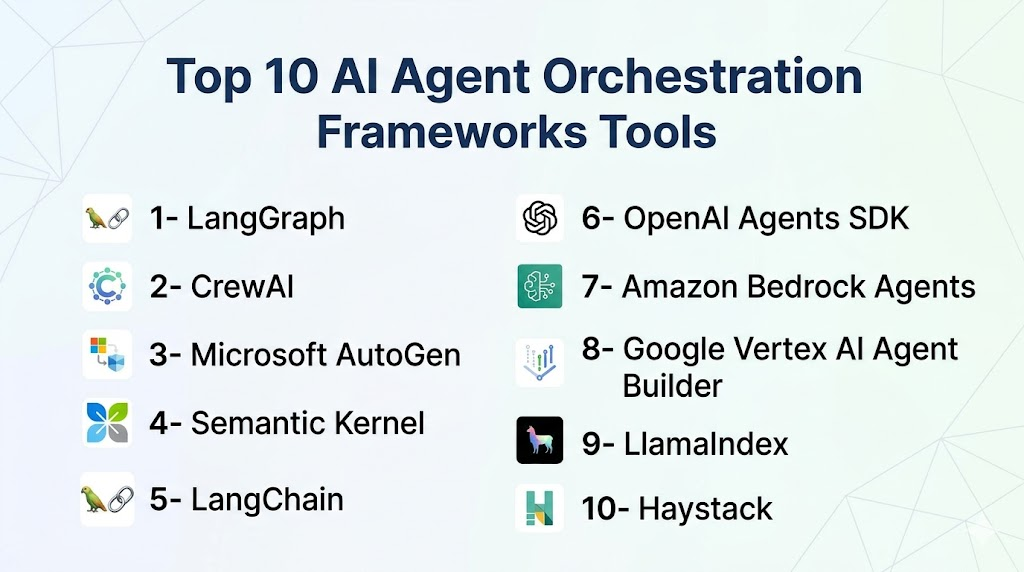
Top 10 AI Agent Orchestration Frameworks Tools (Updated)
1- LangGraph
One-line verdict: Best for enterprise-grade agent workflows requiring reliability, state management, and complex orchestration.
Short description:
LangGraph extends the LangChain ecosystem with graph-based orchestration for agent workflows. It focuses on stateful execution, durable workflows, and production-grade agent systems.
Standout Capabilities
- Stateful agent workflows
- Graph-based orchestration
- Human-in-the-loop controls
- Durable execution
- Multi-agent coordination
- Branching workflow logic
- Long-running task support
- Deep LangChain integration
AI-Specific Depth
- Model support: Multi-model, BYO model
- RAG / knowledge integration: Extensive vector database compatibility
- Evaluation: Compatible with LangSmith evaluation workflows
- Guardrails: Supports custom policy and validation layers
- Observability: Strong tracing and workflow visibility
Pros
- Excellent workflow control
- Enterprise-ready architecture
- Strong ecosystem adoption
Cons
- Learning curve for beginners
- Requires development expertise
- Rapid ecosystem changes
Security & Compliance
SSO, RBAC, retention controls, and compliance features vary by deployment architecture and supporting platform integrations.
Deployment & Platforms
- Windows
- macOS
- Linux
- Cloud
- Self-hosted
Integrations & Ecosystem
LangGraph benefits from the broader LangChain ecosystem.
- LangChain
- OpenAI
- Anthropic
- Vector databases
- APIs
- Custom tools
- Cloud platforms
Pricing Model
Open-source with enterprise offerings available through associated ecosystem products.
Best-Fit Scenarios
- Enterprise AI assistants
- Agentic workflow automation
- Multi-agent business processes
2- CrewAI
One-line verdict: Best for teams building collaborative multi-agent systems with role-based agent structures.
Short description:
CrewAI focuses on creating specialized AI agents that collaborate as a team. It provides a structured approach to agent delegation and coordination.
Standout Capabilities
- Role-based agents
- Task delegation
- Agent collaboration
- Multi-step workflows
- Process orchestration
- Tool integration
- Workflow management
- Human review options
AI-Specific Depth
- Model support: Multi-model, BYO model
- RAG / knowledge integration: Supported
- Evaluation: Basic evaluation workflows
- Guardrails: Custom implementation supported
- Observability: Available through ecosystem tools
Pros
- Easy multi-agent design
- Strong developer adoption
- Flexible architecture
Cons
- Less mature than some alternatives
- Enterprise governance varies
- Monitoring often requires additional tooling
Security & Compliance
Varies by deployment model.
Deployment & Platforms
- Windows
- macOS
- Linux
- Cloud
- Self-hosted
Integrations & Ecosystem
Strong developer-focused ecosystem.
- OpenAI
- Anthropic
- Ollama
- APIs
- Vector databases
- Custom tools
Pricing Model
Open-source with commercial ecosystem options.
Best-Fit Scenarios
- Research agents
- Content generation teams
- Multi-agent business workflows
3- Microsoft AutoGen
One-line verdict: Best for developers creating sophisticated conversational multi-agent architectures.
Short description:
AutoGen enables multiple AI agents to communicate and collaborate through structured conversations and task execution.
Standout Capabilities
- Agent conversations
- Multi-agent orchestration
- Human feedback loops
- Tool execution
- Code generation
- Autonomous workflows
- Agent collaboration
- Flexible architecture
AI-Specific Depth
- Model support: Multi-model
- RAG / knowledge integration: Supported
- Evaluation: Supported through custom workflows
- Guardrails: Customizable
- Observability: Available through integrations
Pros
- Strong research pedigree
- Highly flexible
- Excellent for experimentation
Cons
- Requires engineering expertise
- Governance requires additional implementation
- Production hardening needed
Security & Compliance
Varies based on deployment.
Deployment & Platforms
- Windows
- macOS
- Linux
- Cloud
- Self-hosted
Integrations & Ecosystem
Strong integration with AI ecosystems.
- Azure AI
- OpenAI
- APIs
- Python ecosystem
- Databases
Pricing Model
Open-source.
Best-Fit Scenarios
- Research projects
- Multi-agent collaboration
- AI development environments
4- Semantic Kernel
One-line verdict: Best for enterprises standardizing AI orchestration across Microsoft-centric environments.
Short description:
Semantic Kernel is Microsoft’s framework for orchestrating AI functions, memory, plugins, and agent workflows within enterprise applications.
Standout Capabilities
- Plugin architecture
- Memory management
- Enterprise integration
- Workflow orchestration
- AI planning
- Function calling
- Multi-model support
- Agent coordination
AI-Specific Depth
- Model support: Multi-model, BYO
- RAG / knowledge integration: Supported
- Evaluation: Available through ecosystem tools
- Guardrails: Enterprise controls supported
- Observability: Azure ecosystem integration
Pros
- Enterprise-focused
- Strong Microsoft ecosystem
- Mature governance options
Cons
- Best experience within Microsoft stack
- Complexity for small projects
- Some features require Azure services
Security & Compliance
Enterprise security capabilities available through Microsoft ecosystem integrations.
Deployment & Platforms
- Windows
- Linux
- macOS
- Cloud
- Hybrid
- Self-hosted
Integrations & Ecosystem
- Azure AI
- Microsoft services
- Databases
- APIs
- Enterprise applications
Pricing Model
Open-source with cloud consumption costs depending on usage.
Best-Fit Scenarios
- Enterprise copilots
- Internal AI platforms
- Microsoft-centric organizations
5- LangChain
One-line verdict: Best for developers seeking the broadest AI orchestration ecosystem and community.
Short description:
LangChain remains one of the most widely adopted AI application frameworks, providing building blocks for agent development and orchestration.
Standout Capabilities
- Agent frameworks
- Tool calling
- RAG support
- Workflow creation
- Memory management
- Large ecosystem
- Extensive integrations
- Community support
AI-Specific Depth
- Model support: Multi-model
- RAG / knowledge integration: Extensive
- Evaluation: LangSmith integration
- Guardrails: Supported through ecosystem
- Observability: LangSmith tracing
Pros
- Massive ecosystem
- Extensive documentation
- Large community
Cons
- Rapidly evolving APIs
- Complexity at scale
- Framework abstraction overhead
Security & Compliance
Varies by deployment and supporting infrastructure.
Deployment & Platforms
- Windows
- macOS
- Linux
- Cloud
- Self-hosted
Integrations & Ecosystem
- OpenAI
- Anthropic
- Vector databases
- APIs
- Cloud providers
Pricing Model
Open-source plus commercial services.
Best-Fit Scenarios
- AI application development
- RAG systems
- Agent prototypes
6- OpenAI Agents SDK
One-line verdict: Best for developers building production agents closely aligned with OpenAI models.
Short description:
OpenAI Agents SDK provides agent orchestration capabilities focused on tool usage, workflows, tracing, and production deployment.
Standout Capabilities
- Native OpenAI integration
- Tool calling
- Workflow orchestration
- Agent execution
- Tracing
- Memory support
- Structured outputs
AI-Specific Depth
- Model support: Primarily OpenAI models
- RAG / knowledge integration: Supported
- Evaluation: Available
- Guardrails: Supported
- Observability: Built-in tracing
Pros
- Simplified development
- Native ecosystem integration
- Production-oriented
Cons
- Greater platform dependency
- Less model flexibility
- Vendor lock-in considerations
Security & Compliance
Varies by deployment and service configuration.
Deployment & Platforms
- Cloud
- Windows
- macOS
- Linux
Integrations & Ecosystem
- OpenAI models
- APIs
- External tools
- Databases
Pricing Model
Usage-based cloud consumption.
Best-Fit Scenarios
- OpenAI-centric applications
- Customer support agents
- Workflow automation
7- Amazon Bedrock Agents
One-line verdict: Best for AWS customers seeking managed agent orchestration services.
Short description:
Amazon Bedrock Agents enables orchestration of AI agents using managed AWS infrastructure and services.
Standout Capabilities
- Managed agent infrastructure
- AWS integration
- Knowledge bases
- Workflow orchestration
- Security controls
- Multi-model access
AI-Specific Depth
- Model support: Multi-model
- RAG / knowledge integration: Native AWS integrations
- Evaluation: Supported through AWS ecosystem
- Guardrails: Available
- Observability: AWS monitoring integration
Pros
- Fully managed
- Strong AWS integration
- Enterprise scalability
Cons
- AWS dependency
- Cloud-first approach
- Potential complexity
Security & Compliance
Enterprise-grade controls available through AWS security ecosystem.
Deployment & Platforms
- Cloud
- AWS managed services
Integrations & Ecosystem
- AWS services
- Databases
- APIs
- Storage services
- Security services
Pricing Model
Consumption-based cloud pricing.
Best-Fit Scenarios
- AWS-native enterprises
- Agent automation
- Scalable production deployments
8- Google Vertex AI Agent Builder
One-line verdict: Best for organizations building agents within the Google Cloud AI ecosystem.
Short description:
Vertex AI Agent Builder provides managed capabilities for building, deploying, and scaling AI agents.
Standout Capabilities
- Agent creation
- Search integration
- Enterprise deployment
- Workflow management
- Model access
- Managed infrastructure
AI-Specific Depth
- Model support: Multi-model
- RAG / knowledge integration: Strong search capabilities
- Evaluation: Available
- Guardrails: Supported
- Observability: Google Cloud monitoring
Pros
- Managed platform
- Strong search capabilities
- Enterprise scalability
Cons
- Google Cloud dependency
- Learning curve
- Ecosystem concentration
Security & Compliance
Available through Google Cloud security services.
Deployment & Platforms
- Cloud
- Managed platform
Integrations & Ecosystem
- Google Cloud
- Search services
- APIs
- Data platforms
Pricing Model
Usage-based cloud pricing.
Best-Fit Scenarios
- Enterprise search agents
- Customer support
- Knowledge assistants
9- LlamaIndex
One-line verdict: Best for knowledge-intensive agent systems and advanced RAG applications.
Short description:
LlamaIndex specializes in connecting LLMs to enterprise data and powering agent systems that require deep knowledge integration.
Standout Capabilities
- Data ingestion
- RAG workflows
- Agent frameworks
- Knowledge management
- Data connectors
- Retrieval optimization
AI-Specific Depth
- Model support: Multi-model
- RAG / knowledge integration: Core strength
- Evaluation: Supported
- Guardrails: Available through ecosystem
- Observability: Available
Pros
- Excellent RAG support
- Strong data integration
- Flexible architecture
Cons
- Less focused on complex orchestration
- Requires engineering effort
- Ecosystem complexity
Security & Compliance
Varies by deployment architecture.
Deployment & Platforms
- Windows
- macOS
- Linux
- Cloud
- Self-hosted
Integrations & Ecosystem
- Databases
- Vector stores
- APIs
- LLM providers
- Enterprise data sources
Pricing Model
Open-source plus commercial offerings.
Best-Fit Scenarios
- Enterprise knowledge agents
- RAG systems
- Search assistants
10- Haystack
One-line verdict: Best for organizations seeking open-source AI orchestration with strong retrieval capabilities.
Short description:
Haystack is an open-source framework focused on search, retrieval, and agent-based AI application development.
Standout Capabilities
- RAG workflows
- Agent support
- Pipeline orchestration
- Search systems
- Document processing
- Open-source flexibility
AI-Specific Depth
- Model support: Open-source and proprietary
- RAG / knowledge integration: Strong
- Evaluation: Available
- Guardrails: Varies
- Observability: Basic to moderate
Pros
- Open-source
- Flexible deployment
- Strong retrieval ecosystem
Cons
- Smaller ecosystem
- More configuration required
- Enterprise features may require customization
Security & Compliance
Varies by deployment.
Deployment & Platforms
- Windows
- macOS
- Linux
- Cloud
- Self-hosted
Integrations & Ecosystem
- Vector databases
- Search engines
- APIs
- LLM providers
- Enterprise systems
Pricing Model
Open-source.
Best-Fit Scenarios
- Open-source AI platforms
- Knowledge assistants
- Enterprise search
Comparison Table (Top 10)
| Tool Name | Best For | Deployment | Model Flexibility | Strength | Watch-Out | Public Rating |
|---|---|---|---|---|---|---|
| LangGraph | Enterprise workflows | Cloud/Self-hosted | Multi-model | Stateful orchestration | Learning curve | N/A |
| CrewAI | Multi-agent teams | Cloud/Self-hosted | Multi-model | Agent collaboration | Governance maturity | N/A |
| AutoGen | Research & development | Cloud/Self-hosted | Multi-model | Agent conversations | Production hardening | N/A |
| Semantic Kernel | Microsoft enterprises | Hybrid | Multi-model/BYO | Enterprise integration | Azure dependency | N/A |
| LangChain | General AI development | Cloud/Self-hosted | Multi-model | Ecosystem depth | Complexity | N/A |
| OpenAI Agents SDK | OpenAI workloads | Cloud | Hosted | Native integration | Vendor lock-in | N/A |
| Amazon Bedrock Agents | AWS enterprises | Cloud | Multi-model | Managed operations | AWS dependency | N/A |
| Vertex AI Agent Builder | Google Cloud users | Cloud | Multi-model | Search integration | Cloud dependency | N/A |
| LlamaIndex | Knowledge agents | Cloud/Self-hosted | Multi-model | RAG excellence | Orchestration depth | N/A |
| Haystack | Open-source adoption | Self-hosted/Cloud | Open-source | Retrieval pipelines | Smaller ecosystem | N/A |
Scoring & Evaluation (Transparent Rubric)
These scores are comparative rather than absolute. They reflect relative strengths across common enterprise evaluation criteria. Organizations should adjust weighting based on their requirements, security needs, deployment preferences, and governance expectations.
| Tool | Core | Reliability/Eval | Guardrails | Integrations | Ease | Perf/Cost | Security/Admin | Support | Weighted Total |
|---|---|---|---|---|---|---|---|---|---|
| LangGraph | 10 | 9 | 8 | 9 | 7 | 8 | 8 | 9 | 8.75 |
| CrewAI | 8 | 7 | 7 | 8 | 8 | 8 | 7 | 8 | 7.75 |
| AutoGen | 9 | 8 | 7 | 8 | 7 | 8 | 7 | 8 | 7.95 |
| Semantic Kernel | 9 | 8 | 8 | 9 | 8 | 8 | 9 | 8 | 8.45 |
| LangChain | 9 | 8 | 7 | 10 | 7 | 8 | 7 | 10 | 8.30 |
| OpenAI Agents SDK | 8 | 8 | 8 | 8 | 9 | 8 | 8 | 8 | 8.15 |
| Amazon Bedrock Agents | 8 | 8 | 9 | 8 | 8 | 8 | 9 | 8 | 8.25 |
| Vertex AI Agent Builder | 8 | 8 | 8 | 8 | 8 | 8 | 9 | 8 | 8.10 |
| LlamaIndex | 9 | 8 | 7 | 9 | 7 | 8 | 7 | 9 | 8.10 |
| Haystack | 8 | 7 | 7 | 8 | 7 | 8 | 7 | 8 | 7.60 |
Which AI Agent Orchestration Framework Tool Is Right for You?
Solo / Freelancer
CrewAI, LangChain, and OpenAI Agents SDK provide fast implementation with manageable complexity. They are suitable for prototypes, client projects, and smaller automation initiatives.
SMB
LangChain, CrewAI, and LlamaIndex offer strong flexibility without requiring large enterprise budgets. These frameworks balance capability and implementation effort.
Mid-Market
Semantic Kernel, LangGraph, and LlamaIndex provide better governance, scalability, and integration capabilities suitable for growing organizations.
Enterprise
LangGraph, Semantic Kernel, Amazon Bedrock Agents, and Vertex AI Agent Builder are strong options for large-scale deployments requiring governance and reliability.
Regulated Industries (Finance/Healthcare/Public Sector)
Prioritize deployment flexibility, auditability, access controls, data residency options, and human approval workflows. Semantic Kernel, LangGraph, and Bedrock Agents are often strong candidates.
Budget vs Premium
Budget-focused organizations should evaluate Haystack, CrewAI, LangChain, and LlamaIndex. Premium buyers may benefit from managed platforms such as Bedrock Agents and Vertex AI Agent Builder.
Build vs Buy (When to DIY)
Build when orchestration logic is a strategic differentiator, security requirements are unique, or model flexibility is critical. Buy managed platforms when speed, operational simplicity, and vendor support matter more than customization.
Implementation Playbook (30 / 60 / 90 Days)
First 30 Days
- Define business objectives
- Select pilot use case
- Build evaluation datasets
- Establish success metrics
- Implement tracing
- Create prompt version control
- Establish human review workflows
First 60 Days
- Harden security controls
- Implement RBAC
- Build evaluation harnesses
- Conduct red-team testing
- Add prompt injection defenses
- Expand integrations
- Roll out to selected users
First 90 Days
- Optimize model routing
- Implement cost monitoring
- Establish governance committees
- Scale across departments
- Add incident response processes
- Improve evaluation coverage
- Formalize lifecycle management
Common Mistakes & How to Avoid Them
- Deploying agents without evaluation frameworks
- Ignoring prompt injection risks
- Over-automating sensitive workflows
- Skipping human approval stages
- Failing to monitor token costs
- Not implementing tracing
- Weak access control management
- Poor memory management practices
- Excessive vendor dependency
- No rollback strategy
- Lack of prompt version control
- Ignoring hallucination monitoring
- Unmanaged data retention
- Poor documentation of agent behavior
FAQs
What is an AI Agent Orchestration Framework?
It is a platform or framework that coordinates AI agents, tools, workflows, memory, and decision-making processes to accomplish complex tasks.
Do I need orchestration for simple chatbots?
Usually not. Basic chatbot applications can often operate without dedicated orchestration frameworks.
Can these frameworks work with multiple models?
Many modern frameworks support multiple model providers and allow model switching based on cost or performance requirements.
What is BYO model support?
Bring Your Own Model support allows organizations to connect proprietary, hosted, or open-source models rather than relying on a single vendor.
Why is observability important?
Observability helps teams understand agent behavior, identify failures, optimize costs, and improve reliability.
What are guardrails?
Guardrails are controls that restrict unsafe outputs, enforce policies, and reduce risks such as prompt injection and jailbreak attacks.
Are open-source frameworks production ready?
Many are production capable, but enterprises often need additional security, monitoring, and governance layers.
What role does evaluation play?
Evaluation validates agent quality, reliability, and consistency before deployment into production environments.
Can these frameworks support RAG systems?
Most leading orchestration frameworks support retrieval-augmented generation and vector database integrations.
How can organizations reduce vendor lock-in?
Use abstraction layers, support multiple model providers, and maintain portable workflow architectures.
Is self-hosting important?
For regulated industries and privacy-sensitive applications, self-hosting can provide greater control over data and compliance requirements.
What is the biggest mistake enterprises make?
Deploying agents without robust testing, evaluation, governance, and observability controls.
Conclusion
AI Agent Orchestration Frameworks have quickly become one of the most important layers in modern AI architectures. As organizations move from isolated chatbots to autonomous workflows, the ability to coordinate agents, tools, memory, retrieval systems, and governance controls becomes essential. No single framework is universally best. LangGraph excels in enterprise workflow orchestration, CrewAI shines in multi-agent collaboration, Semantic Kernel offers strong enterprise integration, LangChain provides ecosystem depth, and managed platforms such as Amazon Bedrock Agents and Vertex AI Agent Builder simplify large-scale deployment.
