Introduction
Agent Workflow Engines help organizations design, orchestrate, automate, and manage AI-powered workflows involving large language models, tools, APIs, databases, business processes, and autonomous agents. As enterprises move beyond simple chatbots and experiment with AI-driven automation, workflow engines have become a critical layer for building reliable, scalable, and governable AI systems.
Modern AI applications often require multiple steps such as planning, reasoning, data retrieval, tool execution, validation, approval workflows, and continuous monitoring. Agent Workflow Engines provide the orchestration capabilities needed to coordinate these tasks efficiently while maintaining visibility, control, and operational reliability.
Real-world use cases include:
- Multi-agent customer support automation
- AI-powered research and analysis workflows
- Enterprise knowledge retrieval and action execution
- Sales and marketing automation
- IT operations and incident management workflows
- Document processing and approval pipelines
- Business process automation with AI decision-making
- Autonomous software engineering assistants
What buyers should evaluate:
- Workflow design flexibility
- Multi-agent orchestration capabilities
- Tool and API integrations
- Observability and monitoring
- Scalability and performance
- Human-in-the-loop support
- Security and governance controls
- Developer experience and learning curve
- Enterprise deployment options
- Ecosystem maturity
Best for: Enterprises, AI platform teams, automation engineers, AI application developers, and organizations deploying complex agentic workflows.
Not ideal for: Teams requiring only simple chatbot functionality or basic prompt automation.
What’s Changed
The Agent Workflow Engine market has evolved rapidly due to advances in large language models and autonomous AI systems.
Key developments include:
- Multi-agent collaboration frameworks
- Event-driven workflow orchestration
- Built-in memory management
- Human approval workflows
- Advanced observability and tracing
- AI planning and reasoning engines
- Enterprise governance capabilities
- Hybrid AI and automation architectures
Quick Buyer Checklist
Before selecting an Agent Workflow Engine, consider:
- Does it support multi-agent workflows?
- Can it integrate with your existing systems?
- Does it provide workflow visualization?
- Are monitoring and debugging capabilities available?
- Can workflows scale across production environments?
- Is human oversight supported?
- What security controls are available?
- Does it support cloud and self-hosted deployment?
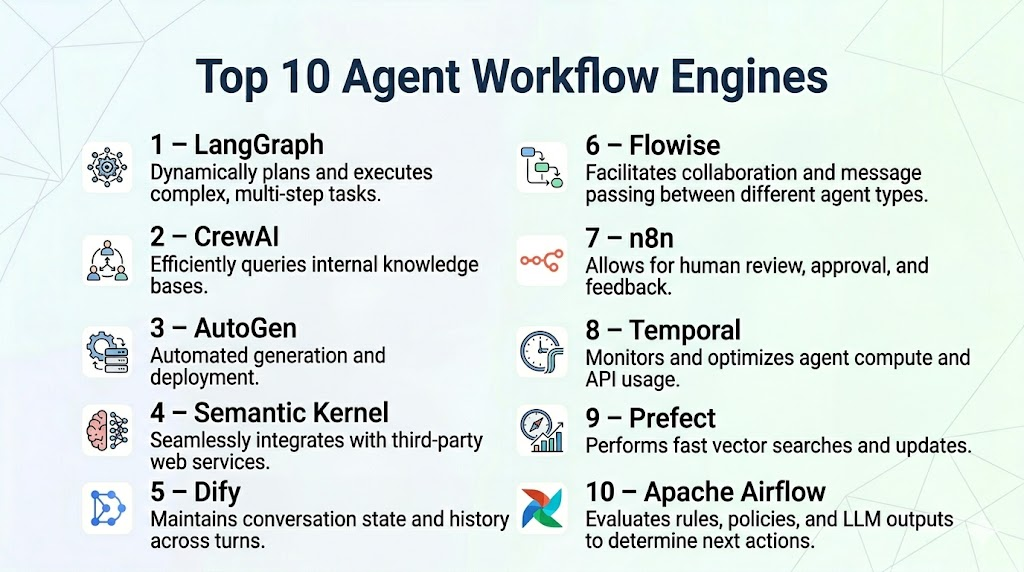
Top 10 Agent Workflow Engines
1- LangGraph
One-line Verdict
Best overall framework for building stateful and production-ready AI agent workflows.
Short Description
LangGraph extends the LangChain ecosystem by enabling graph-based workflow orchestration for AI agents. It supports complex state management, branching logic, memory persistence, and multi-agent collaboration. Organizations use it to create advanced AI systems that require reliability and scalability.
Standout Capabilities
- Graph-based workflow architecture
- Stateful agent execution
- Human-in-the-loop workflows
- Memory persistence
- Multi-agent coordination
AI-Specific Depth
LangGraph excels at handling long-running workflows where agents must maintain context, make decisions, and collaborate over multiple execution stages.
Pros
- Strong ecosystem support
- Flexible workflow modeling
- Excellent state management
Cons
- Learning curve for beginners
- Requires developer expertise
Security & Compliance
Varies by deployment environment.
Deployment & Platforms
- Cloud
- Self-hosted
- Kubernetes
Integrations & Ecosystem
Integrates with LLM providers, databases, vector stores, APIs, and enterprise systems.
Pricing Model
Open-source.
Best-Fit Scenarios
- Enterprise AI applications
- Multi-agent systems
- Autonomous workflows
2- CrewAI
One-line Verdict
Best for collaborative multi-agent workflows.
Short Description
CrewAI focuses on coordinating specialized AI agents working together toward common objectives. It simplifies multi-agent architecture and enables role-based collaboration models.
Standout Capabilities
- Role-based agents
- Task delegation
- Agent collaboration
- Workflow automation
- Team-based execution
AI-Specific Depth
Designed specifically for multi-agent coordination and autonomous task completion.
Pros
- Easy multi-agent setup
- Strong collaboration model
- Developer-friendly
Cons
- Smaller enterprise ecosystem
- Limited advanced orchestration features
Security & Compliance
Not publicly stated.
Deployment & Platforms
- Cloud
- Self-hosted
Integrations & Ecosystem
Supports major LLMs and API integrations.
Pricing Model
Open-source with commercial offerings.
Best-Fit Scenarios
- Research automation
- Team-based AI workflows
- Task orchestration
3- AutoGen
One-line Verdict
Best for AI agent conversations and collaborative reasoning.
Short Description
AutoGen enables agents to communicate, negotiate, and solve tasks collaboratively. It supports autonomous and human-guided workflows across multiple AI agents.
Standout Capabilities
- Agent conversations
- Human participation
- Multi-agent reasoning
- Task decomposition
- Workflow automation
AI-Specific Depth
Strong conversational orchestration and reasoning capabilities.
Pros
- Advanced agent communication
- Research-backed framework
- Flexible architecture
Cons
- Complex deployment
- Requires customization
Security & Compliance
Varies by implementation.
Deployment & Platforms
- Cloud
- Self-hosted
Integrations & Ecosystem
Supports major AI models and APIs.
Pricing Model
Open-source.
Best-Fit Scenarios
- Research workflows
- Autonomous collaboration
- Complex decision-making
4- Semantic Kernel
One-line Verdict
Best for enterprise AI workflow orchestration.
Short Description
Semantic Kernel provides enterprise-grade orchestration capabilities for AI workflows, allowing integration between AI models and traditional business systems.
Key Features
- Planning engine
- Workflow orchestration
- Memory management
- Plugin architecture
- Enterprise integration
Pros
- Enterprise-ready
- Strong governance support
- Microsoft ecosystem integration
Cons
- More enterprise-focused
- Higher implementation complexity
Platforms / Deployment
- Cloud
- Hybrid
- On-premises
Security & Compliance
Enterprise-grade security controls available.
Integrations & Ecosystem
Strong integration with Microsoft technologies.
Support & Community
Large enterprise developer community.
5- Dify
One-line Verdict
Best low-code platform for AI workflow automation.
Short Description
Dify provides visual workflow building capabilities that allow teams to create AI applications without extensive coding.
Key Features
- Visual workflow builder
- Prompt orchestration
- Knowledge integration
- Multi-model support
- API management
Pros
- User-friendly interface
- Fast deployment
- Low-code experience
Cons
- Less flexibility than code-first tools
- Advanced customization limitations
Platforms / Deployment
- Cloud
- Self-hosted
Security & Compliance
Varies by deployment.
Integrations & Ecosystem
Broad AI and API integrations.
Support & Community
Growing community support.
6- Flowise
One-line Verdict
Best visual workflow platform for developers.
Short Description
Flowise enables drag-and-drop workflow creation for AI agents, RAG applications, and automation pipelines.
Key Features
- Visual editor
- Agent orchestration
- RAG workflows
- Tool integration
- Workflow templates
Pros
- Easy setup
- Open-source
- Visual development
Cons
- Limited enterprise controls
- Scaling complexity
Platforms / Deployment
- Cloud
- Self-hosted
Security & Compliance
Not publicly stated.
Integrations & Ecosystem
Supports major LLM and vector database integrations.
Support & Community
Active open-source community.
7- n8n
One-line Verdict
Best for combining AI workflows with business automation.
Short Description
n8n combines workflow automation with AI orchestration, allowing organizations to integrate AI agents into existing operational processes.
Key Features
- Workflow automation
- AI node integrations
- API orchestration
- Event-driven workflows
- Low-code development
Pros
- Extensive integrations
- Strong automation features
- Flexible deployment
Cons
- AI-specific capabilities still evolving
- Complex large-scale workflows
Platforms / Deployment
- Cloud
- Self-hosted
Security & Compliance
Enterprise controls available.
Integrations & Ecosystem
Hundreds of connectors and integrations.
Support & Community
Large automation community.
8- Temporal
One-line Verdict
Best for mission-critical workflow execution.
Short Description
Temporal delivers reliable workflow orchestration for long-running business and AI processes with fault tolerance and scalability.
Key Features
- Durable execution
- Workflow recovery
- Scalability
- Event orchestration
- High availability
Pros
- Extremely reliable
- Enterprise scalability
- Strong workflow guarantees
Cons
- Developer-centric
- Higher complexity
Platforms / Deployment
- Cloud
- Self-hosted
Security & Compliance
Enterprise-grade controls.
Integrations & Ecosystem
Supports custom AI integrations.
Support & Community
Strong developer ecosystem.
9- Prefect
One-line Verdict
Best for data and AI workflow orchestration.
Short Description
Prefect provides orchestration capabilities for AI, machine learning, and data pipelines through modern workflow management.
Key Features
- Workflow automation
- Scheduling
- Monitoring
- Data orchestration
- Event triggers
Pros
- Excellent observability
- Flexible deployment
- Modern architecture
Cons
- Less agent-focused
- Advanced setup requirements
Platforms / Deployment
- Cloud
- Hybrid
Security & Compliance
Enterprise features available.
Integrations & Ecosystem
Strong data ecosystem support.
Support & Community
Active community.
10- Apache Airflow
One-line Verdict
Best for large-scale workflow scheduling.
Short Description
Apache Airflow remains a popular orchestration platform for managing complex workflows, data pipelines, and AI-related automation tasks.
Key Features
- DAG orchestration
- Scheduling
- Monitoring
- Extensibility
- Workflow management
Pros
- Mature ecosystem
- Massive adoption
- Highly extensible
Cons
- Not built specifically for agents
- Operational complexity
Platforms / Deployment
- Cloud
- On-premises
Security & Compliance
Enterprise deployment controls available.
Integrations & Ecosystem
Large integration ecosystem.
Support & Community
Extensive open-source community.
Comparison Table
| Tool | Best For | Deployment | Multi-Agent Support | Visual Builder |
|---|---|---|---|---|
| LangGraph | Production Agents | Cloud/Self-hosted | Yes | No |
| CrewAI | Agent Teams | Cloud/Self-hosted | Yes | Limited |
| AutoGen | Agent Collaboration | Cloud/Self-hosted | Yes | No |
| Semantic Kernel | Enterprise AI | Hybrid | Yes | Limited |
| Dify | Low-Code AI | Cloud/Self-hosted | Moderate | Yes |
| Flowise | Visual AI Workflows | Cloud/Self-hosted | Moderate | Yes |
| n8n | AI Automation | Cloud/Self-hosted | Moderate | Yes |
| Temporal | Durable Workflows | Cloud/Self-hosted | Limited | No |
| Prefect | Data + AI Workflows | Cloud/Hybrid | Limited | Partial |
| Apache Airflow | Enterprise Scheduling | Cloud/On-prem | Limited | Partial |
Evaluation & Scoring
| Tool | Core | Ease | Integrations | Security | Performance | Support | Value | Total |
|---|---|---|---|---|---|---|---|---|
| LangGraph | 9.8 | 8.5 | 9.5 | 8.8 | 9.5 | 9.2 | 9.3 | 9.3 |
| CrewAI | 9.0 | 9.0 | 8.7 | 8.2 | 8.8 | 8.5 | 9.0 | 8.9 |
| AutoGen | 9.1 | 8.2 | 8.8 | 8.3 | 8.9 | 8.6 | 8.8 | 8.8 |
| Semantic Kernel | 9.2 | 8.0 | 9.2 | 9.4 | 9.0 | 9.1 | 8.7 | 9.0 |
| Dify | 8.5 | 9.4 | 8.6 | 8.2 | 8.5 | 8.3 | 9.0 | 8.7 |
| Flowise | 8.4 | 9.2 | 8.5 | 8.0 | 8.4 | 8.4 | 8.9 | 8.6 |
| n8n | 8.6 | 8.9 | 9.5 | 8.8 | 8.7 | 9.0 | 9.1 | 8.9 |
| Temporal | 9.4 | 7.5 | 8.5 | 9.3 | 9.8 | 8.9 | 8.5 | 9.0 |
| Prefect | 8.7 | 8.8 | 8.9 | 8.7 | 8.8 | 8.7 | 8.8 | 8.8 |
| Apache Airflow | 8.8 | 7.8 | 9.4 | 8.8 | 9.0 | 9.5 | 8.7 | 8.8 |
Which Agent Workflow Engine Is Right for You?
For AI Startups
Choose LangGraph or CrewAI for fast development and advanced agent orchestration.
For Enterprise Organizations
Choose Semantic Kernel or Temporal for governance, scalability, and reliability.
For Low-Code Teams
Choose Dify or Flowise for visual workflow creation.
For Automation Teams
Choose n8n for integrating AI into existing business workflows.
For Data and AI Operations
Choose Prefect or Apache Airflow for workflow scheduling and orchestration.
Frequently Asked Questions
1- What is an Agent Workflow Engine?
An Agent Workflow Engine coordinates AI agents, tools, APIs, and business processes to execute complex tasks automatically while maintaining visibility and control.
2- Why are Agent Workflow Engines important?
They enable reliable orchestration of multi-step AI workflows, improving scalability, governance, and operational efficiency.
3- What is the difference between an AI agent and a workflow engine?
An AI agent performs tasks and reasoning, while a workflow engine manages execution flow, orchestration, and coordination.
4- Which framework is best for multi-agent systems?
LangGraph, CrewAI, and AutoGen are among the strongest options for multi-agent orchestration.
5- Can Agent Workflow Engines support enterprise deployments?
Yes. Platforms such as Semantic Kernel, Temporal, and LangGraph are commonly used for enterprise-scale deployments.
6- Are these platforms suitable for non-developers?
Tools like Dify and Flowise offer low-code capabilities, making them accessible to non-technical users.
7- What role does observability play?
Observability helps monitor workflows, diagnose failures, and optimize AI agent performance.
8- Do Agent Workflow Engines support human approvals?
Many platforms support human-in-the-loop workflows to ensure governance and oversight.
9- Can they integrate with existing business systems?
Yes. Most leading platforms support APIs, databases, cloud services, and enterprise applications.
10- What should organizations prioritize when selecting a platform?
Focus on scalability, orchestration flexibility, security, integrations, developer experience, and operational visibility.
Conclusion
Agent Workflow Engines are rapidly becoming a foundational layer for enterprise AI systems. As organizations move toward autonomous agents and AI-driven operations, the ability to orchestrate complex workflows reliably becomes critical. LangGraph currently leads for production-grade agent orchestration, while CrewAI and AutoGen excel in multi-agent collaboration. Semantic Kernel offers strong enterprise capabilities, and Dify and Flowise simplify adoption through visual development. Organizations should begin by identifying their workflow complexity, governance requirements, integration needs, and scalability goals. A pilot implementation with one or two shortlisted platforms is often the best way to validate operational fit before scaling AI agent workflows across the enterprise.
