Introduction
Autonomous Task Automation Platforms are AI-powered systems that can plan, execute, monitor, and optimize multi-step tasks with minimal human intervention. Unlike traditional automation tools that follow predefined workflows, autonomous platforms leverage AI agents, reasoning engines, tool-calling capabilities, and contextual memory to make decisions, adapt to changing conditions, and complete complex business processes.
As organizations accelerate AI adoption, autonomous task automation is becoming a strategic priority. Enterprises are increasingly using AI agents to automate customer support, software operations, business workflows, data analysis, IT service management, research tasks, and internal knowledge work. The emergence of multimodal AI, advanced reasoning models, agent orchestration frameworks, and enterprise-grade governance capabilities has significantly expanded what these systems can accomplish.
Real-World Use Cases
- Customer support automation and ticket resolution
- IT operations and infrastructure management
- Sales prospecting and outreach workflows
- Research and data gathering tasks
- HR onboarding and employee support
- Finance operations and document processing
Evaluation Criteria for Buyers
When evaluating autonomous task automation platforms, consider:
- Agent reasoning capabilities
- Workflow orchestration flexibility
- Multi-model support
- Enterprise security controls
- Human-in-the-loop capabilities
- Evaluation and testing frameworks
- Observability and monitoring
- Integration ecosystem
- Cost management features
- Deployment flexibility
- Governance and auditability
- Scalability for production workloads
Best for: Enterprises, technology companies, IT teams, operations departments, customer support organizations, financial services firms, healthcare organizations, and digital transformation initiatives seeking scalable automation.
Not ideal for: Organizations with extremely simple workflows, teams requiring only basic rule-based automation, or businesses lacking governance requirements where traditional automation tools may provide a lower-cost alternative.
What’s Changed in Autonomous Task Automation Platforms
- AI agents now execute complex multi-step workflows with less human intervention.
- Multi-agent collaboration is becoming a standard capability.
- Tool calling has evolved beyond APIs into dynamic system interactions.
- Enterprise demand for auditability and traceability has increased significantly.
- Guardrail frameworks now address prompt injection and unsafe actions.
- Multimodal inputs support text, image, audio, and document processing.
- Model routing helps optimize cost, latency, and performance.
- Human approval workflows are becoming mandatory for sensitive actions.
- Observability platforms provide detailed execution traces.
- Enterprise customers increasingly require BYO-model capabilities.
- Agent memory systems improve long-running task execution.
- Governance requirements are influencing platform architecture decisions.
Quick Buyer Checklist
Before shortlisting a platform, verify:
- □ Supports enterprise-grade access controls
- □ Offers audit logs and activity tracking
- □ Supports hosted and BYO model options
- □ Includes evaluation and testing capabilities
- □ Provides prompt version management
- □ Includes guardrails and policy enforcement
- □ Supports human approval workflows
- □ Offers observability and tracing
- □ Provides latency and cost monitoring
- □ Supports enterprise integrations
- □ Allows workflow customization
- □ Minimizes vendor lock-in risk
- □ Supports hybrid or self-hosted deployment if required
- □ Includes retention and privacy controls
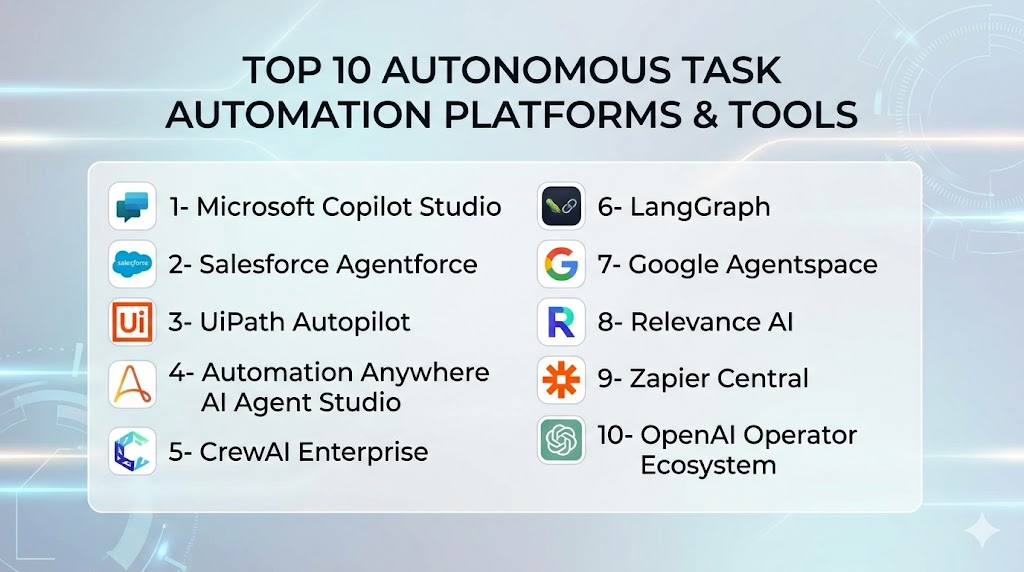
Top 10 Autonomous Task Automation Platforms Tools
1- Microsoft Copilot Studio
One-line verdict: Best for enterprises building AI-powered business automation within Microsoft ecosystems.
Short description:
Microsoft Copilot Studio enables organizations to create AI agents that automate business processes across Microsoft applications and enterprise systems. It combines conversational AI, workflow automation, and enterprise governance.
Standout Capabilities
- Enterprise agent creation
- Workflow orchestration
- Power Platform integration
- Human approval workflows
- Enterprise security controls
- Multi-channel deployment
- Business process automation
AI-Specific Depth
- Model support: Proprietary and Microsoft-hosted models
- RAG / knowledge integration: Enterprise data connectors
- Evaluation: Testing and monitoring capabilities
- Guardrails: Policy controls and approval workflows
- Observability: Analytics and execution monitoring
Pros
- Strong Microsoft ecosystem integration
- Enterprise-grade governance
- Familiar low-code environment
Cons
- Best value within Microsoft stack
- Less flexible than some developer-focused platforms
- Licensing complexity
Security & Compliance
Enterprise authentication, RBAC, audit capabilities, encryption, and administrative controls. Certifications vary by Microsoft service.
Deployment & Platforms
- Web
- Cloud
- Enterprise cloud environments
Integrations & Ecosystem
Extensive integration across Microsoft’s enterprise portfolio and third-party systems.
- Power Automate
- Microsoft 365
- Dynamics 365
- Azure AI services
- Enterprise APIs
Pricing Model
Tiered enterprise licensing.
Best-Fit Scenarios
- Enterprise process automation
- Internal employee assistants
- Customer support workflows
2- Salesforce Agentforce
One-line verdict: Best for customer-facing autonomous agents in Salesforce environments.
Short description:
Agentforce enables organizations to deploy AI agents capable of handling customer service, sales, and operational workflows directly within Salesforce ecosystems.
Standout Capabilities
- CRM-native automation
- Customer interaction workflows
- Enterprise governance
- Agent orchestration
- Sales automation
- Service automation
- Knowledge integration
AI-Specific Depth
- Model support: Multi-model support
- RAG / knowledge integration: Salesforce knowledge ecosystem
- Evaluation: Built-in monitoring capabilities
- Guardrails: Enterprise controls
- Observability: Operational dashboards
Pros
- Deep CRM integration
- Strong customer-service automation
- Enterprise governance
Cons
- Salesforce-centric
- Enterprise pricing
- Learning curve
Security & Compliance
Enterprise access controls, audit capabilities, and security administration.
Deployment & Platforms
- Web
- Cloud
Integrations & Ecosystem
- Salesforce CRM
- Service Cloud
- Data Cloud
- APIs
- Enterprise applications
Pricing Model
Enterprise subscription model.
Best-Fit Scenarios
- Customer service automation
- Sales workflow automation
- CRM-centric enterprises
3- UiPath Autopilot
One-line verdict: Best for organizations combining AI agents with traditional RPA.
Short description:
UiPath Autopilot extends robotic process automation with autonomous AI capabilities, allowing organizations to automate structured and unstructured workflows.
Standout Capabilities
- AI plus RPA integration
- Process mining
- Enterprise orchestration
- Human-in-the-loop workflows
- Document processing
- Task automation
- Governance tools
AI-Specific Depth
- Model support: Multi-model
- RAG / knowledge integration: Enterprise integrations available
- Evaluation: Workflow testing capabilities
- Guardrails: Approval and governance workflows
- Observability: Process monitoring
Pros
- Mature automation ecosystem
- Strong enterprise adoption
- Powerful workflow capabilities
Cons
- Complexity for smaller teams
- Enterprise-oriented pricing
- Setup effort
Security & Compliance
RBAC, auditing, governance controls, encryption.
Deployment & Platforms
- Cloud
- Hybrid
- Self-hosted options
Integrations & Ecosystem
- ERP systems
- CRM platforms
- Databases
- APIs
- Business applications
Pricing Model
Tiered enterprise licensing.
Best-Fit Scenarios
- RPA modernization
- Enterprise automation
- Complex workflows
4- Automation Anywhere AI Agent Studio
One-line verdict: Best for enterprises scaling intelligent automation initiatives.
Short description:
Automation Anywhere combines AI agents and process automation to enable autonomous business workflows across departments.
Standout Capabilities
- AI-powered automation
- Agent orchestration
- Process automation
- Enterprise governance
- Workflow optimization
- Human approvals
- Analytics
AI-Specific Depth
- Model support: Multi-model
- RAG / knowledge integration: Enterprise connectors
- Evaluation: Workflow validation
- Guardrails: Governance frameworks
- Observability: Monitoring dashboards
Pros
- Strong automation heritage
- Enterprise-ready
- Broad integration support
Cons
- Enterprise complexity
- Training requirements
- Premium pricing
Security & Compliance
Enterprise-grade controls and governance features.
Deployment & Platforms
- Cloud
- Hybrid
Integrations & Ecosystem
- ERP
- CRM
- Databases
- APIs
- Productivity tools
Pricing Model
Enterprise subscription.
Best-Fit Scenarios
- Large-scale automation
- Back-office operations
- Process modernization
5- CrewAI Enterprise
One-line verdict: Best for multi-agent collaboration and AI-native workflow automation.
Short description:
CrewAI focuses on collaborative AI agents that work together to accomplish complex business tasks through role-based coordination.
Standout Capabilities
- Multi-agent architecture
- Agent collaboration
- Role specialization
- Workflow orchestration
- Developer flexibility
- Open ecosystem
- Rapid deployment
AI-Specific Depth
- Model support: Open-source, proprietary, BYO model
- RAG / knowledge integration: Vector database integrations
- Evaluation: Framework-based evaluation
- Guardrails: Varies by implementation
- Observability: Agent tracing capabilities
Pros
- Highly flexible
- Strong developer adoption
- Multi-agent specialization
Cons
- Requires technical expertise
- Governance varies by deployment
- Less turnkey than enterprise suites
Security & Compliance
Varies based on deployment architecture.
Deployment & Platforms
- Cloud
- Self-hosted
- Hybrid
Integrations & Ecosystem
- OpenAI
- Anthropic
- Vector databases
- APIs
- Custom tools
Pricing Model
Open-source plus enterprise offerings.
Best-Fit Scenarios
- AI-native startups
- Agent experimentation
- Custom automation platforms
6- LangGraph
One-line verdict: Best for developers building complex autonomous agent workflows.
Short description:
LangGraph provides graph-based orchestration for agent workflows, enabling stateful execution and advanced task automation.
Standout Capabilities
- Stateful workflows
- Agent orchestration
- Graph architecture
- Human intervention support
- Flexible execution paths
- Developer-centric design
- Open ecosystem
AI-Specific Depth
- Model support: Multi-model and BYO model
- RAG / knowledge integration: Extensive support
- Evaluation: LangSmith ecosystem
- Guardrails: Framework-dependent
- Observability: Advanced tracing
Pros
- Powerful orchestration
- Developer flexibility
- Strong ecosystem
Cons
- Technical learning curve
- Requires engineering resources
- Not low-code
Security & Compliance
Varies by deployment.
Deployment & Platforms
- Cloud
- Self-hosted
Integrations & Ecosystem
- LangChain
- Vector databases
- APIs
- Open-source tools
- LLM providers
Pricing Model
Open-source with commercial services.
Best-Fit Scenarios
- Agent development
- Workflow orchestration
- AI platform engineering
7- Google Agentspace
One-line verdict: Best for organizations leveraging Google’s AI ecosystem for enterprise productivity.
Short description:
Agentspace provides AI-powered task automation and enterprise agent capabilities integrated with Google services and enterprise knowledge systems.
Standout Capabilities
- Enterprise search
- Agent automation
- Workspace integration
- Knowledge access
- Enterprise AI capabilities
- Workflow assistance
- Productivity enhancement
AI-Specific Depth
- Model support: Google-hosted models
- RAG / knowledge integration: Enterprise search capabilities
- Evaluation: Platform monitoring
- Guardrails: Enterprise governance
- Observability: Administrative monitoring
Pros
- Strong Google integration
- Enterprise knowledge access
- User-friendly experience
Cons
- Ecosystem dependency
- Less customization than developer frameworks
- Newer platform
Security & Compliance
Enterprise administration and security controls.
Deployment & Platforms
- Cloud
- Web
Integrations & Ecosystem
- Google Workspace
- Google Cloud
- Enterprise systems
- APIs
Pricing Model
Enterprise subscription.
Best-Fit Scenarios
- Google-centric organizations
- Knowledge workers
- Internal productivity automation
8- Relevance AI
One-line verdict: Best for no-code and low-code AI workforce automation.
Short description:
Relevance AI allows organizations to build AI agents and autonomous workflows using low-code interfaces and enterprise integrations.
Standout Capabilities
- No-code agent builder
- Workflow automation
- Agent teams
- Business integrations
- Task execution
- Knowledge management
- Rapid deployment
AI-Specific Depth
- Model support: Multi-model
- RAG / knowledge integration: Built-in support
- Evaluation: Workflow testing
- Guardrails: Administrative controls
- Observability: Monitoring dashboards
Pros
- Faster deployment
- Business-user friendly
- Strong automation focus
Cons
- Less developer customization
- Platform dependency
- Enterprise scaling considerations
Security & Compliance
Not publicly stated.
Deployment & Platforms
- Cloud
- Web
Integrations & Ecosystem
- CRM systems
- Databases
- APIs
- Productivity applications
Pricing Model
Tiered subscription.
Best-Fit Scenarios
- Business automation
- Operations teams
- Low-code AI adoption
9- Zapier Central
One-line verdict: Best for SMBs extending workflow automation with AI agents.
Short description:
Zapier Central brings AI-powered autonomous task execution into the popular Zapier automation ecosystem.
Standout Capabilities
- AI-assisted workflows
- Large integration catalog
- Low-code automation
- Business process automation
- Trigger-based execution
- Fast deployment
- Broad connectivity
AI-Specific Depth
- Model support: Hosted AI services
- RAG / knowledge integration: Limited compared to enterprise platforms
- Evaluation: Basic testing tools
- Guardrails: Workflow permissions
- Observability: Workflow monitoring
Pros
- Easy to use
- Massive integration ecosystem
- Fast implementation
Cons
- Less advanced autonomy
- Limited enterprise governance
- Complex workflows can become difficult
Security & Compliance
Administrative controls vary by plan.
Deployment & Platforms
- Cloud
- Web
Integrations & Ecosystem
- Thousands of SaaS integrations
- APIs
- Productivity tools
- CRM systems
Pricing Model
Usage-based and tiered subscriptions.
Best-Fit Scenarios
- SMB automation
- Marketing workflows
- Productivity automation
10- OpenAI Operator Ecosystem
One-line verdict: Best for organizations exploring cutting-edge AI-driven task execution.
Short description:
OpenAI’s emerging operator capabilities enable AI systems to perform tasks across software environments with increasing levels of autonomy.
Standout Capabilities
- Advanced reasoning
- Tool usage
- Multi-step planning
- Browser interaction
- Workflow execution
- AI-native task completion
- Rapid innovation
AI-Specific Depth
- Model support: Proprietary OpenAI models
- RAG / knowledge integration: Supported through APIs
- Evaluation: Platform-dependent
- Guardrails: Safety systems included
- Observability: API-level monitoring
Pros
- Strong reasoning capabilities
- Rapid innovation
- Developer-friendly APIs
Cons
- Evolving ecosystem
- Enterprise governance varies
- Production practices still maturing
Security & Compliance
Varies by deployment and implementation.
Deployment & Platforms
- Cloud
- API-based
Integrations & Ecosystem
- APIs
- Developer tools
- Third-party integrations
- Enterprise applications
Pricing Model
Usage-based API pricing.
Best-Fit Scenarios
- AI-first applications
- Autonomous assistants
- Experimental automation initiatives
Comparison Table
| Tool Name | Best For | Deployment | Model Flexibility | Strength | Watch-Out | Public Rating |
|---|---|---|---|---|---|---|
| Microsoft Copilot Studio | Enterprise automation | Cloud | Hosted | Microsoft ecosystem | Licensing complexity | N/A |
| Salesforce Agentforce | CRM automation | Cloud | Multi-model | Customer workflows | Salesforce dependency | N/A |
| UiPath Autopilot | Enterprise RPA | Cloud/Hybrid | Multi-model | AI + RPA | Complexity | N/A |
| Automation Anywhere | Intelligent automation | Cloud/Hybrid | Multi-model | Enterprise automation | Cost | N/A |
| CrewAI | Multi-agent systems | Hybrid | Open-source/BYO | Agent collaboration | Technical skills | N/A |
| LangGraph | Developer workflows | Self-hosted/Cloud | Multi-model | Workflow orchestration | Learning curve | N/A |
| Google Agentspace | Productivity automation | Cloud | Hosted | Workspace integration | Ecosystem dependency | N/A |
| Relevance AI | Low-code agents | Cloud | Multi-model | Ease of deployment | Customization limits | N/A |
| Zapier Central | SMB automation | Cloud | Hosted | Integrations | Limited autonomy | N/A |
| OpenAI Operator | AI-native automation | Cloud | Proprietary | Advanced reasoning | Emerging platform | N/A |
Scoring & Evaluation
Scores are comparative and intended to help buyers evaluate relative strengths across key categories. They are not absolute measurements and should be validated through pilots and proof-of-concept deployments.
| Tool | Core | Reliability | Guardrails | Integrations | Ease | Perf/Cost | Security | Support | Weighted Total |
|---|---|---|---|---|---|---|---|---|---|
| Microsoft Copilot Studio | 9 | 8 | 9 | 9 | 8 | 8 | 9 | 9 | 8.7 |
| Salesforce Agentforce | 9 | 8 | 9 | 8 | 8 | 8 | 9 | 8 | 8.5 |
| UiPath Autopilot | 9 | 8 | 8 | 9 | 7 | 8 | 9 | 8 | 8.4 |
| Automation Anywhere | 8 | 8 | 8 | 8 | 7 | 8 | 9 | 8 | 8.0 |
| CrewAI | 8 | 7 | 7 | 8 | 7 | 8 | 7 | 8 | 7.6 |
| LangGraph | 9 | 8 | 7 | 9 | 6 | 8 | 7 | 8 | 7.9 |
| Google Agentspace | 8 | 8 | 8 | 8 | 8 | 8 | 8 | 8 | 8.0 |
| Relevance AI | 8 | 7 | 7 | 8 | 9 | 8 | 7 | 7 | 7.8 |
| Zapier Central | 7 | 7 | 6 | 10 | 9 | 8 | 6 | 8 | 7.7 |
| OpenAI Operator | 8 | 8 | 7 | 7 | 8 | 8 | 7 | 8 | 7.8 |
Which Autonomous Task Automation Platform Is Right for You?
Solo / Freelancer
Choose Zapier Central or Relevance AI if simplicity, affordability, and rapid deployment matter most.
SMB
Relevance AI, Zapier Central, and Google Agentspace provide strong automation capabilities without requiring large engineering teams.
Mid-Market
UiPath, Automation Anywhere, and Microsoft Copilot Studio offer governance and scalability while remaining manageable.
Enterprise
Microsoft Copilot Studio, Salesforce Agentforce, and UiPath Autopilot provide the strongest governance, security, and enterprise integration capabilities.
Regulated Industries
Prioritize platforms with strong auditability, approval workflows, retention controls, and enterprise identity integration.
Budget vs Premium
Budget-focused teams should evaluate open-source frameworks like CrewAI and LangGraph. Premium buyers may benefit from Microsoft, Salesforce, and UiPath ecosystems.
Build vs Buy
Build when customization and competitive differentiation are critical. Buy when speed, governance, and operational support matter more than flexibility.
Common Mistakes & How to Avoid Them
- Deploying agents without evaluation frameworks
- Ignoring prompt injection risks
- Over-automating sensitive processes
- Missing human approval checkpoints
- Failing to monitor execution costs
- Neglecting observability and tracing
- Poor access control management
- Lack of prompt version control
- Inadequate testing before production
- Ignoring data retention policies
- Vendor lock-in without abstraction layers
- Weak incident response planning
- Overlooking model performance drift
- Underestimating governance requirements
FAQs
What is an autonomous task automation platform?
It is an AI-powered platform that can independently plan and execute multi-step workflows while interacting with software systems and business applications.
How are these different from traditional automation tools?
Traditional automation follows predefined rules. Autonomous platforms can reason, adapt, and make decisions based on changing conditions.
Can these platforms use multiple AI models?
Many modern platforms support multiple model providers and some offer BYO-model capabilities for greater flexibility.
Are autonomous agents safe for production use?
They can be safe when combined with governance controls, evaluations, guardrails, approvals, and monitoring.
What is human-in-the-loop automation?
It allows humans to review, approve, or intervene in critical decisions before actions are completed.
Do I need technical expertise to use these platforms?
Some platforms are low-code while others require software engineering expertise. Requirements vary significantly.
What are AI guardrails?
Guardrails are controls that prevent unsafe actions, policy violations, data exposure, or unauthorized behavior.
How important is observability?
Observability is critical because it helps teams understand agent behavior, diagnose failures, and manage costs.
Can these platforms work with private data?
Yes, many support enterprise data integrations, though privacy controls and retention policies should be reviewed carefully.
What is BYO model support?
Bring Your Own Model allows organizations to connect proprietary or preferred AI models instead of relying solely on vendor-hosted models.
Are open-source options viable?
Yes. Frameworks such as CrewAI and LangGraph are widely used for custom autonomous systems and offer significant flexibility.
How should organizations start?
Begin with a focused pilot, establish evaluation metrics, validate governance controls, and expand gradually based on measurable outcomes.
Conclusion
Autonomous Task Automation Platforms are rapidly becoming a foundational layer of enterprise AI strategy. The market now spans enterprise suites such as Microsoft Copilot Studio, Salesforce Agentforce, and UiPath Autopilot, alongside developer-centric frameworks like LangGraph and CrewAI. The right choice depends on organizational goals, technical maturity, governance requirements, and integration needs. Enterprises typically prioritize security, compliance, and operational control, while startups and developers often favor flexibility and customization. Success ultimately depends less on the platform itself and more on disciplined implementation practices, robust evaluation frameworks, effective guardrails, and continuous monitoring. Start by shortlisting three platforms, run a controlled pilot with measurable outcomes, verify security and evaluation capabilities, and then scale gradually across business-critical workflows.
