Introduction
AI Agent Marketplaces are platforms where users can discover, deploy, customize, share, and monetize AI agents designed for specific tasks. These marketplaces function similarly to app stores but focus on AI-powered assistants, autonomous agents, workflow automations, and specialized AI services. Organizations increasingly use these platforms to accelerate AI adoption without building every agent from scratch.
The rapid growth of agentic AI has transformed marketplaces from simple prompt repositories into sophisticated ecosystems containing autonomous agents capable of research, customer support, content creation, software development, data analysis, workflow automation, and business operations. As AI agents become more capable, marketplaces provide a centralized way to evaluate, acquire, govern, and manage agent deployments across teams.
Real-World Use Cases
- Customer service and support automation
- Research and market intelligence agents
- Sales and lead generation assistants
- Content creation and marketing workflows
- IT operations and service desk automation
- Software development and testing assistants
Evaluation Criteria for Buyers
When evaluating AI Agent Marketplaces, consider:
- Agent quality and verification process
- Marketplace size and ecosystem maturity
- Customization capabilities
- Multi-model support
- Security and governance controls
- Integration ecosystem
- Enterprise deployment options
- Agent monetization opportunities
- Observability and analytics
- Collaboration capabilities
- Vendor lock-in risks
- Cost transparency
Best for: Enterprises, startups, software teams, digital agencies, operations teams, customer support organizations, and businesses seeking rapid AI adoption through reusable agents.
Not ideal for: Organizations requiring fully custom AI architectures, highly sensitive environments with strict self-hosting requirements, or businesses needing only basic AI chatbot functionality.
What’s Changed in AI Agent Marketplaces
- Agent marketplaces have evolved beyond prompt libraries into full agent ecosystems.
- Multi-agent collaboration is becoming a standard marketplace capability.
- Enterprises increasingly demand governance and approval workflows.
- Agent monetization models are attracting developers and vendors.
- Verification programs are emerging to improve trust and reliability.
- Agent observability and execution tracing are becoming critical features.
- BYO-model support is gaining importance.
- Enterprise customers require private marketplace deployments.
- Multimodal agent capabilities are expanding rapidly.
- Agent performance benchmarking is becoming more common.
- Security reviews are becoming part of agent publishing workflows.
- Marketplace operators are focusing on agent lifecycle management.
Quick Buyer Checklist
Before selecting a marketplace, verify:
- □ Agent review and verification process
- □ Enterprise governance controls
- □ Audit logging and activity tracking
- □ Agent customization capabilities
- □ BYO-model support
- □ Human approval workflows
- □ Observability and tracing
- □ Security and privacy controls
- □ Deployment flexibility
- □ Vendor reputation
- □ Agent quality standards
- □ Integration ecosystem
- □ Cost visibility
- □ Marketplace growth trajectory
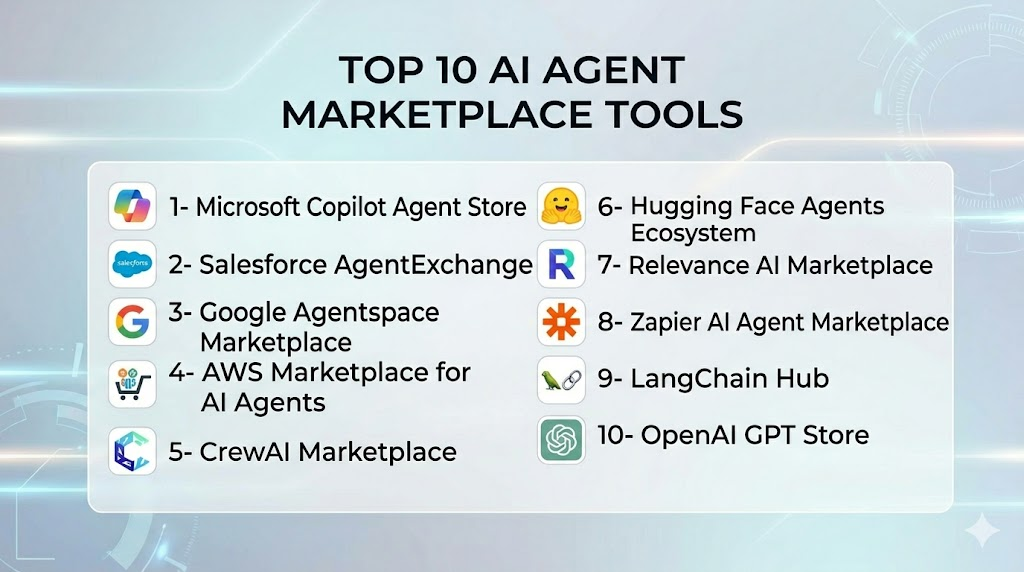
Top 10 AI Agent Marketplace Tools
1- Microsoft Copilot Agent Store
One-line verdict: Best for enterprises already invested in the Microsoft ecosystem.
Short description:
Microsoft’s growing Copilot ecosystem enables organizations to discover, deploy, and manage AI agents integrated with Microsoft 365, Dynamics, and enterprise workflows.
Standout Capabilities
- Enterprise-grade governance
- Microsoft ecosystem integration
- Internal agent publishing
- Business workflow automation
- Security controls
- Enterprise administration
- Large organizational deployment
AI-Specific Depth
- Model support: Microsoft-hosted AI models
- RAG / knowledge integration: Microsoft Graph and enterprise connectors
- Evaluation: Administrative monitoring
- Guardrails: Enterprise governance controls
- Observability: Analytics and usage monitoring
Pros
- Strong enterprise governance
- Extensive Microsoft integration
- Large enterprise adoption
Cons
- Best suited for Microsoft customers
- Ecosystem dependency
- Licensing complexity
Security & Compliance
Enterprise identity integration, access controls, audit capabilities, encryption, and administrative controls.
Deployment & Platforms
- Web
- Cloud
Integrations & Ecosystem
Extensive integration across Microsoft’s productivity, business, and cloud platforms.
Pricing Model
Subscription and enterprise licensing.
Best-Fit Scenarios
- Enterprise AI deployment
- Internal employee assistants
- Business process automation
2- Salesforce AgentExchange
One-line verdict: Best for CRM-centric organizations deploying customer-facing AI agents.
Short description:
AgentExchange provides a marketplace for discovering and deploying AI agents integrated with Salesforce business applications and customer workflows.
Standout Capabilities
- CRM-native deployment
- Enterprise governance
- Agent discovery
- Customer service automation
- Sales workflow support
- Partner ecosystem
- Enterprise scalability
AI-Specific Depth
- Model support: Multi-model support
- RAG / knowledge integration: Salesforce ecosystem
- Evaluation: Monitoring capabilities
- Guardrails: Governance controls
- Observability: Administrative dashboards
Pros
- Strong CRM integration
- Large enterprise ecosystem
- Business workflow focus
Cons
- Salesforce-centric
- Enterprise-oriented pricing
- Less developer-focused
Security & Compliance
Enterprise-grade administrative controls and auditability.
Deployment & Platforms
- Cloud
- Web
Integrations & Ecosystem
- Salesforce CRM
- Service Cloud
- Data Cloud
- APIs
- Partner solutions
Pricing Model
Subscription-based.
Best-Fit Scenarios
- Customer support automation
- Sales automation
- CRM workflows
3- Google Agentspace Marketplace
One-line verdict: Best for organizations leveraging Google’s AI and productivity ecosystem.
Short description:
Google’s agent ecosystem enables businesses to discover AI-powered assistants and workflow automation capabilities integrated with enterprise knowledge systems.
Standout Capabilities
- Enterprise search integration
- Workspace connectivity
- Knowledge-driven agents
- Productivity enhancement
- AI-powered automation
- Cloud-native architecture
- Enterprise deployment
AI-Specific Depth
- Model support: Google AI models
- RAG / knowledge integration: Enterprise search and connectors
- Evaluation: Administrative insights
- Guardrails: Enterprise controls
- Observability: Usage analytics
Pros
- Workspace integration
- Enterprise knowledge access
- User-friendly experience
Cons
- Ecosystem dependency
- Newer marketplace ecosystem
- Limited customization compared to open platforms
Security & Compliance
Enterprise administration and access management.
Deployment & Platforms
- Cloud
- Web
Integrations & Ecosystem
- Google Workspace
- Google Cloud
- Enterprise APIs
- Productivity tools
Pricing Model
Subscription-based.
Best-Fit Scenarios
- Internal productivity
- Knowledge management
- Enterprise search
4- AWS Marketplace for AI Agents
One-line verdict: Best for cloud-native organizations seeking flexible AI agent deployments.
Short description:
AWS Marketplace increasingly supports AI agent solutions, autonomous workflow systems, and AI-powered automation offerings.
Standout Capabilities
- Large vendor ecosystem
- Cloud-native deployment
- Flexible procurement
- Enterprise scalability
- Third-party innovation
- Infrastructure integration
- Global reach
AI-Specific Depth
- Model support: Multi-model and BYO model
- RAG / knowledge integration: Extensive cloud integrations
- Evaluation: Vendor dependent
- Guardrails: Varies by solution
- Observability: Cloud-native monitoring
Pros
- Broad solution availability
- Enterprise scalability
- Flexible deployment options
Cons
- Quality varies by vendor
- Evaluation effort required
- Complex marketplace navigation
Security & Compliance
Varies by vendor offering.
Deployment & Platforms
- Cloud
- Hybrid
Integrations & Ecosystem
- AWS services
- Enterprise applications
- APIs
- Developer tools
Pricing Model
Vendor-specific.
Best-Fit Scenarios
- Cloud-native enterprises
- Custom deployments
- Multi-vendor strategies
5- CrewAI Marketplace
One-line verdict: Best for developers building collaborative multi-agent systems.
Short description:
CrewAI’s ecosystem enables developers to discover, share, and deploy specialized AI agent teams designed for complex workflows.
Standout Capabilities
- Multi-agent collaboration
- Open ecosystem
- Developer flexibility
- Agent sharing
- Workflow orchestration
- Open-source foundation
- Community innovation
AI-Specific Depth
- Model support: Open-source, proprietary, BYO model
- RAG / knowledge integration: Broad compatibility
- Evaluation: Framework-driven
- Guardrails: Varies by implementation
- Observability: Agent tracing available
Pros
- Highly customizable
- Strong developer community
- Open architecture
Cons
- Technical expertise required
- Governance depends on implementation
- Less turnkey
Security & Compliance
Varies by deployment.
Deployment & Platforms
- Cloud
- Self-hosted
- Hybrid
Integrations & Ecosystem
- LLM providers
- APIs
- Vector databases
- Open-source tools
Pricing Model
Open-source and enterprise offerings.
Best-Fit Scenarios
- Agent development
- Multi-agent automation
- AI experimentation
6- Hugging Face Agents Ecosystem
One-line verdict: Best for open-source AI agent innovation and experimentation.
Short description:
Hugging Face provides a large ecosystem of AI models, agents, and community-driven innovation for developers and researchers.
Standout Capabilities
- Open-source ecosystem
- Community innovation
- Model diversity
- Agent experimentation
- Developer tools
- Research support
- Global community
AI-Specific Depth
- Model support: Open-source and proprietary
- RAG / knowledge integration: Extensive compatibility
- Evaluation: Community-driven tools
- Guardrails: Varies
- Observability: Varies
Pros
- Massive community
- Open ecosystem
- Strong innovation
Cons
- Enterprise governance varies
- Quality control varies
- Additional implementation required
Security & Compliance
Varies by deployment.
Deployment & Platforms
- Cloud
- Self-hosted
Integrations & Ecosystem
- Open-source models
- APIs
- Developer frameworks
- Community tools
Pricing Model
Freemium and enterprise offerings.
Best-Fit Scenarios
- Research
- Open-source AI
- Rapid prototyping
7- Relevance AI Marketplace
One-line verdict: Best for business users deploying AI workers without heavy coding.
Short description:
Relevance AI provides a marketplace of AI workers and business automation agents designed for operational efficiency.
Standout Capabilities
- AI workforce concept
- Business automation
- No-code deployment
- Agent templates
- Workflow management
- Operational efficiency
- Fast deployment
AI-Specific Depth
- Model support: Multi-model
- RAG / knowledge integration: Built-in support
- Evaluation: Workflow testing
- Guardrails: Administrative controls
- Observability: Monitoring dashboards
Pros
- Easy deployment
- Business-friendly
- Rapid automation
Cons
- Less customization
- Vendor dependency
- Advanced use cases may require customization
Security & Compliance
Not publicly stated.
Deployment & Platforms
- Cloud
- Web
Integrations & Ecosystem
- Business applications
- APIs
- Productivity tools
- Databases
Pricing Model
Tiered subscription.
Best-Fit Scenarios
- Operations automation
- Business users
- Rapid AI adoption
8- Zapier AI Agent Marketplace
One-line verdict: Best for SMBs automating workflows across thousands of applications.
Short description:
Zapier combines its automation ecosystem with AI-powered agents that help organizations automate routine business processes.
Standout Capabilities
- Large integration library
- Workflow automation
- Easy deployment
- Business productivity
- Trigger-based execution
- Low-code environment
- Broad SaaS support
AI-Specific Depth
- Model support: Hosted AI services
- RAG / knowledge integration: Basic capabilities
- Evaluation: Workflow testing
- Guardrails: Workflow permissions
- Observability: Workflow monitoring
Pros
- Easy to use
- Huge integration ecosystem
- Fast implementation
Cons
- Limited advanced autonomy
- Less enterprise governance
- Complex workflows may require redesign
Security & Compliance
Administrative controls vary by plan.
Deployment & Platforms
- Cloud
- Web
Integrations & Ecosystem
- Thousands of SaaS applications
- APIs
- Productivity platforms
- CRM systems
Pricing Model
Tiered and usage-based.
Best-Fit Scenarios
- SMB automation
- Marketing workflows
- Productivity enhancement
9- LangChain Hub
One-line verdict: Best for developers sharing and discovering reusable AI agent components.
Short description:
LangChain Hub serves as a repository and discovery platform for prompts, chains, agents, and reusable AI workflow components.
Standout Capabilities
- Developer-focused ecosystem
- Reusable components
- Agent templates
- Open architecture
- Framework integration
- Rapid experimentation
- Community contributions
AI-Specific Depth
- Model support: Multi-model and BYO model
- RAG / knowledge integration: Extensive support
- Evaluation: LangSmith ecosystem
- Guardrails: Framework dependent
- Observability: Advanced tracing
Pros
- Strong developer ecosystem
- High flexibility
- Rapid experimentation
Cons
- Technical expertise required
- Less business-user friendly
- Governance requires additional tooling
Security & Compliance
Varies by deployment.
Deployment & Platforms
- Cloud
- Self-hosted
Integrations & Ecosystem
- LangChain
- Vector databases
- APIs
- LLM providers
Pricing Model
Open-source and commercial services.
Best-Fit Scenarios
- AI engineering teams
- Agent development
- Custom AI platforms
10- OpenAI GPT Store
One-line verdict: Best for discovering consumer and business-focused AI assistants quickly.
Short description:
The GPT Store enables users to discover, deploy, and share specialized GPT-powered assistants for a wide variety of business and personal tasks.
Standout Capabilities
- Large public ecosystem
- Easy discovery
- Fast deployment
- Broad use cases
- Consumer accessibility
- GPT customization
- Rapid innovation
AI-Specific Depth
- Model support: OpenAI models
- RAG / knowledge integration: Knowledge uploads supported
- Evaluation: Limited compared to enterprise platforms
- Guardrails: Platform-level controls
- Observability: Basic analytics
Pros
- Easy adoption
- Large ecosystem
- Rapid deployment
Cons
- Less enterprise governance
- Limited customization
- Vendor dependency
Security & Compliance
Varies by deployment and plan.
Deployment & Platforms
- Web
- Mobile
- Cloud
Integrations & Ecosystem
- GPT ecosystem
- APIs
- Enterprise tools
- Custom actions
Pricing Model
Subscription and usage-based.
Best-Fit Scenarios
- Individual productivity
- Rapid experimentation
- Specialized assistants
Comparison Table
| Tool Name | Best For | Deployment | Model Flexibility | Strength | Watch-Out | Public Rating |
|---|---|---|---|---|---|---|
| Microsoft Copilot Agent Store | Enterprise | Cloud | Hosted | Governance | Microsoft dependency | N/A |
| Salesforce AgentExchange | CRM teams | Cloud | Multi-model | CRM workflows | Salesforce focus | N/A |
| Google Agentspace Marketplace | Productivity | Cloud | Hosted | Enterprise knowledge | Ecosystem dependency | N/A |
| AWS Marketplace | Cloud-native teams | Cloud/Hybrid | BYO/Multi-model | Vendor diversity | Quality varies | N/A |
| CrewAI Marketplace | Developers | Hybrid | Open-source/BYO | Multi-agent systems | Technical complexity | N/A |
| Hugging Face Ecosystem | Researchers | Cloud/Self-hosted | Open-source | Innovation | Governance varies | N/A |
| Relevance AI Marketplace | Business users | Cloud | Multi-model | Ease of use | Less customization | N/A |
| Zapier AI Marketplace | SMBs | Cloud | Hosted | Integrations | Limited autonomy | N/A |
| LangChain Hub | AI engineers | Self-hosted/Cloud | BYO/Multi-model | Developer flexibility | Technical learning curve | N/A |
| OpenAI GPT Store | General users | Cloud | Proprietary | Ease of discovery | Limited governance | N/A |
Scoring & Evaluation
| Tool | Core | Reliability/Eval | Guardrails | Integrations | Ease | Perf/Cost | Security/Admin | Support | Weighted Total |
|---|---|---|---|---|---|---|---|---|---|
| Microsoft Copilot Agent Store | 9 | 8 | 9 | 9 | 8 | 8 | 9 | 9 | 8.7 |
| Salesforce AgentExchange | 9 | 8 | 9 | 8 | 8 | 8 | 9 | 8 | 8.5 |
| Google Agentspace Marketplace | 8 | 8 | 8 | 8 | 8 | 8 | 8 | 8 | 8.0 |
| AWS Marketplace | 8 | 7 | 7 | 9 | 7 | 8 | 8 | 8 | 7.9 |
| CrewAI Marketplace | 8 | 7 | 7 | 8 | 7 | 8 | 7 | 8 | 7.6 |
| Hugging Face Ecosystem | 8 | 7 | 6 | 8 | 7 | 8 | 6 | 9 | 7.5 |
| Relevance AI Marketplace | 8 | 7 | 7 | 8 | 9 | 8 | 7 | 7 | 7.8 |
| Zapier AI Marketplace | 7 | 7 | 6 | 10 | 9 | 8 | 6 | 8 | 7.7 |
| LangChain Hub | 9 | 8 | 7 | 9 | 6 | 8 | 7 | 8 | 7.9 |
| OpenAI GPT Store | 8 | 7 | 7 | 7 | 10 | 8 | 6 | 8 | 7.8 |
Which AI Agent Marketplace Is Right for You?
Solo / Freelancer
OpenAI GPT Store and Zapier AI Marketplace provide fast access to reusable AI assistants without requiring technical expertise.
SMB
Relevance AI and Zapier AI Marketplace offer practical automation capabilities with manageable complexity and deployment effort.
Mid-Market
Google Agentspace Marketplace and AWS Marketplace provide a balance of scalability, flexibility, and governance.
Enterprise
Microsoft Copilot Agent Store and Salesforce AgentExchange deliver the strongest governance, administration, and enterprise integration capabilities.
Regulated Industries
Prioritize marketplaces offering auditability, approval workflows, access controls, and detailed governance capabilities.
Budget vs Premium
Open-source ecosystems such as Hugging Face and CrewAI offer flexibility, while enterprise platforms provide managed governance and support.
Build vs Buy
Buy when speed and governance matter most. Build when differentiation, customization, and control are strategic priorities.
Common Mistakes & How to Avoid Them
- Selecting agents without security review
- Ignoring governance requirements
- Overlooking vendor lock-in risks
- Deploying without evaluation testing
- Missing auditability requirements
- Failing to monitor costs
- Neglecting prompt security
- Over-automating sensitive workflows
- Ignoring observability needs
- Not validating agent outputs
- Skipping user training
- Underestimating integration requirements
FAQs
What is an AI Agent Marketplace?
An AI Agent Marketplace is a platform where users can discover, deploy, customize, and manage AI agents designed for specific business or personal tasks.
How is an AI Agent Marketplace different from an app store?
AI marketplaces focus on autonomous agents that perform tasks and workflows rather than traditional software applications.
Are marketplace agents safe to use?
Safety depends on governance, testing, permissions, and security controls. Enterprise review processes are strongly recommended.
Can I customize marketplace agents?
Most modern marketplaces provide varying levels of customization, workflow editing, and knowledge integration.
Do these marketplaces support multiple AI models?
Many enterprise and developer-focused marketplaces support multiple model providers or BYO-model approaches.
Can organizations build private marketplaces?
Yes. Some enterprise platforms support private agent catalogs and internal distribution.
What role does observability play?
Observability helps organizations understand agent behavior, costs, performance, and failure patterns.
Are open-source marketplaces viable?
Yes. Open-source ecosystems provide flexibility and innovation but often require more technical expertise.
How should enterprises evaluate agents?
Enterprises should test security, reliability, governance, integration capabilities, and operational performance before deployment.
What are the biggest risks?
Security gaps, vendor lock-in, poor governance, inadequate testing, and unmanaged costs are among the most common risks.
Can AI marketplaces support regulated industries?
Yes, but organizations should carefully assess compliance, governance, auditability, and data handling requirements.
What is the future of AI Agent Marketplaces?
The market is evolving toward multi-agent ecosystems, enterprise governance, private marketplaces, and autonomous workflow orchestration.
Conclusion
AI Agent Marketplaces are becoming a foundational component of enterprise AI adoption by providing reusable, discoverable, and increasingly autonomous AI capabilities. The market ranges from enterprise-focused ecosystems such as Microsoft Copilot Agent Store and Salesforce AgentExchange to developer-centric communities like CrewAI, LangChain Hub, and Hugging Face. No single marketplace is universally best. The right choice depends on governance requirements, ecosystem alignment, technical expertise, and business objectives. Organizations should begin by identifying priority use cases, evaluating governance and security requirements, and running controlled pilot programs before large-scale deployment. The most successful implementations combine strong marketplace ecosystems with rigorous evaluation, observability, and operational governance practices.
