Introduction
MLOps Lifecycle Management Platforms are systems that help organizations build, deploy, monitor, and govern machine learning models across their entire lifecycle—from data preparation and training to deployment, monitoring, retraining, and retirement. Unlike basic ML toolkits or standalone model training frameworks, MLOps platforms provide end-to-end orchestration for machine learning operations at scale.
machine learning is no longer experimental—it is core infrastructure for enterprises. However, managing ML models in production introduces challenges such as model drift, data versioning, reproducibility, governance, compliance, and cost optimization. MLOps platforms solve these challenges by combining CI/CD for ML, experiment tracking, model registries, feature stores, monitoring, and automated retraining pipelines.
These platforms are now critical for AI-driven businesses because models continuously evolve, data changes rapidly, and production systems demand reliability, transparency, and governance.
Real-World Use Cases
- End-to-end ML model deployment pipelines
- Model monitoring and drift detection
- Automated retraining workflows
- Fraud detection systems in finance
- Recommendation systems in e-commerce
- Predictive maintenance in manufacturing
- Healthcare prediction models
- AI-powered personalization systems
Evaluation Criteria for Buyers
When evaluating MLOps Lifecycle Management Platforms, consider:
- End-to-end ML pipeline support
- Model versioning and registry capabilities
- Data and feature store integration
- CI/CD automation for ML workflows
- Model monitoring and drift detection
- Experiment tracking capabilities
- Scalability across teams and environments
- Multi-cloud and hybrid deployment support
- Governance and compliance features
- Explainability and model transparency
- Integration with data engineering tools
- Cost efficiency and performance
Best for: Enterprises, AI/ML engineering teams, data science teams, fintech companies, healthcare AI systems, SaaS platforms with ML features, and organizations deploying production-grade AI systems.
Not ideal for: Beginners, small businesses without ML infrastructure, or teams running only occasional ML experiments without production deployment needs.
What’s Changed in MLOps Lifecycle Management Platforms
- MLOps is now deeply integrated with LLMOps and agentic AI pipelines
- Model registries now support multimodal AI models
- Continuous training pipelines are becoming fully automated
- Feature stores are real-time and streaming-enabled
- Model observability includes explainability and fairness metrics
- AI governance and compliance tracking are mandatory in enterprises
- AutoML and MLOps are converging into unified platforms
- Drift detection now uses AI-based anomaly detection
- Multi-cloud model deployment is standard
- Model marketplaces are integrated into MLOps ecosystems
- CI/CD pipelines now include evaluation gates for models
- Cost-aware model routing is becoming a key optimization layer
Quick Buyer Checklist
Before selecting an MLOps platform, verify:
- □ Model registry and versioning support
- □ End-to-end pipeline orchestration
- □ CI/CD automation for ML workflows
- □ Model monitoring and drift detection
- □ Feature store integration
- □ Multi-cloud deployment support
- □ Governance and compliance controls
- □ Experiment tracking capabilities
- □ Explainability and transparency tools
- □ Scalability for large datasets
- □ Integration with data engineering stack
- □ Retraining automation support
- □ Cost optimization and observability
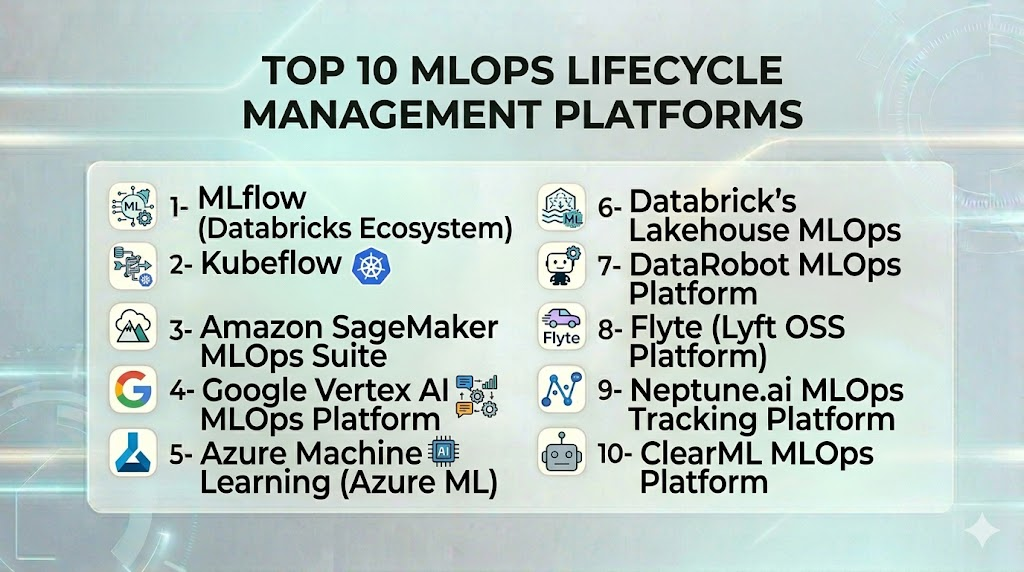
Top 10 MLOps Lifecycle Management Platforms
1- MLflow (Databricks Ecosystem)
One-line verdict: Best open-source MLOps standard for experiment tracking and model lifecycle management.
Short description:
MLflow is a widely adopted open-source platform that manages the ML lifecycle including experiment tracking, model registry, deployment, and reproducibility across environments.
Standout Capabilities
- Experiment tracking
- Model registry
- Reproducible ML pipelines
- Multi-framework support
- Deployment tracking
- Lifecycle versioning
- Integration flexibility
AI-Specific Depth
- Model support: Any ML/DL framework
- RAG / knowledge integration: External integrations required
- Evaluation: Basic experiment metrics tracking
- Guardrails: Not built-in
- Observability: Logging and tracking APIs
Pros
- Industry standard
- Highly flexible
- Strong community support
Cons
- Requires engineering setup
- Limited built-in governance
- Needs external tools for full MLOps stack
Security & Compliance
Varies depending on deployment environment.
Deployment & Platforms
- Cloud
- Self-hosted
- Hybrid
Integrations & Ecosystem
- Databricks
- Kubernetes
- AWS/GCP/Azure
- Airflow
- Spark
Pricing Model
Open-source + enterprise Databricks integration.
Best-Fit Scenarios
- ML experimentation
- Model tracking systems
- Custom MLOps pipelines
2- Kubeflow
One-line verdict: Best Kubernetes-native MLOps orchestration platform.
Short description:
Kubeflow provides a Kubernetes-native platform for building, deploying, and managing ML workflows at scale using containerized pipelines.
Standout Capabilities
- Kubernetes-based ML pipelines
- Scalable training workflows
- Model deployment orchestration
- Hyperparameter tuning
- Distributed training
- Pipeline automation
- Multi-tenant ML systems
AI-Specific Depth
- Model support: TensorFlow, PyTorch, XGBoost, others
- RAG / knowledge integration: External systems required
- Evaluation: Pipeline-based evaluation
- Guardrails: Kubernetes policies
- Observability: Kubernetes monitoring tools
Pros
- Highly scalable
- Cloud-native architecture
- Strong for large teams
Cons
- Complex setup
- Requires Kubernetes expertise
- Steep learning curve
Security & Compliance
Kubernetes-based RBAC and enterprise security configurations.
Deployment & Platforms
- Cloud
- Kubernetes (self-hosted)
- Hybrid
Integrations & Ecosystem
- Kubernetes
- Argo Workflows
- Prometheus
- ML frameworks
Pricing Model
Open-source.
Best-Fit Scenarios
- Enterprise ML systems
- Large-scale training pipelines
- Cloud-native ML teams
3- Amazon SageMaker MLOps Suite
One-line verdict: Best fully managed MLOps platform for AWS-native ML workflows.
Short description:
Amazon SageMaker provides a complete MLOps suite including training, deployment, monitoring, and model governance within AWS.
Standout Capabilities
- End-to-end ML pipeline management
- Model registry
- AutoML support
- Deployment endpoints
- Drift detection
- Feature store
- Workflow automation
AI-Specific Depth
- Model support: AWS-supported frameworks
- RAG / knowledge integration: AWS ecosystem integration
- Evaluation: Built-in model evaluation tools
- Guardrails: AWS IAM policies
- Observability: CloudWatch integration
Pros
- Fully managed service
- Strong AWS integration
- Scalable infrastructure
Cons
- AWS lock-in
- Complex pricing
- Learning curve
Security & Compliance
Enterprise AWS security, IAM, encryption, and compliance tools.
Deployment & Platforms
- Cloud (AWS)
Integrations & Ecosystem
- AWS Lambda
- S3
- Redshift
- EMR
- AWS AI services
Pricing Model
Pay-as-you-go usage-based pricing.
Best-Fit Scenarios
- AWS-centric ML systems
- Enterprise deployments
- Production AI pipelines
4- Google Vertex AI MLOps Platform
One-line verdict: Best for unified Google Cloud AI lifecycle management.
Short description:
Vertex AI provides a unified MLOps platform for training, deploying, monitoring, and managing ML models within Google Cloud.
Standout Capabilities
- Unified ML lifecycle
- AutoML capabilities
- Feature store
- Model registry
- Pipeline orchestration
- Monitoring and drift detection
- Multi-model deployment
AI-Specific Depth
- Model support: Google + open-source models
- RAG / knowledge integration: BigQuery + GCP data services
- Evaluation: Built-in model evaluation tools
- Guardrails: IAM-based controls
- Observability: Cloud monitoring tools
Pros
- Strong GCP integration
- Unified ML workflow
- Scalable infrastructure
Cons
- Google ecosystem dependency
- Complex configuration
- Pricing variability
Security & Compliance
Enterprise Google Cloud security and IAM.
Deployment & Platforms
- Cloud (GCP)
Integrations & Ecosystem
- BigQuery
- Dataflow
- GCS
- AI APIs
Pricing Model
Usage-based cloud pricing.
Best-Fit Scenarios
- Data-heavy ML workloads
- GCP-native teams
- Enterprise AI pipelines
5- Azure Machine Learning (Azure ML)
One-line verdict: Best enterprise MLOps platform for Microsoft ecosystem integration.
Short description:
Azure ML provides a full lifecycle MLOps platform with strong enterprise governance and integration with Microsoft tools.
Standout Capabilities
- ML pipeline automation
- Model registry
- AutoML
- Deployment endpoints
- Drift monitoring
- Feature engineering tools
- Workflow orchestration
AI-Specific Depth
- Model support: OpenAI, Azure models, open-source
- RAG / knowledge integration: Azure data services
- Evaluation: Model evaluation metrics
- Guardrails: Azure Active Directory controls
- Observability: Azure Monitor integration
Pros
- Strong enterprise governance
- Deep Microsoft integration
- Flexible deployment options
Cons
- Azure dependency
- Complex setup
- Cost management challenges
Security & Compliance
Enterprise Azure security, identity, and compliance controls.
Deployment & Platforms
- Cloud
- Hybrid
Integrations & Ecosystem
- Microsoft 365
- Power BI
- Databricks
- Azure Data Factory
Pricing Model
Usage-based + enterprise subscriptions.
Best-Fit Scenarios
- Enterprise AI systems
- Microsoft ecosystem users
- Hybrid ML infrastructure
6- Databricks Lakehouse MLOps
One-line verdict: Best unified data + ML lifecycle platform.
Short description:
Databricks integrates data engineering, analytics, and MLOps into a unified lakehouse architecture.
Standout Capabilities
- Unified data + ML workflows
- Model registry
- Feature engineering
- AutoML support
- Pipeline orchestration
- Real-time monitoring
- Collaborative notebooks
AI-Specific Depth
- Model support: Multi-framework
- RAG / knowledge integration: Lakehouse architecture
- Evaluation: MLflow-based evaluation
- Guardrails: Workspace policies
- Observability: Unified telemetry
Pros
- Unified data + ML platform
- Strong scalability
- Excellent collaboration
Cons
- Cost complexity
- Vendor lock-in risk
- Learning curve
Security & Compliance
Enterprise RBAC, encryption, and governance.
Deployment & Platforms
- Cloud
- Hybrid
Integrations & Ecosystem
- AWS
- Azure
- GCP
- MLflow ecosystem
Pricing Model
Usage-based + enterprise subscription.
Best-Fit Scenarios
- Data-heavy ML systems
- AI + analytics platforms
- Enterprise AI pipelines
7- DataRobot MLOps Platform
One-line verdict: Best AutoML-driven MLOps automation platform.
Short description:
DataRobot provides automated ML lifecycle management with strong AutoML and deployment capabilities.
Standout Capabilities
- AutoML pipelines
- Model deployment automation
- Monitoring and drift detection
- Feature engineering automation
- Model governance
- Explainability tools
- Experiment tracking
AI-Specific Depth
- Model support: AutoML + custom models
- RAG / knowledge integration: External integration required
- Evaluation: Automated benchmarking
- Guardrails: Governance policies
- Observability: Model monitoring dashboards
Pros
- Strong automation
- Easy to use
- Good for business users
Cons
- Less developer flexibility
- Proprietary system
- Expensive at scale
Security & Compliance
Enterprise governance and compliance controls.
Deployment & Platforms
- Cloud
- Hybrid
Integrations & Ecosystem
- Data warehouses
- BI tools
- APIs
- Cloud platforms
Pricing Model
Enterprise subscription.
Best-Fit Scenarios
- Business-driven ML
- Rapid model deployment
- AutoML workflows
8- Flyte (Lyft OSS Platform)
One-line verdict: Best for scalable, production-grade ML workflows.
Short description:
Flyte is an open-source workflow orchestration platform designed for large-scale ML pipelines.
Standout Capabilities
- Workflow orchestration
- ML pipeline automation
- Versioned workflows
- Distributed execution
- Kubernetes-native design
- Data lineage tracking
- Scalable scheduling
AI-Specific Depth
- Model support: Any ML framework
- RAG / knowledge integration: External systems
- Evaluation: Pipeline-based evaluation
- Guardrails: Custom policies
- Observability: Workflow tracking
Pros
- Highly scalable
- Strong workflow engine
- Production-grade
Cons
- Requires engineering effort
- Kubernetes dependency
- Limited UI simplicity
Security & Compliance
Varies by deployment.
Deployment & Platforms
- Kubernetes
- Cloud
- Self-hosted
Integrations & Ecosystem
- Kubernetes
- ML frameworks
- Data pipelines
- APIs
Pricing Model
Open-source.
Best-Fit Scenarios
- Large ML pipelines
- Production AI systems
- Engineering-heavy teams
9- Neptune.ai MLOps Tracking Platform
One-line verdict: Best for experiment tracking and model observability.
Short description:
Neptune.ai focuses on ML experiment tracking, metadata logging, and model monitoring.
Standout Capabilities
- Experiment tracking
- Model metadata management
- Visualization dashboards
- Collaboration tools
- Model comparison
- Performance monitoring
- Logging system
AI-Specific Depth
- Model support: Any ML framework
- RAG / knowledge integration: External systems
- Evaluation: Experiment metrics
- Guardrails: Not built-in
- Observability: Strong tracking system
Pros
- Excellent tracking tools
- Lightweight integration
- Developer-friendly
Cons
- Not full MLOps suite
- Requires external tools
- Limited automation
Security & Compliance
Varies by deployment.
Deployment & Platforms
- Cloud
- Self-hosted
Integrations & Ecosystem
- ML frameworks
- Databricks
- Kubernetes
- APIs
Pricing Model
Freemium + subscription.
Best-Fit Scenarios
- Experiment tracking
- ML research teams
- Model monitoring
10- ClearML MLOps Platform
One-line verdict: Best open-source end-to-end MLOps platform.
Short description:
ClearML provides an integrated MLOps platform for experiment tracking, orchestration, deployment, and monitoring.
Standout Capabilities
- End-to-end ML lifecycle
- Experiment tracking
- Pipeline automation
- Model deployment
- Resource management
- Monitoring tools
- Orchestration engine
AI-Specific Depth
- Model support: Multi-framework
- RAG / knowledge integration: External integrations
- Evaluation: Built-in metrics tracking
- Guardrails: Basic policy controls
- Observability: Full ML tracking
Pros
- Fully open-source
- End-to-end platform
- Flexible architecture
Cons
- Requires setup effort
- Smaller ecosystem
- Enterprise features limited
Security & Compliance
Varies by deployment.
Deployment & Platforms
- Cloud
- Self-hosted
Integrations & Ecosystem
- Kubernetes
- ML frameworks
- Cloud providers
- APIs
Pricing Model
Open-source + enterprise version.
Best-Fit Scenarios
- End-to-end ML workflows
- Research + production systems
- Cost-sensitive teams
Comparison Table
| Tool Name | Best For | Deployment | Model Flexibility | Strength | Watch-Out | Public Rating |
|---|---|---|---|---|---|---|
| MLflow | Experiment tracking | Cloud/Self-hosted | Multi-framework | Standardization | Needs tooling | N/A |
| Kubeflow | Kubernetes ML | Kubernetes | Multi-model | Scalability | Complexity | N/A |
| SageMaker | AWS ML pipelines | Cloud | AWS models | Managed service | AWS lock-in | N/A |
| Vertex AI | GCP ML lifecycle | Cloud | Multi-model | Unified ML stack | GCP lock-in | N/A |
| Azure ML | Enterprise ML | Cloud/Hybrid | Multi-model | Governance | Azure lock-in | N/A |
| Databricks | Data + ML unified | Cloud/Hybrid | Multi-model | Lakehouse | Cost complexity | N/A |
| DataRobot | AutoML MLOps | Cloud/Hybrid | AutoML + custom | Automation | Limited flexibility | N/A |
| Flyte | Workflow engine | Kubernetes | Multi-model | Scalability | Dev complexity | N/A |
| Neptune.ai | Experiment tracking | Cloud/Self-hosted | Multi-framework | Observability | Not full MLOps | N/A |
| ClearML | End-to-end MLOps | Cloud/Self-hosted | Multi-framework | Open-source suite | Smaller ecosystem | N/A |
Scoring & Evaluation
| Tool | Core | Reliability | Guardrails | Integrations | Ease | Perf/Cost | Security | Support | Weighted Total |
|---|---|---|---|---|---|---|---|---|---|
| MLflow | 9 | 8 | 7 | 9 | 8 | 8 | 7 | 8 | 8.0 |
| Kubeflow | 9 | 9 | 8 | 9 | 6 | 8 | 8 | 8 | 8.1 |
| SageMaker | 9 | 9 | 9 | 9 | 8 | 8 | 9 | 8 | 8.7 |
| Vertex AI | 9 | 9 | 9 | 9 | 8 | 8 | 9 | 8 | 8.7 |
| Azure ML | 9 | 9 | 9 | 9 | 8 | 8 | 9 | 8 | 8.7 |
| Databricks | 9 | 9 | 8 | 9 | 7 | 7 | 9 | 8 | 8.3 |
| DataRobot | 8 | 8 | 9 | 8 | 9 | 8 | 8 | 8 | 8.3 |
| Flyte | 8 | 8 | 7 | 8 | 7 | 8 | 8 | 8 | 7.9 |
| Neptune.ai | 8 | 8 | 7 | 8 | 9 | 8 | 8 | 8 | 8.0 |
| ClearML | 8 | 8 | 7 | 8 | 8 | 8 | 8 | 8 | 8.0 |
Which MLOps Platform Is Right for You?
Solo / Freelancer
MLflow and Neptune.ai provide lightweight experiment tracking and monitoring.
SMB
ClearML and MLflow support full lifecycle management without heavy infrastructure.
Mid-Market
Databricks, DataRobot, and Flyte balance scalability and automation.
Enterprise
SageMaker, Vertex AI, and Azure ML offer full governance and managed MLOps.
Regulated Industries
Prioritize auditability, explainability, version control, and secure deployment pipelines.
Budget vs Premium
Open-source tools are cost-effective; cloud platforms offer managed scalability.
Build vs Buy
Build when customization is critical; buy when governance, scalability, and reliability matter.
Common Mistakes & How to Avoid Them
- Skipping model versioning
- Ignoring drift detection
- No CI/CD for ML
- Poor data governance
- Lack of experiment tracking
- Weak observability
- Over-complex pipelines
- No rollback strategy
- Vendor lock-in without abstraction
- Missing compliance checks
- Poor feature store design
- No retraining strategy
FAQs
1- What is an MLOps Lifecycle Management Platform?
It manages the full lifecycle of machine learning models from training to deployment and monitoring.
2- Why is MLOps important?
It ensures ML models remain reliable, scalable, and maintainable in production.
3- What is model drift?
It occurs when model performance degrades due to changes in real-world data.
4- Do MLOps platforms support AutoML?
Yes, many platforms include AutoML capabilities.
5- What is a model registry?
It is a system that stores, versions, and manages ML models.
6- Can MLOps work with LLMs?
Yes, modern MLOps integrates LLMOps workflows.
7- What is a feature store?
It stores and manages ML features for reuse across models.
8- Are these platforms cloud-only?
No, many support hybrid and self-hosted deployments.
9- What are CI/CD pipelines in MLOps?
They automate ML model training, testing, and deployment.
10- Do MLOps tools support Kubernetes?
Yes, many platforms are Kubernetes-native.
11- What are the biggest MLOps challenges?
Data quality, model drift, and operational complexity.
12- What is the future of MLOps?
It is converging with LLMOps and agentic AI lifecycle management.
Conclusion
MLOps Lifecycle Management Platforms are the backbone of modern AI systems, enabling organizations to reliably deploy, monitor, and scale machine learning models in production. From open-source tools like MLflow and ClearML to enterprise-grade platforms like SageMaker, Vertex AI, and Azure ML, the ecosystem offers solutions for every maturity level.
Th
