Introduction
LLMOps Lifecycle Management Platforms are specialized systems designed to manage the full lifecycle of large language model applications—from prompt engineering, model selection, evaluation, and deployment to monitoring, safety, governance, and continuous improvement. Unlike traditional MLOps, LLMOps focuses on non-deterministic systems where outputs vary, reasoning is probabilistic, and quality depends heavily on prompts, context, retrieval systems, and guardrails.
Inenterprises are rapidly adopting LLM-powered applications for customer support, research, coding assistants, analytics, automation agents, and decision intelligence systems. However, deploying LLMs in production introduces new challenges: hallucinations, prompt injection risks, cost variability, latency issues, model drift across versions, and evaluation complexity. LLMOps platforms solve these problems by providing structured tooling for experimentation, observability, evaluation, prompt versioning, and safe deployment.
These platforms are now the backbone of enterprise GenAI systems and agentic workflows.
Real-World Use Cases
- LLM-powered chatbots and copilots
- RAG-based enterprise knowledge assistants
- AI agents for IT, sales, and support automation
- Code generation and developer assistants
- Legal and compliance document analysis
- AI-driven research and summarization tools
- Multimodal LLM applications
Evaluation Criteria for Buyers
When evaluating LLMOps Lifecycle Management Platforms, consider:
- Prompt versioning and management
- LLM evaluation frameworks
- RAG pipeline support
- Model routing and orchestration
- Cost and latency optimization
- Safety and guardrails (prompt injection defense)
- Observability and tracing
- Dataset and feedback loop management
- Multi-model support (OpenAI, Anthropic, open-source)
- Deployment flexibility (cloud, hybrid, self-hosted)
- Enterprise governance and access control
- Integration with vector databases and APIs
Best for: AI engineering teams, enterprises building GenAI applications, SaaS companies embedding LLMs, startups building AI agents, and organizations scaling production-grade LLM systems.
Not ideal for: Teams using LLMs only for experimentation, hobby projects, or simple chat-based use without production requirements.
What’s Changed in LLMOps Lifecycle Management Platforms
- Prompt engineering has evolved into structured prompt lifecycle management
- Evaluation pipelines are now mandatory before deployment
- LLM routing across multiple models is standard practice
- Agentic workflows are integrated into LLMOps stacks
- Real-time hallucination detection is improving reliability
- RAG pipelines are fully managed and observable
- Cost optimization via dynamic model switching is widely used
- Prompt injection protection is a core security requirement
- Fine-tuning is increasingly replaced by context engineering
- LLM observability includes token-level tracing
- Feedback loops from users directly retrain system behavior
- Multi-agent orchestration is now part of LLMOps platforms
Quick Buyer Checklist
Before selecting an LLMOps platform, verify:
- □ Prompt versioning and lifecycle tracking
- □ Evaluation framework for LLM outputs
- □ RAG pipeline support with vector DB integration
- □ Multi-model orchestration capability
- □ Observability (traces, logs, token usage)
- □ Guardrails against prompt injection
- □ Cost and latency monitoring tools
- □ Dataset management for testing prompts
- □ Feedback loop integration
- □ API and SDK availability
- □ Deployment flexibility (cloud/self-hosted/hybrid)
- □ Enterprise security and governance controls
- □ Scalability for high-volume LLM usage
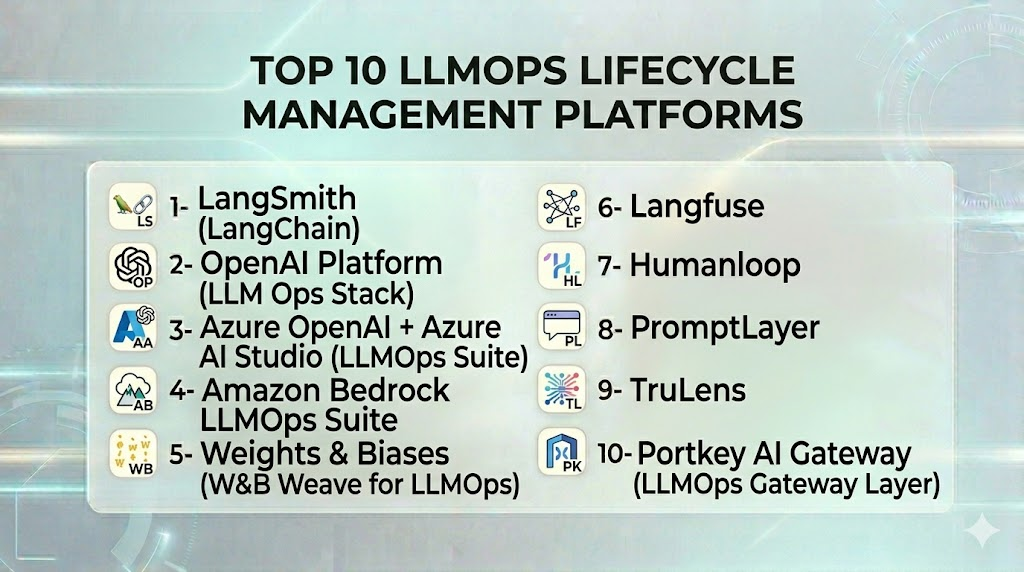
Top 10 LLMOps Lifecycle Management Platforms
1- LangSmith (LangChain)
One-line verdict: Best LLM observability and evaluation platform for LangChain-based applications.
Short description:
LangSmith provides full lifecycle management for LLM applications including tracing, prompt versioning, dataset testing, and evaluation workflows tightly integrated with LangChain.
Standout Capabilities
- LLM application tracing
- Prompt version control
- Evaluation pipelines
- Dataset management
- Debugging LLM chains
- Performance monitoring
- Feedback collection
AI-Specific Depth
- Model support: Multi-model (OpenAI, Anthropic, open-source)
- RAG integration: Native LangChain + vector DB support
- Evaluation: Built-in LLM evaluation suite
- Guardrails: External integrations required
- Observability: Deep trace-level visibility
Pros
- Excellent debugging tools
- Strong ecosystem integration
- Powerful evaluation framework
Cons
- Best suited for LangChain users
- Requires engineering setup
- Not fully standalone platform
Security & Compliance
Enterprise features available; details vary by deployment.
Deployment & Platforms
- Cloud
- API-based integration
Integrations & Ecosystem
- LangChain
- Vector databases
- OpenAI / Anthropic APIs
- RAG frameworks
Pricing Model
Usage-based + enterprise plans.
Best-Fit Scenarios
- LLM app debugging
- RAG pipelines
- Agent-based systems
2- OpenAI Platform (LLM Ops Stack)
One-line verdict: Best for end-to-end LLM lifecycle control within OpenAI ecosystem.
Short description:
OpenAI provides built-in tooling for prompt management, evaluation, fine-tuning, and monitoring of LLM applications.
Standout Capabilities
- Prompt engineering tools
- Model routing
- Evaluation APIs
- Fine-tuning workflows
- Safety systems
- Usage monitoring
- Tool calling support
AI-Specific Depth
- Model support: OpenAI models
- RAG integration: External vector DBs required
- Evaluation: Built-in eval APIs
- Guardrails: Strong safety layer
- Observability: Usage dashboards
Pros
- High model quality
- Integrated ecosystem
- Strong safety systems
Cons
- Vendor lock-in
- Limited multi-model flexibility
- Less customizable pipelines
Security & Compliance
Enterprise-grade controls (varies by plan).
Deployment & Platforms
- Cloud API
Integrations & Ecosystem
- OpenAI APIs
- Assistants API
- Tool calling frameworks
Pricing Model
Usage-based token pricing.
Best-Fit Scenarios
- GPT-based applications
- Rapid LLM deployment
- AI copilots
3- Azure OpenAI + Azure AI Studio (LLMOps Suite)
One-line verdict: Best enterprise LLMOps platform for Microsoft ecosystems.
Short description:
Azure AI Studio provides lifecycle management for LLM applications including prompt workflows, evaluation, safety, and enterprise governance.
Standout Capabilities
- Prompt flow management
- Enterprise evaluation pipelines
- Model orchestration
- RAG integration tools
- Safety and compliance controls
- Deployment pipelines
- Monitoring dashboards
AI-Specific Depth
- Model support: OpenAI + Azure models
- RAG integration: Azure AI Search
- Evaluation: Built-in evaluation tools
- Guardrails: Enterprise policy system
- Observability: Azure monitoring stack
Pros
- Strong enterprise governance
- Deep Microsoft integration
- Hybrid deployment support
Cons
- Complex setup
- Azure dependency
- Cost management challenges
Security & Compliance
Enterprise Azure security, IAM, encryption, compliance controls.
Deployment & Platforms
- Cloud
- Hybrid
Integrations & Ecosystem
- Microsoft 365
- Azure AI Search
- Databricks
- Power Platform
Pricing Model
Usage-based + enterprise licensing.
Best-Fit Scenarios
- Enterprise LLM systems
- Microsoft ecosystem users
- Regulated industries
4- Amazon Bedrock LLMOps Suite
One-line verdict: Best for scalable multi-model LLMOps in AWS environments.
Short description:
Amazon Bedrock provides lifecycle tools for deploying, evaluating, and managing LLM applications across multiple foundation models.
Standout Capabilities
- Multi-model orchestration
- Prompt management
- Guardrails system
- RAG pipeline support
- Evaluation tools
- Usage monitoring
- Enterprise scaling
AI-Specific Depth
- Model support: Anthropic, Meta, AWS models
- RAG integration: AWS knowledge base services
- Evaluation: Built-in metrics tools
- Guardrails: AWS policy system
- Observability: CloudWatch integration
Pros
- Strong scalability
- Multi-model flexibility
- Enterprise security
Cons
- AWS lock-in
- Complex architecture
- Learning curve
Security & Compliance
AWS enterprise-grade security controls.
Deployment & Platforms
- Cloud (AWS)
Integrations & Ecosystem
- S3
- Lambda
- Bedrock models
- AWS AI services
Pricing Model
Usage-based.
Best-Fit Scenarios
- AWS-native AI systems
- Multi-model LLM apps
- Enterprise deployments
5- Weights & Biases (W&B Weave for LLMOps)
One-line verdict: Best for experiment tracking and LLM evaluation workflows.
Short description:
Weave extends W&B into LLMOps with tracing, evaluation, and dataset management for GenAI applications.
Standout Capabilities
- LLM experiment tracking
- Prompt evaluation
- Dataset versioning
- Trace visualization
- Performance benchmarking
- Collaboration tools
- Model monitoring
AI-Specific Depth
- Model support: Multi-model support
- RAG integration: External system support
- Evaluation: Strong evaluation framework
- Guardrails: External implementations
- Observability: Deep experiment tracking
Pros
- Excellent tracking tools
- Strong ML + LLM synergy
- Developer-friendly
Cons
- Requires setup effort
- Not a full deployment platform
- Enterprise features vary
Security & Compliance
Varies by deployment.
Deployment & Platforms
- Cloud
- Self-hosted
Integrations & Ecosystem
- ML frameworks
- LLM APIs
- Vector databases
- CI/CD pipelines
Pricing Model
Freemium + enterprise plans.
Best-Fit Scenarios
- LLM experimentation
- Research teams
- Evaluation pipelines
6- Langfuse
One-line verdict: Best open-source LLM observability and prompt tracking platform.
Short description:
Langfuse provides observability, prompt management, and evaluation tooling for LLM applications with open-source flexibility.
Standout Capabilities
- LLM tracing
- Prompt version control
- Dataset evaluation
- Cost tracking
- User feedback loops
- Debugging tools
- Analytics dashboards
AI-Specific Depth
- Model support: Multi-model support
- RAG integration: External vector DBs
- Evaluation: Built-in evaluation tools
- Guardrails: Custom implementations
- Observability: Full trace logs
Pros
- Open-source flexibility
- Strong observability
- Easy integration
Cons
- Requires self-hosting for full control
- Less enterprise governance
- Smaller ecosystem
Security & Compliance
Depends on deployment setup.
Deployment & Platforms
- Cloud
- Self-hosted
Integrations & Ecosystem
- OpenAI
- LangChain
- Vector databases
- APIs
Pricing Model
Open-source + hosted plans.
Best-Fit Scenarios
- LLM observability
- Developer tools
- Startup AI apps
7- Humanloop
One-line verdict: Best for prompt lifecycle management and LLM evaluation workflows.
Short description:
Humanloop enables structured prompt engineering, evaluation, and deployment workflows for LLM applications.
Standout Capabilities
- Prompt versioning
- Evaluation pipelines
- Human feedback loops
- Model comparison
- Deployment tracking
- A/B testing for prompts
- Collaboration tools
AI-Specific Depth
- Model support: Multi-model support
- RAG integration: External systems
- Evaluation: Strong evaluation framework
- Guardrails: Policy-based controls
- Observability: Prompt-level tracking
Pros
- Strong prompt management
- Good evaluation tools
- Team collaboration features
Cons
- Smaller ecosystem
- Enterprise adoption still growing
- Limited orchestration depth
Security & Compliance
Enterprise controls available (varies).
Deployment & Platforms
- Cloud
Integrations & Ecosystem
- OpenAI
- Anthropic
- LangChain
- APIs
Pricing Model
Subscription-based.
Best-Fit Scenarios
- Prompt engineering teams
- LLM experimentation
- AI product development
8- PromptLayer
One-line verdict: Best lightweight prompt tracking and logging tool.
Short description:
PromptLayer provides simple logging and tracking of LLM prompts, responses, and usage analytics.
Standout Capabilities
- Prompt logging
- Usage analytics
- Version tracking
- API request tracing
- Cost monitoring
- Collaboration tools
- Debugging support
AI-Specific Depth
- Model support: Multi-model support
- RAG integration: External systems required
- Evaluation: Basic evaluation tools
- Guardrails: Not built-in
- Observability: Request-level logs
Pros
- Simple to use
- Fast integration
- Lightweight system
Cons
- Limited enterprise features
- Not full LLMOps suite
- Basic evaluation tools
Security & Compliance
Varies by deployment.
Deployment & Platforms
- Cloud
Integrations & Ecosystem
- OpenAI
- LangChain
- APIs
Pricing Model
Freemium + subscription.
Best-Fit Scenarios
- Small teams
- Prototype LLM apps
- Prompt debugging
9- TruLens
One-line verdict: Best for LLM evaluation and trust scoring systems.
Short description:
TruLens focuses on evaluating LLM applications for quality, relevance, and trustworthiness using structured scoring systems.
Standout Capabilities
- LLM evaluation framework
- Trust scoring systems
- RAG evaluation
- Feedback functions
- Model comparison
- Performance analytics
- Quality monitoring
AI-Specific Depth
- Model support: Multi-model support
- RAG integration: Strong RAG evaluation support
- Evaluation: Core strength
- Guardrails: External systems required
- Observability: Evaluation dashboards
Pros
- Strong evaluation focus
- Great for RAG systems
- Open-source flexibility
Cons
- Not full lifecycle platform
- Requires integration work
- Limited deployment tools
Security & Compliance
Varies by setup.
Deployment & Platforms
- Cloud
- Self-hosted
Integrations & Ecosystem
- LangChain
- Vector DBs
- LLM APIs
- ML tools
Pricing Model
Open-source.
Best-Fit Scenarios
- LLM evaluation systems
- RAG validation
- Research teams
10- Portkey AI Gateway (LLMOps Gateway Layer)
One-line verdict: Best for LLM routing, governance, and cost optimization layer.
Short description:
Portkey acts as a gateway layer for managing, routing, and optimizing LLM requests across multiple providers.
Standout Capabilities
- Multi-model routing
- Cost optimization
- Prompt logging
- Load balancing
- Failover systems
- API governance
- Observability layer
AI-Specific Depth
- Model support: Multi-model routing
- RAG integration: External systems
- Evaluation: Basic monitoring
- Guardrails: Policy routing rules
- Observability: Request-level tracing
Pros
- Excellent routing layer
- Reduces LLM costs
- Easy integration
Cons
- Not full LLMOps suite
- Requires external tools
- Limited evaluation features
Security & Compliance
Enterprise controls available (varies).
Deployment & Platforms
- Cloud
- Self-hosted
Integrations & Ecosystem
- OpenAI
- Anthropic
- Azure OpenAI
- LangChain
Pricing Model
Usage-based + enterprise plans.
Best-Fit Scenarios
- Multi-model LLM systems
- Cost optimization
- API governance
Comparison Table
| Tool Name | Best For | Deployment | Model Flexibility | Strength | Watch-Out | Public Rating |
|---|---|---|---|---|---|---|
| LangSmith | LLM debugging | Cloud | Multi-model | Observability | LangChain dependency | N/A |
| OpenAI Platform | GPT apps | Cloud | OpenAI models | Model quality | Lock-in | N/A |
| Azure AI Studio | Enterprise LLMOps | Cloud/Hybrid | Multi-model | Governance | Complexity | N/A |
| AWS Bedrock | Multi-model scale | Cloud | Multi-model | Infrastructure | AWS lock-in | N/A |
| W&B Weave | Experiment tracking | Cloud/Self-hosted | Multi-model | Evaluation | Not full platform | N/A |
| Langfuse | Open-source LLMOps | Cloud/Self-hosted | Multi-model | Observability | Less governance | N/A |
| Humanloop | Prompt lifecycle | Cloud | Multi-model | Prompt mgmt | Smaller ecosystem | N/A |
| PromptLayer | Logging tool | Cloud | Multi-model | Simplicity | Limited features | N/A |
| TruLens | Evaluation | Cloud/Self-hosted | Multi-model | Evaluation depth | Not full suite | N/A |
| Portkey AI | Gateway layer | Cloud/Self-hosted | Multi-model | Routing | Not full LLMOps | N/A |
Scoring & Evaluation
| Tool | Core | Reliability | Guardrails | Integrations | Ease | Perf/Cost | Security | Support | Weighted Total |
|---|---|---|---|---|---|---|---|---|---|
| LangSmith | 9 | 9 | 8 | 9 | 8 | 8 | 8 | 8 | 8.5 |
| OpenAI Platform | 9 | 9 | 9 | 8 | 9 | 8 | 9 | 8 | 8.7 |
| Azure AI Studio | 9 | 9 | 9 | 9 | 8 | 8 | 9 | 8 | 8.8 |
| AWS Bedrock | 9 | 9 | 9 | 9 | 8 | 8 | 9 | 8 | 8.8 |
| W&B Weave | 8 | 8 | 8 | 9 | 8 | 8 | 8 | 8 | 8.1 |
| Langfuse | 8 | 8 | 8 | 8 | 9 | 8 | 8 | 8 | 8.1 |
| Humanloop | 8 | 8 | 8 | 8 | 9 | 8 | 8 | 8 | 8.0 |
| PromptLayer | 7 | 7 | 6 | 8 | 9 | 9 | 7 | 7 | 7.6 |
| TruLens | 8 | 8 | 7 | 8 | 8 | 8 | 8 | 8 | 8.0 |
| Portkey AI | 8 | 8 | 8 | 9 | 9 | 9 | 8 | 8 | 8.4 |
Which LLMOps Platform Is Right for You?
Solo / Freelancer
PromptLayer or Langfuse for lightweight tracking and debugging.
SMB
Humanloop, Langfuse, and W&B Weave for prompt lifecycle and evaluation.
Mid-Market
LangSmith and Portkey for observability and routing control.
Enterprise
Azure AI Studio, AWS Bedrock, and OpenAI Platform for governance and scale.
Regulated Industries
Prioritize audit logs, data privacy controls, prompt tracking, and evaluation pipelines.
Budget vs Premium
Open-source tools are cost-efficient; enterprise platforms provide governance and scalability.
Build vs Buy
Build when you need custom evaluation systems; buy when you need scalable governance and reliability.
Common Mistakes & How to Avoid Them
- No prompt version control
- Ignoring evaluation pipelines
- Weak guardrails against injection attacks
- No cost monitoring
- Over-reliance on single model
- Missing RAG observability
- Poor dataset management
- Lack of tracing systems
- No feedback loop integration
- Weak governance controls
- Underestimating latency costs
- No rollback strategy for prompts
FAQs
1- What is an LLMOps platform?
It manages the lifecycle of LLM applications including prompts, evaluation, deployment, and monitoring.
2- How is LLMOps different from MLOps?
LLMOps focuses on prompt-based and generative AI systems, while MLOps focuses on traditional ML models.
3- Why is prompt management important?
Because prompt changes significantly impact LLM behavior and output quality.
4- What is RAG in LLMOps?
Retrieval-Augmented Generation, where LLMs use external data sources for responses.
5- Do LLMOps platforms support multiple models?
Yes, most support OpenAI, Anthropic, Azure, and open-source models.
6- What is model routing?
It selects the best LLM based on cost, latency, or performance requirements.
7- Are LLMOps tools secure?
Enterprise tools include governance, access control, and audit logging.
8- What is prompt injection?
A security risk where malicious inputs manipulate LLM behavior.
9- Do LLMOps platforms support evaluation?
Yes, evaluation frameworks are a core component.
10- Can LLMOps reduce costs?
Yes, through model routing and usage optimization.
11- Are these platforms cloud-only?
No, many support hybrid and self-hosted deployments.
12- What is the future of LLMOps?
It will evolve into autonomous AI lifecycle management with agentic orchestration.
Conclusion
LLMOps Lifecycle Management Platforms are essential for scaling large language model applications safely, efficiently, and reliably. As enterprises adopt generative AI across workflows, these platforms provide critical infrastructure for prompt management, evaluation, observability, governance, and multi-model orchestration.
