Introduction
LLM Output Quality Monitoring Platforms are systems designed to continuously evaluate, track, and improve the quality of outputs generated by large language models in production. Unlike traditional ML monitoring (which focuses on accuracy and drift), these platforms specifically measure LLM behavior quality such as hallucination rate, relevance, toxicity, factual correctness, tone consistency, and instruction adherence.
these tools have become essential because LLMs are now embedded in copilots, agents, customer support systems, search engines, and enterprise workflows. Since LLM outputs are probabilistic and non-deterministic, quality can degrade silently without proper monitoring.
These platforms help organizations:
- Detect hallucinations in real time
- Measure response quality at scale
- Compare prompt/model versions
- Track user satisfaction signals
- Enforce safety and compliance policies
- Continuously optimize LLM behavior
Real-World Use Cases
- Chatbot response quality tracking
- Customer support AI QA monitoring
- Enterprise copilots (HR, legal, finance)
- RAG-based answer correctness validation
- Agent workflow output validation
- Toxicity and safety filtering in LLM apps
- Hallucination detection in knowledge assistants
- Multi-model output comparison
Evaluation Criteria for Buyers
When evaluating LLM Output Quality Monitoring Platforms, consider:
- Hallucination detection accuracy
- Relevance scoring mechanisms
- Human + AI evaluation support
- Real-time monitoring capabilities
- Prompt and model version comparison
- RAG evaluation support
- Safety and toxicity detection
- Custom evaluation metrics support
- Dataset-based benchmarking
- Observability and tracing depth
- Feedback loop integration
- API/SDK usability
- Cost scalability
Best for: AI product teams, LLM application developers, enterprise AI governance teams, and organizations deploying production-grade LLM systems.
Not ideal for: Simple chatbots, experimental prototypes, or non-production AI systems.
What’s Changed in LLM Output Quality Monitoring
- Quality monitoring now includes LLM-as-a-judge evaluation systems
- Hallucination detection is a standard built-in feature
- Multi-dimensional scoring (tone, accuracy, relevance) is standard
- Real-time output evaluation is widely adopted
- RAG-groundedness evaluation is mandatory in enterprise systems
- Continuous feedback loops are integrated into production
- Automated red-teaming is part of monitoring pipelines
- Multi-model comparison dashboards are standard
- Cost-quality tradeoff monitoring is emerging
- Agent output quality tracking is now critical
- Safety and bias detection are deeply integrated
- User feedback signals are part of evaluation pipelines
Quick Buyer Checklist
- □ Hallucination detection capability
- □ Real-time LLM output monitoring
- □ Multi-metric evaluation system
- □ Prompt/version comparison tools
- □ RAG grounding evaluation
- □ Toxicity and safety detection
- □ Human feedback integration
- □ Dataset-based evaluation support
- □ API/SDK integration
- □ Cost and latency tracking
- □ Observability dashboards
- □ Multi-model support
- □ CI/CD integration
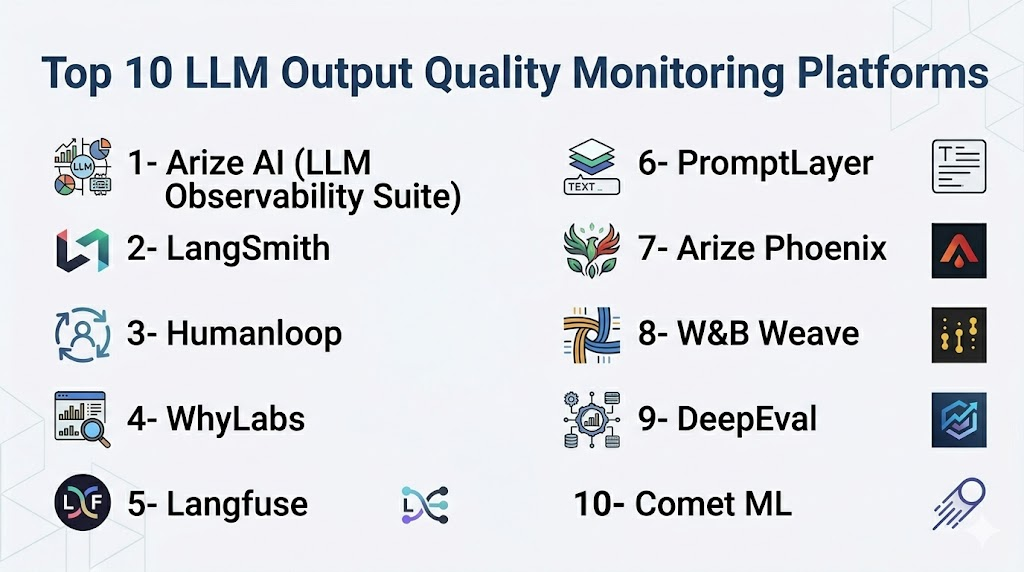
Top 10 LLM Output Quality Monitoring Platforms
1- Arize AI (LLM Observability Suite)
One-line verdict: Best enterprise-grade LLM output quality monitoring and evaluation platform.
Short description:
Arize AI provides deep observability into LLM outputs, including hallucination detection, RAG evaluation, and multi-model comparison dashboards.
Standout Capabilities
- LLM output quality scoring
- Hallucination detection system
- RAG evaluation tools
- Multi-model comparison
- Real-time monitoring dashboards
- Root cause analysis
- Feedback loop tracking
AI-Specific Depth
- Model support: Multi-model (OpenAI, Anthropic, open-source)
- RAG integration: Strong evaluation support
- Evaluation: Built-in LLM-as-a-judge system
- Guardrails: Policy-based safety controls
- Observability: Full trace-level monitoring
Pros
- Enterprise-ready LLM observability
- Strong evaluation framework
- Excellent debugging tools
Cons
- Higher cost
- Complex onboarding
- Vendor lock-in risk
Security & Compliance
Enterprise RBAC, encryption, audit logging.
Deployment & Platforms
- Cloud
Integrations & Ecosystem
- Vector databases
- ML pipelines
- LLM frameworks
- Data warehouses
Pricing Model
Enterprise subscription.
Best-Fit Scenarios
- Enterprise LLM systems
- RAG-based applications
- AI copilots
2- LangSmith
One-line verdict: Best LLM output quality monitoring platform for LangChain-based applications.
Short description:
LangSmith enables tracing, evaluation, and quality monitoring of LLM outputs with strong prompt and chain observability.
Standout Capabilities
- LLM output tracing
- Quality evaluation pipelines
- Prompt version comparison
- Dataset-based evaluation
- A/B testing workflows
- Debugging tools
- Feedback collection
AI-Specific Depth
- Model support: Multi-model
- RAG integration: Native LangChain support
- Evaluation: Built-in evaluation framework
- Guardrails: External integrations required
- Observability: Deep trace system
Pros
- Excellent debugging tools
- Strong evaluation pipelines
- Tight ecosystem integration
Cons
- Best for LangChain ecosystem
- Requires setup effort
- Not fully standalone
Security & Compliance
Enterprise-grade controls available depending on deployment.
Deployment & Platforms
- Cloud
- API-based
Integrations & Ecosystem
- LangChain
- Vector databases
- OpenAI / Anthropic APIs
- RAG pipelines
Pricing Model
Usage-based + enterprise plans.
Best-Fit Scenarios
- LLM apps using LangChain
- RAG systems
- Agent workflows
3- Humanloop
One-line verdict: Best dedicated LLM output evaluation and quality feedback platform.
Short description:
Humanloop focuses on evaluating and improving LLM output quality using human feedback and structured scoring systems.
Standout Capabilities
- Output quality scoring
- Human feedback loops
- A/B testing for prompts
- Evaluation dashboards
- Model comparison
- Prompt tracking
- CI/CD integration
AI-Specific Depth
- Model support: Multi-model
- RAG integration: External systems
- Evaluation: Strong evaluation framework
- Guardrails: Policy-based controls
- Observability: Output-level monitoring
Pros
- Strong evaluation workflows
- Human-in-the-loop feedback
- Easy experimentation
Cons
- Smaller ecosystem
- Limited deep observability
- Enterprise maturity evolving
Security & Compliance
Enterprise controls available depending on plan.
Deployment & Platforms
- Cloud
Integrations & Ecosystem
- OpenAI
- Anthropic
- LangChain
- APIs
Pricing Model
Subscription-based.
Best-Fit Scenarios
- LLM product teams
- Prompt optimization
- Quality testing pipelines
4- WhyLabs
One-line verdict: Best privacy-first LLM output monitoring and quality tracking platform.
Short description:
WhyLabs provides scalable monitoring of LLM outputs with strong emphasis on privacy, governance, and data protection.
Standout Capabilities
- LLM output quality monitoring
- Drift detection for outputs
- Data privacy controls
- Real-time alerts
- Toxicity detection
- Performance tracking
- Feature monitoring
AI-Specific Depth
- Model support: Multi-model
- RAG integration: Supported
- Evaluation: Statistical + LLM metrics
- Guardrails: Policy enforcement
- Observability: Output + feature tracking
Pros
- Strong privacy design
- Lightweight integration
- Good scalability
Cons
- Limited visualization depth
- Fewer advanced LLM features
- Enterprise features vary
Security & Compliance
Strong privacy-first architecture.
Deployment & Platforms
- Cloud
- Hybrid
Integrations & Ecosystem
- ML pipelines
- Data warehouses
- AWS/GCP/Azure
- APIs
Pricing Model
Usage-based + enterprise plans.
Best-Fit Scenarios
- Regulated industries
- Privacy-sensitive LLM apps
- Enterprise AI monitoring
5- Langfuse
One-line verdict: Best open-source LLM output monitoring and observability platform.
Short description:
Langfuse provides tracing, evaluation, and output quality monitoring for LLM applications with developer-first design.
Standout Capabilities
- LLM output tracing
- Quality evaluation system
- Prompt version tracking
- Cost monitoring per request
- Feedback integration
- Debugging dashboards
- Performance analytics
AI-Specific Depth
- Model support: Multi-model
- RAG integration: External systems
- Evaluation: Built-in evaluation tools
- Guardrails: Custom implementations
- Observability: Full trace system
Pros
- Open-source flexibility
- Strong observability
- Easy integration
Cons
- Requires self-hosting for full control
- Limited enterprise governance
- Smaller ecosystem
Security & Compliance
Depends on deployment configuration.
Deployment & Platforms
- Cloud
- Self-hosted
Integrations & Ecosystem
- OpenAI
- LangChain
- Vector databases
- APIs
Pricing Model
Open-source + hosted plans.
Best-Fit Scenarios
- Developer LLM apps
- Startup AI systems
- Output debugging
6- PromptLayer
One-line verdict: Best lightweight LLM output logging and quality tracking tool.
Short description:
PromptLayer provides simple tracking and monitoring of LLM outputs with basic quality evaluation features.
Standout Capabilities
- Output logging system
- Version tracking
- API request monitoring
- Cost tracking
- Basic evaluation
- Debugging tools
- Usage analytics
AI-Specific Depth
- Model support: Multi-model
- RAG integration: External systems
- Evaluation: Basic support
- Guardrails: Not built-in
- Observability: Request-level logs
Pros
- Very easy to use
- Fast setup
- Lightweight system
Cons
- Limited evaluation depth
- Not enterprise-grade
- Basic observability
Security & Compliance
Varies by deployment.
Deployment & Platforms
- Cloud
Integrations & Ecosystem
- OpenAI
- LangChain
- APIs
Pricing Model
Freemium + subscription.
Best-Fit Scenarios
- Small teams
- Prototype LLM apps
- Basic monitoring
7- Arize Phoenix
One-line verdict: Best deep observability platform for LLM output quality debugging.
Short description:
Phoenix provides advanced tracing, evaluation, and debugging for LLM output quality issues.
Standout Capabilities
- LLM output tracing
- Quality regression detection
- RAG evaluation tools
- Root cause analysis
- Dataset analysis
- Performance monitoring
- Debugging dashboards
AI-Specific Depth
- Model support: Multi-model
- RAG integration: Strong support
- Evaluation: Advanced evaluation system
- Guardrails: External systems required
- Observability: Deep trace system
Pros
- Strong debugging tools
- Excellent observability
- Enterprise-grade analytics
Cons
- Not full lifecycle platform
- Requires integration effort
- Focused on observability layer
Security & Compliance
Enterprise features available depending on deployment.
Deployment & Platforms
- Cloud
- Self-hosted
Integrations & Ecosystem
- LLM frameworks
- Vector databases
- APIs
- ML pipelines
Pricing Model
Open-source + enterprise offerings.
Best-Fit Scenarios
- LLM debugging
- Output quality analysis
- Enterprise observability
8- W&B Weave
One-line verdict: Best experiment-driven LLM output evaluation platform.
Short description:
Weave extends Weights & Biases into LLM output monitoring, evaluation, and regression tracking.
Standout Capabilities
- Output quality evaluation
- Dataset tracking
- LLM benchmarking
- Experiment comparison
- Performance scoring
- Trace analysis
- Collaboration dashboards
AI-Specific Depth
- Model support: Multi-model
- RAG integration: External systems
- Evaluation: Strong evaluation system
- Guardrails: External implementations
- Observability: Deep experiment tracking
Pros
- Strong ML + LLM synergy
- Excellent evaluation tools
- Good for research workflows
Cons
- Not purely LLM-focused
- Requires setup effort
- Enterprise features vary
Security & Compliance
Varies by deployment.
Deployment & Platforms
- Cloud
- Self-hosted
Integrations & Ecosystem
- ML frameworks
- LLM APIs
- CI/CD tools
- Vector databases
Pricing Model
Freemium + enterprise plans.
Best-Fit Scenarios
- LLM evaluation research
- Output benchmarking
- AI experimentation
9- DeepEval
One-line verdict: Best open-source framework for LLM output quality testing and evaluation.
Short description:
DeepEval provides structured testing and scoring of LLM outputs for hallucination, relevance, and correctness.
Standout Capabilities
- Output quality scoring
- Hallucination detection
- RAG evaluation
- Custom metrics
- Automated test pipelines
- CI/CD integration
- Dataset evaluation
AI-Specific Depth
- Model support: Multi-model
- RAG integration: Strong support
- Evaluation: Core functionality
- Guardrails: External systems required
- Observability: Test-level tracking
Pros
- Open-source and flexible
- Strong evaluation framework
- CI/CD friendly
Cons
- No UI platform
- Requires engineering setup
- Limited observability features
Security & Compliance
Depends on deployment.
Deployment & Platforms
- Cloud
- Self-hosted
Integrations & Ecosystem
- Python ML stack
- CI/CD pipelines
- LLM APIs
- Vector databases
Pricing Model
Open-source.
Best-Fit Scenarios
- LLM testing pipelines
- CI/CD evaluation
- Developer QA systems
10- Comet ML
One-line verdict: Best collaborative ML + LLM output tracking and monitoring platform.
Short description:
Comet ML provides output tracking, evaluation, and performance monitoring for ML and LLM systems.
Standout Capabilities
- Output quality tracking
- Experiment comparison
- Dataset logging
- Performance monitoring
- Visualization dashboards
- Model evaluation
- Collaboration tools
AI-Specific Depth
- Model support: Multi-model
- RAG integration: External systems
- Evaluation: Experiment-based evaluation
- Guardrails: Role-based access
- Observability: Full tracking system
Pros
- Strong collaboration features
- Easy integration
- Good experiment tracking
Cons
- Not fully LLM-native
- Limited deep evaluation features
- Smaller ecosystem
Security & Compliance
Enterprise features available (varies).
Deployment & Platforms
- Cloud
- Self-hosted
Integrations & Ecosystem
- ML frameworks
- APIs
- CI/CD tools
- LLM pipelines
Pricing Model
Freemium + enterprise plans.
Best-Fit Scenarios
- ML + LLM hybrid systems
- Output tracking
- Team collaboration
Comparison Table
| Tool Name | Best For | Deployment | LLM Monitoring Depth | Strength | Watch-Out | Public Rating |
|---|---|---|---|---|---|---|
| Arize AI | Enterprise LLM monitoring | Cloud | Very high | Observability | Cost | N/A |
| LangSmith | LLM apps | Cloud | High | Debugging | LangChain dependency | N/A |
| Humanloop | Prompt QA | Cloud | High | Evaluation workflows | Smaller ecosystem | N/A |
| WhyLabs | Privacy monitoring | Cloud/Hybrid | Medium-High | Data privacy | Limited UI depth | N/A |
| Langfuse | Open-source monitoring | Cloud/Self-hosted | High | Flexibility | Setup effort | N/A |
| PromptLayer | Lightweight logging | Cloud | Medium | Simplicity | Limited features | N/A |
| Phoenix | LLM debugging | Cloud/Self-hosted | Very high | Trace analysis | Not full platform | N/A |
| W&B Weave | Experiment evaluation | Cloud/Self-hosted | High | ML synergy | Not LLM-only | N/A |
| DeepEval | Testing framework | Cloud/Self-hosted | High | Regression testing | No UI | N/A |
| Comet ML | Collaboration | Cloud/Self-hosted | Medium | Team workflows | Limited LLM depth | N/A |
Scoring & Evaluation
| Tool | Core | Reliability | Guardrails | Integrations | Ease | Perf/Cost | Security | Support | Weighted Total |
|---|---|---|---|---|---|---|---|---|---|
| Arize AI | 9 | 9 | 9 | 9 | 8 | 8 | 9 | 9 | 8.8 |
| LangSmith | 9 | 9 | 8 | 9 | 8 | 8 | 8 | 8 | 8.5 |
| Humanloop | 8 | 8 | 8 | 8 | 9 | 8 | 8 | 8 | 8.1 |
| WhyLabs | 8 | 9 | 8 | 8 | 8 | 9 | 9 | 8 | 8.4 |
| Langfuse | 8 | 8 | 8 | 8 | 9 | 8 | 8 | 8 | 8.1 |
| PromptLayer | 7 | 7 | 6 | 8 | 9 | 9 | 7 | 7 | 7.6 |
| Phoenix | 8 | 9 | 8 | 8 | 8 | 8 | 8 | 8 | 8.2 |
| W&B Weave | 8 | 8 | 8 | 9 | 8 | 8 | 8 | 8 | 8.1 |
| DeepEval | 8 | 9 | 8 | 8 | 8 | 9 | 8 | 8 | 8.3 |
| Comet ML | 8 | 8 | 7 | 8 | 9 | 8 | 8 | 8 | 8.0 |
Which LLM Output Quality Monitoring Tool Is Right for You?
Solo / Freelancer
PromptLayer or DeepEval for lightweight monitoring.
SMB
Langfuse and WhyLabs for scalable monitoring.
Mid-Market
LangSmith and W&B Weave for structured evaluation.
Enterprise
Arize AI, Phoenix, and LangSmith for governance and scale.
Regulated Industries
Focus on privacy, audit logs, and hallucination detection.
Budget vs Premium
Open-source tools reduce cost; enterprise tools improve reliability.
Build vs Buy
Build for custom evaluation logic; buy for scalability and observability.
Common Mistakes & How to Avoid Them
- No hallucination detection
- Ignoring RAG grounding evaluation
- Missing feedback loops
- No dataset-based evaluation
- Weak observability setup
- Over-reliance on manual QA
- No cost tracking per prompt
- Lack of version comparison
- Ignoring safety monitoring
- No CI/CD integration
- Poor alert configuration
- Not tracking model drift in outputs
FAQs
1- What is LLM output quality monitoring?
It is tracking and evaluating the quality of LLM-generated responses in production.
2- Why is it important?
Because LLM outputs are non-deterministic and can degrade over time.
3- What is hallucination detection?
Identifying when an LLM generates incorrect or unsupported information.
4- Do these tools support RAG systems?
Yes, most modern tools support RAG evaluation.
5- What is LLM-as-a-judge?
Using another model to evaluate output quality.
6- Are these tools real-time?
Many support real-time monitoring and alerts.
7- Can I monitor multiple models?
Yes, multi-model support is standard.
8- Are these tools cloud-only?
No, many support self-hosted deployments.
9- What is output drift?
When LLM responses change in quality or style over time.
10- Do these tools track cost?
Yes, most include token and cost monitoring.
11- Can they detect toxicity?
Yes, many include safety and toxicity detection.
12- What is the future of LLM monitoring?
Autonomous self-healing AI quality systems.
Conclusion
LLM Output Quality Monitoring Platforms are essential for ensuring safe, reliable, and high-quality AI systems in production. As LLMs become more deeply integrated into enterprise workflows, monitoring output quality is as important as monitoring infrastructure or model accuracy.
Tools like Arize AI, LangSmith, and Phoenix lead enterprise-grade monitoring, while Langfuse, DeepEval, and PromptLayer provide flexible solutions for developers and startups.
future of LLM monitoring will be autonomous systems that continuously evaluate, debug, and improve model outputs in real time using feedback loops, evaluation agents, and self-healing pipelines.
