Introduction
LLM Output Quality Monitoring Platforms are tools designed to track, evaluate, and improve the reliability of AI-generated responses in production systems. As organizations increasingly deploy large language models into customer support, coding assistants, research tools, and autonomous agents, ensuring output quality is no longer optional—it is a core operational requirement.
and beyond, these platforms play a critical role in managing hallucinations, detecting unsafe or biased outputs, tracking latency and cost per request, and enabling continuous evaluation of AI systems in real-world environments. Unlike traditional monitoring tools, they are specifically built for probabilistic AI systems where outputs are non-deterministic.
Real-world use cases include:
- Monitoring chatbot responses for factual accuracy and hallucination detection
- Evaluating RAG pipelines for retrieval quality and grounding
- Tracking cost, latency, and token usage across multiple models
- Running regression tests on prompts and model updates
- Enforcing safety guardrails in customer-facing AI applications
- Auditing agentic workflows in enterprise automation systems
To effectively evaluate these platforms, buyers should consider:
- Evaluation and testing frameworks (offline + online)
- Observability depth (traces, logs, prompt chains)
- Model support flexibility (multi-model, BYO model)
- RAG compatibility and vector database integrations
- Guardrails and safety controls
- Cost and latency tracking
- Data privacy and governance
- Alerting and incident workflows
- Scalability for production workloads
- Ease of integration with LLM stacks (LangChain, APIs, agents)
Best for: AI engineering teams, MLOps/LLMOps teams, SaaS companies building LLM features, enterprises deploying copilots, and startups scaling AI agents in production.
Not ideal for: small projects without production LLM usage, experimental prototypes without user-facing outputs, or teams relying only on single-model API calls with no monitoring requirements.
What’s Changed in LLM Output Quality Monitoring Platforms
- Shift from simple logging to full LLM observability with trace-level visibility
- Widespread adoption of agentic workflows requiring multi-step evaluation
- Increased focus on hallucination detection and factual grounding metrics
- Built-in prompt injection and jailbreak detection becoming standard
- Strong demand for real-time evaluation pipelines rather than batch-only checks
- Native support for multi-model routing (OpenAI, Anthropic, open-source models)
- Integration with vector databases for RAG quality scoring
- Cost optimization dashboards tied to token-level analytics
- Expansion of human-in-the-loop feedback loops for continuous improvement
- Governance-first design with audit logs and enterprise compliance controls
- Automatic regression testing for prompt/version updates
- Stronger emphasis on privacy controls and data residency requirements
Quick Buyer Checklist
- Does the platform support multi-model or BYO model workflows?
- Can it evaluate both prompts and full agent chains?
- Does it provide real-time + offline evaluation capabilities?
- Are hallucination and safety checks built-in or configurable?
- Does it support RAG pipelines and vector database integrations?
- Are traces available for debugging multi-step agent workflows?
- Can it track cost per request and token-level usage?
- Does it support alerting, dashboards, and incident workflows?
- Is data encrypted, and are retention policies configurable?
- Does it integrate with existing LLM stacks (LangChain, APIs, SDKs)?
- Is there support for human feedback labeling and evaluation loops?
- What is the risk of vendor lock-in?
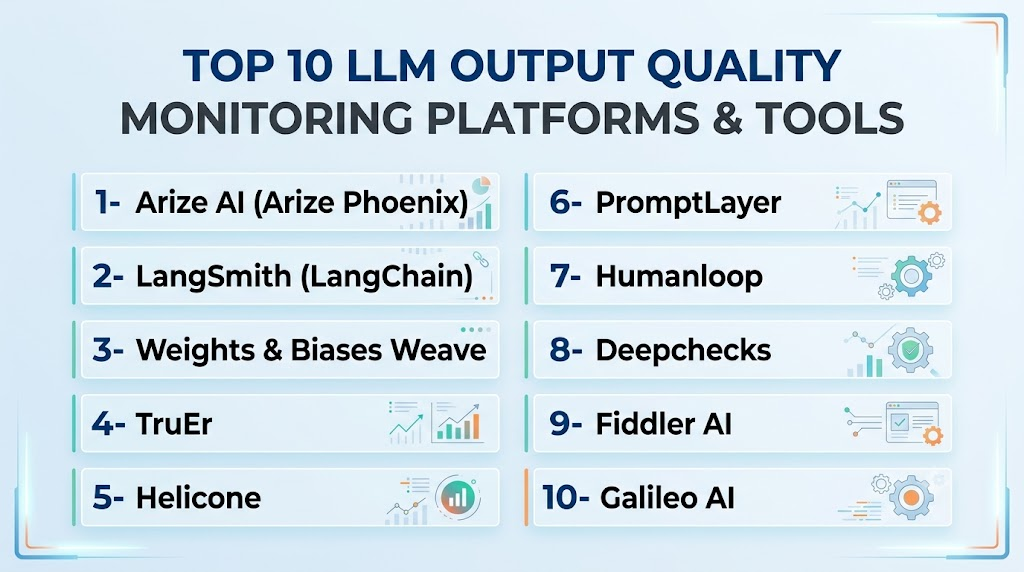
Top 10 LLM Output Quality Monitoring Platforms Tools
1- Arize AI (Arize Phoenix)
One-line verdict: Best for enterprises needing deep LLM observability, evaluation, and production monitoring.
Short description:
Arize AI is a full-stack AI observability platform focused on monitoring ML and LLM systems in production. It is widely used by enterprise AI teams for debugging, evaluation, and drift detection across LLM pipelines.
Standout Capabilities
- End-to-end LLM trace visualization
- Advanced hallucination detection metrics
- RAG evaluation dashboards
- Drift detection across embeddings and outputs
- Real-time alerting for production failures
- Integration with vector databases
- Root cause analysis for model behavior issues
AI-Specific Depth
- Model support: Multi-model + BYO model support
- RAG / knowledge integration: Strong support for embeddings and vector DBs
- Evaluation: Offline + online evaluation, regression testing
- Guardrails: Limited native, integrates with external tools
- Observability: Full trace-level observability, latency, cost tracking
Pros
- Extremely deep observability capabilities
- Strong enterprise-grade analytics
- Excellent RAG debugging tools
Cons
- Complex setup for beginners
- Requires engineering maturity
Security & Compliance
RBAC, audit logs, encryption supported; certifications vary / not publicly stated.
Deployment & Platforms
Cloud and hybrid deployments supported.
Integrations & Ecosystem
Integrates with LangChain, OpenAI APIs, vector databases, and ML pipelines.
Pricing Model
Usage-based and enterprise licensing; exact pricing not publicly stated.
Best-Fit Scenarios
- Enterprise LLM deployments
- RAG-heavy applications
- Production AI monitoring at scale
2- LangSmith (LangChain)
One-line verdict: Best for developers building and testing LLM apps with LangChain ecosystems.
Short description:
LangSmith is an observability and evaluation platform designed by LangChain for tracing, debugging, and testing LLM applications and agent workflows.
Standout Capabilities
- Full prompt and chain tracing
- Dataset-based evaluation workflows
- Built-in regression testing
- Seamless LangChain integration
- Debugging multi-step agent flows
- Human feedback collection
- Prompt version comparison tools
AI-Specific Depth
- Model support: Multi-model via LangChain ecosystem
- RAG integration: Strong support for retrieval workflows
- Evaluation: Regression testing, dataset evaluation
- Guardrails: Basic, via LangChain ecosystem tools
- Observability: Full trace logs and execution graphs
Pros
- Best-in-class LangChain integration
- Easy debugging for agent workflows
- Developer-friendly UI
Cons
- Less flexible outside LangChain ecosystem
- Enterprise features still evolving
Security & Compliance
RBAC and workspace controls; certifications not publicly stated.
Deployment & Platforms
Cloud-based platform.
Integrations & Ecosystem
LangChain, OpenAI, vector DBs, API tools, CI pipelines.
Pricing Model
Tiered SaaS model; details vary.
Best-Fit Scenarios
- LangChain developers
- Prototype-to-production AI apps
- Agent-based systems
3- Weights & Biases Weave
One-line verdict: Best for teams already using W&B for ML and expanding into LLM observability.
Short description:
Weave extends Weights & Biases into LLM observability, evaluation, and prompt monitoring for production AI systems.
Standout Capabilities
- LLM tracing and visualization
- Experiment tracking for prompts
- Dataset evaluation tools
- Model comparison dashboards
- Integration with ML pipelines
- Feedback loop tracking
- Performance benchmarking
AI-Specific Depth
- Model support: Multi-model + BYO
- RAG integration: Supported via pipelines
- Evaluation: Strong experimental evaluation tools
- Guardrails: Limited native support
- Observability: Strong experiment and trace tracking
Pros
- Strong ML ecosystem integration
- Mature analytics platform
- Good experimentation tools
Cons
- LLM features still evolving
- Requires setup overhead
Security & Compliance
Enterprise controls available; details vary.
Deployment & Platforms
Cloud and enterprise deployment options.
Integrations & Ecosystem
PyTorch, Hugging Face, LangChain, OpenAI APIs.
Pricing Model
Freemium + enterprise tiers.
Best-Fit Scenarios
- ML + LLM hybrid teams
- Experiment-heavy AI workflows
- Research-to-production pipelines
4- TruEra
One-line verdict: Best for AI explainability and model quality diagnostics in enterprise environments.
Short description:
TruEra focuses on AI quality testing, explainability, and evaluation for both traditional ML and LLM systems in production.
Standout Capabilities
- Model explainability metrics
- LLM quality scoring
- Bias and fairness detection
- Performance diagnostics
- Regression testing
- Root cause analysis tools
- Governance reporting
AI-Specific Depth
- Model support: Multi-model
- RAG integration: Limited but evolving
- Evaluation: Strong statistical evaluation tools
- Guardrails: Not primary focus
- Observability: Diagnostic-focused observability
Pros
- Strong explainability tools
- Enterprise governance focus
- Deep diagnostic capabilities
Cons
- Less developer-friendly UX
- LLM-native features limited
Security & Compliance
Enterprise-grade controls; certifications not publicly stated.
Deployment & Platforms
Cloud and enterprise deployments.
Integrations & Ecosystem
ML pipelines, data platforms, APIs.
Pricing Model
Enterprise licensing.
Best-Fit Scenarios
- Regulated industries
- AI governance teams
- Model risk management
5- Helicone
One-line verdict: Best lightweight LLM observability layer for startups and developers.
Short description:
Helicone is an open-source LLM observability platform focused on API logging, monitoring, and analytics for LLM applications.
Standout Capabilities
- API request logging
- Cost and token tracking
- Prompt analytics dashboard
- Caching layer for optimization
- Request replay debugging
- Simple integration proxy
- Open-source flexibility
AI-Specific Depth
- Model support: Multi-model APIs
- RAG integration: Basic
- Evaluation: Limited
- Guardrails: Not built-in
- Observability: Strong API-level observability
Pros
- Easy setup
- Open-source option available
- Developer-friendly
Cons
- Limited enterprise features
- Not full evaluation suite
Security & Compliance
Depends on deployment; enterprise features vary.
Deployment & Platforms
Cloud + self-hosted options.
Integrations & Ecosystem
OpenAI, Anthropic APIs, LangChain, custom APIs.
Pricing Model
Open-source + paid hosted tiers.
Best-Fit Scenarios
- Startups
- MVP AI applications
- API-based LLM apps
6- PromptLayer
One-line verdict: Best for prompt versioning, tracking, and experimentation workflows.
Short description:
PromptLayer helps teams manage, track, and evaluate prompts used in LLM applications with version control and analytics.
Standout Capabilities
- Prompt version control
- Execution tracking
- A/B testing prompts
- Analytics dashboards
- Collaboration tools
- API logging
- Feedback integration
AI-Specific Depth
- Model support: Multi-model APIs
- RAG integration: Limited
- Evaluation: Prompt-level evaluation
- Guardrails: Not primary
- Observability: Prompt-focused observability
Pros
- Strong prompt lifecycle management
- Simple developer UX
- Good for experimentation
Cons
- Limited full-stack observability
- Not ideal for enterprise-scale monitoring
Security & Compliance
Not publicly stated.
Deployment & Platforms
Cloud-based platform.
Integrations & Ecosystem
OpenAI, LangChain, APIs, SDK support.
Pricing Model
Tiered SaaS model.
Best-Fit Scenarios
- Prompt engineering teams
- AI experimentation workflows
- Early-stage LLM apps
7- Humanloop
One-line verdict: Best for combining human feedback with LLM evaluation pipelines.
Short description:
Humanloop enables teams to build, evaluate, and improve LLM systems using structured human feedback loops.
Standout Capabilities
- Human-in-the-loop evaluation
- Dataset labeling tools
- Prompt testing frameworks
- Feedback collection UI
- Model comparison tools
- Evaluation pipelines
- Collaboration workflows
AI-Specific Depth
- Model support: Multi-model
- RAG integration: Supported
- Evaluation: Strong human + automated evaluation
- Guardrails: Basic policy checks
- Observability: Evaluation-centric
Pros
- Strong human feedback integration
- Excellent for quality improvement loops
- Easy collaboration
Cons
- Less deep infrastructure observability
- Enterprise scale still evolving
Security & Compliance
RBAC and workspace controls; details vary.
Deployment & Platforms
Cloud platform.
Integrations & Ecosystem
OpenAI, LangChain, APIs, labeling tools.
Pricing Model
SaaS tiered pricing.
Best-Fit Scenarios
- AI product teams
- Quality improvement workflows
- Human feedback systems
8- Deepchecks
One-line verdict: Best for automated ML and LLM testing pipelines with strong validation frameworks.
Short description:
Deepchecks provides automated testing frameworks for ML and LLM systems, focusing on validation, drift detection, and data quality.
Standout Capabilities
- Automated validation suites
- Data drift detection
- Model evaluation tests
- LLM output checks
- Pipeline integration
- Monitoring dashboards
- CI/CD testing support
AI-Specific Depth
- Model support: Multi-model
- RAG integration: Limited
- Evaluation: Strong automated testing
- Guardrails: Not primary focus
- Observability: Monitoring-focused
Pros
- Strong automated testing focus
- CI/CD friendly
- Good for production validation
Cons
- Limited conversational debugging
- Less LLM-native UX
Security & Compliance
Not publicly stated.
Deployment & Platforms
Cloud and self-hosted.
Integrations & Ecosystem
ML pipelines, CI/CD systems, APIs.
Pricing Model
Open-source + enterprise.
Best-Fit Scenarios
- MLOps teams
- CI/CD validation pipelines
- Data-driven LLM systems
9- Fiddler AI
One-line verdict: Best enterprise AI observability platform for fairness, explainability, and monitoring.
Short description:
Fiddler AI provides production monitoring, explainability, and fairness analysis for ML and LLM systems in enterprise environments.
Standout Capabilities
- Model monitoring dashboards
- Explainability tools
- Bias detection
- Drift analysis
- Root cause diagnostics
- Alerting systems
- Governance reporting
AI-Specific Depth
- Model support: Multi-model
- RAG integration: Limited
- Evaluation: Strong monitoring metrics
- Guardrails: Governance-focused
- Observability: Enterprise-grade
Pros
- Strong enterprise adoption
- Deep explainability features
- Good governance tools
Cons
- Complex setup
- Less developer-friendly
Security & Compliance
Enterprise-grade security; certifications not publicly stated.
Deployment & Platforms
Cloud + enterprise deployments.
Integrations & Ecosystem
Data warehouses, ML platforms, APIs.
Pricing Model
Enterprise licensing.
Best-Fit Scenarios
- Large enterprises
- Regulated industries
- AI governance programs
10- Galileo AI
One-line verdict: Best for LLM evaluation, hallucination detection, and quality scoring pipelines.
Short description:
Galileo AI focuses on evaluating LLM outputs, detecting hallucinations, and improving AI system reliability through structured evaluation.
Standout Capabilities
- LLM evaluation pipelines
- Hallucination detection metrics
- Prompt testing frameworks
- Dataset evaluation tools
- Model comparison dashboards
- Quality scoring systems
- Feedback loops
AI-Specific Depth
- Model support: Multi-model
- RAG integration: Strong support
- Evaluation: Core strength (LLM eval focus)
- Guardrails: Evaluation-driven
- Observability: Evaluation + analytics hybrid
Pros
- Strong evaluation focus
- Good hallucination detection
- Developer-friendly tooling
Cons
- Less mature observability layer
- Enterprise features still growing
Security & Compliance
Not publicly stated.
Deployment & Platforms
Cloud platform.
Integrations & Ecosystem
OpenAI, LangChain, APIs, data tools.
Pricing Model
SaaS tiered model.
Best-Fit Scenarios
- LLM evaluation pipelines
- RAG quality testing
- AI QA teams
Comparison Table (Top 10)
| Tool Name | Best For | Deployment | Model Flexibility | Strength | Watch-Out | Public Rating |
|---|---|---|---|---|---|---|
| Arize AI | Enterprise observability | Cloud/Hybrid | Multi/BYO | Deep tracing | Complexity | N/A |
| LangSmith | LangChain apps | Cloud | Multi-model | Agent tracing | Ecosystem lock-in | N/A |
| Weave (W&B) | ML+LLM teams | Cloud/Enterprise | Multi/BYO | Experiment tracking | LLM maturity | N/A |
| TruEra | Governance & explainability | Cloud | Multi-model | Diagnostics | UX complexity | N/A |
| Helicone | Startups/devs | Cloud/Self-hosted | API-based | Lightweight monitoring | Limited eval | N/A |
| PromptLayer | Prompt tracking | Cloud | Multi-model | Prompt versioning | Not full observability | N/A |
| Humanloop | Feedback systems | Cloud | Multi-model | Human evaluation | Scale limits | N/A |
| Deepchecks | Testing pipelines | Cloud/Self-hosted | Multi-model | Automated tests | LLM UX limited | N/A |
| Fiddler AI | Enterprise governance | Cloud/Enterprise | Multi-model | Fairness/explainability | Complexity | N/A |
| Galileo AI | LLM evaluation | Cloud | Multi-model | Hallucination detection | Observability gaps | N/A |
Scoring & Evaluation (Transparent Rubric)
Scoring below is comparative and based on category fit, not absolute performance. Each dimension is weighted to reflect production LLM system needs.
| Tool | Core | Reliability/Eval | Guardrails | Integrations | Ease | Perf/Cost | Security/Admin | Support | Weighted Total |
|---|---|---|---|---|---|---|---|---|---|
| Arize AI | 10 | 9 | 8 | 9 | 6 | 9 | 9 | 8 | 8.8 |
| LangSmith | 9 | 8 | 6 | 10 | 9 | 8 | 7 | 8 | 8.4 |
| Weave (W&B) | 9 | 8 | 7 | 9 | 7 | 8 | 8 | 8 | 8.1 |
| TruEra | 8 | 9 | 8 | 7 | 6 | 7 | 9 | 8 | 7.9 |
| Helicone | 7 | 6 | 5 | 8 | 9 | 9 | 6 | 7 | 7.2 |
| PromptLayer | 7 | 6 | 5 | 8 | 9 | 8 | 6 | 7 | 7.0 |
| Humanloop | 8 | 8 | 7 | 8 | 8 | 7 | 7 | 8 | 7.8 |
| Deepchecks | 8 | 8 | 7 | 8 | 7 | 8 | 8 | 7 | 7.9 |
| Fiddler AI | 9 | 9 | 9 | 8 | 6 | 7 | 10 | 8 | 8.4 |
| Galileo AI | 8 | 9 | 8 | 8 | 8 | 7 | 7 | 7 | 8.0 |
Which LLM Output Quality Monitoring Platforms Tool Is Right for You?
Solo / Freelancer
Lightweight tools like Helicone or PromptLayer are sufficient. Focus is on logging, debugging, and cost tracking rather than full observability.
SMB
LangSmith, Galileo AI, or Humanloop provide strong balance between evaluation, usability, and cost control for growing AI products.
Mid-Market
Weave, Deepchecks, and Arize AI offer scalable observability and evaluation frameworks suitable for production workloads.
Enterprise
Arize AI, Fiddler AI, and TruEra provide governance, compliance, and deep monitoring needed for large-scale AI systems.
Regulated industries (finance/healthcare/public sector)
TruEra and Fiddler AI are strong due to explainability, auditability, and governance-first design.
Budget vs premium
- Budget: Helicone, PromptLayer
- Mid-tier: LangSmith, Galileo AI
- Premium: Arize AI, Fiddler AI
Build vs buy (when to DIY)
- Build if you only need logging + basic metrics
- Buy if you need evaluation, hallucination detection, or governance layers
- Hybrid approach is common for enterprise stacks
Common Mistakes & How to Avoid Them
- Ignoring evaluation frameworks and relying only on logs
- Not tracking prompt versions leading to debugging chaos
- Overlooking cost per request at scale
- Missing hallucination detection mechanisms
- No human feedback loop in production systems
- Locking into a single model provider too early
- Not monitoring RAG retrieval quality
- Treating LLMs as deterministic systems
- Lack of alerting for performance degradation
- No separation between dev and production evaluation
- Poor dataset management for testing
- Skipping security and data retention policies
- Not planning for multi-agent workflows
- Overengineering without baseline observability
FAQs
1. What is an LLM Output Quality Monitoring Platform?
It is a system that tracks and evaluates AI-generated outputs for quality, safety, and performance.
It helps detect hallucinations, latency issues, and inconsistent responses in production systems.
2. Why are these platforms important in 2026?
Because LLMs are widely used in production systems, requiring reliability, governance, and cost control.
They ensure AI outputs are safe, accurate, and consistent at scale.
3. Do these tools support multiple models?
Yes, most modern platforms support multi-model or BYO model configurations.
This helps teams switch between OpenAI, Anthropic, and open-source models.
4. What is LLM observability?
It refers to monitoring prompts, responses, traces, and system behavior in real time.
It helps debug and optimize AI applications.
5. Can these platforms detect hallucinations?
Many platforms include hallucination scoring or evaluation pipelines.
However, detection accuracy varies by tool and setup quality.
6. Are these tools expensive?
Pricing varies widely depending on scale and enterprise needs.
Some tools offer open-source versions with paid enterprise upgrades.
7. Do I need coding knowledge to use them?
Basic understanding of APIs or LLM frameworks is usually required.
Some tools offer low-code or UI-based workflows.
8. Can they integrate with LangChain?
Yes, most platforms support LangChain or similar orchestration frameworks.
This makes integration into agent workflows easier.
9. What is RAG evaluation?
It is the process of measuring how well retrieval-augmented generation systems fetch and use relevant data.
It ensures outputs are grounded in accurate sources.
10. How do these tools handle data privacy?
They offer controls like encryption, RBAC, and data retention settings.
However, compliance certifications vary by vendor.
11. Can I switch between platforms later?
Yes, but migration can be complex due to logging and schema differences.
Using abstraction layers helps reduce vendor lock-in.
12. What is the biggest challenge in LLM monitoring?
Handling non-deterministic outputs and defining measurable quality metrics.
This makes evaluation frameworks essential.
Conclusion
LLM Output Quality Monitoring Platforms are becoming a foundational layer of modern AI infrastructure. As organizations deploy increasingly complex agentic systems and multimodal workflows, visibility into model behavior is essential for safety, cost control, and reliability.
The right platform depends heavily on your stage: startups benefit from lightweight observability tools, mid-market teams need structured evaluation systems, and enterprises require full governance and compliance layers. No single tool fits every use case, which is why most mature AI teams adopt a hybrid stack combining observability, evaluation, and feedback systems.
Choosing the right monitoring foundation early ensures long-term reliability as your AI systems evolve into more autonomous and mission-critical workflows.
