Introduction
Hallucination Detection Tools help teams identify when an AI model produces inaccurate, unsupported, misleading, or fabricated responses. These tools are especially important for LLM apps, RAG systems, AI agents, customer support bots, legal assistants, healthcare copilots, and enterprise knowledge assistants.
As AI systems move from experiments into production, hallucination detection has become a core reliability layer. Modern tools now combine evaluation datasets, LLM-as-a-judge scoring, RAG faithfulness checks, trace monitoring, human review, prompt regression testing, and guardrails.
Best for: AI engineers, LLMOps teams, product teams, compliance teams, and enterprises deploying customer-facing AI.
Not ideal for: very small prototypes, internal experiments with no users, or teams that only need basic API logging.
What’s Changed in Hallucination Detection Tools
- More focus on RAG faithfulness and answer grounding.
- Growth of real-time hallucination blocking for production apps.
- Stronger support for AI agents and multi-step workflows.
- More tools now support LLM-as-a-judge evaluation.
- Open-source options like Ragas, DeepEval, Promptfoo, and Phoenix are becoming popular.
- Enterprise buyers now expect audit logs, RBAC, privacy controls, and evaluation history.
- Hallucination detection is moving into CI/CD pipelines for prompt and model regression testing.
- Vendors are adding cost, latency, and token-level observability.
Quick Buyer Checklist
- Check whether the tool supports RAG faithfulness testing.
- Look for prompt regression testing and eval datasets.
- Confirm support for hosted, BYO, and open-source models.
- Review privacy, retention, RBAC, and audit controls.
- Check integration with LangChain, LlamaIndex, OpenTelemetry, and vector databases.
- Validate latency impact for real-time detection.
- Ensure dashboards cover traces, cost, tokens, and failures.
- Avoid tools that only provide logs but no evaluation workflow.
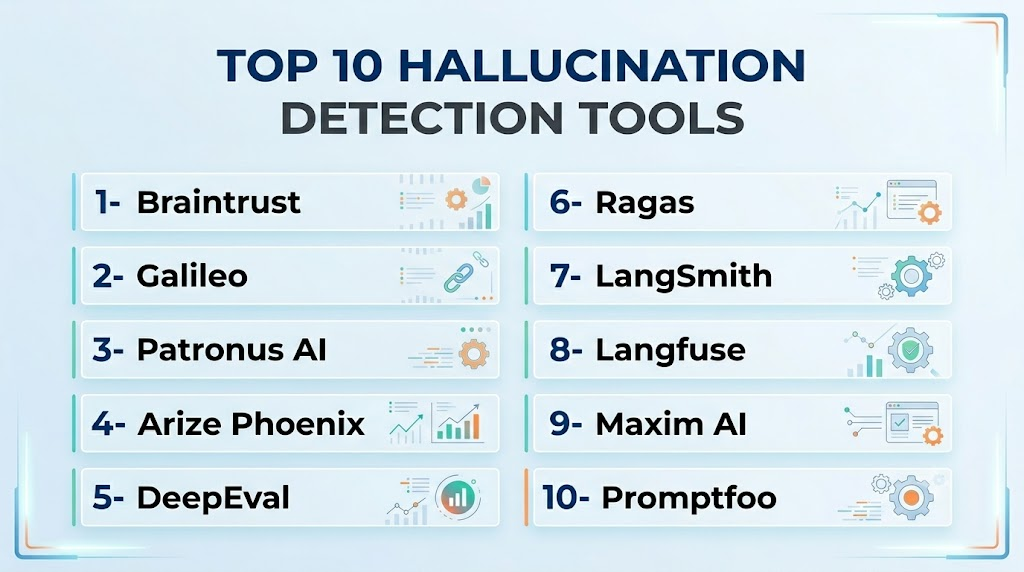
Top 10 Hallucination Detection Tools
1- Braintrust
One-line verdict: Best for teams needing evaluation, tracing, human review, and release control in one workflow.
Short description:
Braintrust helps teams evaluate AI outputs, compare prompt/model versions, inspect traces, and create production-to-evaluation feedback loops. It is especially useful for teams that want hallucination testing connected to product releases.
Standout Capabilities
- LLM eval workflows
- Trace-level debugging
- Human review loops
- Regression testing
- Prompt and model comparison
- Production trace-to-eval conversion
AI-Specific Depth
- Model support: Multi-model / BYO model
- RAG / knowledge integration: Supported through app traces and evals
- Evaluation: Strong
- Guardrails: Evaluation-driven
- Observability: Traces, scoring, and review workflows
Pros
- Strong end-to-end evaluation workflow
- Good for production quality gates
- Useful for both engineers and product teams
Cons
- May require process changes
- Advanced workflows need setup time
- Pricing details vary
Security & Compliance
Enterprise controls are available; exact certifications vary / N/A.
Deployment & Platforms
Cloud-first; deployment options vary.
Pricing Model
Tiered / usage-based; exact pricing varies.
Best-Fit Scenarios
- AI product teams
- Release quality gates
- Human-in-the-loop hallucination review
2- Galileo
One-line verdict: Best for real-time hallucination detection and RAG quality evaluation.
Short description:
Galileo focuses on LLM evaluation, observability, and hallucination detection. Its Luna evaluators are positioned for runtime quality checks and production monitoring. (Galileo AI)
Standout Capabilities
- Hallucination scoring
- RAG evaluation
- Prompt testing
- Production monitoring
- AI quality dashboards
- Model comparison
AI-Specific Depth
- Model support: Multi-model
- RAG / knowledge integration: Strong
- Evaluation: Strong hallucination and quality scoring
- Guardrails: Runtime detection support
- Observability: Quality, latency, and traces
Pros
- Strong hallucination detection focus
- Good for RAG applications
- Production-ready monitoring
Cons
- May be more than small teams need
- Some details vary by plan
- Requires eval design maturity
Security & Compliance
Enterprise controls available; exact certifications not publicly stated.
Deployment & Platforms
Cloud platform; enterprise options vary.
Pricing Model
SaaS / enterprise pricing; exact pricing not publicly stated.
Best-Fit Scenarios
- RAG copilots
- Customer-facing AI apps
- Runtime hallucination checks
3- Patronus AI
One-line verdict: Best for enterprise hallucination detection, safety testing, and domain-specific AI evaluation.
Short description:
Patronus AI provides LLM evaluation and safety testing. Its Lynx model is designed specifically for hallucination detection and has been released as an open-source hallucination detection model. (patronus.ai)
Standout Capabilities
- Lynx hallucination detection model
- Enterprise AI evaluation
- Safety testing
- Domain-specific benchmarks
- Copyright and compliance-focused checks
- Automated evaluation workflows
AI-Specific Depth
- Model support: Multi-model / open-source model support
- RAG / knowledge integration: Supported through evaluation workflows
- Evaluation: Strong hallucination and safety evaluation
- Guardrails: Safety-focused
- Observability: Evaluation-focused
Pros
- Strong hallucination detection specialization
- Useful for regulated enterprise use cases
- Open-source Lynx option
Cons
- May be too specialized for simple monitoring
- Enterprise-focused setup
- Pricing not publicly stated
Security & Compliance
Enterprise controls vary; certifications not publicly stated.
Deployment & Platforms
Cloud and model-based workflows; deployment varies.
Pricing Model
Enterprise pricing; exact pricing not publicly stated.
Best-Fit Scenarios
- Regulated AI systems
- Safety-sensitive LLM apps
- Hallucination benchmark testing
4- Arize Phoenix
One-line verdict: Best open-source option for LLM observability, RAG tracing, and hallucination debugging.
Short description:
Arize Phoenix is an open-source observability and evaluation tool for LLM applications. It is useful for tracing, debugging, and evaluating RAG systems and AI agents.
Standout Capabilities
- Open-source observability
- RAG tracing
- OpenTelemetry support
- Evaluation workflows
- Prompt and response inspection
- Embedding and retrieval analysis
AI-Specific Depth
- Model support: Multi-model / BYO
- RAG / knowledge integration: Strong
- Evaluation: Good
- Guardrails: Limited native
- Observability: Strong tracing and debugging
Pros
- Open-source flexibility
- Strong for RAG debugging
- Good developer adoption
Cons
- Requires setup and maintenance
- Enterprise governance may require Arize platform
- Less plug-and-play than SaaS tools
Security & Compliance
Depends on deployment; enterprise controls vary.
Deployment & Platforms
Self-hosted / cloud options vary.
Pricing Model
Open-source + enterprise options.
Best-Fit Scenarios
- Developer teams
- RAG evaluation
- Self-hosted observability
5- DeepEval
One-line verdict: Best Python-first hallucination testing framework for developers and CI/CD pipelines.
Short description:
DeepEval is an LLM evaluation framework designed for testing outputs with metrics such as hallucination, faithfulness, answer relevancy, and more. Its hallucination metric compares output against provided context using LLM-as-a-judge methods. (DeepEval)
Standout Capabilities
- Python-first testing
- Hallucination metric
- RAG evaluation metrics
- CI/CD friendly
- Unit-test style workflows
- Integration with Confident AI platform
AI-Specific Depth
- Model support: Multi-model
- RAG / knowledge integration: Strong through metrics
- Evaluation: Strong
- Guardrails: Limited
- Observability: Evaluation-focused
Pros
- Developer-friendly
- Strong for automated tests
- Works well in pipelines
Cons
- Less of a full observability platform
- Requires coding
- Human review workflows may need add-ons
Security & Compliance
Varies / N/A.
Deployment & Platforms
Open-source Python framework; hosted options vary.
Pricing Model
Open-source + hosted platform options.
Best-Fit Scenarios
- CI hallucination testing
- Python AI apps
- Prompt regression testing
6- Ragas
One-line verdict: Best open-source framework for RAG hallucination and faithfulness evaluation.
Short description:
Ragas is an open-source framework for evaluating retrieval-augmented generation pipelines. It provides metrics for RAG evaluation and supports systematic experiments and dataset-based assessment. (Ragas)
Standout Capabilities
- RAG faithfulness scoring
- Context precision and recall
- Answer relevancy metrics
- Dataset-based evaluation
- Open-source flexibility
- Works with common LLM stacks
AI-Specific Depth
- Model support: BYO / multi-model
- RAG / knowledge integration: Very strong
- Evaluation: Strong for RAG
- Guardrails: N/A
- Observability: Limited unless integrated with other tools
Pros
- Excellent for RAG evaluation
- Open-source and flexible
- Strong research foundation
Cons
- Not a full monitoring platform
- Requires engineering setup
- Limited enterprise admin controls
Security & Compliance
Depends on deployment; not publicly stated.
Deployment & Platforms
Open-source framework.
Pricing Model
Open-source; commercial ecosystem varies.
Best-Fit Scenarios
- RAG quality testing
- Retrieval evaluation
- Offline hallucination analysis
7- LangSmith
One-line verdict: Best for LangChain teams monitoring hallucinations across chains and agents.
Short description:
LangSmith provides tracing, debugging, evaluation, and dataset workflows for LLM applications. It is especially useful for teams already building with LangChain.
Standout Capabilities
- Chain and agent tracing
- Dataset-based evaluation
- Prompt regression testing
- Human feedback support
- Debugging for multi-step workflows
- Production monitoring
AI-Specific Depth
- Model support: Multi-model via LangChain ecosystem
- RAG / knowledge integration: Strong
- Evaluation: Strong
- Guardrails: Basic / ecosystem-dependent
- Observability: Strong tracing
Pros
- Excellent for LangChain apps
- Strong developer experience
- Good for agents and RAG
Cons
- Best value inside LangChain ecosystem
- Less open-ended than custom frameworks
- Advanced governance varies
Security & Compliance
Workspace controls available; exact certifications vary.
Deployment & Platforms
Cloud; enterprise options vary.
Pricing Model
Tiered SaaS pricing.
Best-Fit Scenarios
- LangChain apps
- Agent debugging
- Prompt and chain evaluation
8- Langfuse
One-line verdict: Best open-source LLM observability platform for traces, evals, and cost monitoring.
Short description:
Langfuse is an open-source LLM engineering platform focused on tracing, analytics, prompt management, evaluation, and observability.
Standout Capabilities
- Open-source LLM tracing
- Prompt management
- Evaluation workflows
- Cost and latency tracking
- Dataset support
- API and SDK integrations
AI-Specific Depth
- Model support: Multi-model / BYO
- RAG / knowledge integration: Supported through traces and evals
- Evaluation: Good
- Guardrails: Limited native
- Observability: Strong
Pros
- Open-source friendly
- Good observability depth
- Useful for startups and dev teams
Cons
- Guardrails are limited
- Requires setup for self-hosting
- Enterprise features vary
Security & Compliance
Varies by deployment; enterprise controls may be available.
Deployment & Platforms
Cloud and self-hosted.
Pricing Model
Open-source + hosted SaaS.
Best-Fit Scenarios
- Cost monitoring
- Self-hosted LLM observability
- Trace-based hallucination review
9- Maxim AI
One-line verdict: Best for AI product teams needing evaluation, simulation, and production monitoring.
Short description:
Maxim AI provides tools for AI evaluation, simulation, observability, and monitoring. It is used to detect hallucinations, test agent workflows, and evaluate production AI applications. (Maxim AI)
Standout Capabilities
- AI simulation testing
- Production monitoring
- Agent evaluation
- Hallucination detection workflows
- Prompt testing
- Observability dashboards
AI-Specific Depth
- Model support: Multi-model
- RAG / knowledge integration: Supported
- Evaluation: Strong
- Guardrails: Evaluation-driven
- Observability: Strong
Pros
- Good for agentic AI testing
- Combines simulation and monitoring
- Useful for product QA teams
Cons
- Smaller ecosystem than larger platforms
- Pricing details vary
- Requires structured eval setup
Security & Compliance
Not publicly stated.
Deployment & Platforms
Cloud platform; options vary.
Pricing Model
SaaS / enterprise pricing; exact pricing not publicly stated.
Best-Fit Scenarios
- AI agent testing
- Product QA workflows
- Hallucination monitoring
10- Promptfoo
One-line verdict: Best lightweight open-source tool for prompt testing and hallucination regression checks.
Short description:
Promptfoo is an open-source evaluation and testing framework for prompts and LLM applications. It is useful for CI/CD workflows, regression tests, and structured assertions.
Standout Capabilities
- YAML-based prompt tests
- CI/CD integration
- Model comparison
- Regression testing
- Custom assertions
- Lightweight developer workflow
AI-Specific Depth
- Model support: Multi-model / BYO
- RAG / knowledge integration: Possible through custom tests
- Evaluation: Strong for prompt tests
- Guardrails: Limited
- Observability: Limited
Pros
- Simple and developer-friendly
- Great for CI quality gates
- Open-source option
Cons
- Not a full monitoring platform
- Limited dashboards
- Requires test design
Security & Compliance
Depends on deployment; not publicly stated.
Deployment & Platforms
Open-source CLI / framework.
Pricing Model
Open-source + commercial options vary.
Best-Fit Scenarios
- Prompt regression testing
- CI/CD evals
- Lightweight hallucination checks
Comparison Table
| Tool Name | Best For | Deployment | Model Flexibility | Strength | Watch-Out | Public Rating |
|---|---|---|---|---|---|---|
| Braintrust | Evaluation + release quality | Cloud | Multi-model / BYO | End-to-end eval workflow | Setup process | N/A |
| Galileo | Runtime hallucination detection | Cloud | Multi-model | RAG and hallucination scoring | Pricing varies | N/A |
| Patronus AI | Enterprise safety testing | Cloud / model workflows | Multi-model / open-source | Lynx hallucination model | Enterprise focus | N/A |
| Arize Phoenix | Open-source observability | Self-hosted / cloud | Multi-model / BYO | RAG tracing | Setup required | N/A |
| DeepEval | Python eval tests | Open-source / hosted | Multi-model | CI hallucination metrics | Code-first | N/A |
| Ragas | RAG evaluation | Open-source | BYO / multi-model | Faithfulness metrics | Not full monitoring | N/A |
| LangSmith | LangChain apps | Cloud | Multi-model | Chain and agent tracing | Ecosystem fit | N/A |
| Langfuse | Open-source LLM observability | Cloud / self-hosted | Multi-model / BYO | Traces and cost monitoring | Limited guardrails | N/A |
| Maxim AI | AI app simulation | Cloud | Multi-model | Agent monitoring | Smaller ecosystem | N/A |
| Promptfoo | Prompt regression testing | Open-source | Multi-model / BYO | CI/CD evals | Limited observability | N/A |
Scoring & Evaluation
This scoring is comparative, not absolute. It reflects category fit for hallucination detection, RAG quality, production readiness, developer usability, integrations, and governance. Scores may vary depending on deployment size, architecture, and evaluation strategy.
| Tool | Core | Reliability/Eval | Guardrails | Integrations | Ease | Perf/Cost | Security/Admin | Support | Weighted Total |
|---|---|---|---|---|---|---|---|---|---|
| Braintrust | 9 | 9 | 7 | 9 | 8 | 8 | 8 | 8 | 8.4 |
| Galileo | 9 | 9 | 8 | 8 | 8 | 8 | 8 | 8 | 8.5 |
| Patronus AI | 8 | 9 | 8 | 7 | 7 | 7 | 8 | 7 | 7.9 |
| Arize Phoenix | 8 | 8 | 6 | 9 | 7 | 8 | 7 | 8 | 7.8 |
| DeepEval | 8 | 9 | 6 | 8 | 8 | 8 | 6 | 7 | 7.8 |
| Ragas | 8 | 9 | 5 | 8 | 7 | 8 | 5 | 7 | 7.4 |
| LangSmith | 9 | 8 | 6 | 10 | 9 | 8 | 7 | 8 | 8.3 |
| Langfuse | 8 | 7 | 5 | 8 | 8 | 9 | 7 | 7 | 7.5 |
| Maxim AI | 8 | 8 | 7 | 8 | 8 | 8 | 7 | 7 | 7.8 |
| Promptfoo | 7 | 8 | 5 | 8 | 8 | 8 | 5 | 7 | 7.1 |
Which Hallucination Detection Tool Is Right for You?
Solo / Freelancer
Choose Promptfoo, DeepEval, or Ragas. These are lightweight, developer-friendly, and useful for testing prompts or RAG pipelines without a heavy platform.
SMB
Choose LangSmith, Langfuse, or Galileo. These provide stronger workflows for tracing, monitoring, and quality evaluation as AI usage grows.
Mid-Market
Choose Braintrust, Galileo, or Maxim AI. These tools help teams connect evaluation, production monitoring, and release quality checks.
Enterprise
Choose Galileo, Patronus AI, Braintrust, or Arize. These tools are better suited for governance, production reliability, and larger AI teams.
Regulated industries
Patronus AI, Galileo, and Braintrust are strong fits where hallucination risk, safety, auditability, and evaluation history matter.
Budget vs premium
For budget-conscious teams, start with Ragas, DeepEval, Promptfoo, or Langfuse. For premium workflows, evaluate Galileo, Braintrust, Patronus AI, and Arize.
Build vs buy
Build your own only if your needs are simple: basic logs, manual review, and offline tests. Buy when you need real-time scoring, dashboards, governance, alerts, and production workflows.
Common Mistakes & How to Avoid Them
- Relying only on user complaints to find hallucinations.
- Testing prompts once and never retesting after updates.
- Ignoring RAG retrieval quality.
- Using generic evals without domain-specific test data.
- Not tracking prompt and model versions.
- Allowing production AI outputs with no human review path.
- Forgetting to monitor latency added by detection tools.
- Not separating dev, staging, and production evals.
- Treating LLM-as-a-judge scores as perfect truth.
- Skipping privacy and data retention reviews.
- Overusing one model provider without abstraction.
- Not measuring cost per evaluated response.
- Ignoring multilingual hallucination risks.
- Failing to create escalation workflows for unsafe outputs.
FAQs
1. What is a hallucination detection tool?
A hallucination detection tool checks whether an AI-generated answer is factual, grounded, and supported by the given context. It helps teams reduce fabricated or misleading outputs.
2. Can hallucination detection be fully automated?
It can be partially automated, but not perfectly. High-risk use cases should combine automated scoring with human review.
3. What is RAG faithfulness?
RAG faithfulness measures whether an answer is supported by retrieved documents. It is one of the most important metrics for reducing hallucinations in knowledge-based AI apps.
4. Are open-source tools enough?
Open-source tools are enough for many developer teams and early-stage products. Enterprises usually need stronger governance, dashboards, access controls, and support.
5. Which tool is best for developers?
DeepEval, Ragas, Promptfoo, Langfuse, and Arize Phoenix are strong developer-friendly options.
6. Which tool is best for enterprises?
Galileo, Braintrust, Patronus AI, and Arize are strong enterprise options depending on evaluation, governance, and monitoring needs.
7. Do these tools work with OpenAI and Anthropic models?
Most modern tools support multiple model providers, but exact support varies. Always confirm model compatibility before purchase.
8. Can these tools detect hallucinations in AI agents?
Yes, some tools support agent tracing and multi-step evaluation. LangSmith, Braintrust, Maxim AI, Galileo, and Langfuse are useful for agent workflows.
9. Do hallucination detection tools increase latency?
Runtime detection can add latency. Offline evaluation does not affect user experience, while real-time blocking must be carefully tested.
10. How do I measure hallucination risk?
Use metrics like faithfulness, factual consistency, context relevance, answer relevancy, citation accuracy, and human review failure rate.
11. Can hallucination detection tools replace guardrails?
No. They complement guardrails. Detection identifies unsupported outputs, while guardrails help block or control risky behavior.
12. What is the best starting point?
Start with a small eval dataset, add tracing, run hallucination tests, and compare results across prompts and models before scaling.
Conclusion
Hallucination Detection Tools are now essential for any serious LLM, RAG, or AI agent deployment. The best tool depends on your maturity level: developers may prefer DeepEval, Ragas, Promptfoo, or Langfuse; growing teams may choose LangSmith or Maxim AI; enterprises may need Galileo, Braintrust, Patronus AI, or Arize.
