Introduction
As organizations scale Large Language Models, AI agents, Retrieval-Augmented Generation systems, and multimodal applications, controlling inference costs and maintaining low latency have become top priorities. Even highly capable AI systems can fail to deliver business value if response times are slow or operational costs become unpredictable.
Model Latency & Cost Optimization Tools help organizations monitor, analyze, and optimize AI workloads. These platforms provide visibility into token consumption, API usage, GPU utilization, model performance, routing decisions, caching opportunities, and infrastructure efficiency. By optimizing both cost and speed, businesses can improve user experience while maximizing the return on their AI investments.
Real-world use cases include:
- Reducing token costs for AI-powered customer support systems
- Optimizing response times for AI search and recommendation engines
- Managing multi-model AI environments
- Improving GPU resource utilization
- Implementing intelligent model routing strategies
- Monitoring AI agent workflows and performance
Evaluation Criteria for Buyers
When evaluating Model Latency & Cost Optimization Tools, consider:
- Cost visibility and forecasting
- Latency monitoring capabilities
- Model routing intelligence
- Multi-provider support
- Token-level analytics
- AI observability features
- Scalability
- Security controls
- Integration ecosystem
- Ease of deployment
Best for: AI engineering teams, LLMOps professionals, MLOps teams, SaaS providers, enterprises running production AI systems, and organizations managing large-scale AI workloads.
Not ideal for: Small experimental projects, low-volume AI deployments, or teams that do not yet operate production AI applications.
What’s Changed in Model Latency & Cost Optimization Tools
- Dynamic model routing has become mainstream.
- Organizations increasingly use multiple LLM providers simultaneously.
- Cost governance is becoming a board-level concern.
- AI agents require optimization across multi-step workflows.
- Prompt caching adoption continues to grow.
- Token-level observability is becoming standard.
- GPU efficiency monitoring is receiving more attention.
- Latency SLAs are now common for customer-facing AI systems.
- AI infrastructure teams are prioritizing workload orchestration.
- Enterprise governance and audit requirements are expanding.
- Automated optimization recommendations are becoming more common.
- Open-source optimization platforms are gaining adoption.
Quick Buyer Checklist
- Does the tool provide token-level cost analytics?
- Can it monitor latency across AI workflows?
- Does it support multiple LLM providers?
- Is intelligent model routing available?
- Does it provide observability dashboards?
- Can it optimize AI agent performance?
- Are cost forecasting features included?
- Does it support cloud and self-hosted deployments?
- Are governance and audit controls available?
- Does it integrate with existing AI infrastructure?
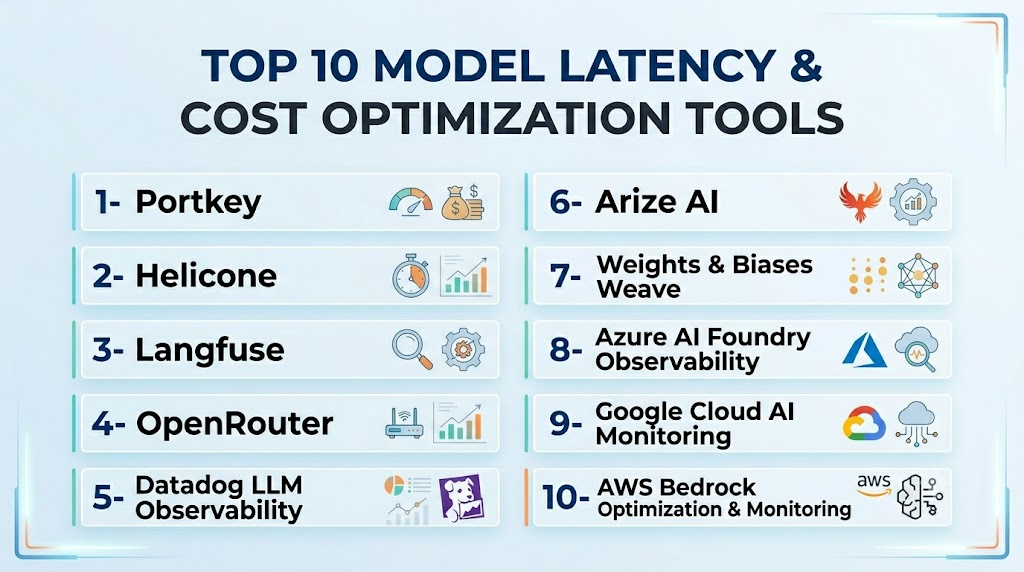
Top 10 Model Latency & Cost Optimization Tools
1- Portkey
One-line verdict: Best overall platform for AI gateway management, latency reduction, and cost optimization.
Short description:
Portkey provides a unified AI gateway that helps organizations manage multiple LLM providers while optimizing cost, reliability, performance, and governance. Its intelligent routing capabilities help teams reduce expenses while maintaining quality.
Standout Capabilities
- AI gateway architecture
- Intelligent model routing
- Failover management
- Cost optimization
- Latency reduction
- Request governance
- Multi-provider orchestration
AI-Specific Depth
- Model support: Multi-model and BYO model
- RAG / knowledge integration: Supported
- Evaluation: Basic monitoring and analytics
- Guardrails: Strong governance controls
- Observability: Extensive request tracking
Pros
- Excellent multi-model management
- Strong optimization capabilities
- Enterprise-ready architecture
Cons
- Initial setup complexity
- Learning curve for advanced features
- Pricing varies by usage
Security & Compliance
RBAC, audit logging, governance controls, and enterprise access management.
Deployment & Platforms
- Cloud
- Hybrid deployments
Integrations & Ecosystem
Supports major AI providers, APIs, AI frameworks, observability platforms, and enterprise infrastructure tools.
Pricing Model
Usage-based and enterprise licensing.
Best-Fit Scenarios
- Enterprise AI platforms
- Multi-model deployments
- Cost-sensitive AI workloads
2- Helicone
One-line verdict: Best for startups and growing AI teams seeking cost visibility and observability.
Short description:
Helicone is a popular LLM observability platform that helps teams understand token consumption, latency patterns, API costs, and optimization opportunities across AI applications.
Standout Capabilities
- Cost tracking
- Token analytics
- Latency monitoring
- Request replay
- Caching support
- Open-source availability
- Usage analytics
AI-Specific Depth
- Model support: Multi-model
- RAG / knowledge integration: Supported
- Evaluation: Basic
- Guardrails: Limited
- Observability: Strong
Pros
- Easy deployment
- Open-source option
- Excellent cost visibility
Cons
- Limited governance features
- Less advanced evaluation
- Enterprise controls vary
Security & Compliance
Depends on deployment configuration.
Deployment & Platforms
- Cloud
- Self-hosted
Integrations & Ecosystem
OpenAI, Anthropic, LangChain, LlamaIndex, custom APIs.
Pricing Model
Freemium and usage-based plans.
Best-Fit Scenarios
- Startup AI products
- Cost monitoring
- Token analytics
3- Langfuse
One-line verdict: Best open-source platform for tracing, cost monitoring, and latency analysis.
Short description:
Langfuse combines observability, tracing, evaluation, and analytics into a single platform designed specifically for modern LLM applications.
Standout Capabilities
- End-to-end tracing
- Prompt management
- Cost analytics
- Latency analysis
- Evaluation workflows
- Open-source deployment
- Token monitoring
AI-Specific Depth
- Model support: Multi-model
- RAG / knowledge integration: Supported
- Evaluation: Strong
- Guardrails: Basic
- Observability: Excellent
Pros
- Open-source flexibility
- Strong observability features
- Active ecosystem
Cons
- Requires setup effort
- Limited governance compared to enterprise platforms
- Self-hosting complexity
Security & Compliance
Varies based on deployment.
Deployment & Platforms
- Cloud
- Self-hosted
Integrations & Ecosystem
LangChain, LlamaIndex, vector databases, APIs, SDKs.
Pricing Model
Open-source with managed hosting options.
Best-Fit Scenarios
- Developer teams
- Self-hosted AI environments
- AI observability projects
4- OpenRouter
One-line verdict: Best for model selection and provider cost comparison.
Short description:
OpenRouter provides unified access to multiple AI models, allowing organizations to compare costs, performance, and latency while avoiding vendor lock-in.
Standout Capabilities
- Unified model access
- Cost comparison
- Provider flexibility
- Unified API
- Performance benchmarking
- Rapid model switching
AI-Specific Depth
- Model support: Extensive multi-model support
- RAG / knowledge integration: Supported
- Evaluation: Basic
- Guardrails: Limited
- Observability: Moderate
Pros
- Easy model experimentation
- Strong flexibility
- Reduced vendor lock-in
Cons
- Limited observability depth
- Fewer enterprise controls
- Basic governance
Security & Compliance
Varies by deployment.
Deployment & Platforms
- Cloud
Pricing Model
Usage-based.
Best-Fit Scenarios
- Model experimentation
- Cost benchmarking
- AI startups
5- Datadog LLM Observability
One-line verdict: Best for organizations already using Datadog for infrastructure monitoring.
Short description:
Datadog extends its monitoring capabilities to AI workloads, providing visibility into latency, costs, traces, and operational performance.
Standout Capabilities
- Unified monitoring
- LLM observability
- Infrastructure visibility
- Cost monitoring
- Trace analysis
- Alerting systems
Pros
- Familiar enterprise platform
- Strong ecosystem
- Unified dashboards
Cons
- May be expensive
- Complex deployments
- Best suited for existing Datadog customers
Security & Compliance
Enterprise-grade access controls and auditing.
Deployment & Platforms
- Cloud
Best-Fit Scenarios
- Existing Datadog customers
- Enterprise observability
- Large-scale deployments
6- Arize AI
One-line verdict: Best for AI observability and production performance optimization.
Short description:
Arize AI provides monitoring, observability, drift detection, and performance analysis for AI systems operating at scale.
Standout Capabilities
- AI observability
- Latency analysis
- Performance monitoring
- Drift detection
- Root cause analysis
- Production diagnostics
Pros
- Enterprise-ready
- Deep analytics
- Strong debugging capabilities
Cons
- Complexity
- Requires expertise
- Pricing varies
Pricing Model
Enterprise licensing.
Best-Fit Scenarios
- Enterprise AI systems
- Production monitoring
- AI performance optimization
7- Weights & Biases Weave
One-line verdict: Best for organizations combining ML experimentation and LLM optimization.
Short description:
Weave extends experiment tracking and observability into LLM workflows, helping teams improve efficiency and performance.
Standout Capabilities
- Experiment tracking
- Cost monitoring
- Workflow tracing
- Evaluation support
- Performance analysis
- Model comparisons
Pros
- Strong ML ecosystem
- Good analytics
- Broad adoption
Cons
- Learning curve
- LLM-specific features still evolving
- Setup complexity
Pricing Model
Freemium and enterprise tiers.
Best-Fit Scenarios
- ML engineering teams
- Hybrid ML and LLM environments
- Performance optimization
8- Azure AI Foundry Observability
One-line verdict: Best for Microsoft-centric enterprises optimizing AI workloads.
Short description:
Azure AI Foundry offers monitoring, governance, performance optimization, and operational visibility for AI systems deployed within the Microsoft ecosystem.
Standout Capabilities
- Enterprise monitoring
- Cost management
- Governance controls
- Latency analytics
- AI workflow visibility
- Security integration
Pros
- Strong Microsoft integration
- Enterprise governance
- Scalable architecture
Cons
- Azure dependency
- Complex licensing
- Learning curve
Best-Fit Scenarios
- Microsoft enterprises
- Regulated industries
- Enterprise AI deployments
9- Google Cloud AI Monitoring
One-line verdict: Best for organizations running AI workloads on Google Cloud.
Short description:
Google Cloud AI Monitoring provides observability, performance tracking, and operational optimization for AI applications hosted within GCP.
Standout Capabilities
- Cloud-native monitoring
- Performance analytics
- Cost visibility
- Operational dashboards
- AI workload management
- Scalability tools
Pros
- Strong GCP integration
- Scalable infrastructure
- Comprehensive monitoring
Cons
- GCP-focused
- Vendor dependency
- Advanced features may require expertise
Best-Fit Scenarios
- GCP customers
- Cloud-native AI applications
- Enterprise AI monitoring
10- AWS Bedrock Optimization & Monitoring
One-line verdict: Best for organizations building AI systems within AWS environments.
Short description:
AWS Bedrock provides managed access to multiple foundation models while offering monitoring, optimization, governance, and performance management capabilities.
Standout Capabilities
- Managed AI services
- Multi-model access
- Cost visibility
- Governance controls
- Performance monitoring
- Enterprise scalability
Pros
- Strong AWS integration
- Enterprise features
- Simplified AI operations
Cons
- AWS-centric
- Pricing complexity
- Vendor ecosystem dependency
Best-Fit Scenarios
- AWS customers
- Enterprise AI workloads
- Managed AI deployments
Comparison Table
| Tool Name | Best For | Deployment | Model Flexibility | Strength | Watch-Out | Public Rating |
|---|---|---|---|---|---|---|
| Portkey | AI gateways | Cloud/Hybrid | Multi-model | Routing | Setup complexity | N/A |
| Helicone | Cost monitoring | Cloud/Self-hosted | Multi-model | Token analytics | Limited governance | N/A |
| Langfuse | Open-source observability | Cloud/Self-hosted | Multi-model | Tracing | Self-hosting effort | N/A |
| OpenRouter | Model access | Cloud | Multi-model | Provider flexibility | Limited monitoring | N/A |
| Datadog | Enterprise monitoring | Cloud | Multi-model | Unified observability | Cost | N/A |
| Arize AI | AI observability | Cloud/Hybrid | Multi-model | Diagnostics | Complexity | N/A |
| Weave | ML and LLM teams | Cloud | Multi-model | Experiment tracking | Learning curve | N/A |
| Azure AI Foundry | Microsoft enterprises | Cloud | Multi-model | Governance | Azure dependency | N/A |
| Google Cloud AI | GCP customers | Cloud | Multi-model | Cloud integration | GCP dependency | N/A |
| AWS Bedrock | AWS customers | Cloud | Multi-model | Managed AI services | AWS dependency | N/A |
Scoring & Evaluation
This scoring is comparative rather than absolute. Scores reflect platform capabilities related to latency optimization, cost reduction, observability, governance, integrations, and operational efficiency.
| Tool | Core | Reliability/Eval | Guardrails | Integrations | Ease | Perf/Cost | Security/Admin | Support | Weighted Total |
|---|---|---|---|---|---|---|---|---|---|
| Portkey | 9 | 8 | 8 | 9 | 7 | 10 | 8 | 8 | 8.6 |
| Helicone | 8 | 7 | 6 | 8 | 9 | 9 | 7 | 8 | 8.0 |
| Langfuse | 8 | 8 | 6 | 8 | 8 | 9 | 7 | 8 | 8.0 |
| OpenRouter | 7 | 7 | 5 | 8 | 9 | 9 | 6 | 7 | 7.4 |
| Datadog | 9 | 8 | 8 | 10 | 8 | 8 | 9 | 9 | 8.7 |
| Arize AI | 9 | 9 | 8 | 9 | 7 | 8 | 9 | 8 | 8.6 |
| Weave | 8 | 8 | 7 | 9 | 7 | 8 | 8 | 8 | 8.0 |
| Azure AI Foundry | 9 | 8 | 9 | 9 | 8 | 8 | 9 | 8 | 8.6 |
| Google Cloud AI | 8 | 8 | 8 | 8 | 8 | 8 | 8 | 8 | 8.0 |
| AWS Bedrock | 9 | 8 | 9 | 9 | 8 | 8 | 9 | 9 | 8.7 |
Which Model Latency & Cost Optimization Tool Is Right for You?
Solo / Freelancer
Helicone, Langfuse, and OpenRouter offer affordable ways to monitor AI costs and latency without requiring enterprise infrastructure.
SMB
Portkey, Langfuse, and Helicone provide strong optimization capabilities while maintaining manageable operational complexity.
Mid-Market
Arize AI, Datadog, and Weights & Biases Weave offer deeper visibility into AI workloads and performance metrics.
Enterprise
AWS Bedrock, Azure AI Foundry, Datadog, and Arize AI deliver governance, observability, scalability, and operational controls needed for large deployments.
Regulated Industries
Organizations in healthcare, finance, and public sector environments should prioritize governance, auditing, and access controls alongside optimization capabilities.
Budget vs Premium
- Budget: Helicone, Langfuse, OpenRouter
- Premium: Datadog, Arize AI, AWS Bedrock, Azure AI Foundry
Build vs Buy
Build a custom solution only when you have specialized infrastructure requirements and experienced AI platform engineers. Most organizations gain faster value from established platforms.
Common Mistakes & How to Avoid Them
- Using expensive models for low-value tasks
- Ignoring token consumption analytics
- Not implementing caching strategies
- Failing to monitor latency trends
- Overlooking model routing opportunities
- Ignoring infrastructure utilization
- Not forecasting AI spending
- Missing observability coverage
- Creating vendor lock-in without abstraction layers
- Poor prompt optimization practices
- No governance or access controls
- Lack of performance benchmarking
- Not monitoring AI agent workflows
- Delaying cost optimization until expenses become significant
FAQs
1. What are Model Latency & Cost Optimization Tools?
These tools help organizations reduce AI operational costs while improving response times through monitoring, analytics, routing, and optimization capabilities.
2. Why are they important?
AI applications can become expensive and slow as usage grows. Optimization tools help maintain performance while controlling spending.
3. Can these tools reduce token usage?
Yes. Many platforms identify inefficient prompts, unnecessary requests, and opportunities to reduce token consumption.
4. What is model routing?
Model routing automatically selects the most appropriate AI model for a task based on cost, performance, or quality requirements.
5. Do these platforms support multiple AI providers?
Most leading solutions support multiple providers, enabling organizations to avoid vendor lock-in and optimize costs.
6. Can they improve AI agent performance?
Yes. They help identify latency bottlenecks and inefficiencies across multi-step agent workflows.
7. Are open-source options available?
Yes. Langfuse and Helicone are among the most popular open-source-friendly platforms in this category.
8. Do they support Retrieval-Augmented Generation applications?
Most leading platforms provide observability and optimization support for RAG systems.
9. How do these tools reduce infrastructure costs?
They help organizations optimize model selection, caching, routing, resource utilization, and workload distribution.
10. Are they suitable for enterprise environments?
Absolutely. Many platforms offer governance, security controls, audit logging, and scalability features required by enterprises.
11. What is prompt caching?
Prompt caching stores responses for repeated requests, reducing latency and API costs by avoiding redundant model calls.
12. When should organizations invest in these tools?
Organizations should consider these tools when AI applications reach production, operational costs increase, or latency begins affecting user experience.
Conclusion
Model Latency & Cost Optimization Tools have become a critical component of modern AI infrastructure. As AI applications, agents, and multimodal systems continue to grow, organizations must balance performance, reliability, and operational efficiency. The right optimization platform can significantly reduce expenses while improving user experience and scalability.
