Introduction
Active Learning Data Selection Tools are specialized systems that help machine learning models choose the most informative data points for labeling and training. Instead of labeling entire datasets blindly, these tools intelligently identify samples where the model is uncertain, likely to make mistakes, or where additional data would most improve performance.
active learning has become a core part of AI infrastructure. As datasets grow exponentially, labeling everything is no longer practical or cost-efficient. Active learning tools optimize this process by reducing annotation costs while improving model accuracy faster.
These platforms are widely used in computer vision, NLP, LLM fine-tuning, and multimodal AI systems where data efficiency is critical.
Real-world use cases include:
- Selecting high-value images for autonomous vehicle training
- Choosing uncertain text samples for sentiment classification models
- Improving LLM fine-tuning datasets with minimal labeling cost
- Prioritizing edge cases in fraud detection systems
- Optimizing medical imaging datasets for rare condition detection
Key evaluation criteria for buyers:
- Sampling strategy quality (uncertainty, diversity, entropy-based)
- Integration with labeling platforms
- Model feedback loop support
- Scalability for large datasets
- Real-time vs batch selection capability
- Support for multimodal data
- Ease of integration into ML pipelines
- Observability and dataset tracking
- Cost efficiency improvements
- API flexibility and automation support
Best for: ML engineers, data scientists, AI research teams, and enterprises training large-scale models with expensive labeling pipelines.
Not ideal for: Simple rule-based systems or small datasets where full labeling is already affordable.
What’s Changed in Active Learning Data Selection Tools
- Shift from uncertainty sampling to hybrid multi-strategy selection (uncertainty + diversity + representativeness)
- Deep integration with LLM fine-tuning pipelines
- Real-time active learning in production systems
- Strong coupling with labeling platforms like Labelbox and Scale AI
- Use of embedding-based selection for semantic diversity
- Automated data pruning and dataset compression techniques
- Integration with vector databases for sample selection
- Support for multimodal embeddings (text + image + audio)
- Reinforcement learning-based sample prioritization
- Continuous learning loops instead of static training cycles
- Cost-aware sampling based on labeling budgets
- Explainable selection reasoning for compliance and auditability
Quick Buyer Checklist
- Does it support uncertainty and diversity sampling methods?
- Can it integrate with your labeling platform?
- Does it support real-time or batch selection?
- Can it handle multimodal datasets?
- Does it work with your model training pipeline?
- Is API-based automation supported?
- Does it support embedding-based selection?
- Can it track dataset coverage and drift?
- Does it support active feedback loops?
- Is it scalable for millions of samples?
- Does it optimize for labeling cost reduction?
- Can it be used in CI/CD training workflows?
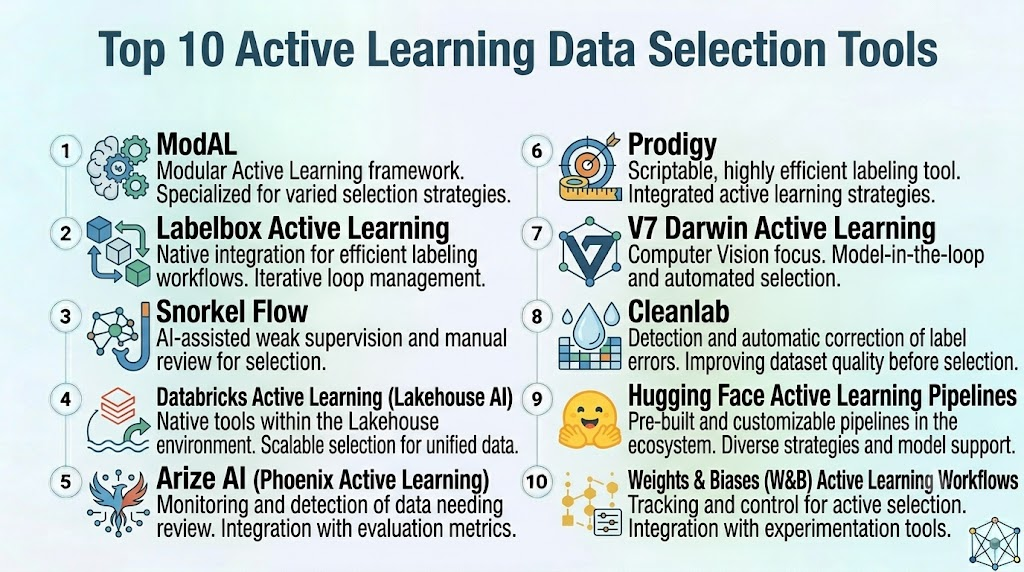
Top 10 Active Learning Data Selection Tools
1 — ModAL
One-line verdict: Best lightweight Python framework for active learning experimentation and research workflows.
Short description:
ModAL is a flexible active learning library designed for researchers and ML engineers to build custom sampling strategies and integrate them into model training pipelines.
Standout Capabilities
- Uncertainty sampling strategies
- Custom query strategies support
- Scikit-learn integration
- Pool-based active learning workflows
- Query-by-committee methods
- Easy experimental setup
- Lightweight Python API
AI-Specific Depth
- Model support: Scikit-learn compatible models + custom models
- Data selection: Uncertainty, entropy, committee-based sampling
- Evaluation: Basic model performance tracking
- Feedback loops: Manual integration required
- Observability: Minimal
Pros
- Extremely flexible and lightweight
- Great for research and prototyping
- Easy integration with ML workflows
Cons
- No production-grade orchestration
- Limited scalability features
Security & Compliance
Not publicly stated
Deployment & Platforms
- Python library
- Local or cloud environments
Integrations & Ecosystem
- Scikit-learn
- TensorFlow (custom integration)
- PyTorch (custom integration)
- ML pipelines
Pricing Model
Open-source
Best-Fit Scenarios
- Academic research
- Active learning prototyping
- Small-scale ML experiments
2 — Labelbox Active Learning
One-line verdict: Best enterprise-grade active learning system integrated with labeling pipelines.
Short description:
Labelbox provides built-in active learning capabilities that automatically select high-value data points for labeling based on model uncertainty and dataset gaps.
Standout Capabilities
- Integrated active learning workflows
- Model-in-the-loop training loops
- Dataset prioritization engine
- Annotation queue optimization
- Feedback-driven retraining cycles
- Multi-model selection support
- Workflow automation
AI-Specific Depth
- Model support: Multi-model and BYO model
- Data selection: Uncertainty + confidence-based sampling
- Evaluation: Integrated model performance tracking
- Feedback loops: Strong dataset retraining integration
- Observability: Dataset-level metrics and coverage tracking
Pros
- Seamless labeling + active learning integration
- Strong enterprise scalability
- Improves annotation efficiency significantly
Cons
- Requires Labelbox ecosystem usage
- Can be costly at scale
Security & Compliance
- Enterprise RBAC available
- Audit logs supported
- Certifications: Not publicly stated
Deployment & Platforms
- Cloud-based SaaS platform
Integrations & Ecosystem
- ML pipelines
- Cloud storage systems
- Labeling workflows
- API-based automation
Pricing Model
Enterprise subscription (usage + seats)
Best-Fit Scenarios
- Enterprise AI training pipelines
- Computer vision datasets
- Large-scale labeling optimization
3 — Snorkel Flow
One-line verdict: Best data-centric AI platform combining active learning with programmatic labeling.
Short description:
Snorkel Flow enables active learning alongside weak supervision and programmatic labeling to accelerate dataset creation.
Standout Capabilities
- Active learning + weak supervision hybrid
- Programmatic labeling functions
- Data prioritization engine
- Training data generation workflows
- Model feedback loops
- Data quality monitoring
- Dataset versioning
AI-Specific Depth
- Model support: Multi-model pipelines
- Data selection: Hybrid rule + uncertainty-based selection
- Evaluation: Strong dataset quality scoring
- Feedback loops: Tight integration with model training
- Observability: Dataset drift and quality tracking
Pros
- Powerful data-centric AI approach
- Reduces manual labeling needs
- Strong enterprise adoption
Cons
- Requires ML expertise
- Complex setup for beginners
Security & Compliance
Not publicly stated
Deployment & Platforms
- Cloud and enterprise deployment
Integrations & Ecosystem
- ML frameworks
- Data pipelines
- Labeling systems
- Active learning APIs
Pricing Model
Enterprise licensing
Best-Fit Scenarios
- Data-centric AI teams
- Weak supervision workflows
- Large-scale training pipelines
4 — Databricks Active Learning (Lakehouse AI)
One-line verdict: Best for active learning integrated directly into lakehouse data ecosystems.
Short description:
Databricks supports active learning workflows through its ML and AI ecosystem, enabling intelligent sample selection within large-scale data lakes.
Standout Capabilities
- Lakehouse-integrated sampling
- Embedding-based selection
- MLflow integration
- Scalable dataset processing
- Feature store integration
- Real-time data pipelines
- Model feedback loops
AI-Specific Depth
- Model support: Multi-model via MLflow
- Data selection: Embedding + uncertainty-based selection
- Evaluation: Experiment tracking via MLflow
- Feedback loops: Strong pipeline integration
- Observability: Full data pipeline tracking
Pros
- Excellent scalability
- Unified data + ML platform
- Strong enterprise integration
Cons
- Requires Databricks ecosystem
- Complex for small teams
Security & Compliance
- Enterprise-grade access control
- Data governance features
Deployment & Platforms
- Cloud-based (AWS/Azure/GCP)
Integrations & Ecosystem
- MLflow
- Delta Lake
- Feature stores
- BI and data pipelines
Pricing Model
Usage-based enterprise pricing
Best-Fit Scenarios
- Big data AI systems
- Enterprise ML pipelines
- Real-time active learning workflows
5 — Arize AI (Phoenix Active Learning)
One-line verdict: Best for combining active learning with observability and model monitoring.
Short description:
Arize AI provides model observability and supports active learning workflows by identifying high-impact data points for retraining.
Standout Capabilities
- Model drift detection
- Uncertainty-based sampling
- Embedding monitoring
- Dataset prioritization
- Performance regression detection
- Feedback loop tracking
- Model observability dashboards
AI-Specific Depth
- Model support: Multi-model tracking
- Data selection: Drift + uncertainty-based selection
- Evaluation: Strong performance monitoring
- Feedback loops: Observability-driven learning loops
- Observability: Full model lifecycle tracking
Pros
- Strong observability integration
- Good for production systems
- Helps detect data drift early
Cons
- Not purely active learning focused
- Requires integration setup
Security & Compliance
Not publicly stated
Deployment & Platforms
- Cloud-based platform
- Web + API access
Integrations & Ecosystem
- Vector databases
- ML pipelines
- Monitoring systems
- LLM applications
Pricing Model
Tiered SaaS model
Best-Fit Scenarios
- Production ML systems
- Drift-sensitive AI applications
- Continuous retraining pipelines
6 — Prodigy
One-line verdict: Best developer-friendly annotation tool with built-in active learning support.
Short description:
Prodigy is a scriptable annotation tool that integrates active learning directly into labeling workflows for fast dataset creation.
Standout Capabilities
- Scriptable active learning workflows
- Real-time annotation interface
- Custom sampling strategies
- NLP-focused labeling support
- Fast iteration loops
- Local deployment capability
- Human-in-the-loop training cycles
AI-Specific Depth
- Model support: Custom models via Python
- Data selection: Uncertainty-based sampling
- Evaluation: Basic evaluation support
- Feedback loops: Strong annotation feedback loop
- Observability: Minimal tracking
Pros
- Extremely fast iteration
- Developer-friendly
- Highly customizable
Cons
- Paid license
- Limited enterprise tooling
Security & Compliance
Not publicly stated
Deployment & Platforms
- Local/self-hosted
Integrations & Ecosystem
- Python ML ecosystem
- NLP pipelines
- Custom models
Pricing Model
Paid license
Best-Fit Scenarios
- NLP dataset creation
- Research projects
- Fast prototyping workflows
7 — V7 Darwin Active Learning
One-line verdict: Best computer vision-focused active learning system with automation capabilities.
Short description:
V7 Darwin integrates active learning into its CV annotation platform to optimize image and video labeling workflows.
Standout Capabilities
- CV-focused active learning engine
- Image/video sample prioritization
- Model-assisted labeling
- Dataset optimization tools
- Annotation workflow integration
- Training loop automation
- Dataset version tracking
AI-Specific Depth
- Model support: Vision models
- Data selection: Confidence + uncertainty-based
- Evaluation: Model performance tracking
- Feedback loops: Strong CV pipeline integration
- Observability: Dataset analytics
Pros
- Excellent for vision AI
- Strong automation support
- Clean UI
Cons
- Limited NLP support
- Enterprise features vary
Security & Compliance
Not publicly stated
Deployment & Platforms
- Cloud-based platform
Integrations & Ecosystem
- ML pipelines
- Annotation tools
- Cloud storage
Pricing Model
Tiered SaaS pricing
Best-Fit Scenarios
- Computer vision datasets
- Robotics AI systems
- Medical imaging workflows
8 — Cleanlab
One-line verdict: Best for data quality-driven active learning and error detection.
Short description:
Cleanlab focuses on identifying mislabeled data and selecting high-value samples for model improvement.
Standout Capabilities
- Label error detection
- Data quality scoring
- Active learning sample selection
- Noise-aware training pipelines
- Dataset cleanup tools
- Confidence-based filtering
- Model improvement suggestions
AI-Specific Depth
- Model support: Multi-model compatible
- Data selection: Error + uncertainty-based selection
- Evaluation: Strong data quality metrics
- Feedback loops: Data correction loops
- Observability: Dataset quality analytics
Pros
- Excellent for data cleaning
- Improves dataset quality significantly
- Easy integration
Cons
- Not full annotation platform
- Requires ML integration
Security & Compliance
Not publicly stated
Deployment & Platforms
- Python library + cloud tools
Integrations & Ecosystem
- ML frameworks
- Data pipelines
- Labeling tools
Pricing Model
Open-source + enterprise options
Best-Fit Scenarios
- Dataset cleaning
- Active learning optimization
- Data quality improvement workflows
9 — Hugging Face Active Learning Pipelines
One-line verdict: Best ecosystem for integrating active learning into transformer-based training workflows.
Short description:
Hugging Face provides tools and integrations that enable active learning loops for NLP and LLM training pipelines.
Standout Capabilities
- Transformer-based active learning
- Dataset streaming pipelines
- Model evaluation loops
- Embedding-based sampling
- Integration with datasets hub
- Training loop automation
- Community-driven models
AI-Specific Depth
- Model support: Transformer ecosystem
- Data selection: Embedding + uncertainty sampling
- Evaluation: Training metrics tracking
- Feedback loops: Model retraining integration
- Observability: Experiment tracking
Pros
- Strong NLP ecosystem
- Easy model integration
- Large community support
Cons
- Requires engineering setup
- Not a standalone product
Security & Compliance
Not publicly stated
Deployment & Platforms
- Cloud + local environments
Integrations & Ecosystem
- Hugging Face Hub
- Transformers library
- Datasets library
- ML pipelines
Pricing Model
Open-source + paid enterprise services
Best-Fit Scenarios
- NLP active learning
- LLM fine-tuning
- Research workflows
10 — Weights & Biases (W&B) Active Learning Workflows
One-line verdict: Best for combining experiment tracking with active learning loops in ML pipelines.
Short description:
W&B enables experiment tracking and can support active learning workflows through dataset selection and model performance monitoring.
Standout Capabilities
- Experiment tracking integration
- Dataset versioning
- Model performance monitoring
- Custom active learning pipelines
- Embedding visualization tools
- Training loop optimization
- Collaboration features
AI-Specific Depth
- Model support: Multi-model ecosystem
- Data selection: Indirect via metrics + embeddings
- Evaluation: Strong experiment tracking
- Feedback loops: Model-driven selection workflows
- Observability: Full ML lifecycle monitoring
Pros
- Strong ML lifecycle platform
- Excellent visualization tools
- Widely adopted in industry
Cons
- Not a dedicated active learning tool
- Requires custom pipeline setup
Security & Compliance
- Enterprise RBAC available
- Audit logs in enterprise tier
- Certifications: Not publicly stated
Deployment & Platforms
- Cloud-based SaaS platform
Integrations & Ecosystem
- ML frameworks
- Data pipelines
- Experiment tracking tools
- LLM workflows
Pricing Model
Tiered SaaS pricing
Best-Fit Scenarios
- ML experimentation teams
- Active learning in custom pipelines
- Model performance tracking workflows
Comparison Table (Top 10)
| Tool Name | Best For | Deployment | Model Flexibility | Strength | Watch-Out | Public Rating |
|---|---|---|---|---|---|---|
| ModAL | Research | Local | Custom models | Lightweight | No production tools | N/A |
| Labelbox | Enterprise pipelines | Cloud | Multi-model | Integration | Cost | N/A |
| Snorkel Flow | Data-centric AI | Cloud | Multi-model | Weak supervision | Complexity | N/A |
| Databricks | Big data AI | Cloud | Multi-model | Scalability | Ecosystem lock-in | N/A |
| Arize AI | Observability | Cloud | Multi-model | Drift detection | Not pure AL tool | N/A |
| Prodigy | NLP labeling | Local | Custom models | Speed | Paid license | N/A |
| V7 Darwin | CV workflows | Cloud | Vision models | Automation | Narrow scope | N/A |
| Cleanlab | Data quality | Hybrid | Multi-model | Error detection | Needs integration | N/A |
| Hugging Face | NLP pipelines | Hybrid | Transformer models | Ecosystem | Setup required | N/A |
| W&B | ML tracking | Cloud | Multi-model | Experiment tracking | Not AL-native | N/A |
Scoring & Evaluation (Weighted Rubric)
| Tool | Core | Reliability | Sampling Quality | Integrations | Ease | Performance | Security | Support | Weighted Total |
|---|---|---|---|---|---|---|---|---|---|
| ModAL | 8 | 7 | 8 | 7 | 9 | 8 | 6 | 6 | 7.6 |
| Labelbox | 9 | 9 | 9 | 9 | 8 | 8 | 8 | 8 | 8.6 |
| Snorkel Flow | 9 | 9 | 9 | 9 | 7 | 8 | 8 | 8 | 8.5 |
| Databricks | 10 | 9 | 9 | 10 | 7 | 10 | 9 | 9 | 9.1 |
| Arize AI | 9 | 9 | 8 | 9 | 8 | 8 | 8 | 8 | 8.4 |
| Prodigy | 8 | 8 | 8 | 8 | 9 | 8 | 7 | 7 | 8.0 |
| V7 Darwin | 8 | 8 | 8 | 8 | 8 | 8 | 7 | 7 | 7.9 |
| Cleanlab | 9 | 9 | 9 | 8 | 8 | 8 | 7 | 8 | 8.3 |
| Hugging Face | 9 | 9 | 9 | 9 | 8 | 8 | 7 | 8 | 8.5 |
| W&B | 9 | 9 | 8 | 9 | 8 | 8 | 8 | 8 | 8.4 |
Which Active Learning Tool Is Right for You?
Solo / Freelancer
ModAL, Prodigy, and Cleanlab are ideal for experimentation and lightweight workflows.
SMB
Labelbox, V7 Darwin, and Hugging Face provide balanced automation and usability.
Mid-Market
Snorkel Flow, Arize AI, and W&B offer scalable pipelines with strong observability.
Enterprise
Databricks, Labelbox, and Snorkel Flow provide full-scale active learning infrastructure.
Regulated industries
Arize AI, Databricks, and W&B offer stronger governance and observability.
Budget vs premium
- Budget: ModAL, Prodigy
- Mid-range: Cleanlab, V7 Darwin
- Premium: Databricks, Labelbox, Snorkel Flow
Build vs buy
- Build: ModAL, Cleanlab
- Buy: Labelbox, Databricks, Snorkel Flow
Common Mistakes & How to Avoid Them
- Using only uncertainty sampling
- Ignoring diversity in dataset selection
- Not integrating labeling platforms
- Poor feedback loop design
- No tracking of labeling efficiency
- Overfitting active learning loops
- Not validating sampling bias
- Ignoring multimodal data needs
- Lack of experiment tracking
- No integration with ML pipelines
- Overcomplicating early-stage workflows
- Not measuring cost reduction impact
- Weak dataset versioning strategy
- No production monitoring of sampling quality
FAQs
1. What is active learning in machine learning?
It is a technique where the model selects the most informative data points to be labeled, reducing annotation cost and improving efficiency.
2. Why is active learning important?
It reduces the amount of labeled data needed while improving model performance faster.
3. What types of sampling are used?
Common methods include uncertainty sampling, entropy-based sampling, and diversity sampling.
4. Can active learning work with deep learning models?
Yes, it is widely used in CNNs, transformers, and LLM pipelines.
5. Do I need a labeling platform with active learning?
Yes, integration with annotation systems improves workflow efficiency significantly.
6. Is active learning only for image data?
No, it works for text, audio, video, and multimodal datasets.
7. What is the biggest challenge in active learning?
Avoiding sampling bias while maintaining diversity in selected data.
8. Can active learning be real-time?
Yes, modern systems support real-time sample selection in production.
9. Does active learning reduce costs?
Yes, it significantly reduces labeling costs by prioritizing important samples.
10. What is uncertainty sampling?
It selects data points where the model is least confident in its predictions.
11. Can I build my own active learning system?
Yes, using frameworks like ModAL or Cleanlab.
12. What is the future of active learning?
It is moving toward fully autonomous, continuous learning systems integrated into production AI pipelines.
Conclusion
Active learning is becoming a critical component of modern AI systems by making dataset creation more efficient and model training more intelligent. Instead of labeling everything, teams now focus only on the most informative data points, dramatically reducing cost and improving accuracy.
