Introduction
AI Risk Assessment Tools are platforms designed to evaluate, monitor, and control risks in artificial intelligence systems before and after deployment. These risks include hallucinations, unsafe outputs, biased decisions, data leakage, prompt injection attacks, model drift, and compliance violations in production environments.
As organizations move toward agentic AI systems, multimodal models, and real-time decision automation, risk exposure increases significantly. AI systems are no longer isolated models—they are connected workflows that interact with tools, APIs, databases, and users. This creates new attack surfaces and operational risks that traditional QA processes cannot handle.
AI Risk Assessment Tools help organizations manage these challenges by providing evaluation frameworks, guardrails, observability layers, and governance workflows.
Common real-world use cases include AI chatbots in customer support, financial decision engines, healthcare diagnostic assistants, fraud detection systems, HR screening tools, and autonomous AI agents executing multi-step workflows.
Key evaluation criteria for buyers include evaluation depth, guardrails, observability, model flexibility, integration capabilities, cost control, security controls, compliance readiness, and deployment options.
Best for: Enterprise AI teams, MLOps/LLMOps engineers, compliance officers, and organizations deploying production-grade AI systems.
Not ideal for: Early prototypes, hobby projects, or non-production AI experiments without user-facing risk exposure.
What’s Changing in AI Risk Assessment Tools
- Shift from static evaluation to continuous AI monitoring
- Growth of agent-based AI systems requiring multi-step risk analysis
- Increasing importance of prompt injection and jailbreak detection
- Expansion of multimodal AI risk evaluation (text, image, audio, video)
- Integration of evaluation into CI/CD pipelines for AI systems
- Strong focus on AI governance, auditability, and compliance reporting
- Rise of real-time observability with token-level tracing
- Adoption of BYO-model and multi-model routing architectures
- Increased demand for data privacy and retention controls
- Cost and latency optimization becoming core evaluation metrics
- Automated red-teaming and adversarial testing capabilities
- Standardization of AI safety frameworks across industries
Quick Buyer Checklist
- Continuous evaluation support instead of one-time testing
- Detection of hallucination, bias, toxicity, and unsafe outputs
- Support for agent-based workflows and tool calling systems
- BYO model or multi-model compatibility
- Prompt injection and jailbreak protection mechanisms
- Strong observability (logs, traces, token metrics)
- Integration with RAG pipelines and vector databases
- Automated and human-in-the-loop evaluation options
- Data privacy and retention control policies
- Audit logs and compliance reporting capabilities
- Deployment flexibility (cloud, hybrid, self-hosted)
- Low vendor lock-in risk and portability options
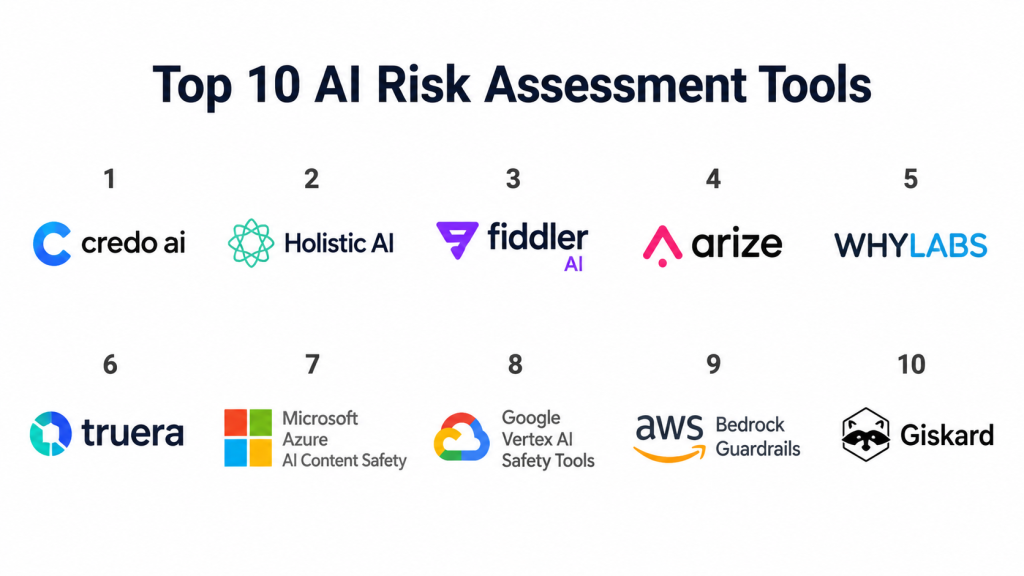
Top 10 AI Risk Assessment Tools
1 — Credo AI
One-line verdict: Best for enterprise AI governance, compliance tracking, and structured risk management.
Short description:
Credo AI helps organizations manage AI governance by aligning models, workflows, and policies under a unified risk framework. It is widely used in enterprise environments where compliance and accountability are critical.
Standout Capabilities
- AI governance lifecycle management
- Policy enforcement across AI systems
- Model inventory and documentation
- Risk classification frameworks
- Approval workflows for AI deployment
- Compliance reporting dashboards
- AI accountability tracking
AI-Specific Depth
- Model support: Multi-model environments (details vary)
- RAG integration: Not publicly stated
- Evaluation: Governance-level evaluation, not deep technical testing
- Guardrails: Policy-based governance enforcement
- Observability: High-level risk tracking dashboards
Pros
- Strong enterprise governance capabilities
- Clear compliance mapping workflows
- Suitable for large-scale AI deployments
Cons
- Limited technical debugging features
- Not developer-focused
- Requires enterprise onboarding effort
Security & Compliance
- SSO and RBAC support (commonly available)
- Audit logs supported
- Certifications: Not publicly stated
Deployment & Platforms
- Cloud-based enterprise platform
Integrations & Ecosystem
- APIs for governance workflows
- Integration with ML platforms and data catalogs
- Enterprise workflow systems
Pricing Model
- Enterprise subscription model (Not publicly stated)
Best-Fit Scenarios
- Enterprise AI governance programs
- Regulated industries requiring auditability
- Multi-team AI oversight environments
2 — Holistic AI
One-line verdict: Best for automated AI compliance and regulatory risk alignment.
Short description:
Holistic AI provides tools for AI compliance automation, risk monitoring, and regulatory mapping across enterprise AI systems.
Standout Capabilities
- Automated compliance checks
- AI risk scoring systems
- Model validation workflows
- Regulatory mapping tools
- Bias and fairness monitoring
- AI inventory tracking
- Audit-ready reporting systems
AI-Specific Depth
- Model support: Multi-model environments
- RAG integration: Not publicly stated
- Evaluation: Compliance-driven evaluation
- Guardrails: Policy enforcement mechanisms
- Observability: Risk dashboards and monitoring views
Pros
- Strong compliance automation features
- Good for regulated industries
- Structured governance workflows
Cons
- Less developer-oriented
- Limited low-level model debugging
- Enterprise-heavy setup
Security & Compliance
- Role-based access controls
- Audit logging supported
- Certifications: Not publicly stated
Deployment & Platforms
- Cloud-based enterprise solution
Integrations & Ecosystem
- Enterprise data systems integration
- ML pipeline connectors
- API-based workflows
Pricing Model
- Custom enterprise pricing
Best-Fit Scenarios
- Financial and healthcare AI systems
- Compliance-driven organizations
- Large enterprise AI deployments
3 — Fiddler AI
One-line verdict: Best for model monitoring, explainability, and AI performance diagnostics.
Short description:
Fiddler AI provides observability and explainability for machine learning and AI systems in production, helping teams understand model behavior and detect issues.
Standout Capabilities
- Model monitoring dashboards
- Explainability for predictions
- Drift detection systems
- Bias detection analysis
- Performance anomaly detection
- Feature-level insights
- Root cause analysis tools
AI-Specific Depth
- Model support: ML and LLM systems
- RAG integration: Limited support
- Evaluation: Strong model-level evaluation
- Guardrails: Limited runtime guardrails
- Observability: Advanced monitoring and metrics
Pros
- Strong explainability features
- Good production monitoring
- Useful for ML engineering teams
Cons
- Limited LLM guardrails
- Requires technical expertise
- Not a full governance platform
Security & Compliance
- Enterprise RBAC support
- Audit logging available
- Security controls for enterprise use
Deployment & Platforms
- Cloud and hybrid deployment options
Integrations & Ecosystem
- ML platform integrations
- Data warehouse connectors
- API-based monitoring
Pricing Model
- Tiered enterprise pricing (Not publicly stated)
Best-Fit Scenarios
- ML model monitoring
- Explainability-focused deployments
- Regulated ML environments
4 — Arize AI
One-line verdict: Best for LLM observability, evaluation, and production monitoring.
Short description:
Arize AI focuses on observability for ML and LLM systems, including tracing, evaluation, and drift detection in production environments.
Standout Capabilities
- LLM tracing and debugging
- Model performance monitoring
- Embedding analysis tools
- Drift detection systems
- Prompt-level diagnostics
- Evaluation frameworks
- Data quality monitoring
AI-Specific Depth
- Model support: Multi-model and LLM systems
- RAG integration: Strong support for RAG workflows
- Evaluation: Advanced LLM evaluation tools
- Guardrails: Limited built-in guardrails
- Observability: Deep tracing and monitoring
Pros
- Excellent LLM observability
- Strong debugging capabilities
- Scalable architecture
Cons
- Limited governance features
- Requires technical expertise
- Not a compliance-first tool
Security & Compliance
- Enterprise security features
- Audit logs and RBAC
Deployment & Platforms
- Cloud-native platform
Integrations & Ecosystem
- LLM frameworks integration
- Vector database compatibility
- API-based observability
Pricing Model
- Usage-based and enterprise pricing (varies)
Best-Fit Scenarios
- LLM production monitoring
- RAG system evaluation
- AI debugging workflows
5 — WhyLabs
One-line verdict: Best for data-centric AI monitoring and drift detection at scale.
Short description:
WhyLabs provides monitoring tools for ML and AI systems focused on data quality, drift detection, and model health tracking.
Standout Capabilities
- Data drift monitoring
- Model health dashboards
- Feature-level monitoring
- Automated alerts
- Data quality scoring
- Performance tracking
- Observability pipelines
AI-Specific Depth
- Model support: ML and LLM systems
- RAG integration: Partial support
- Evaluation: Data-centric evaluation approach
- Guardrails: Limited runtime enforcement
- Observability: Strong monitoring layer
Pros
- Strong data monitoring foundation
- Scalable architecture
- Reliable alerting system
Cons
- Limited governance workflows
- Less LLM safety focus
- UI complexity for beginners
Security & Compliance
- Enterprise security controls
- Audit logging support
Deployment & Platforms
- Cloud-based deployment
Integrations & Ecosystem
- Data warehouse integration
- ML pipeline connectors
- API-based workflows
Pricing Model
- Subscription-based (Not publicly stated)
Best-Fit Scenarios
- Data-centric AI systems
- Large-scale ML monitoring
- Drift detection pipelines
6 — TruEra
One-line verdict: Best for AI model testing, explainability, and quality assurance.
Short description:
TruEra provides testing and evaluation tools for ML and LLM systems, focusing on model quality, fairness, and diagnostics.
Standout Capabilities
- Model testing frameworks
- Explainability analysis tools
- Bias detection systems
- Model comparison features
- Quality evaluation pipelines
- LLM evaluation tools
- Root cause diagnostics
AI-Specific Depth
- Model support: ML and LLM systems
- RAG integration: Partial support
- Evaluation: Strong evaluation framework
- Guardrails: Limited runtime enforcement
- Observability: Moderate monitoring
Pros
- Strong model QA capabilities
- Good explainability tools
- Useful for evaluation pipelines
Cons
- Limited real-time monitoring
- Not a governance platform
- Requires technical setup
Security & Compliance
- Enterprise security features
- Audit logging available
Deployment & Platforms
- Cloud-based deployment
Integrations & Ecosystem
- ML pipeline integrations
- API-based evaluation workflows
Pricing Model
- Enterprise pricing (Not publicly stated)
Best-Fit Scenarios
- AI testing pipelines
- Model QA teams
- Explainability-focused systems
7 — Microsoft Azure AI Content Safety
One-line verdict: Best for enterprise-grade AI safety filtering and moderation in Azure ecosystems.
Short description:
Microsoft Azure AI Content Safety provides real-time filtering for harmful content, policy violations, and unsafe AI outputs.
Standout Capabilities
- Toxicity detection
- Content moderation APIs
- Jailbreak detection
- Multilingual safety filters
- Policy-based enforcement
- Real-time response filtering
- Integration with Azure AI stack
AI-Specific Depth
- Model support: Azure AI models and APIs
- RAG integration: Supported within Azure ecosystem
- Evaluation: Safety-focused evaluation tools
- Guardrails: Strong built-in safety controls
- Observability: Basic safety monitoring
Pros
- Strong enterprise integration
- Reliable safety enforcement
- Scalable cloud infrastructure
Cons
- Limited explainability tools
- Azure ecosystem dependency
- Less customization flexibility
Security & Compliance
- Enterprise security controls
- RBAC and audit logs
- Certifications: Not publicly stated
Deployment & Platforms
- Cloud-native (Azure only)
Integrations & Ecosystem
- Azure AI services
- Cognitive APIs
- Enterprise security tools
Pricing Model
- Usage-based API pricing
Best-Fit Scenarios
- Enterprise chatbots
- Content moderation systems
- Azure-based AI deployments
8 — Google Vertex AI Safety Tools
One-line verdict: Best for AI evaluation and safety in Google Cloud AI pipelines.
Short description:
Google Vertex AI provides safety, evaluation, and monitoring tools for AI systems deployed within the Google Cloud ecosystem.
Standout Capabilities
- AI safety filtering
- Model evaluation pipelines
- Bias detection tools
- Prompt testing frameworks
- Responsible AI dashboards
- Performance monitoring
- Integration with Vertex AI pipelines
AI-Specific Depth
- Model support: Google models and BYO models
- RAG integration: Strong support
- Evaluation: Built-in evaluation framework
- Guardrails: Safety filtering mechanisms
- Observability: Monitoring dashboards
Pros
- Strong cloud-native integration
- Good evaluation tools
- Scalable infrastructure
Cons
- Complex ecosystem
- Limited portability outside Google Cloud
- Evolving feature maturity
Security & Compliance
- Enterprise security controls
- Access management systems
Deployment & Platforms
- Cloud-native (Google Cloud)
Integrations & Ecosystem
- Vertex AI ecosystem
- BigQuery integration
- ML pipelines support
Pricing Model
- Usage-based pricing
Best-Fit Scenarios
- Google Cloud AI systems
- LLM evaluation pipelines
- Enterprise AI deployments
9— AWS Bedrock Guardrails
One-line verdict: Best for enforcing safety policies in AWS-based generative AI applications.
Short description:
AWS Bedrock Guardrails provides policy enforcement, safety filtering, and runtime controls for AI applications built on AWS.
Standout Capabilities
- Content filtering rules
- Prompt injection protection
- Output validation layers
- Policy enforcement engine
- Multi-model support
- Real-time guardrails
- AWS ecosystem integration
AI-Specific Depth
- Model support: AWS Bedrock models and BYO
- RAG integration: Strong support
- Evaluation: Limited evaluation features
- Guardrails: Strong enforcement layer
- Observability: Basic monitoring
Pros
- Strong AWS integration
- Reliable safety enforcement
- Scalable architecture
Cons
- Limited explainability tools
- AWS ecosystem dependency
- Requires AWS expertise
Security & Compliance
- IAM-based security controls
- Audit logging support
- Enterprise-grade security
Deployment & Platforms
- AWS cloud only
Integrations & Ecosystem
- AWS ML services
- Lambda and API Gateway
- Bedrock ecosystem
Pricing Model
- Usage-based pricing
Best-Fit Scenarios
- AWS-native AI applications
- Enterprise LLM deployments
- Regulated AI workflows
10 — Giskard
One-line verdict: Best open-source AI testing framework for risk detection and model evaluation.
Short description:
Giskard is an open-source platform designed for testing AI systems for bias, robustness, and performance issues.
Standout Capabilities
- Automated AI testing pipelines
- Bias detection tests
- Robustness evaluation tools
- Dataset validation
- Model comparison frameworks
- LLM testing workflows
- Open-source extensibility
AI-Specific Depth
- Model support: Open-source and BYO models
- RAG integration: Partial support
- Evaluation: Strong testing framework
- Guardrails: Limited runtime enforcement
- Observability: Basic evaluation tracking
Pros
- Open-source flexibility
- Strong testing capabilities
- Developer-friendly
Cons
- Requires engineering setup
- Limited enterprise governance
- No full observability stack
Security & Compliance
- Depends on self-hosted setup
- No formal certifications
Deployment & Platforms
- Self-hosted or cloud deployment
Integrations & Ecosystem
- Python ecosystem
- ML pipeline integration
- API extensibility
Pricing Model
- Open-source + enterprise support options
Best-Fit Scenarios
- AI testing frameworks
- Research environments
- Custom evaluation pipelines
Comparison Table (Top 10)
| Tool | Best For | Deployment | Model Flexibility | Strength | Watch-Out | Public Rating |
|---|---|---|---|---|---|---|
| Credo AI | Governance | Cloud | Multi-model | Compliance workflows | Limited technical depth | N/A |
| Holistic AI | Compliance | Cloud | Multi-model | Regulatory alignment | Enterprise complexity | N/A |
| Fiddler AI | Monitoring | Cloud/Hybrid | ML + LLM | Explainability | Limited guardrails | N/A |
| Arize AI | LLM observability | Cloud | Multi-model | Deep tracing | Less governance | N/A |
| WhyLabs | Data monitoring | Cloud | ML + LLM | Drift detection | Limited governance | N/A |
| TruEra | Model QA | Cloud | ML + LLM | Evaluation depth | Limited real-time monitoring | N/A |
| Azure AI Safety | Content safety | Cloud | Azure models | Strong filtering | Vendor lock-in | N/A |
| Vertex AI Safety | AI evaluation | Cloud | Multi/BYO | Evaluation tools | GCP lock-in | N/A |
| AWS Guardrails | Policy enforcement | Cloud | Multi/BYO | Strong guardrails | Limited explainability | N/A |
| Giskard | AI testing | Self-hosted | Open/BYO | Open-source flexibility | Setup effort | N/A |
Scoring & Evaluation
Scoring is based on relative capability across risk evaluation, observability, governance, safety enforcement, integration strength, and production readiness.
| Tool | Core | Reliability/Eval | Guardrails | Integrations | Ease | Perf/Cost | Security/Admin | Support | Weighted Total |
|---|---|---|---|---|---|---|---|---|---|
| Credo AI | 9 | 8 | 9 | 9 | 7 | 8 | 9 | 8 | 8.4 |
| Holistic AI | 8 | 8 | 9 | 8 | 7 | 8 | 9 | 8 | 8.2 |
| Fiddler AI | 8 | 9 | 6 | 9 | 7 | 8 | 8 | 8 | 8.0 |
| Arize AI | 9 | 9 | 7 | 9 | 7 | 8 | 8 | 8 | 8.3 |
| WhyLabs | 8 | 8 | 6 | 8 | 7 | 8 | 8 | 7 | 7.8 |
| TruEra | 8 | 9 | 6 | 8 | 7 | 8 | 8 | 8 | 8.0 |
| Azure AI Safety | 8 | 7 | 9 | 9 | 8 | 9 | 9 | 8 | 8.3 |
| Vertex AI Safety | 8 | 8 | 8 | 9 | 7 | 8 | 9 | 8 | 8.2 |
| AWS Guardrails | 8 | 7 | 9 | 9 | 7 | 9 | 9 | 8 | 8.2 |
| Giskard | 8 | 8 | 6 | 7 | 8 | 8 | 7 | 7 | 7.6 |
Which AI Risk Assessment Tool Is Right for You?
Solo / Freelancer
Best suited for lightweight testing tools. Giskard is ideal for experimentation, debugging, and small-scale evaluation workflows.
SMB
Small teams need balance between cost and capability. WhyLabs and Fiddler AI provide strong monitoring without heavy governance overhead.
Mid-Market
Mid-sized organizations should prioritize scalable observability and evaluation. Arize AI and TruEra are strong choices for production AI systems.
Enterprise
Enterprises require governance, compliance, and auditability. Credo AI, Holistic AI, AWS Guardrails, and Azure AI Safety are strong options.
Regulated industries
Finance, healthcare, insurance, and government require strict compliance controls. Azure AI Safety, AWS Guardrails, and Credo AI are commonly used.
Budget vs premium
- Budget: Giskard, WhyLabs
- Premium: Credo AI, Holistic AI, cloud-native enterprise platforms
Build vs buy
- Build when you need custom evaluation pipelines or research flexibility
- Buy when you need governance, compliance, and scalability out of the box
Common Mistakes & How to Avoid Them
- No continuous evaluation pipeline in production
- Ignoring prompt injection attacks in agent systems
- Lack of observability into LLM reasoning chains
- Underestimating inference cost and token usage
- No fallback or rollback strategy for model updates
- Missing audit logs for AI decisions
- Over-automation without human review
- Vendor lock-in without abstraction layer
- Poor dataset versioning and tracking
- Not testing adversarial prompts
- Weak governance structure for AI deployments
- Ignoring data retention and privacy policies
- Deploying without bias testing
- Treating AI safety as optional instead of required
FAQs
1. What are AI Risk Assessment Tools?
They are platforms that help detect and manage risks in AI systems such as hallucinations, bias, unsafe outputs, and compliance violations.
2. Do these tools work with LLMs and AI agents?
Yes, most modern tools support LLMs, RAG pipelines, and agent-based architectures.
3. Can open-source tools handle AI risk assessment?
Yes, tools like Giskard provide strong testing capabilities, but enterprise governance features may be limited.
4. What is the difference between evaluation and guardrails?
Evaluation measures risk after or during testing, while guardrails prevent unsafe outputs in real time.
5. Are these tools required for all AI systems?
Not always. They are most important for production systems with user-facing or business-critical outputs.
6. Do these tools support BYO models?
Many tools support BYO or multi-model setups, but capabilities vary by platform.
7. Are they expensive?
Pricing varies widely and is often not publicly disclosed, especially for enterprise tools.
8. Can I switch tools later?
Yes, but migration becomes harder as tools are deeply integrated into pipelines.
9. is prompt injection risk?
It is when malicious inputs manipulate AI systems into bypassing rules or leaking data.
10. Do these tools improve AI accuracy?
They improve reliability indirectly by detecting failures and improving evaluation loops.
11. What industries need them most?
Finance, healthcare, insurance, legal, and government sectors.
12. What is the biggest risk without them?
Uncontrolled AI systems can produce unsafe, biased, or non-compliant outputs at scale.
Conclusion
AI Risk Assessment Tools are now a core part of modern AI infrastructure. As AI systems evolve into autonomous agents and multimodal decision engines, the need for structured risk management becomes critical.
The right choice depends on your goals—governance, observability, evaluation, or runtime safety. Most real-world organizations use a combination of tools rather than a single platform.
