Introduction
AI Model Cards & Documentation Tools are platforms designed to standardize, automate, and manage documentation for machine learning and AI models. A model card typically includes essential details such as model purpose, training data summary, evaluation metrics, ethical considerations, limitations, and deployment guidelines.
As AI systems become more complex and widely deployed across industries, documentation is no longer optional—it is a governance requirement. Modern AI systems are used in healthcare diagnostics, financial decision-making, legal automation, customer support, and autonomous agents. Without clear documentation, organizations risk poor transparency, regulatory issues, and operational failures.
These tools help teams maintain structured documentation across the AI lifecycle, ensuring models are explainable, auditable, and maintainable.
Common use cases include:
- Documenting LLM and machine learning model behavior
- Maintaining audit-ready AI governance records
- Tracking model versions and updates
- Supporting compliance teams in regulated industries
- Enabling explainability for stakeholders and auditors
- Standardizing documentation across multiple AI teams
Key evaluation criteria include automation capabilities, integration with ML pipelines, version tracking, governance features, collaboration tools, and support for compliance frameworks.
Best for: MLOps teams, AI governance teams, data science teams, and enterprises deploying multiple models in production.
Not ideal for: Small experimental projects without production deployment or governance needs.
What’s Changing in AI Model Documentation Tools
- Shift from manual documentation to automated model card generation
- Integration with CI/CD pipelines for continuous documentation updates
- Increased focus on LLM documentation and prompt-based systems
- Standardization of AI governance and audit requirements
- Support for multimodal model documentation (text, image, audio models)
- Stronger alignment with regulatory frameworks and compliance audits
- Version-controlled model cards tied to model registry systems
- Collaboration features for cross-functional AI teams
- Integration with observability and evaluation tools
- Automated extraction of training and evaluation metadata
- Emphasis on explainability and transparency requirements
- Growing demand for real-time documentation updates in production AI systems
Quick Buyer Checklist
- Does the tool auto-generate model cards or require manual input?
- Can it integrate with ML pipelines (CI/CD or MLOps tools)?
- Does it support versioning of models and documentation?
- Is collaboration supported across data science and governance teams?
- Does it include audit logs and compliance reporting?
- Can it document LLMs, RAG pipelines, and agent systems?
- Does it support structured metadata and schema enforcement?
- Is there integration with model registries?
- Can documentation be exported for audits?
- Does it support multi-model and multimodal AI systems?
- How flexible is customization for enterprise needs?
- Does it reduce documentation overhead significantly?
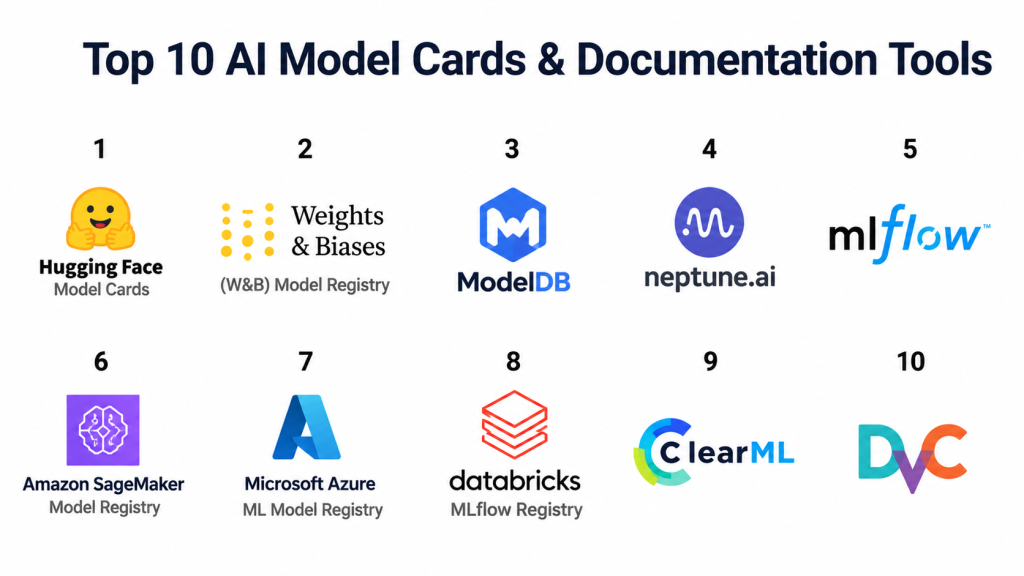
Top 10 AI Model Cards & Documentation Tools
1 — Hugging Face Model Cards
One-line verdict: Best for standardized open-source model documentation and community transparency.
Short description:
Hugging Face Model Cards provide structured documentation templates for machine learning models, widely used in open-source and research communities.
Standout Capabilities
- Standardized model card templates
- Dataset and training metadata documentation
- Evaluation metric reporting
- Ethical considerations section
- Model limitations tracking
- Community sharing support
- Integration with Hugging Face Hub
AI-Specific Depth
- Model support: Open-source and hosted models
- RAG integration: Not applicable
- Evaluation: Basic evaluation reporting
- Governance: Limited enterprise governance
- Observability: Not supported
Pros
- Widely adopted standard
- Simple and transparent documentation format
- Strong community ecosystem
Cons
- Limited enterprise governance features
- Manual effort required in many cases
- Not deeply integrated with MLOps pipelines
Security & Compliance
- Not enterprise-focused
- No formal compliance tooling
Deployment & Platforms
- Web-based + open-source ecosystem
Integrations & Ecosystem
- Hugging Face Hub
- Python ML workflows
- Model sharing ecosystem
Pricing Model
- Free + open-source ecosystem
Best-Fit Scenarios
- Open-source AI projects
- Research documentation
- Community model sharing
2 — Weights & Biases (W&B) Model Registry
One-line verdict: Best for experiment tracking and model documentation in MLOps workflows.
Short description:
Weights & Biases provides experiment tracking and model registry capabilities that automatically document training runs and model performance.
Standout Capabilities
- Automated experiment tracking
- Model versioning system
- Performance metric logging
- Dataset tracking
- Visualization dashboards
- Collaboration tools
- Model registry integration
AI-Specific Depth
- Model support: ML and LLM workflows
- RAG integration: Supported via pipelines
- Evaluation: Strong experiment-level evaluation
- Governance: Limited governance features
- Observability: Strong training observability
Pros
- Excellent experiment tracking
- Strong integration with ML pipelines
- Great visualization tools
Cons
- Not a pure documentation tool
- Governance features are limited
- Can become expensive at scale
Security & Compliance
- Enterprise security features available
- SSO and RBAC support (varies)
Deployment & Platforms
- Cloud + hybrid deployment options
Integrations & Ecosystem
- ML frameworks (PyTorch, TensorFlow)
- CI/CD pipelines
- Data science tools ecosystem
Pricing Model
- Freemium + enterprise tiers (Not publicly stated fully)
Best-Fit Scenarios
- ML experiment tracking
- Model lifecycle documentation
- Data science collaboration
3 — ModelDB
One-line verdict: Best for centralized model versioning and metadata management.
Short description:
ModelDB provides structured storage and tracking for machine learning models, metadata, and lineage.
Standout Capabilities
- Model version tracking
- Metadata storage system
- Experiment lineage tracking
- Model comparison tools
- Dataset linking
- Reproducibility tracking
- API-based documentation
AI-Specific Depth
- Model support: Traditional ML systems
- RAG integration: Not applicable
- Evaluation: Limited evaluation support
- Governance: Basic tracking
- Observability: Metadata-level only
Pros
- Strong version control
- Good reproducibility support
- Centralized model tracking
Cons
- Limited modern LLM support
- Requires engineering setup
- UI and UX limitations
Security & Compliance
- Depends on deployment setup
- No built-in certifications
Deployment & Platforms
- Self-hosted and cloud options
Integrations & Ecosystem
- ML pipelines
- Data engineering workflows
- Custom API integrations
Pricing Model
- Open-source
Best-Fit Scenarios
- Research labs
- ML lifecycle tracking
- Enterprise internal model registries
4 — eptune AI
One-line verdict: Best for metadata logging and experiment tracking at scale.
Short description:
Neptune AI helps teams track ML experiments and automatically generate structured documentation for models and training runs.
Standout Capabilities
- Experiment tracking dashboards
- Model metadata logging
- Performance visualization
- Dataset version tracking
- Collaboration features
- Reproducibility tools
- Model comparison
AI-Specific Depth
- Model support: ML and LLM experiments
- RAG integration: Partial support
- Evaluation: Strong experiment evaluation
- Governance: Limited governance
- Observability: Strong training observability
Pros
- Excellent tracking capabilities
- Scalable for enterprise ML teams
- Strong visualization tools
Cons
- Not a full documentation governance system
- Requires integration effort
- Pricing scales with usage
Security & Compliance
- Enterprise-grade controls (Not fully publicly stated)
Deployment & Platforms
- Cloud + self-hosted options
Integrations & Ecosystem
- ML frameworks
- Data pipelines
- CI/CD systems
Pricing Model
- Subscription-based (Not publicly stated)
Best-Fit Scenarios
- Large ML teams
- Experiment-heavy workflows
- Model lifecycle tracking
5 — MLflow
One-line verdict: Best open-source standard for ML lifecycle tracking and model documentation.
Short description:
MLflow is an open-source platform for managing the ML lifecycle including tracking, model registry, and documentation.
Standout Capabilities
- Experiment tracking
- Model registry system
- Reproducibility support
- Deployment tracking
- Pipeline integration
- Model versioning
- API-based logging
AI-Specific Depth
- Model support: ML + some LLM workflows
- RAG integration: Limited
- Evaluation: Basic tracking
- Governance: Minimal
- Observability: Experiment-level only
Pros
- Widely adopted open-source standard
- Flexible and extensible
- Strong ecosystem support
Cons
- Requires engineering setup
- Limited governance layer
- UI is basic compared to commercial tools
Security & Compliance
- Depends on deployment configuration
- No built-in certifications
Deployment & Platforms
- Self-hosted or managed cloud deployments
Integrations & Ecosystem
- Databricks ecosystem
- Python ML frameworks
- CI/CD pipelines
Pricing Model
- Open-source + enterprise support available
Best-Fit Scenarios
- ML lifecycle management
- Engineering-heavy teams
- Custom AI documentation pipelines
6 — Amazon SageMaker Model Registry
One-line verdict: Best for AWS-native model documentation and lifecycle tracking.
Short description:
Amazon SageMaker provides model registry and documentation capabilities integrated into AWS ML workflows.
Standout Capabilities
- Model version registry
- Metadata tracking
- Deployment lineage
- Model approval workflows
- Integration with training jobs
- Automated documentation generation
- Governance workflows
AI-Specific Depth
- Model support: AWS ML models
- RAG integration: Supported in AWS ecosystem
- Evaluation: Basic to moderate
- Governance: Strong AWS governance integration
- Observability: Limited outside AWS tools
Pros
- Strong AWS integration
- Enterprise-grade scalability
- Secure deployment environment
Cons
- AWS lock-in
- Limited portability
- Complex configuration
Security & Compliance
- IAM-based security
- Encryption and audit logging
- Certifications depend on AWS environment
Deployment & Platforms
- AWS cloud only
Integrations & Ecosystem
- SageMaker pipelines
- AWS data services
- ML tooling ecosystem
Pricing Model
- Usage-based AWS pricing
Best-Fit Scenarios
- AWS-based ML systems
- Enterprise AI deployments
- Regulated environments in AWS
7 — Microsoft Azure ML Model Registry
One-line verdict: Best for enterprise AI documentation inside Microsoft ecosystem.
Short description:
Azure ML Model Registry provides centralized model tracking, documentation, and lifecycle management.
Standout Capabilities
- Model version tracking
- Deployment history
- Metadata documentation
- Approval workflows
- Integration with pipelines
- Automated logging
- Governance controls
AI-Specific Depth
- Model support: Azure ML models
- RAG integration: Supported
- Evaluation: Basic tracking
- Governance: Strong enterprise support
- Observability: Limited
Pros
- Strong enterprise integration
- Good governance workflows
- Scalable infrastructure
Cons
- Azure dependency
- Limited flexibility outside ecosystem
- Complex setup
Security & Compliance
- RBAC and enterprise security
- Audit logs supported
- Certifications depend on Azure
Deployment & Platforms
- Azure cloud only
Integrations & Ecosystem
- Azure ML pipelines
- Cognitive services
- Data factory integration
Pricing Model
- Usage-based Azure pricing
Best-Fit Scenarios
- Enterprise ML documentation
- Azure-native AI systems
- Regulated industries
8 — Databricks MLflow Registry
One-line verdict: Best for unified data + AI documentation inside lakehouse architecture.
Short description:
Databricks extends MLflow with enterprise model registry and documentation capabilities integrated into lakehouse platforms.
Standout Capabilities
- Model registry integration
- Experiment tracking
- Data lineage tracking
- Unified analytics + AI documentation
- Collaboration features
- Governance controls
- Pipeline integration
AI-Specific Depth
- Model support: ML + LLM workflows
- RAG integration: Strong support
- Evaluation: Moderate to strong
- Governance: Enterprise-grade
- Observability: Strong pipeline tracking
Pros
- Unified data + AI platform
- Strong scalability
- Good governance integration
Cons
- Platform dependency
- Cost increases at scale
- Requires Databricks ecosystem
Security & Compliance
- Enterprise RBAC
- Audit logging
- Security controls depend on setup
Deployment & Platforms
- Cloud-based (multi-cloud support)
Integrations & Ecosystem
- Databricks ecosystem
- Spark pipelines
- MLflow integration
Pricing Model
- Enterprise subscription (Not publicly stated)
Best-Fit Scenarios
- Lakehouse architectures
- Enterprise ML pipelines
- Data + AI unified teams
9 — ClearML
One-line verdict: Best open-source MLOps platform with built-in model documentation.
Short description:
ClearML provides experiment tracking, orchestration, and model documentation in a unified open-source platform.
Standout Capabilities
- Experiment tracking
- Model registry
- Pipeline orchestration
- Dataset versioning
- Automation workflows
- Reproducibility tracking
- Open-source flexibility
AI-Specific Depth
- Model support: ML + LLM workflows
- RAG integration: Partial support
- Evaluation: Moderate
- Governance: Limited
- Observability: Strong experiment tracking
Pros
- Fully open-source core
- End-to-end MLOps coverage
- Flexible architecture
Cons
- Requires setup and maintenance
- Limited enterprise governance
- UI can feel complex
Security & Compliance
- Depends on deployment
- No built-in certifications
Deployment & Platforms
- Self-hosted or cloud
Integrations & Ecosystem
- ML frameworks
- CI/CD systems
- Data pipelines
Pricing Model
- Open-source + enterprise option
Best-Fit Scenarios
- Engineering-driven ML teams
- Custom MLOps pipelines
- Research environments
10 — DVC (Data Version Control)
One-line verdict: Best for dataset and model versioning with lightweight documentation support.
Short description:
DVC is an open-source tool for dataset versioning and reproducible machine learning pipelines.
Standout Capabilities
- Dataset version control
- Model tracking
- Pipeline reproducibility
- Git-based integration
- Lightweight metadata tracking
- Experiment tracking support
- Storage management
AI-Specific Depth
- Model support: ML workflows
- RAG integration: Limited
- Evaluation: Not core feature
- Governance: Minimal
- Observability: Basic
Pros
- Lightweight and flexible
- Git-native workflow
- Strong reproducibility support
Cons
- Not a full documentation system
- Limited enterprise features
- Requires engineering discipline
Security & Compliance
- Depends on infrastructure setup
- No certifications
Deployment & Platforms
- Self-hosted
Integrations & Ecosystem
- Git workflows
- ML pipelines
- Cloud storage systems
Pricing Model
- Open-source
Best-Fit Scenarios
- Dataset versioning
- Lightweight ML documentation
- Research workflows
Comparison Table (Top 10)
| Tool | Best For | Deployment | Model Support | Strength | Watch-Out | Public Rating |
|---|---|---|---|---|---|---|
| Hugging Face Model Cards | Open-source docs | Cloud/Web | Open models | Simplicity | Limited governance | N/A |
| W&B | Experiment tracking | Cloud/Hybrid | ML + LLM | Visualization | Cost scaling | N/A |
| ModelDB | Model versioning | Self-hosted | ML | Reproducibility | Limited modern AI | N/A |
| Neptune AI | Experiment tracking | Cloud/Hybrid | ML + LLM | Metadata logging | Not full governance | N/A |
| MLflow | ML lifecycle | Self-hosted/Cloud | ML + LLM | Open standard | Basic UI | N/A |
| SageMaker Registry | AWS ML docs | AWS cloud | AWS ML | AWS integration | Lock-in | N/A |
| Azure ML Registry | Enterprise docs | Azure cloud | Azure ML | Governance | Ecosystem lock-in | N/A |
| Databricks MLflow | Lakehouse AI | Multi-cloud | ML + LLM | Unified platform | Cost | N/A |
| ClearML | MLOps platform | Self-hosted | ML + LLM | End-to-end MLOps | Setup complexity | N/A |
| DVC | Dataset versioning | Self-hosted | ML | Git-based workflow | Limited features | N/A |
Scoring & Evaluation
This scoring is based on documentation depth, MLOps integration, governance capability, usability, and scalability across AI workflows.
| Tool | Core | Reliability | Governance | Integrations | Ease | Performance | Security/Admin | Support | Weighted Total |
|---|---|---|---|---|---|---|---|---|---|
| Hugging Face | 8 | 7 | 6 | 8 | 9 | 8 | 6 | 7 | 7.4 |
| W&B | 9 | 9 | 7 | 9 | 8 | 8 | 8 | 8 | 8.4 |
| ModelDB | 7 | 7 | 6 | 7 | 7 | 7 | 6 | 6 | 6.9 |
| Neptune AI | 8 | 8 | 7 | 8 | 8 | 8 | 7 | 7 | 7.8 |
| MLflow | 9 | 8 | 6 | 9 | 8 | 8 | 7 | 8 | 8.0 |
| SageMaker | 8 | 8 | 9 | 9 | 7 | 9 | 9 | 8 | 8.4 |
| Azure ML | 8 | 8 | 9 | 9 | 7 | 9 | 9 | 8 | 8.4 |
| Databricks | 9 | 9 | 9 | 9 | 7 | 9 | 9 | 8 | 8.8 |
| ClearML | 8 | 8 | 7 | 8 | 7 | 8 | 7 | 7 | 7.6 |
| DVC | 7 | 7 | 6 | 7 | 9 | 7 | 6 | 7 | 7.0 |
Which AI Model Documentation Tool Is Right for You?
Solo / Freelancer
Lightweight tools like DVC or Hugging Face Model Cards are ideal for simple documentation and experimentation.
SMB
Small teams benefit from Neptune AI or MLflow for structured experiment tracking and documentation.
Mid-Market
Mid-sized organizations should use Weights & Biases or ClearML for scalable documentation and MLOps integration.
Enterprise
Enterprises need governance and lifecycle control. Databricks, Azure ML Registry, and SageMaker Registry are strong options.
Regulated industries
Finance, healthcare, and government require auditability and governance. Azure ML and SageMaker are commonly used.
Budget vs premium
- Budget: DVC, MLflow, Hugging Face
- Premium: Databricks, W&B, cloud-native enterprise tools
Build vs buy
- Build if you need custom documentation pipelines
- Buy if you need enterprise governance and scalability
Common Mistakes & How to Avoid Them
- Relying on manual documentation only
- No integration with ML pipelines
- Missing version control for models
- Inconsistent documentation formats
- Ignoring LLM-specific documentation needs
- Lack of governance alignment
- No dataset lineage tracking
- Poor metadata standardization
- Overcomplicating documentation workflows
- Not updating documentation after deployment
- No audit-ready structure
- Ignoring collaboration between teams
- Vendor lock-in without portability planning
- Treating documentation as optional instead of mandatory
FAQs
What are AI Model Cards?
They are structured documents that describe an AI model’s purpose, data, performance, limitations, and ethical considerations.
Why are model documentation tools important?
They ensure transparency, compliance, and reproducibility in AI systems.
Do these tools support LLMs?
Yes, many modern tools now support LLM and prompt-based system documentation.
Are these tools required for all AI projects?
They are essential for production systems but optional for experimental models.
Can open-source tools be enough?
Yes, tools like MLflow, DVC, and Hugging Face can cover many use cases.
What is a model registry?
It is a system that tracks different versions of models and their metadata.
Do these tools support automation?
Yes, many integrate with CI/CD pipelines for automated documentation.
Can I use multiple tools together?
Yes, many organizations combine tracking, registry, and governance tools.
What is the biggest risk without documentation tools?
Lack of transparency, auditability issues, and difficulty managing AI lifecycle.
Do these tools support compliance?
Enterprise tools support compliance workflows, audit logs, and governance.
Are these tools expensive?
Open-source tools are free, while enterprise tools follow subscription models.
What industries need them most?
Finance, healthcare, legal, insurance, and regulated AI systems.
Conclusion
AI Model Cards & Documentation Tools are becoming essential for building transparent, auditable, and scalable AI systems. As AI systems grow more complex and autonomous, proper documentation ensures reliability, governance, and long-term maintainability.
