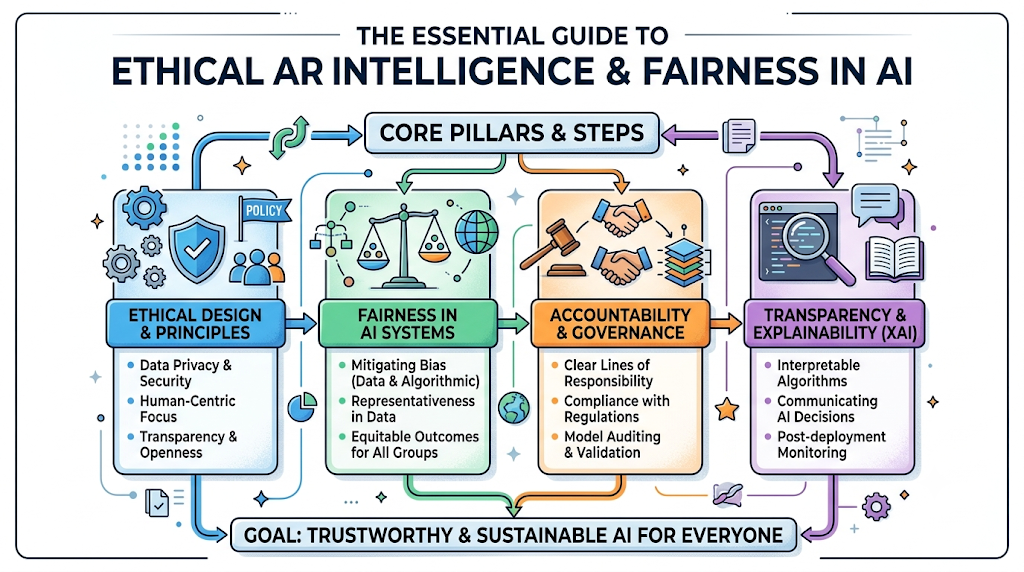
Introduction
Artificial intelligence is no longer a futuristic concept tucked away in research labs. Today, AI systems power our daily lives—they curate our social media feeds, help doctors diagnose medical conditions, screen job applications, and automate financial decisions. As machine learning models take on increasingly vital roles in society and business, ensuring their choices are safe, fair, and reliable has become a critical priority. Building trustworthy systems requires developers and organizations to actively address how these mathematical models interact with human values. This is why Understanding AI Ethics and Bias is one of the most vital areas of modern technological development. Without an intentional focus on fairness, even the most advanced code can unintentionally reproduce or amplify historical patterns of discrimination. At AIUniverse.xyz, we dedicate our resources to breaking down complex technical shifts into accessible, high-quality knowledge. We believe that building responsible AI is a shared duty across the entire tech ecosystem, from software developers writing code to business leaders implementing enterprise tools.
What Are AI Ethics and AI Bias?
Featured Snippet Definition: AI ethics is a system of moral principles, values, and operational standards designed to guide the development and deployment of artificial intelligence systems safely. AI bias refers to systematic, unfair errors in machine learning outputs that occur when an algorithm produces prejudiced results based on flawed training data or development assumptions.
Understanding both terms is critical because they dictate how a computer system impacts real human lives. While AI ethics provides the overarching philosophical and structural framework for what software should do, addressing AI bias is the practical engineering work required to keep systems balanced and fair.
The relationship between ethics, fairness, and AI accountability is deeply structural. If a machine learning model operates without clear human accountability, its decisions cannot be properly audited. True fairness in AI can only be achieved when developers actively audit their training sets, track hidden algorithmic patterns, and maintain complete ownership of the system’s societal impact.
Core Principles of Ethical AI
Fairness
An ethical AI system must treat all individuals equitably. It should not yield skewed results or deny resources based on sensitive personal characteristics like age, gender, race, or cultural background.
Transparency
Systems should never operate as an impenetrable mystery. Developers and end-users need to understand how an algorithm reaches a particular conclusion. This principle relies heavily on explainable AI techniques that reveal the underlying logic behind automated outputs.
Accountability
There must always be a clear answer to who is responsible for an AI system’s actions. Organizations must establish clear internal AI governance policies so that errors can be reported, investigated, and corrected immediately by human operators.
Privacy
Responsible AI systems must respect human data rights. This means utilizing secure, compliant data-gathering techniques, ensuring user consent, and safeguarding personal information against unauthorized extraction or training exposure.
Security
Machine learning models are vulnerable to specialized cyberattacks, such as data poisoning or adversarial inputs. Ethical AI requires strict engineering guardrails to prevent malicious actors from manipulating model behaviors.
Human Oversight
Technology should support human capability, not completely replace human moral reasoning. Maintaining a human-in-the-loop system ensures that a qualified professional can override automated decisions in high-impact scenarios like healthcare or legal judgments.
Understanding AI Ethics and Bias
Sources of AI Bias
Machine learning systems do not independently generate their own thoughts or opinions. They look for mathematical patterns within the data assets they are given. Consequently, automated bias emerges when the information used to train a model reflects existing human prejudices or historical inequalities.
Data Bias
Data bias occurs when the information used to train a model does not accurately represent the real-world environment it will operate in. For example, if a medical diagnostic tool is trained exclusively on clinical data from patients in a single geographic region, it may deliver highly inaccurate diagnoses when deployed to treat patients in other parts of the world.
Algorithmic Bias
Sometimes, the bias stems from the way the software code is constructed or optimized. If an engineer sets a performance metric that heavily favors speed over accuracy, the algorithm might take flawed shortcuts, creating systematic errors that disproportionately affect complex, minority edge cases.
Human Bias in AI Development
Engineers, data scientists, and product managers carry their own unconscious assumptions. If a development team lacks diverse perspectives, they might unintentionally design an application based on subjective viewpoints, failing to realize how the system might negatively impact a completely different demographic.
Bias During Model Deployment
A machine learning model might perform flawlessly in a controlled testing environment but fail completely when introduced to the messy real world. If a retail demand-forecasting model is deployed during an unprecedented economic shift, the sudden change in consumer behavior can render its original training parameters irrelevant, resulting in skewed, erratic choices.
Monitoring AI Systems After Deployment
Bias is not a one-time issue that you can fix and forget. Systems suffer from “data drift” as real-world environments evolve. Continuous monitoring and automated auditing are required to detect when a model’s live outputs begin to skew away from acceptable fairness parameters.
AIUniverse.xyz Guide to AI Ethics and Responsible AI
To help software engineers and business leaders implement reliable guardrails, we have outlined the AIUniverse.xyz Guide to AI Ethics and Responsible AI. Following this strategic implementation pipeline helps teams systematically neutralize structural biases:
[Diverse Data Collection] ➔ [Fairness Testing] ➔ [Explainable Documentation] ➔ [Human Governance]
Building Fair AI Systems
Fairness must be integrated from the very first phase of a project’s lifecycle. Teams must explicitly define what fairness means for their specific use case—whether it means ensuring equal predictive accuracy across all demographic groups or matching demographic distribution ratios exactly.
Improving Data Quality
To eliminate machine learning bias, your training inputs must be thoroughly audited. Teams must actively identify missing perspectives, remove duplicate records, and balance their training sets to reflect the actual diversity of the populations the technology intends to serve.
Reducing Bias in Machine Learning Models
Engineers should regularly apply algorithmic mitigation techniques. This includes utilizing open-source adversarial debiasing libraries during training or applying post-processing adjustments to re-balance output scores before they reach the user.
Creating Transparent AI Solutions
Move away from untraceable “black-box” systems. By incorporating explainable AI methods, you can generate clear visual charts and text summaries that explain exactly which data attributes had the highest mathematical influence over a specific automated decision.
Encouraging Responsible AI Adoption
Building trustworthy AI requires systemic organizational support. Leaders must foster an open workplace culture where developers feel empowered to voice ethical concerns, delay unsafe product rollouts, and prioritize system safety over speed.
Real-World Applications
Healthcare
An AI algorithm designed to predict patient risk profiles might mistakenly allocate fewer resources to marginalized groups if it relies solely on historical healthcare spending metrics, since historical spending is often dictated by financial access rather than actual medical need.
Banking and Finance
When automated credit-scoring tools review loan applications, they must be rigorously audited to ensure they judge candidates entirely on current creditworthiness, rather than utilizing proxy variables like postal codes to indirectly discriminate against specific neighborhoods.
Recruitment
An automated resume screening tool trained on an organization’s historic hiring profiles might conclude that certain technical roles are better suited to specific demographics simply because those groups held the majority of those positions in the past.
Education
Automated essay grading systems must be carefully checked for bias to ensure they evaluate an argument’s core logical structure and comprehension accurately, rather than unfairly penalizing students who speak with unique regional accents or regional language patterns.
Retail
Dynamic pricing tools used by e-commerce platforms must operate ethically to avoid predatory patterns, ensuring that localized price adjustments are based on logistical shipping costs rather than exploiting vulnerable consumer situations.
Customer Service
AI-driven virtual assistants and automated chatbots must be trained on diverse linguistic data so they can comprehend and assist users of all ages, accents, and vernaculars with equal precision and speed.
Benefits of Ethical AI
- Increased Trust: Users are significantly more likely to adopt and share digital solutions when they feel confident that the technology behaves honestly, transparently, and safely.
- Better Decision-Making: Eliminating hidden bias strips away flawed data assumptions, resulting in automated predictions that are far more accurate in the real world.
- Improved Customer Confidence: Demonstrating a clear commitment to responsible AI builds long-term brand equity and protects corporate reputation from public fallout.
- Regulatory Compliance: As governments introduce strict data laws, proactive AI governance keeps your systems aligned with emerging international compliance standards.
- Reduced Business Risk: Catching discriminatory skews early protects your business from costly product recalls, operational redesigns, and expensive class-action legal disputes.
- Long-Term AI Adoption: Ethical systems build a sustainable operational framework that allows technologies to scale safely across diverse international markets.
Ethical AI vs Biased AI Systems
| Feature | Ethical AI | Biased AI |
| Decision-Making | Fair, balanced, and verified across all user groups | Potentially unfair and skewed toward specific metrics |
| Transparency | High; utilizes explainable AI features and clear documentation | Limited; operates as an unauditable “black box” |
| Accountability | Clearly defined; human operators manage exceptions | Often unclear; errors are blamed on system anomalies |
| User Trust | High long-term public and consumer confidence | Lower adoption rates; frequent user pushback |
| Compliance | Easier to achieve across global data standards | Greater risk of legal fines and regulatory penalties |
Common Challenges
Poor Data Quality
Raw data is often unorganized, incomplete, or saturated with systemic historical inequalities that reflect past societal prejudices.
- Recommendation: Establish automated data preprocessing pipelines that scan your datasets for missing information, unbalance, or unrepresentative sampling patterns prior to model training.
Lack of Diversity in Training Data
If your engineering workforce lacks diverse perspectives, it becomes exceptionally difficult to spot missing angles in your dataset designs.
- Recommendation: Actively recruit diverse technical teams and involve cross-functional stakeholders—including ethicists, educators, and end-users—during the initial system planning phase.
Limited Transparency
Modern deep learning models use millions of complex mathematical connections, making it difficult to isolate the exact reason behind a single output.
- Recommendation: Integrate model-agnostic explanation tools like SHAP or LIME to map out feature importance and provide clear rationales for automated selections.
Complex AI Models
The more complex an algorithm is, the harder it becomes to test for subtle, hidden bugs or systemic output drifts.
- Recommendation: Break large models down into modular, testable components and maintain rigorous version control for all training runs and testing parameters.
Governance and Compliance
Many organizations want to deploy responsible AI but lack standard corporate playbooks to audit their technology stacks.
- Recommendation: Form an independent internal AI ethics board tasked with setting clear validation benchmarks, reviewing algorithmic risks, and approving high-stakes software deployments.
Best Practices
- Use diverse and representative datasets: Ensure your training samples accurately mirror the diverse real-world environment where your tool will be deployed.
- Continuously monitor AI performance: Run automated validation loops after deployment to check for data drift or performance drops among specific sub-populations.
- Conduct fairness testing: Use quantitative metrics to evaluate model predictions across multiple demographic groups before any public rollout.
- Maintain transparency in AI decisions: Provide users with clear explanations of why an automated action was taken and what parameters influenced it.
- Keep humans involved in high-impact decisions: Never fully automate life-altering processes; use AI as an advisory asset alongside human professional judgment.
Key Performance Metrics
- Fairness Metrics: Statistical measurements that check if an algorithm offers equal predictive accuracy or equal selection rates across all tracked groups.
- Model Accuracy: Ensuring the system maintains its high performance across all subcategories, rather than displaying high overall accuracy built on high performance in only one majority group.
- Bias Detection Score: Quantitative assessments derived from regular data auditing tools to identify skewed mathematical patterns in training datasets.
- Explainability: A metric that rates how easily an average non-technical user can comprehend the logical steps taken by the software to produce an output.
- User Trust: Tracked via direct customer feedback, opt-in rates, and error-reporting patterns to determine how comfortable users are with automated recommendations.
- Regulatory Compliance: Scoring your system against modern data governance standards to verify full legal compliance and data protection.
Career Opportunities
The massive industry push toward trustworthy AI has created a high demand for specialized tech talent. Organizations are actively hiring AI Ethics Consultants to shape product blueprints and Responsible AI Specialists to implement automated evaluation toolkits.
Additionally, roles like AI Governance Analysts, AI Policy Advisors, and specialized Data Scientists focus entirely on auditing data pipelines and keeping applications aligned with global legal requirements. If you enjoy blending computer science, sociology, and law, this field offers incredible long-term career growth.
Future of Responsible AI
Explainable AI
Future machine learning frameworks will feature built-in interpretability. Instead of retrofitting translation layers onto complex neural networks, the next generation of algorithms will document their own reasoning step-by-step in clear human language.
Responsible AI Frameworks
Standardized deployment toolkits will become universal. Software engineers will have access to unified open-source toolkits that automatically flag machine learning bias and run compliance testing during every code update.
AI Governance Platforms
Enterprise management systems will soon automate compliance mapping. These centralized portals will track every machine learning model in a company’s inventory, monitoring data usage and generating audit reports automatically for regulatory reviews.
Ethical AI Regulations
Global legal frameworks will continue to evolve, requiring mandatory independent risk audits for algorithms deployed in sensitive public sectors, mirroring the rigorous validation methods used by the automotive and pharmaceutical industries.
Human-Centered AI
The tech landscape will shift focus from raw processing power to human-centered assistance. AI design will prioritize applications that work alongside humans, augmenting human creativity and problem-solving while respecting personal choices.
Common Misconceptions
Misconception 1: AI Is Always Neutral
Fact: Algorithms are built by humans and trained on human data. Because they inherit our historical trends and design choices, they are never completely free from human bias.
Misconception 2: Removing Bias Is Easy
Fact: Bias cannot be fixed by simply deleting sensitive attributes like gender or race from a dataset. Algorithms can easily reconstruct those missing links using proxy data like shopping patterns or location history.
Misconception 3: Ethics Only Matters After Deployment
Fact: Waiting until a model is live to address ethical flaws is incredibly expensive and risky. Ethical considerations must be baked into data gathering, model selection, and user experience design from day one.
Misconception 4: AI Can Replace Human Judgment Completely
Fact: While AI can process massive datasets at incredible speeds, it lacks empathy, moral understanding, and context. Complex human situations will always require real human oversight.
FAQ Section
1. What is the main cause of machine learning bias?
The primary cause of algorithmic bias is unrepresentative or historically skewed training data. If the input data contains human prejudices or reflects past social inequalities, the machine learning model will naturally treat those patterns as ground truth and replicate them in its decisions.
2. How do engineers test a live system for AI bias?
Engineers use specialized auditing tools to feed identical test scenarios representing different demographic groups into the model. They then analyze the outputs to see if the system’s accuracy or selection rates vary unfairly between groups.
3. Can you completely eliminate bias from an artificial intelligence model?
Total elimination of bias is almost impossible because all data is collected from a complex and subjective human world. However, by using rigorous data auditing, diverse training groups, and continuous performance monitoring, developers can reduce bias to safe, negligible levels.
4. What is explainable AI and why should regular users care about it?
Explainable AI refers to tools and techniques that translate complex algorithmic math into clear, human-understandable terms. It matters to regular users because it lets them see exactly why an automated system approved or denied a request, preventing unfair black-box choices.
5. How do proxy variables accidentally introduce bias into a software model?
A proxy variable is a piece of data that stands in for another attribute. For example, if a developer removes race from a model but leaves in specific neighborhood zip codes, the algorithm can often deduce the hidden demographic information anyway, causing bias to persist.
6. Who is legally responsible when an automated system makes a damaging error?
Under modern AI governance frameworks, legal responsibility lies with the company or organization that deploys the system. This highlights the vital need for clear internal accountability protocols and continuous human oversight to check high-stakes decisions.
7. Do ethical AI practices slow down corporate innovation?
No, ethical development actually accelerates long-term innovation. By catching data errors and structural flaws early in development, organizations avoid expensive product recalls, public brand damage, and legal penalties, while building deeper trust with their customers.
8. How do data privacy laws connect with the principles of ethical AI?
Data privacy laws are a core pillar of ethical artificial intelligence. They dictate that training data must be gathered securely, transparently, and with clear user consent, preventing organizations from misusing personal data to build unverified algorithmic profiles.
9. What role do non-technical professionals play in AI governance?
Non-technical professionals like ethicists, legal experts, policy creators, and community educators are essential. They provide the necessary cultural, legal, and ethical context that developers might miss, helping design software that aligns with real-world human values.
10. How does AIUniverse.xyz help teams learn more about trustworthy AI development?
AIUniverse.xyz acts as an open educational resource that provides clear guides, framework breakdowns, and practical case studies. We help tech enthusiasts and industry professionals master the balance between advanced system development and responsible engineering.
Final Summary
To build long-term innovation and public trust, understanding AI ethics and bias is an absolute necessity for modern technology creators and users alike. Ensuring that automated tools are developed around fairness, transparency, and clear accountability prevents machine learning systems from repeating historical inequalities. Managing these challenges requires proactive data quality testing, explainable design architectures, and consistent human oversight across every stage of development. Ultimately, building responsible AI is not about limiting technology’s reach—it is about creating resilient, safe systems that respect human values and drive sustainable growth. By prioritizing these ethical considerations, organizations can scale their innovations with confidence and build a reliable digital space.
