Introduction
Every single day, people around the world make billions of buying decisions. We buy coffee in the morning, browse clothing websites during lunch, and stream movies at night. For decades, businesses have tried to guess what customers will do next. Historically, this involved a lot of guesswork, slow surveys, and intuition. Today, the digital landscape moves too fast for guesswork. This is where artificial intelligence comes in. Modern organizations use AI to analyze massive amounts of customer data instantly. Instead of looking backward at what people already bought, businesses use technology to look forward. By identifying hidden patterns and anticipating upcoming trends, intelligent tools support better decision-making for companies of all sizes. For more insights on how automation changes industries, check out the educational resources available directly on AIUniverse.xyz. Understanding these technical concepts helps digital marketers, students, and entrepreneurs stay ahead in a fast-evolving marketplace.
What Is Consumer Behavior?
Definition
Consumer behavior is the study of how individuals, groups, or organizations select, buy, use, and experience goods, services, ideas, or experiences to satisfy their needs and wants. It looks closely at the entire journey a person takes before, during, and after spending their money.
Why Businesses Study Consumer Behavior
Companies do not just want to sell a product once; they want to build lasting relationships. By studying buying behavior, businesses can figure out exactly what problems their customers face. This knowledge helps companies design better products, set fairer prices, and communicate more effectively. If a business does not understand its audience, it risks building products nobody wants.
Factors That Influence Purchasing Decisions
A person’s decision to buy something is rarely simple. It is shaped by a mix of different forces:
- Psychological Factors: A consumer’s personal motivations, perceptions, learning, and beliefs.
- Social Factors: Family dynamics, friend groups, social media influencers, and cultural background.
- Economic Factors: Personal income, savings, inflation rates, and overall economic stability.
- Situational Factors: The time of day, store layout, temporary discounts, or even the current weather.
Traditional Methods vs. AI-Driven Analysis
In the past, understanding these factors required manual research. Companies relied on focus groups, phone surveys, and historical sales spreadsheets. While useful, traditional methods have major limitations. They are slow, expensive, and sample only a tiny fraction of the market. Furthermore, what people say in a survey does not always match what they actually do when they pull out their wallets.
AI-driven analysis flips this approach completely. Instead of asking a small group what they might do, advanced computer systems look at what millions of real people are actually doing in real-time. By processing live data streams, intelligent platforms uncover objective truths about customer preferences that traditional surveys miss entirely.
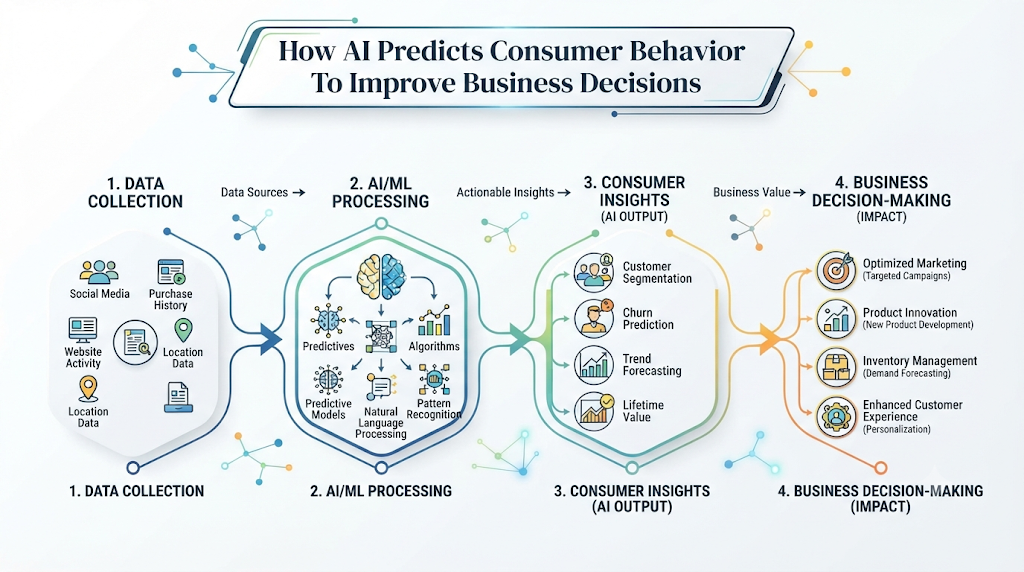
How AI Predicts Consumer Behavior
To understand how software performs this feat, it helps to think of artificial intelligence as a master detective. It processes clues, spots connections, and draws logical conclusions without needing explicit instructions for every single step.
Data Collection
The process begins with gathering information. Every time an action occurs online—like clicking a link, adding an item to a cart, or reading an article—a digital footprint is left behind. Advanced software securely collects these fragments of information from multiple touchpoints to build a foundation for analysis.
Pattern Recognition
Once the information is gathered, the system looks for hidden connections. Human analysts might struggle to see a relationship between a drop in outdoor temperatures, an increase in website visits at 9:00 PM, and a sudden demand for travel mugs. AI, however, excels at finding these subtle, complex links across millions of data points simultaneously.
Machine Learning Models
At the core of this technology is machine learning. Think of machine learning as a computer system that trains itself to get smarter over time. By looking at historical examples of customer journeys, the software learns which actions usually lead to a sale and which actions lead to a customer leaving the website empty-handed.
Predictive Analytics
After learning from the past, the system applies this knowledge to the present. Predictive analytics is the practice of using historical data to forecast future events. For example, if the system notices that a shopper exhibits the exact same digital behaviors as thousands of people who previously bought running shoes, it can predict with high accuracy that this new visitor is also ready to buy running shoes.
Customer Segmentation
Not all customers are the same. Instead of treating everyone as a single group, automated platforms use customer analytics to group people based on shared habits, interests, and spending styles. A business can instantly divide its audience into precise categories, such as “weekend bargain hunters” or “late-night impulse buyers.”
Behavioral Analysis
This step goes deeper than simple demographics like age or location. Behavioral analysis focuses entirely on actions. It tracks how long someone hovers their mouse over an image, how fast they scroll through a page, and how frequently they open promotional emails. This paints a vivid picture of the customer’s true intent.
Continuous Learning
The most powerful aspect of this technology is that it never stops improving. If a system predicts a customer will buy an item, but the customer chooses not to, the system does not fail. Instead, it absorbs that outcome as a new piece of data, adjusts its internal logic, and makes a more accurate prediction the next time around.
Data Sources Used by AI
Artificial intelligence requires a steady diet of information to make accurate predictions. Modern customer insights are generated by looking at several key data sources:
- Purchase History: What items were bought, how much was spent, when the purchase occurred, and how frequently the customer returns.
- Website Browsing Activity: The specific pages visited, the time spent on each section, and the items added to—or removed from—a digital shopping cart.
- Mobile App Interactions: Location-based check-ins, push notification clicks, and how often an application is opened throughout the week.
- Customer Feedback: Direct reviews, support tickets, survey responses, and star ratings left on product pages.
- Search Behavior: The exact keywords, phrases, and questions typed into a store’s search bar.
- Social Media Trends: Public posts, mentions, hashtags, and overall sentiment surrounding a specific brand or product category.
- Loyalty Programs: Points earned, rewards redeemed, and the specific physical stores visited by cardholders.
- Demographic Information: General background details such as age, approximate income bracket, occupation, and geographic region.
Responsible Data Handling and Privacy
While these data sources are incredibly valuable, businesses must handle them with extreme care. Collecting data should never mean violating personal privacy. Organizations must remain completely transparent about what information they collect, secure it against cyber threats, and give users clear choices to opt-out at any time. Ethical prediction requires a careful balance between helpful personalization and respecting boundaries.
Benefits of AI in Consumer Behavior Prediction
Implementing these intelligent systems offers widespread advantages for both the companies that use them and the shoppers who benefit from them.
Personalized Recommendations
We have all seen recommendation systems in action when online stores suggest items that perfectly match our taste. By predicting what a customer wants next, platforms save shoppers time and make the digital experience feel custom-built for them.
Better Customer Experience
When a business can anticipate what a customer needs, frustrations disappear. Customer personalization ensures that users see relevant information, receive support at the exact moment they experience confusion, and enjoy a smooth shopping journey.
Improved Marketing Campaigns
Instead of sending generic blast emails to millions of people, digital marketers can craft tailored messages for specific groups. This makes marketing feel less like annoying advertising and more like a helpful reminder, resulting in much higher engagement rates.
Demand Forecasting
For businesses, knowing what will sell next month is priceless. Smart forecasting helps companies order the right amount of inventory. This prevents the costly problem of having too many unsold items sitting in a warehouse, or running out of a popular product when demand spikes.
Customer Retention
It is far more expensive to find a new customer than it is to keep an existing one. Intelligent tools can flag warning signs that show when a client is becoming unhappy or lose interest. This allows the business to step in with a helpful offer to rebuild the relationship before the customer leaves permanently.
Reduced Business Risk
Launching a new product involves a massive financial gamble. By using business intelligence tools to test concepts against simulated customer models, companies can gauge market interest before spending millions on production.
Faster Decision-Making
Market trends can shift overnight. Data analytics platforms process information instantly, allowing management teams to spot emerging market changes and pivot their business strategies in hours rather than months.
Improved Sales Planning
Sales teams can focus their energy where it matters most. By scoring leads based on their likelihood to purchase, professionals can dedicate their time to building relationships with clients who are genuinely ready to buy.
Real-World Applications
To see how these concepts function in everyday life, let us examine how various industries apply intelligent prediction to solve practical problems.
E-Commerce
- Business Challenge: Online clothing stores lose millions when shoppers abandon their digital carts because they are unsure if a garment will fit properly.
- AI Solution: The platform uses behavioral data and past return patterns to predict the user’s correct size and suggest clothing items matching their body shape.
- Customer Benefit: The shopper feels confident in their purchase, enjoys a better-fitting outfit, and avoids the hassle of mailing back returns.
- Business Outcome: The retailer experiences a drastic drop in product return rates and sees a significant lift in completed sales.
Retail
- Business Challenge: Physical grocery stores struggle with food waste because fresh produce spoils quickly if it is not purchased within days.
- AI Solution: Grocers connect local weather data, neighborhood events, and historical loyalty card data to predict exact daily grocery demands.
- Customer Benefit: Shoppers always find fresh, high-quality food on the shelves without encountering missing items.
- Business Outcome: Stores maximize profit margins by slashing inventory waste and cutting down on unnecessary storage costs.
Banking
- Business Challenge: Financial institutions need to offer personal loan products without annoying customers who have zero interest in borrowing money.
- AI Solution: Systems analyze account activities and life-stage indicators to identify clients who are likely planning major life transitions, like buying a home.
- Customer Benefit: Clients receive timely, competitive loan options exactly when they begin researching major life steps.
- Business Outcome: Banks enjoy much higher conversion rates on financial products while maintaining high trust with their account holders.
Healthcare
- Business Challenge: Wellness clinics struggle to keep patients engaged with their preventative health routines, leading to missed appointments.
- AI Solution: Applications track daily activity habits and predict when a patient is most likely to skip their exercises or forget their medication.
- Customer Benefit: Patients receive personalized nudges and encouragement at the precise moment their motivation starts to drop.
- Business Outcome: Clinics achieve vastly superior long-term patient health outcomes and maintain steady, predictable appointment schedules.
Travel
- Business Challenge: Airlines face empty seats on off-peak flights, while popular holiday flights sell out too fast, leaving customers frustrated.
- AI Solution: Predictive models evaluate historical booking velocity, search habits, and local holiday trends to dynamically adjust pricing.
- Customer Benefit: Budget-conscious travelers find highly affordable deals if they book early during predicted low-demand windows.
- Business Outcome: Airlines optimize their flight capacities, ensuring planes fly full while maximizing total passenger revenue.
Entertainment
- Business Challenge: Video streaming platforms risk losing monthly subscribers if users spend too much time scrolling through menus without finding a video to watch.
- AI Solution: Highly tuned recommendation systems evaluate viewing history, time of day, and even fast-forward habits to curate a unique homepage for every user.
- Customer Benefit: Viewers discover incredible movies and shows instantly without wasting their evening searching through vast digital catalogs.
- Business Outcome: Streaming companies secure long-term subscriber loyalty and experience a major drop in monthly cancellation rates.
Telecommunications
- Business Challenge: Mobile network companies struggle to identify which subscribers are planning to switch to a competitor until after they have already canceled their service.
- AI Solution: Software monitors subtle shifts in network usage drops, data speed complaints, and customer service calls to predict churn risk.
- Customer Benefit: Unsatisfied users receive proactive support, upgraded data plans, or special loyalty discounts to fix their issues.
- Business Outcome: Telecom providers save millions in customer acquisition costs by successfully retaining vulnerable accounts.
Food Delivery Services
- Business Challenge: Delivery apps face extreme delivery delays during unexpected rainstorms or sudden local sports events.
- AI Solution: Predictive engines combine real-time weather feeds, live kitchen preparation speeds, and driver locations to manage order volumes.
- Customer Benefit: Hungry users receive highly accurate delivery countdowns and enjoy hot food arriving exactly when promised.
- Business Outcome: Delivery networks maximize their hourly courier efficiency and build an elite reputation for logistical reliability.
Challenges and Ethical Considerations
While the power of prediction is undeniably impressive, it brings serious real-world responsibilities. Businesses must navigate several critical roadblocks carefully:
- Data Privacy: Shoppers are increasingly protective of their digital footprints. Companies must follow strict data protection rules and ensure they never collect private information without clear permission.
- Bias in AI Models: Computer systems learn from historical human behavior. If past data contains human prejudices or unfair patterns, the software will learn those biases and repeat them, leading to unfair treatment of certain consumer groups.
- Limited or Poor-Quality Data: If a business feeds inaccurate, messy, or outdated information into a predictive model, the output will be completely useless. This concept is widely known as “garbage in, garbage out.”
- Transparency: Customers have a right to know why a system is showing them a specific price or product. Black-box systems that hide their reasoning make it difficult to build long-term trust.
- Customer Trust: If a company makes its predictions look too obvious—like advertising a highly sensitive personal item before a user has even told their close family—it creates an uncomfortable feeling that hurts brand loyalty.
- Regulatory Compliance: Governments worldwide are passing strict laws regarding automated decisions. Businesses must ensure their technology conforms to global privacy and AI compliance standards.
- Responsible AI Use: Organizations must explicitly state that the goal of technology is to help and serve the customer, rather than to manipulate human vulnerabilities or exploit impulsive behaviors.
Best Practices
For teams ready to embrace these smart tools, following a balanced roadmap is essential for long-term success:
- Collect Quality Data Responsibly: Focus on gathering accurate, clean data from transparent, opt-in sources rather than buying massive, unverified third-party databases.
- Respect Customer Privacy: Make privacy policies easy to read. Give your users absolute control over their settings so they feel completely safe interacting with your digital channels.
- Keep Models Updated: Human trends evolve rapidly. Regularly retrain your software with fresh data so its predictions reflect current realities instead of past years’ fads.
- Validate Predictions: Do not blindly believe every output a computer generates. Set up small digital experiments to test whether the system’s predictions match real-world outcomes before deploying them fully.
- Combine AI Insights with Human Judgment: Technology spots data correlations, but human experts understand empathy, culture, and context. Always use software to support human creators, not replace them.
- Monitor Performance Continuously: Establish regular check-ups to ensure your predictive systems remain accurate, fast, unbiased, and completely aligned with your core company values.
Future Trends
The field of behavioral prediction is evolving rapidly. Over the coming years, we can expect several major breakthroughs to redefine how businesses interact with audiences:
- Generative AI: Beyond predicting what a customer wants to buy, systems will instantly generate custom product images, descriptions, and videos tailored perfectly to an individual’s design tastes.
- Hyper-Personalization: Digital experiences will move past basic recommendations. Entire store layouts, application interfaces, and pricing structures will adjust dynamically in real-time to match a user’s immediate mood and context.
- Real-Time Customer Analytics: The delay between a customer action and a business response will completely vanish. Prediction will happen instantly, allowing platforms to assist shoppers during their decision-making process.
- Explainable AI: Future systems will be built with open, understandable logic. This allows human managers and everyday consumers to see exactly why an automated system reached a specific conclusion.
- AI-Powered Virtual Assistants: Shopping assistants will become highly conversational, acting as trusted personal guides who know your style, size, and budget perfectly.
- Predictive Customer Journeys: Instead of mapping out traditional sales funnels, software will map entirely unique, unpredictable paths for every consumer, creating smooth journeys across multiple channels.
- Privacy-Enhancing Technologies: New methods will allow software to discover deeply valuable consumer trends without ever seeing or revealing a user’s personal identifying details.
Comparison Tables
Traditional Consumer Analysis vs. AI-Based Prediction
| Feature | Traditional Analysis | AI-Based Prediction | Business Benefit |
| Data Processing Speed | Slow; requires weeks or months of manual work. | Instant; processes millions of records in real-time. | Allows businesses to respond instantly to market changes. |
| Information Scope | Small sample sizes, focus groups, and limited surveys. | Massive datasets covering entire global customer bases. | Eliminates guesswork by providing a complete market view. |
| Analysis Perspective | Retrospective; looks at past historical sales data. | Forward-looking; anticipates future purchasing trends. | Helps teams proactively stock inventory before spikes occur. |
| Level of Detail | Broad demographic groups (e.g., age or region). | Individual behavioral profiles based on action habits. | Enables precise personalization for every single shopper. |
| System Adaptability | Rigid; updates require running brand new studies. | Continuous; automatically learns from new data daily. | Reduces operational costs by keeping insights current. |
Common Data Sources for AI Consumer Behavior Prediction
| Data Source | Information Collected | Business Use | Customer Value |
| Purchase History | Past receipts, order dates, prices, and item types. | Forecasts future buying cycles and reorder times. | Reminds shoppers to restock items right before they run out. |
| Browsing Activity | Clicks, page scroll speeds, and abandoned carts. | Optimizes store navigation layouts and fixes broken links. | Creates a faster, frustration-free online shopping experience. |
| Customer Feedback | Product reviews, star ratings, and support tickets. | Spots product defects and highlights popular features. | Ensures consumer complaints are resolved quickly by the brand. |
| Social Media Trends | Brand mentions, public comments, and emoji usage. | Tracks public brand sentiment and viral product ideas. | Helps brands launch products that match current cultural tastes. |
FAQs
What is the primary difference between predictive analytics and traditional data analysis?
Traditional data analysis looks backward at past metrics to figure out what already happened over a specific timeframe. Predictive analytics uses that historical information alongside active machine learning models to look forward, calculating the high probability of what a customer will do next.
Does a business need massive datasets to start predicting customer habits?
While having a vast amount of data helps improve the overall accuracy of a model, smaller businesses can still achieve great results. Starting out by cleanly tracking basic website activity, newsletter signups, and local purchase histories provides plenty of actionable insights for modern software.
Can artificial intelligence completely replace human marketing teams?
No, it cannot. Software is excellent at processing numbers, tracking patterns, and automating repetitive tasks at scale, but it completely lacks human empathy, cultural awareness, storytelling abilities, and emotional intelligence. The most successful businesses use technology as a supportive assistant for their human creators.
How does personalization improve the day-to-day shopping experience?
Personalization saves shoppers valuable time by filtering out thousands of irrelevant products and showcasing items, deals, and articles that match their unique tastes. It transforms a cluttered, confusing digital marketplace into an intuitive, custom-tailored virtual store.
What exactly is algorithmic bias in consumer predictions?
Algorithmic bias occurs when the historical data used to train a system contains human prejudices, old systemic inequities, or flawed sampling methods. The computer learns these unfair patterns as absolute rules, which can lead to software making unfair recommendations or discriminatory pricing choices.
Is it safe for consumers to share their data with modern retail platforms?
It is safe as long as the organization follows modern privacy regulations, uses advanced data encryption, and remains transparent about its security policies. Shoppers should always review a brand’s privacy settings and opt out of tracking if a company feels untrustworthy.
How do online streaming platforms predict what movies I want to watch?
Streaming recommendation systems look at your personal viewing history, the genres you click on, the time of day you watch, and how quickly you turn off a show. It then cross-references your habits with millions of other users who share similar tastes to suggest matching content.
What is demand forecasting and how does it help protect our environment?
Demand forecasting helps businesses calculate exactly how much product they need to manufacture and ship. By preventing overproduction, companies cut down significantly on raw material waste, warehouse energy usage, and the amount of unsold goods thrown into landfills.
What does the phrase “garbage in, garbage out” mean in data analytics?
This phrase means that the quality of an automated system’s output depends entirely on the quality of the input data. If a business feeds inaccurate, incomplete, or messy information into an intelligent model, the resulting predictions will be completely wrong and unhelpful.
Will future predictive systems know what I want to buy before I even realize it myself?
By analyzing subtle routine habits, seasonal changes, and historical needs, advanced software can accurately predict when you are running low on everyday essentials like groceries or household supplies. However, human free will and spontaneous choices ensure that predictions will never be completely absolute.
Conclusion
Artificial intelligence is fundamentally reshaping how modern organizations interact with their audiences. By turning vast, chaotic streams of raw data into clear, actionable consumer insights, technology allows companies to stop guessing and start truly understanding customer needs. However, achieving success with these advanced tools requires a balanced approach. Technology alone is not a silver bullet; its long-term effectiveness depends entirely on responsible data collection, strict respect for user privacy, algorithmic transparency, and strong human oversight. When businesses view AI as a smart decision-support tool—rather than a replacement for human relationship-building—they can create meaningful digital experiences that respect individual boundaries while delivering incredible value to customers worldwide.
