Introduction
AI AR/VR Learning Coach Systems combine artificial intelligence, augmented reality (AR), virtual reality (VR), immersive simulations, and adaptive learning technologies to provide personalized coaching experiences for students, professionals, and organizations.
Traditional learning methods often depend on lectures, textbooks, videos, and standard training materials. While effective for knowledge transfer, these approaches may not provide enough hands-on practice, real-world simulation, or personalized guidance.
AI-powered AR/VR learning coach systems create immersive environments where learners can practice skills, interact with virtual instructors, complete simulations, and receive real-time feedback.
These systems help learners develop:
- Technical skills
- Professional skills
- Communication abilities
- Practical knowledge
- Problem-solving capabilities
- Safety procedures
- Hands-on experience
AI AR/VR learning platforms are used by:
- Schools and universities
- Corporate training teams
- Healthcare organizations
- Manufacturing companies
- Aviation companies
- Engineering institutions
- Professional development programs
Modern immersive learning systems combine AI coaching, virtual environments, speech recognition, computer vision, simulations, analytics, and personalized recommendations.
The goal of these platforms is to make learning more engaging, practical, and adaptive by allowing users to learn through experience rather than only through theory.
How AI AR/VR Learning Coach Systems Work
Immersive Environment Creation
AR/VR technology creates realistic digital learning environments where users can interact with virtual objects and scenarios.
AI Coaching
Artificial intelligence provides:
- Guidance
- Feedback
- Explanations
- Recommendations
- Performance analysis
User Interaction Analysis
The system evaluates:
- Actions
- Decisions
- Responses
- Learning progress
- Skill development
Adaptive Learning
AI adjusts difficulty levels, scenarios, and recommendations based on learner performance.
Performance Tracking
The platform provides:
- Progress reports
- Skill analytics
- Improvement suggestions
- Learning insights
Common Use Cases
- Medical training simulations
- Employee onboarding
- Technical skill development
- Safety training
- Equipment operation training
- Soft skills coaching
- Language practice
- Engineering education
- Customer service training
- Leadership development
Why AI AR/VR Learning Coach Systems Matter
Experiential Learning
Learners gain practical experience through realistic simulations.
Improved Engagement
Immersive environments encourage active participation and deeper learning.
Safe Practice
Users can practice complex tasks without real-world risks.
Personalized Coaching
AI provides feedback based on individual performance.
Better Skill Retention
Interactive experiences can improve understanding and memory.
Evaluation Criteria for Buyers
Immersive Learning Quality
Platforms should provide realistic, interactive, and engaging experiences.
AI Coaching Capability
Strong systems should provide useful feedback and personalized guidance.
Hardware Compatibility
Organizations should evaluate support for AR devices, VR headsets, mobile devices, and desktop environments.
Content Availability
The platform should support relevant learning scenarios and industry requirements.
Analytics and Reporting
Organizations should evaluate progress tracking and performance insights.
Integration Capability
Important integrations include LMS platforms, HR systems, training tools, and enterprise applications.
Scalability
Solutions should support multiple learners, locations, and training programs.
Key Trends
AI Virtual Tutors
Immersive learning platforms are increasingly adding AI-powered virtual instructors.
Simulation-Based Training
Organizations are adopting realistic simulations for professional skill development.
Personalized Immersive Learning
AI is creating adaptive training experiences based on learner performance.
Enterprise Skill Development
Companies are using AR/VR coaching for workforce upskilling and safety training.
Digital Twin Learning
Industries are creating virtual environments that replicate real-world equipment and processes.
Multimodal Learning
AI systems are combining voice, vision, movement, and interaction data for richer learning experiences.
Methodology
The following platforms were evaluated using:
- AI coaching capabilities
- AR/VR learning features
- Ease of use
- Integrations and ecosystem
- Security and privacy
- Performance and reliability
- Support and community
- Price and value
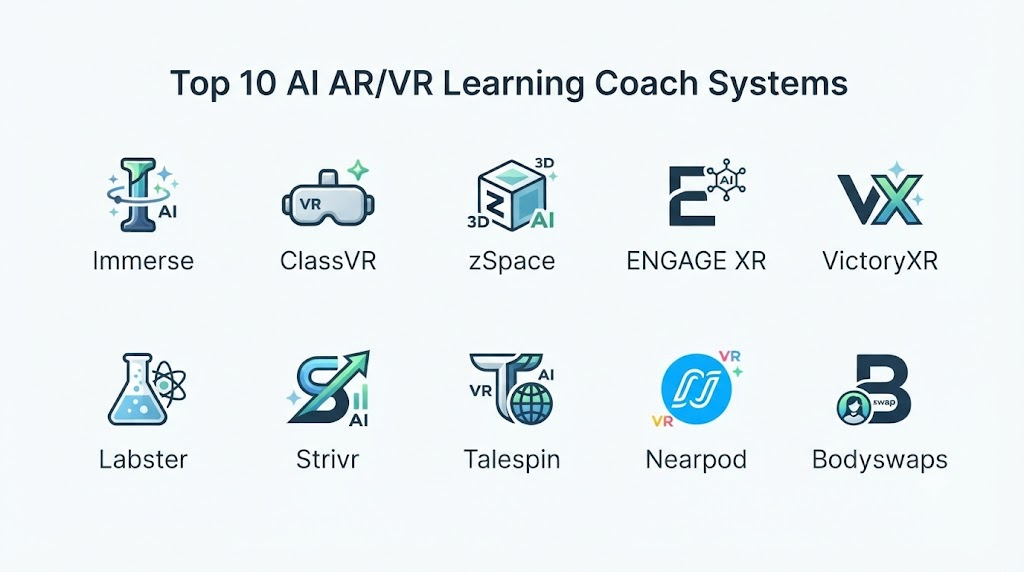
Top 10 AI AR/VR Learning Coach Systems
1. Strivr
Strivr provides immersive VR training solutions that help organizations create realistic learning simulations for workforce development.
Key Features
- VR training simulations
- AI-supported learning experiences
- Employee skill development
- Performance tracking
- Custom training scenarios
- Immersive practice environments
- Enterprise deployment
- Learning analytics
- Simulation-based coaching
- Training management
Pros
- Strong enterprise training focus
- Realistic simulations
- Useful workforce applications
- Supports large organizations
- Practical skill development
Cons
- Enterprise implementation required
- Hardware investment needed
- Custom content development may require resources
Platforms
VR headsets and enterprise environments.
Deployment or Support
Cloud-based immersive learning platform.
Security & Compliance
Enterprise security controls vary.
Integrations & Ecosystem
Enterprise training systems, LMS platforms, and workforce development tools.
Support & Community
Enterprise support and documentation.
2. Talespin
Talespin provides immersive learning solutions using VR, AI, and virtual characters for workplace training.
Key Features
- AI virtual characters
- VR simulations
- Communication training
- Leadership development
- Soft skills coaching
- Scenario-based learning
- Performance feedback
- Employee training
- Learning analytics
- Immersive experiences
Pros
- Strong soft skills training
- Realistic workplace scenarios
- AI-powered coaching
- Useful leadership development
- Interactive learning
Cons
- Primarily enterprise focused
- Requires VR equipment
- Content availability varies
Platforms
VR devices and enterprise platforms.
Deployment or Support
Cloud-based immersive training solution.
Security & Compliance
Enterprise controls vary.
Integrations & Ecosystem
Corporate learning platforms and HR systems.
Support & Community
Enterprise support.
3. Immerse
Immerse provides immersive learning environments for education, workplace training, and collaborative virtual experiences.
Key Features
- Virtual classrooms
- AI-supported learning
- Collaborative environments
- Training simulations
- Interactive lessons
- Virtual meetings
- Learning activities
- Analytics
- Content creation
- Multi-user experiences
Pros
- Collaborative learning experience
- Supports virtual classrooms
- Flexible immersive environments
- Useful for remote learning
- Interactive training
Cons
- Requires compatible devices
- Adoption depends on user readiness
- Content development may require effort
Platforms
VR devices, desktop, and immersive environments.
Deployment or Support
Cloud-based immersive platform.
Security & Compliance
Privacy controls vary.
Integrations & Ecosystem
Education platforms, enterprise tools, and learning systems.
Support & Community
Documentation and user support.
4. ClassVR
ClassVR provides immersive educational experiences using virtual reality technology for schools and learning institutions.
Key Features
- VR classroom experiences
- Educational content library
- Lesson resources
- Teacher tools
- Student engagement
- Virtual field trips
- Learning activities
- Classroom management
- Progress support
- Interactive content
Pros
- Education-focused
- Easy classroom adoption
- Large content library
- Supports immersive lessons
- Teacher-friendly tools
Cons
- Mainly focused on education
- Requires VR hardware
- AI coaching features vary
Platforms
VR headsets and classroom environments.
Deployment or Support
Education-focused immersive platform.
Security & Compliance
Education privacy practices vary.
Integrations & Ecosystem
Schools, educational tools, and classroom systems.
Support & Community
Teacher resources and support.
5. ENGAGE XR
ENGAGE XR provides virtual environments for education, training, collaboration, and immersive events.
Key Features
- Virtual learning spaces
- AI-supported experiences
- Collaboration tools
- Training environments
- Virtual classrooms
- Presentations
- Interactive simulations
- Multi-user sessions
- Content creation
- Analytics
Pros
- Flexible virtual environments
- Supports collaboration
- Useful for training
- Multi-user learning
- Enterprise applications
Cons
- Requires device compatibility
- Adoption challenges
- Content creation needs planning
Platforms
VR devices, desktop, and mobile environments.
Deployment or Support
Cloud-based immersive platform.
Security & Compliance
Enterprise controls vary.
Integrations & Ecosystem
Education platforms, enterprise systems, and collaboration tools.
Support & Community
Documentation and customer support.
6. Meta for Education
Meta provides VR-based educational experiences and tools designed to support immersive learning environments.
Key Features
- VR learning experiences
- Virtual classrooms
- Educational applications
- Collaboration environments
- Immersive simulations
- Student engagement
- Learning activities
- VR device support
- Interactive content
- Education partnerships
Pros
- Strong VR ecosystem
- Wide hardware availability
- Large developer ecosystem
- Immersive experiences
- Supports collaboration
Cons
- Requires VR hardware
- Education features vary
- Implementation planning needed
Platforms
VR devices and immersive environments.
Deployment or Support
Cloud and device-based immersive platform.
Security & Compliance
Controls vary by implementation.
Integrations & Ecosystem
VR applications, education tools, and learning platforms.
Support & Community
Documentation and developer resources.
7. Labster
Labster provides virtual laboratory simulations that allow students to practice science experiments in immersive digital environments.
Key Features
- Virtual laboratories
- Science simulations
- Interactive experiments
- Learning assessments
- Student analytics
- Educational content
- Simulation-based learning
- Teacher tools
- Skill development
- Progress tracking
Pros
- Strong science education focus
- Safe virtual experiments
- Interactive learning
- Useful assessments
- Supports institutions
Cons
- Mainly focused on science education
- Requires digital access
- Content scope varies
Platforms
Web and immersive learning environments.
Deployment or Support
Cloud-based education platform.
Security & Compliance
Education security practices vary.
Integrations & Ecosystem
Schools, universities, LMS platforms, and education systems.
Support & Community
Educational support resources.
8. zSpace
zSpace provides augmented and virtual reality learning solutions designed for interactive education and professional training.
Key Features
- AR/VR learning
- 3D visualization
- Interactive models
- STEM education
- Healthcare training
- Technical learning
- Classroom solutions
- Simulation experiences
- Learning content
- Teacher tools
Pros
- Strong 3D learning experience
- Useful STEM applications
- Supports healthcare education
- Interactive visualization
- Classroom focused
Cons
- Requires specialized hardware
- Content availability varies
- Deployment costs may vary
Platforms
AR/VR devices and specialized systems.
Deployment or Support
Hardware and software learning solution.
Security & Compliance
Education security practices vary.
Integrations & Ecosystem
Educational institutions and training systems.
Support & Community
Customer support and resources.
9. Bodyswaps
Bodyswaps provides immersive VR learning experiences focused on communication, leadership, and professional skills.
Key Features
- VR soft skills training
- AI feedback
- Communication coaching
- Leadership practice
- Scenario simulations
- Self-reflection tools
- Employee development
- Performance insights
- Interactive learning
- Skill assessment
Pros
- Strong soft skills focus
- AI-powered feedback
- Realistic practice scenarios
- Useful professional training
- Personalized coaching
Cons
- Specialized use cases
- Requires VR equipment
- Enterprise deployment needed
Platforms
VR devices.
Deployment or Support
Cloud-based immersive learning platform.
Security & Compliance
Enterprise controls vary.
Integrations & Ecosystem
Corporate learning platforms and training workflows.
Support & Community
Customer support.
10. VictoryXR
VictoryXR provides immersive education solutions using virtual reality classrooms and digital learning environments.
Key Features
- Virtual classrooms
- VR education
- Digital campuses
- Interactive lessons
- Science simulations
- Collaborative learning
- Educational content
- Student engagement
- Immersive experiences
- Teacher support
Pros
- Education-focused VR solution
- Virtual classroom experience
- Interactive learning
- Supports institutions
- Collaborative environments
Cons
- Requires VR hardware
- Content availability varies
- Adoption requires training
Platforms
VR devices and immersive environments.
Deployment or Support
Cloud-based immersive education platform.
Security & Compliance
Education privacy practices vary.
Integrations & Ecosystem
Schools, universities, and education platforms.
Support & Community
Educational support resources.
Comparison Table
| Tool Name | Best For | Platform(s) Supported | Deployment | Standout Feature | Public Rating |
|---|---|---|---|---|---|
| Strivr | Enterprise VR training | VR | Cloud | Workforce simulations | N/A |
| Talespin | Soft skills coaching | VR | Cloud | AI virtual characters | N/A |
| Immerse | Virtual learning spaces | VR/Desktop | Cloud | Collaboration environments | N/A |
| ClassVR | Schools | VR | Education | Classroom VR content | N/A |
| ENGAGE XR | Virtual training | VR/Desktop | Cloud | Virtual collaboration | N/A |
| Meta for Education | VR education ecosystem | VR | Device/Cloud | VR platform ecosystem | N/A |
| Labster | Science education | Web/VR | Cloud | Virtual laboratories | N/A |
| zSpace | STEM learning | AR/VR | Hardware/Software | 3D visualization | N/A |
| Bodyswaps | Professional coaching | VR | Cloud | AI feedback coaching | N/A |
| VictoryXR | Virtual classrooms | VR | Cloud | Digital campuses | N/A |
Weighted Evaluation
| Tool Name | Core Features 25% | Ease of Use 15% | Integrations & Ecosystem 15% | Security & Compliance 10% | Performance & Reliability 10% | Support & Community 10% | Price/Value 15% | Total |
|---|---|---|---|---|---|---|---|---|
| Strivr | 24 | 12 | 14 | 9 | 10 | 10 | 10 | 89 |
| Talespin | 23 | 13 | 13 | 9 | 10 | 9 | 11 | 88 |
| Immerse | 22 | 13 | 13 | 9 | 10 | 9 | 12 | 88 |
| ClassVR | 22 | 15 | 12 | 9 | 10 | 10 | 12 | 90 |
| ENGAGE XR | 22 | 13 | 13 | 9 | 10 | 9 | 11 | 87 |
| Meta for Education | 23 | 14 | 15 | 9 | 10 | 10 | 11 | 92 |
| Labster | 23 | 14 | 13 | 9 | 10 | 10 | 12 | 91 |
| zSpace | 22 | 12 | 13 | 9 | 10 | 9 | 10 | 85 |
| Bodyswaps | 22 | 13 | 12 | 9 | 9 | 9 | 11 | 85 |
| VictoryXR | 21 | 13 | 12 | 9 | 9 | 9 | 11 | 84 |
Which AI AR/VR Learning Coach System Is Right for You?
Choose Strivr when enterprises need immersive workforce training simulations.
Choose Talespin when organizations want AI-powered soft skills coaching.
Choose Immerse when virtual classrooms and collaboration are important.
Choose ClassVR when schools need classroom-focused VR learning.
Choose ENGAGE XR when organizations need virtual training environments.
Choose Meta for Education when a broad VR ecosystem is preferred.
Choose Labster when science and laboratory simulations are required.
Choose zSpace when interactive 3D STEM learning is the priority.
Choose Bodyswaps when communication and leadership coaching are needed.
Choose VictoryXR when institutions want virtual classroom experiences.
Implementation Playbook
Phase 1: Define Learning Goals
- Identify training objectives
- Select immersive scenarios
- Define learner groups
- Choose required hardware
- Establish success metrics
Phase 2: Prepare Infrastructure
- Select AR/VR devices
- Configure software
- Train instructors
- Prepare learning content
- Establish support processes
Phase 3: Deploy Immersive Learning
- Launch simulations
- Monitor learner activity
- Collect performance data
- Provide AI feedback
- Track progress
Phase 4: Measure Outcomes
- Analyze learning improvement
- Review engagement
- Evaluate skill development
- Collect feedback
- Optimize experiences
Phase 5: Scale Learning Programs
- Expand content
- Add new scenarios
- Integrate LMS platforms
- Improve coaching models
- Maintain learner support
Common Mistakes
- Choosing VR without clear learning goals
- Ignoring hardware requirements
- Creating immersive experiences without educational value
- Neglecting accessibility
- Not training instructors
- Ignoring privacy considerations
- Using AI feedback without human guidance
- Failing to measure learning outcomes
FAQs
1. What are AI AR/VR Learning Coach Systems?
AI AR/VR Learning Coach Systems combine artificial intelligence and immersive technologies to provide interactive training, coaching, and personalized learning experiences.
2. How does AI improve AR/VR learning?
AI provides feedback, adapts learning paths, analyzes performance, and creates personalized coaching experiences.
3. Are AR/VR learning systems useful for corporate training?
Yes. Many organizations use immersive learning for safety, technical skills, leadership, and professional development.
4. Do these systems require VR headsets?
Some solutions require VR devices, while others support AR, desktop, or mobile experiences.
5. Can AI coaches replace instructors?
No. AI coaches support learning by providing feedback, while instructors provide expertise and guidance.
6. What industries use immersive AI learning systems?
Healthcare, education, manufacturing, aviation, engineering, and corporate training organizations use these technologies.
7. Are AR/VR learning experiences effective?
They can improve engagement and practical understanding when designed with clear educational objectives.
8. How do AI learning coaches provide feedback?
They analyze learner actions, responses, and performance data to provide recommendations and guidance.
9. What should organizations consider before adopting AR/VR learning?
Organizations should evaluate learning goals, hardware needs, content quality, scalability, cost, and privacy.
10. Can AR/VR learning integrate with LMS platforms?
Many enterprise solutions support integrations with learning management and training systems.
Conclusion
AI AR/VR Learning Coach Systems are transforming education and workforce development by combining immersive environments with intelligent coaching. These platforms help learners practice skills, receive personalized feedback, and experience realistic scenarios before applying knowledge in real situations.Meta for Education, Labster, and ClassVR provide strong education-focused experiences, while Strivr, Talespin, and Bodyswaps support enterprise training and professional development. Platforms such as Immerse and ENGAGE XR enable collaborative virtual learning environments.
